
Mid-market companies can’t build digital capability fast enough, and rarely buy it. Startups without a venture exit already have it. Why aren’t the two connecting?
— 6 min read

The last piece ended on a claim worth unpacking. If most funded startups never reach the exit everyone underwrites for them, they don’t all simply vanish – they become a large pool of capable businesses looking for an outcome. And the buyer who could give them an outcome — and their investors a return — is hiding in plain sight.
It isn’t a fund, a tech giant, or a private-equity roll-up. It’s the established, mid-sized company. Profitable, somewhere in the £20–50m revenue band, the kind of business that rarely appears in a venture conversation at all. It has a problem that looks nothing like the startup’s, but the two fit together almost exactly.
The build problem
Mid-sized companies are under steady pressure to keep innovating. Customers now expect digital products, AI-enabled services, and faster release cycles than a traditional operating model was designed to deliver. The gap between what the market expects and what the company can ship tends to widen quietly until it becomes urgent. The instinctive response is to build the missing capability in-house.
That instinct is deeply ingrained, and it is often the slow option. Clayton Christensen described the reason three decades ago as the innovator’s dilemma: established companies are wired to serve their existing customers and defend their existing margins, which makes them structurally cautious about the unproven thing that doesn’t yet pay.¹ The data reflects the same bias toward building rather than buying – in 2024, UK businesses spent roughly six times as much developing innovation internally as they did acquiring it from outside.² Building is the default setting.
The trouble is that an internal build is slow, and it has to be staffed from the talent pools. With AI, data, modern product engineering capabilities. These are the hardest and most expensive to hire. The result: the mid-market company spends years building a capability from scratch that a competitor could have bought ready-made.
The buy problem
If building is slow and hiring is hard, the logical move is simply to buy the capability instead. The team and the technology, already built. Yet mid-market companies acquire far less often than that logic suggests, and the reasons are consistent and well-documented.
The first is money. A mid-sized company is cash-rich next to a startup but cash-poor next to a private-equity buyer, and PE firms are sitting on record levels of capital they’ve raised but not yet invested. In the US alone, that figure rose from around $290bn in 2021 to $530bn by 2024, according to PitchBook data cited by Forvis Mazars. If it comes down to a bidding contest, the mid-market buyer is usually outbid.
The second is integration risk, and it is well-founded. A peer-reviewed study of roughly 4,000 acquisitions found that a third of acquired employees leave within their first year, against just 12% of comparable direct hires.4 Buy a company for its people, and a third of them may be gone before the capability has landed.
The third is the quietest and, it turns out, the most important. In a survey of 762 US mid-market executives, the single biggest barrier to dealmaking was not price or integration but access: simply finding the right targets and building a route to them. Relationships ranked ahead of financing, cultural fit and integration as the thing that stops deals happening at all.5
Taken together: mid-market companies don’t avoid acquisition because it’s a bad idea. They avoid it because they can’t easily see the deals, can’t always fund them, and are wary of what happens after the deal closes.
What’s changing
Three shifts are moving mid-market acquisition from a theoretical fit toward an active one.
The first is urgency. Post-pandemic, and now under the pressure of AI, the cost of moving slowly has risen sharply. A capability gap that was survivable a few years ago has become pressing, and a three-year internal build is no longer a feasible answer.
The second is that the playbook has been established. Acquiring for talent and capability, rather than for scale or revenue alone, has become a mainstream reason to do a deal. EY finds strategic buyers explicitly pursuing acquisitions to secure technology, talent and operating capabilities.6 What larger companies have normalised, the mid-market can follow.
The third is appetite. Roughly 45% of US mid-market executives say they intend to pursue an acquisition in the near term,⁵ and across Europe, mid-market advisers are markedly more optimistic about dealmaking than a year ago.⁷ The intent and the confidence are building. What’s missing is the connection.
The mismatch
Acquisition isn’t the only way to close this gap. A startup and an established company can work together in plenty of ways – partnerships, pilots, innovation programmes, a minority investment. But acquisition is the fullest version of it: the buyer gets the capability outright, and the startup gets the outcome it’s been waiting for.
What makes this more than a neat theory is the scale on both sides.
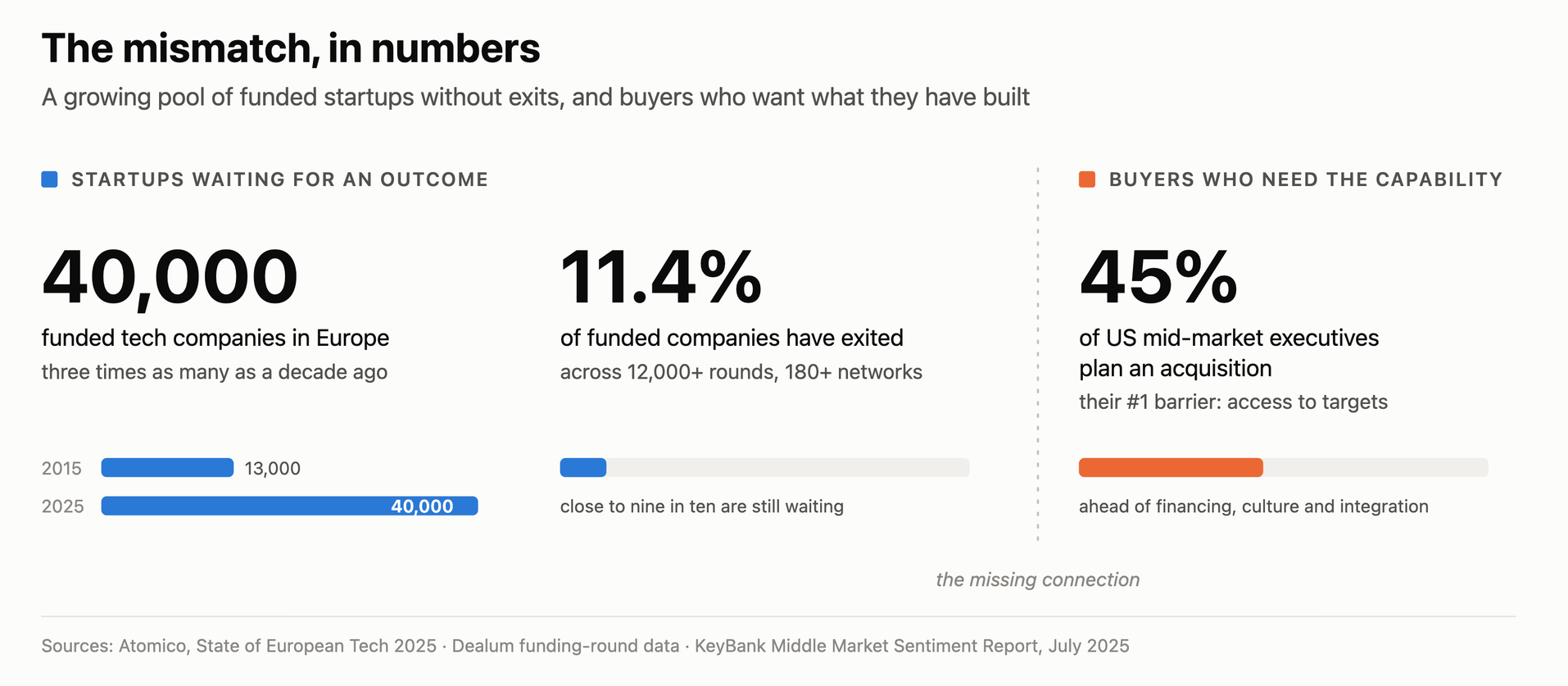
On one side, a large and growing pool of capable, funded companies for whom the traditional venture exit isn’t coming. Europe is now home to almost 40,000 funded tech companies, up from around 13,000 a decade ago.8 Our own data put the exit rate for funded portfolio companies at just over one in ten, which means close to nine in ten are still out there, many of them solid businesses, with real technology and real teams, waiting for an outcome the traditional venture model was never going to provide.
On the other side, thousands of mid-market companies that need precisely that: a working capability, a proven team, a piece of technology they can’t build fast enough on their own, and a growing willingness to buy rather than build it.
Both sides of that picture are well evidenced. The space between them is not. The startup is looking for an exit and sees only the venture routes. The mid-market buyer is looking for a capability and sees only the slow internal build. Neither is looking in the other’s direction, and nothing in the market is doing much to point them there.
That gap is the piece everyone has overlooked. The stranded companies aren’t a graveyard. They’re an underused supply of exactly what the mid-market is trying, and struggling, to build. It’s not the companies, not the capital, but the missing connection between the two.
Which leaves the practical question: where would a mid-market buyer even start looking? The data points somewhere most people aren’t and that’s what the next piece is about.
- Clayton M. Christensen, The Innovator’s Dilemma: When New Technologies Cause Great Firms to Fail, Harvard Business Review Press, 1997. ↩
- UK Innovation Survey 2025 (covering 2024 expenditure data), Department for Science, Innovation and Technology – https://www.gov.uk/government/statistics/uk-innovation-survey-2025-report/uk-innovation-survey-2025-report ↩
- Forvis Mazars, “Q2 2025 Middle-Market M&A Insights,” 2025 (citing PitchBook) — https://www.forvismazars.us/forsights/2025/09/q2-2025-middle-market-m-a-insights-signs-of-potential-recovery ↩
- J. Daniel Kim, “Startup Acquisitions as a Hiring Strategy: Turnover Differences Between Acquired and Regular Hires,” Strategy Science, 9(2), 2024, pp. 118–134; summarised by MIT Sloan, “Your acquired hires are leaving. Here’s why.” — https://mitsloan.mit.edu/ideas-made-to-matter/your-acquired-hires-are-leaving-heres-why ↩
- KeyBank, “Middle Market Sentiment Report,” July 2025 (survey of 762 US middle-market owners and executives, $10m–$1bn revenue) — https://www.key.com/businesses-institutions/business-expertise/articles/middle-market-strategies-growth-exit.html ↩ ↩2
- EY, “M&A activity insights,” 2026 — https://www.ey.com/en_us/insights/mergers-acquisitions/m-and-a-activity-report ↩
- Dealsuite, “European M&A Monitor,” September 2025 (survey of 828 European mid-market M&A advisory firms, companies €1m–€200m revenue) — https://www.dealsuite.com/en/blogs/european-monitor-september-2025 ↩
- Atomico, State of European Tech 2025 (with Invest Europe) — https://www.investeurope.eu/news/newsroom/state-of-european-tech-2025-a-roadmap-to-unlock-further-tech-growth/ ↩