6 minute read
Finding the right research to strengthen your tactics or convince your stakeholders shouldn’t take hours — but for many advocates, it does. That’s why we’re excited to announce the launch of the ACE Research Database.
Rebuilt from our previous Research Library in collaboration with Open Paws, the Database brings together thousands of studies, reviews, reports, and other research relevant to farmed and wild animal advocacy, all in one place.
Research Isn’t Reaching Advocates
Researchers are constantly publishing work that could help animal advocates focus their efforts where they will do the most for animals. But much of it never reaches the people who could use it. It lands scattered across journals, reports, and organizations’ websites, and the tools for finding it weren’t built with advocates in mind.
In our evidence review on conducting research for effective advocacy, the lack of centralized ways to find and keep up with research emerged as one of the key barriers to putting evidence to use. That means campaigns and funding decisions often get made without the best available evidence.
A New Home for Research
We feel this problem in our own work. At Animal Charity Evaluators (ACE), our charity evaluations, recommendations, and grantmaking all rest on evidence, and for years our Research Library has helped us and many others across the movement keep track of it.
Now, we’re introducing its successor: the ACE Research Database, rebuilt from the ground up by collaborating with Open Paws, a nonprofit that builds AI tools for the animal advocacy movement.
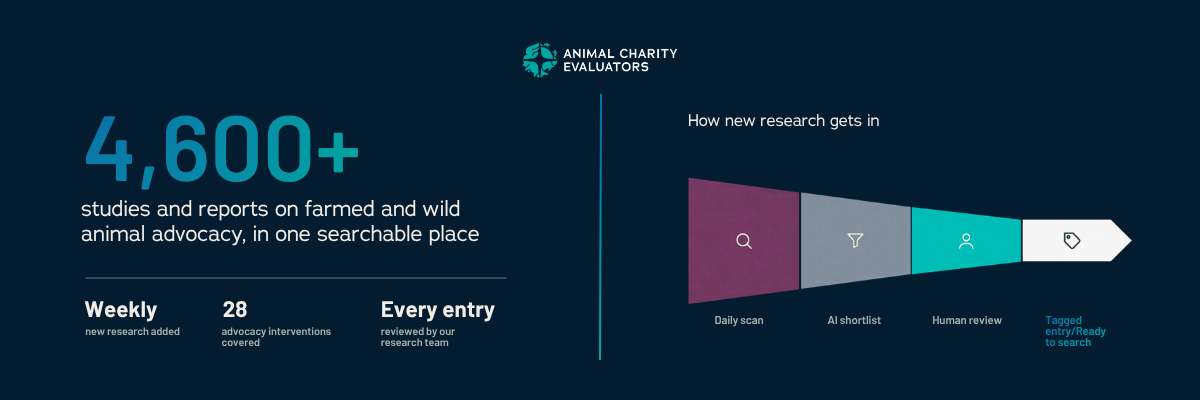
New evidence is added weekly, and every entry is tagged by intervention, outcome, animal group, region, and article type. Semantic search understands what you’re looking for and finds relevant research, even if the wording doesn’t match results exactly.
Below, we walk you through why we rebuilt the Research Library, what’s in the new Database and how it works, who it’s for, and its main limitations.
Why We Rebuilt the Research Library
Two things drove this project: what users asked for in our 2025 Research Library survey, and the limits of maintaining it by hand.
Our previous Research Library was a valuable resource, but it was showing its age. Because we added every article manually, the library was slow to keep current, and we sometimes had to pause updates during busy periods. Its filter categories had grown organically over the years and no longer reflected how users actually search, and its search function relied on keyword matching.
When we surveyed users in 2025, they asked for more frequent updates, filters by intervention, animal group, and research type, and more powerful search.
We rebuilt the library with two goals in mind:
- Usability and accuracy: standardized entries, a clearly defined scope, categories aligned with ACE’s Menu of Interventions, our animal-group and outcome frameworks, and semantic search (which means search based on contextual meaning instead of just matching the keywords) that lowers the effort of finding the right paper.
- Sustainability through automation: automating the finding, ingesting, and tagging of new research as far as possible, allowing us to keep the Database current with far less manual upkeep than before. This also frees up researcher time for the deeper analysis and judgments that inform our recommendations and grantmaking.
To make this possible, we partnered with Open Paws in 2025, pairing ACE’s research expertise and editorial judgment with Open Paws’ technical and AI capabilities.
What’s in the Database
Our guiding line is simple: if research has the potential to be useful to farmed and wild animal advocates, we want it in the Database. This ranges from peer-reviewed studies, review articles, and meta-analyses to research reports and theoretical pieces from within the animal advocacy movement.
The Database spans research on the effectiveness of advocacy interventions and the social science of advocacy; animal welfare science with a clear advocacy takeaway; and foundational topics such as human–animal relations, consumer attitudes and dietary change, messaging and persuasion, and animal ethics and sentience.
We aim to exclude work that mainly serves animal-use industries, falls outside our farmed and wild animal focus (such as research on companion animals), or is too technical or niche to be helpful to most advocates.
How It Works
- Search by meaning. Semantic search understands what you’re looking for and surfaces relevant research, even when the wording doesn’t match. Looking for a specific source? Exact word matches show up as you type; press enter and semantic search widens the net to related work.
- Filter to what you need. Entries are tagged by intervention, outcome, animal group, region, and article type, so you can narrow results down to your specific context, for example research on corporate chicken welfare campaigns in Brazil.
- Automatically updated, with human oversight. Each day the automatic workflow scans academic databases and other websites to shortlist new research; our team then reviews every source before it’s added.
Try searching for: Cage-free campaign effectiveness
Who It’s For
Whether you produce research, run campaigns, or decide where funding goes, the Database is built to support your work:
- Researchers can use it for literature reviews and desk research, including finding work from within the movement that academic databases often miss. Identifying gaps in the evidence can also help prioritize where research efforts are most needed.
- Advocates can use it to inform their strategies and tactics, and to find credible sources to cite when making the case to their stakeholders or the public.
- Funders can find promising approaches to support, look into the evidence behind proposals they receive, and identify under-researched questions that might be worth funding.
Research Database or Better for Animals?
The Research Database complements Better for Animals, our resource synthesizing the evidence on almost 30 animal advocacy interventions. The two are designed to work together:
- Go to Better for Animals for ACE’s assessment of an intervention. We synthesize and critically analyze research on advocacy interventions to assess how effective it appears to be and how much confidence to place in that.
- Go to the Research Database for the underlying research itself. Here you can dig into primary studies, make up your own mind about interventions, explore topics Better for Animals doesn’t cover, or find sources for your campaign materials.
What the Database Doesn’t Do
- Inclusion isn’t endorsement. An entry means we consider the work relevant and potentially useful, but not that we’ve assessed its quality or vouch for its findings.
- Full text isn’t always available. The Database points to research, but where sources sit behind paywalls we can’t provide the full text. In those cases you’ll find the citation, abstract if available, and a link to the research paper, but you may need institutional or other access to read the full article.
- It isn’t exhaustive. We aim for breadth, but we will inevitably miss some relevant research, so don’t treat your search results as a complete account of the evidence on a topic.
- Tags aren’t perfect. Automated tagging across a large catalog means some articles may be categorized less precisely than we would like. Treat the filters as a guide, but use semantic and keyword search alongside them to find relevant research.
What’s Next
The Database will keep growing, with new research added on average once a week, and we’ll explore what other features can improve it in the future. The best way to see what the Database can do is to try it.
And if you notice a bug, a miscategorized article, research we’ve missed, or a feature that would make this more useful for your work, tell us via our feedback form.
Acknowledgments
The ACE Research Database would not exist without our partners at Open Paws, whose technical and AI expertise made it possible to rebuild the library on a modern, automated foundation. Thank you as well to everyone who responded to our 2025 user survey. Your feedback directly shaped the Database’s design.
Explore the ACE Research Database


ACE is dedicated to creating a world where all animals can thrive, regardless of their species. We take the guesswork out of supporting animal advocacy by directing funds toward the most impactful charities and programs, based on evidence and research.

$81M
Donations influenced with the animal advocacy movement

58
Countries across six continents.

284
Recipients working on promising projects.
$58,000,000+
in donations already made to our recommended charities between January 2019 and March 2025
Looking to make your first donation? We’re happy to help