

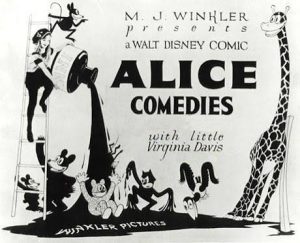
 Walt Disney and Alice in Wonderland had such a long-standing relationship that it was inevitable that he and his artists would adapt author Lewis Carroll’s books.
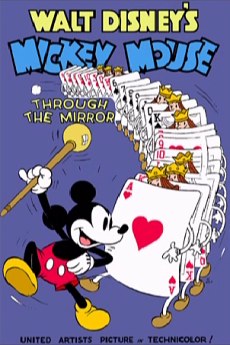
Years before his 1951 animated feature adaptation of the author’s work, which celebrates its 75th anniversary this month, Walt had found inspiration from the stories, as far back as 1923, for his live action/animated silent short, Alice’s Wonderland. Ten years later, Walt looked to partner with actress Mary Pickford on a live action/animated film based on Alice in Wonderland, which never came to be; it was even a vehicle for his biggest star, Mickey Mouse, in 1936 for the short Thru the Mirror.
After the landmark success of Snow White and the Seven Dwarfs in 1937, Walt purchased the film rights to Carroll’s Alice books, in hopes that they could be adapted as a follow-up feature. British artist David Hall was hired by the Studio in 1939 and created beautiful concept art for the film.
 Alice in Wonderland continued through a slow production process that was eventually halted due to the lackluster box-office performance of Pinocchio and Fantasia (both 1940), as well as a loss of an overseas market, with World War II.
It was after the challenging decade of the 40s that Alice in Wonderland was chosen as one of the full-length features to go into production. Noted British author Aldus Huxley was hired to pen another live-action/animated version, which never materialized.
Legendary Disney artist Mary Blair contributed concept art, with her unique style that partnered bright colors with a more modern look, inspiring Walt and his artists to see the possibilities of Alice in Wonderland as a full-length animated feature. So much of what Mary created was translated to the final film.
Based on Carroll’s 1865 novel Alice’s Adventures in Wonderland and its 1871 sequel Through the Looking-Glass, Disney’s Alice in Wonderland centers on the title character, a young girl who, when we first meet her, sits bored during an outdoor lesson with her older sister and begins daydreaming. As she does, she spots a White Rabbit running by, stating that he’s “late for a very important date.” Alice follows him down a rabbit hole, into Wonderland.
 Once there, she meets a cast of increasingly strange characters: the talking Doorknob; the Dodo; Tweedledum and Tweedledee (who relay the story of “The Walrus and the Carpenter”); and the hookah-smoking Caterpillar.
She also encounters the mischievous Cheshire Cat and crashes the Mad Hatter and March Hare’s chaotic “unbirthday” tea party, eventually finding her way into the garden belonging to the tyrannical Queen of Hearts, who’s obsessed with beheading anyone who displeases her.
Alice is accused of wrongdoing and put on trial that descends into absurdity, and Alice wakes up back under the tree with her sister, realizing it may all have been a dream, as the film ends.
Directed by Clyde Geronimi, Wilfred Jackson, and Hamilton Luske, Alice in Wonderland featured a voice cast that included Kathryn Beaumont as Alice, Richard Haydn as the Caterpillar, Verna Felton as the Queen of Hearts, Bill Thompson as the White Rabbit, and J. Pat O’Malley as four characters: the Walrus, Carpenter, Tweedledee, and Tweedledum.

(poster image via Matt Crandall)
Additionally, popular comedians Ed Wynn voiced the Mad Hatter, and Jerry Colonna as the March Hare (with the characters fashioned as caricatures of the comedians), and Disney stalwart voice Sterling Holloway as the Cheshire Cat.
These characters wind up contributing what has become some of the film’s most memorable and iconic scenes. Many of them were thanks to tour-de-force animation from Disney Legend Ward Kimball.
Noted author and animation historian John Canemaker wrote, in his book, Walt Disney’s Nine Old Men & The Art of Animation: “Animating bizarre and insane Wonderland characters, Kimball was literally in his element. The Tweedles Dum and Dee, moved like water-filled balloons in patterned choreography reminiscent of an early Silly Symphony; the Mad Hatter and March Hare turn a jolly tea party into an anarchic Marx Brothers romp; and the purple, striped Cheshire Cat, speaking in a cool Peter Lorre-like monotone, with a dazzling smile pasted on his face, is perhaps the maddest of all.”
Carroll’s many other characters, from the books, were planned for Alice in Wonderland, but never made the final film. The Mock Turtle and the Gryphon were ultimately cut, but were later brought back by Disney, appearing alongside Alice in animated Jell-O commercials.
 The songs in the film by Sammy Fain and Bob Hilliard included the title song, “Alice in Wonderland,” “All in the Golden Afternoon,” and what would become one of the classics connected with Alice, the White Rabbit’s “I’m Late.”
Another of the film’s renowned songs, “A Very Merry Un-Birthday” (The Unbirthday Song) was written by Mack David, Al Hoffman, and Jerry Livingston. For more on the music of Alice in Wonderland, check out Greg Ehrbar’s 2020 article.
Released on July 26, 1951, in London and July 28, 1951, in New York, Walt and his Studio did quite a bit to promote the film, including making it the centerpiece of his first-ever TV project, the special, One Hour in Wonderland. Shown on NBC on Christmas Day, 1950, it centered on the Disney Studio Christmas party, with Walt hosting, and Kathryn Beaumont as one of the guests.
During the special, Walt conjures up the Magic Mirror, from Snow White (played by Hans Conried), who shows scenes from Disney features and shorts, and then, at the end of the special, provides a sneak peek at Alice in Wonderland by showing the film’s Mad Tea Party sequence.
There was also Operation Wonderland, a short promotional featurette featuring behind-the-scenes footage on the making of the film that aired as part of NBC’s variety series Ford Star Revue on June 14, 1951. Operation Wonderland featured live-action footage of Kathryn Beaumont, Ed Wynn, and Jerry Colonna acting out the Mad Hatter’s Tea Party, which was used as reference by the animators.
Amid all this promotion, Alice in Wonderland didn’t ignite the box office and had a lukewarm critical response.
It was a over a decade later that Alice in Wonderland made a comeback. The film did well in the 16mm rental market on college campuses during the 1960s and 1970s. Disney then pulled it from that rental market for a full theatrical re-release. Much like Disney’s own Fantasia, Alice in Wonderland was a hit during the psychedelic age.
Since then, appreciation of and a following for the film has only grown through the years, particularly thanks to its release on VHS in the 1980s, and subsequent showings on television. Many have now embraced the offbeat characters and the surrealistic story. When it comes to the film, seventy-five years later, audiences continue to be, as the title character herself said, “curiouser and curiouser” about Alice in Wonderland.


![The Ogre’s Bride Episode 12 [FINAL] – AngryAnimeBitches Anime Blog](https://som2nynetwork.com/wp-content/uploads/2026/09/sRh7IsYK-The-Ogres-Bride-Ep-11-img-13-768x432-336x220.png)


