Hello, my
name is Gwen Michaels, and I am an Anthropology major, with an Archaeology
concentration, from Gettysburg College. I will soon be going into my senior year;
however, I started studying Archaeology during my freshman year. During my sophomore
year at Gettysburg, I took a class on Pennsylvania-specific Archaeology. This
class along with an excavation of site 36AD592, the Jack Hopkins House in Adams
County, helped grow my interest in both Pre-contact and historic archaeology.
These interests are what led me to apply for the internship with the Section of
Archaeology at the State Museum of Pennsylvania. During my time here, I have
been able to work with vast collections of artifacts from all over Pennsylvania
and learn more about processing and interpreting artifacts. I’m incredibly
grateful for the past 10 weeks and all that I have learned; this experience has
truly encouraged me to continue in Archaeology after completing my time at
Gettysburg. Although it is hard to pick what my favorite task has
been, the past few weeks that I have spent with the Sheep Rock Shelter (36HU1)
collection will remain one of my most prized experiences as an intern.
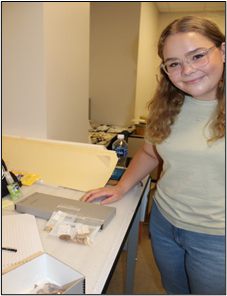 |
| Gwen Michaels |
The Sheep
Rock Shelter (rock overhang) was formerly located in Huntington County,
however, construction of a dam along the Juniata River in 1973 has since
submerged the site, making it inaccessible. Despite this, excavations led by
the Pennsylvania State University and Juniata College from the 1950s and on
allowed for the collection of thousands of distinct artifacts. What makes this
site so remarkable is the immense preservation of botanical and other organic
materials. Unlike most caves in Pennsylvania, the Sheep Rock Shelter was dry,
leading to the preservation of organics that would normally have perished in
the humid climate of Pennsylvania. Due to this, artifacts like leather,
vegetation, animal bone, and more were preserved in time, creating a unique
opportunity for modern Archaeologists to study them.
 |
Animal Bone Recovered from Sheep Rock Shelter
During my
time in the department, I have been helping to fix the original catalog of
artifacts. Unfortunately, the electronic artifact and location inventories
contained errors and omissions. To fix this, I have been going through the
various drawers and shelves of the collection and taking notes on where
materials and each accession number can be located. It has been incredible
looking through the different preserved artifacts. Some of my favorite
artifacts include turtle eggs, a fully preserved salamander, and dietary items
like corn, beans, and more. Although it is hard to choose any one thing as the
most remarkable, I enjoyed looking through faunal remains like the turtle eggs,
turtle shells, various animal bones, and even fur. The chance to better
understand and embody past people through seeing their relationships with
animals and the land was a unique and fulfilling experience.
 |
| Turtle Egg Recovered from Sheep Rock Shelter |
Working with
the Sheep Rock Shelter artifacts has helped me gain better insight into the
work of Archaeologists and important principles of collections management. With
this collection and all the ones that I’ve worked with, I have seen the necessity
of creating precise catalogs for the security of the artifacts and the sanity
of everyone who works with them. More specifically to the Sheep Rock
collection, this experience has augmented details of professional Archaeology
that will stay with me into my future career. First and foremost, I’ve come to
truly appreciate and take in the rarity of being able to work with collections
like the Sheep Rock Shelter. The chance to work with such well-preserved
organic materials is an opportunity that I cherish. Overall, my time as an
intern with the Section of Archaeology at the State Museum of Pennsylvania has
been an incredibly formative experience. I am incredibly grateful for the time
I have spent with various collections from Pennsylvania and everyone who has
helped me throughout my time.
For more information, visit PAarchaeology.state.pa.us or the Hall of Anthropology and Archaeology at The State Museum of Pennsylvania .