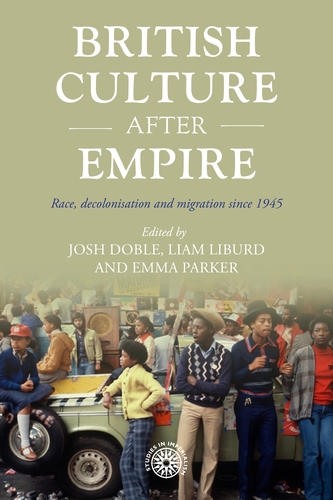
Josh Doble, Liam J. Liburd and Emma Parker, eds. 2024. British Culture After Empire: Race, Decolonisation and Migration Since 1945. Manchester: Manchester University Press.
In August 2023, the BBC reported that Antoinette Sandbach, a former Conservative MP, had threatened legal action against Malik Al Nasir, a history doctoral candidate at the University of Cambridge, regarding his research on Sandbach’s family links to the transatlantic slave trade. Mr. Al Nasir had found that the former MP’s ancestors had been slaveholders of his own and named her in a TEDx Talk discussing her great-great-great grandfather’s stake in plantations in the West Indies. In response, Ms. Sandbach argued that she “had a right to be forgotten” and requested to be removed from his research.
The former MP’s actions fanned the flames of the already heated debate in the UK about which parts of imperial history and colonial conquests should be remembered and how they should be talked about in the present sociopolitical context. Indeed, scholars such as Stuart Hall (1995) and Paul Gilroy (2004) have waxed aplenty on the topic, warning that the selective denial of the colonial past and its present-day legacies only serve to entrench social inequalities and racism by denying the structural frameworks they are embedded in. To this end, the editors of British Culture After Empire: Race, Decolonisation and Migration Since 1945 seek to better make sense of contemporary post-Brexit UK, marked as it is by an environment of ‘culture wars’ themselves underwritten by an increasingly anti-immigrant ‘hostile environment’ and a loss of faith in multiculturalism. Rejecting imperial amnesia and the view that British domestic history is somehow separate from the colonial past, they assert that “the mixture of selectively forgetting and remembering the history of the British Empire […] have fuelled a renewed racial prejudice” (4 and 5). In their aim of “rejecting [sic] the singular, nationalist myths of an island nation and examining […] empire’s afterlives in contemporary Britain” (16), the editors champion an interdisciplinary approach to the topic in the foreword and introduction, and bring together eleven papers and one interview that present “intersecting inquiries in literary, historical, cultural and sociological studies” (5). In their view, this facilitates a “ceaseless conversation and mutual exploration” (xiv) across disciplinary boundaries that respects the multiplicity of interpretations that exist with respect to empire.
The chapters are organised across four sections based on the empirical characteristics of the case studies. Part I, titled “Institutions of Empire”, describes British museums as presented in poetry (John McLeod), the practice of anthropology (Katherine Ambler), and universities (Dongkyung Shin) as complicit in the colonial endeavour and how practices and relationships nurtured through imperialism found new use in British domestic terrain. These chapters highlight, for instance, that after the formal end of colonialism, colonial academics used their expertise to shape domestic anthropological research and to gain influential positions within university administration, creating a “broader implanting of British-style […] as a means to maintain Britain’s soft power at the end of empire and in the post-independence era” (67). Yet, as McLeod argues, such institutions cannot be defined by their colonial origins alone. He presents the British Museum in London as a diasporic institution whose objects and their curation permit us to imagine new kinds of postcolonial relations and futures.
The second section, “Writing identity, Conflict and Class”, is the shortest in the book, comprising two chapters that focus on literature: one on postcolonial anti-racist non-fiction works in the UK (Dominic Davies), and the other on the legacies of empire, war, and class in Graham Swift’s 1996 novel Last Orders (Ed Dodson). The authors denounce the individualisation of systemic inequalities pushed by neoliberalism and seemingly ‘solved’ by putting the onus for self-improvement on people (through ‘self-help’ books on combatting racism and having discussions, for instance), rather than working on actionable tasks that cause systemic change. Therefore, “the emphasis on ‘talk’ risks becoming a simultaneously visible and vacuous replacement for the creation and implementation of anti-racist policies” (91). At the same time, both chapters also deem the individual perspective (through personal experiences of racism enumerated in memoirs and fictional characters’ encounters with the military-industrial complex) crucial in understanding how the legacies of colonialism persist in contemporary systems that perpetuate racism, and even in ‘domestic’ issues such class-based discrimination and experiences of the military and travel that may seem unrelated to colonialism.
The historical specificity of racism and the need to redress it is explored through the race equalities work of the Royal Historical Society (RHS) by Akhtar, who underscores the editors’ assertion in the introduction that decolonising academia does not merely comprise ‘diversity work’, or hiring more people of colour; rather, it is “about reframing power, not public relations” (6).
The next section, titled “Racial Others, National Memory”, is the one that most directly speaks to the book’s aim. It describes the consequences of the UK’s selective remembrance of the imperial past in public memory through case studies on white supremacist movements in the 20th century (Liam J. Liburd), racism and its redressal within the historical discipline (Shahmima Akhtar), and contemporary public debates and media portrayals of empire (Astrid Rasch). Liburd presents 20th century far-right movements in the UK as influenced by imperial nostalgia for white supremacy that cast Commonwealth former colonial subjects as ‘alien’. This then causes white supremacist groups to view “decolonisation and Commonwealth immigration as interlinked civilizational crises” (127), demonstrating that domestic history is contextually linked to imperial events. The historical specificity of racism and the need to redress it is explored through the race equalities work of the Royal Historical Society (RHS) by Akhtar, who underscores the editors’ assertion in the introduction that decolonising academia does not merely comprise ‘diversity work’, or hiring more people of colour; rather, it is “about reframing power, not public relations” (6). The public image of empire is the focus of Rasch’s work, which argues that “contemporary British memory culture is marked by the singularisation of the imperial past,” and that “the Empire is summed up in a few emblematic images and episodes that are seen as representative of the whole” (167). This ‘exemplarification’ of empire and its tenacious afterlife in public memory is presented through the discussion of popular media such as books and TV shows, and public debates about research projects to show how polemics over the simplification of ‘complex’ topics affect public memorialisation of colonialism.
The fourth and last section of the book is titled “At Home in Postcolonial Britain”. This section explores how fictional Muslim characters in British Arab writing experience securitisation and belonging in the UK (Tasnim Qutait) and mapping “a specifically Black British beauty story” (207) through which cultural repertoires around navigating beauty became valuable resources for fashioning Black British identities (Mobeen Hussain). It further describes how music cultures in the 1970s-80s in the predominantly Black London neighbourhood of Brixton created ‘contact zones’ that allowed White Londoners to display racial awareness by engaging with Black music cultures, but without working to dismantle systemic racism (Steve Bentel). The final contribution in this section is an interview that the editors undertook with Tribe Arts, a political media company that works on issues of race, identity, and belonging among black and Asian people in Britain. It delves into the difficult work of moving beyond ‘talk’ in decolonisation, conceptualising it as an ongoing process, and the practical realities of funding and creating media that inspires audiences to act. The volume closes with an afterword by Bill Schwarz which mulls on the messiness of decolonisation. He focuses on the imperial metropole which, once thought to be removed from the disorder of colonialism, must now contend with colonial legacies that sound through contemporary sociopolitical contexts.
The volume thus tells twelve different stories; however, that is where its shortfalls begin. Though the chapters are descriptively rich and comprise a variety of interesting case studies, by sticking to a ‘story’ format and not engaging (for the most part) with relevant academic literature or concepts, the works remain theoretically and conceptually weak. This also renders the entire volume a disorienting read: having to do with imperial afterlives in the UK1 and dealing with the same kind of ‘field site’ (based on the section divisions) is simply not enough of a link, conceptual or otherwise, across vastly different case studies to render the volume cohesive. The volume tends to make grand statements that could be openings for interesting conceptual analysis (e.g., McLeod on the potential of museums to create new imagined postcolonial futures) and then not elaborate much on it. Unfortunately, this means that the links between colonial legacies and sociopolitical contexts after the end of empire – the book’s central aim – are not always clear, with colonialism assumed to be a background actor (for instance, during the wars in the Middle East in Last Orders as discussed by Dodson) without providing context or exploring the mechanisms through which it shapes such political acts.
These pitfalls could have been mediated through greater engagement with conceptual frameworks relating to postcolonial studies. For instance, Quijano’s ‘coloniality of power’ (which surprisingly is not mentioned) would have been beneficial in conceptualising and analysing the channels through which colonial legacies continue to operate in the UK. A literature review would have immensely helped several chapters – such as Bentel’s on music cultures in Brixton – to develop an analytical lens. The chapter, for all its talk of the ‘trendification’ of Brixton, does not even mention gentrification, much less engage with literature and theoretical approaches to understanding it. As a result of the surface-level descriptions, the relevance of the works is not always clear in the chapters. This leads the reader to wonder what the goal of a particular chapter is and what bigger area of research, activist, or policy work it intends to contribute to, requiring several rereads to connect some dots as is attempted in the summaries above. This is regrettable, especially when the editors lay out their theoretical underpinning as pertaining to ‘culture’ and ‘empire’ very explicitly in the introduction. Without clear conceptual foci or an understanding of each individual chapter’s place in broader literature, the volume risks getting caught in the ‘talk’ trap some of its chapters warn about: the contributions simply provide new case studies through which to talk about colonialism and its legacies, without actually creating grounds for bringing about systemic change or instigating decolonial processes.
Second, though the editors speak of the “numerous disciplines and methodologies” (5) utilised by the contributors, the chapters themselves are less explicit on the methodological choices and challenges faced by the authors. It would have been interesting to learn more about why the authors chose certain seemingly unrelated sources – for instance, Hussain who combined newspaper advertisements on Black beauty with fictional Black British writing – and how it contributed to their understanding of the topic. The lack of justification often makes it seem as though sources were cherry-picked to make a point. A greater emphasis on the authors’ positionality and how it affected their research (only McLeod mentioned his experiences as an adoptee in shaping his perspective towards his work) would also have enriched the texts, especially pertaining to Akhtar’s chapter. Akhtar mentions in passing that the RHS instituted a postdoctoral fellowship to work on the results of its race equalities survey and that she held this position, but in no way does she reflect on how the politics of this position may have shaped her perspectives and writing of her chapter. As a result, the reader is left wondering how much of her repeated emphasis on the “genuine commitment” (154) of the RHS to address its past racism is influenced by her status as a former employee of the same.
The UK thus cannot be presumed to be isolated from the effects of colonialism, and the volume does valuable work in providing case studies and sources through which coloniality in the metropole may be analysed.
This is not to say that the volume does not have its merits. The book joins a burgeoning number of volumes that have argued for the pivoting of postcolonial analytical lenses away from the colonial peripheries onto the metropolis, presenting it as a terrain that has “transmogrified from a site of enlightenment, in the eyes of its ideologues, to a disorderly emotional landscape where perpetual disorientation hovers on the horizon” (259). The UK thus cannot be presumed to be isolated from the effects of colonialism, and the volume does valuable work in providing case studies and sources through which coloniality in the metropole may be analysed. Davies, Liburd, and Rasch’s chapters on anti-racist British non-fiction, far-right movements in the UK, and the public discussion of ‘exemplar empires’ respectively stand out for their conceptual richness and developed links to the book’s aims, which are clearly stated in a well-thought-out introduction. The editors make their position on the topic clear at the outset in their refusal to rehabilitate the image of empire and colonialism in the introduction, providing a clear theoretical and positional underpinning for the rest of the work. The variety of case studies, though it works against the volume at times, introduces the reader to new arenas of research where the studied links to colonialism are still nascent. They also provide new ways to connect micro-level forms of research (e.g., literary analysis and ethnographic fieldwork) with systemic infrastructures and think through larger issues of race and inequalities. Though the individual chapters would have benefitted from greater attention to conceptual frameworks and questions of methodology and positionality, they illuminate fertile grounds for future research in postcolonial studies and historical sociology, and through their inclusion of popular media and fiction writing provide new directions for engaging in public debate about imperial afterlives in the colonial metropole.
Featured Image: HMT Empire Windrush FL9448. Source: Wikimedia Commons.
References
Gilroy, Paul. 2004. Postcolonial Melancholia. Columbia University Press: New York City.
Hall, Stuart. 1995. “Negotiating Caribbean Identities”. New Left Review 1 (209): 3-14.