By Yukisato Azai, International and Development Studies, Geneva Graduate Institute.
On a blazing sunny day, when I walked toward the site of a sit-in protest against the construction of a new U.S. military base, I saw a protester climbing a crash barrier alongside a covered fence of the military base to observe the construction process hidden from public view. He stood stationary, his black eyes fixated on something, as if his mind was fully occupied and not really present. Following his example, I also stood on the barrier to get the view usually masked from public eyes. What caught my eyes was a mixture of beauty and brutality. The azure ocean, known for its pivotal role as habitats for endangered species, stretched infinitely to the horizon, its surface shimmering beautifully in the sunlight. Yet, this warm blue was violently interrupted by the dazzling red of a giant pile-driving crane looming staunchly, which was planned to drive more than 70,000 sand compaction piles to solidify the extremely soft seabed. It was also reported that this construction process significantly damaged the coral reefs living nearby the construction site. After I stepped down, he remained unchanged, still glaring at the ocean with deep silence.
This essay explores the moments when the emotional connection between protesters and more-than-human beings is conjured in the face of U.S. military violence. In order to understand the political mobilization in Okinawa against the U.S. militarization, it is beneficial to center the analysis on the relationality between protesters and more-than-human beings, because the environmental destruction perpetuated by the U.S. military is closely intertwined with the formation of protesters’ political subjectivity. Anthropologists and social scientists more broadly have shown how the relationship between humans and more-than-human beings are configured and nurtured in relation to the imperial and colonial states (Khayatt 2022; Rubali 2023; Pugliese 2020). Aligning with these works, the emerging scholarship on Okinawa also attune to more-than-human beings as constituents of longstanding political struggles in Okinawa (Higa 2022; Uehara 2013). Higa (2022) suggests that Okinawans do not simply claim the protection of their own lives but rather advocate for the protection of a unity in which humans and more-than-human beings can coexist constitutively. This interdependent relationship between people in Okinawa and more-than-human beings is considerably shaped by their war-time experiences of desperately living through poverty by grabbing whatever was edible from the ocean and mountains (Uehara 2013).
I build upon and corroborate this scholarship by providing insights into how protesters in Okinawa mundanely form an emotional connection with non-human life in opposition to the U.S. military force. This article suggests that protesters in Okinawa resist the environmental destruction inflicted by the U.S. military by sustaining their emotional relationships with the local ecology. They achieve this through their encounters with ecological devastation and the tenacious persistence of more-than-human life still unfolding. This process ultimately fosters their understanding and imagination of the shared, interrelated vulnerability they experience with more-than-human beings in relation to the U.S. military presence. To better elucidate the formation of such a cross-species alliance in the context of Okinawa, I provide two ethnographic examples: one from a makeshift camp in which protesters rest between their everyday protests and the other from the returned area of a former U.S. military jungle.
This article suggests that protesters in Okinawa resist the environmental destruction inflicted by the U.S. military by sustaining their emotional relationships with the local ecology. They achieve this through their encounters with ecological devastation and the tenacious persistence of more-than-human life still unfolding.
Okinawa is the southernmost prefecture in Japan, known for its tropical climate and pristine vegetation. Previously the Ryukyu Kingdom, Okinawa was colonized by Japan in 1879 and placed under the administration of the Meiji government. Subsequently, people from Okinawa experienced multiple moments of dispossession of their lands as well as forced cultural assimilation. After World War II, the U.S. assumed governance over Okinawa, making it a strategically crucial site for military expansion across the Pacific-Asia region. Upon their arrival, the U.S. military forcibly seized land from Okinawans to construct military bases, employing violent methods such as bulldozing homes, filling paddy fields with sand, and using gunfire to suppress protests. Concurrently, they sent the local citizens to concentration camps. Large portions of this confiscated land remain under military control today, although 10,000 hectares of it have been returned to Japan. In contemporary times, Okinawa still bears the disproportionate burden of the U.S. military bases: although Okinawa accounts for only 0.6% of Japan’s national territory, it hosts more than 70% of the U.S. military facilities in the country. Against this historical backdrop, the Japanese government forcibly initiated the construction of a new military base in Henoko, a town in the northern part of Okinawa, in 2014 without the consent of local residents. For this construction, 150 hectares in Henoko Bay are planned to be landfilled to accommodate a V-shaped runway for U.S. military aircraft, igniting public rage over its disastrous impacts on the environment as well as the safety of residents living nearby. Since the day when the government initiated the examination of the construction site, protesters in Okinawa nonviolently protested against it every single day. They staged daily sit-ins at the gate in front of Camp Schwab to block the hundreds of trucks transporting construction material.
Before and after the sit-in protests, protesters usually spent time at a makeshift wooden barrack located about a 20-minute walk from the protest site. One protester told me that they built it together using trees grown there after their previous camp was dismantled by riot police. This wooden barrack did not have any walls; it consisted of construction timbers and a patio shielded from the rain with heavy, thick vinyl fabric. Under the barrack lay many rows of handmade benches that were made of concrete blocks and thick wooden boards. The benches were mainly painted in azure that resembled the color of the ocean, while pinks and yellows were rhythmically inserted to enjoy the colorfulness and convey the vibrant atmosphere. Notwithstanding the high humidity and temperature of summer that sapped the energy of protesters, this barrack provided shade under which cool winds gently caressed their bodies, as if caring for them, before flowing into the azure ocean; inside it, they enjoyed daily conversations, playing instruments, and taking naps.
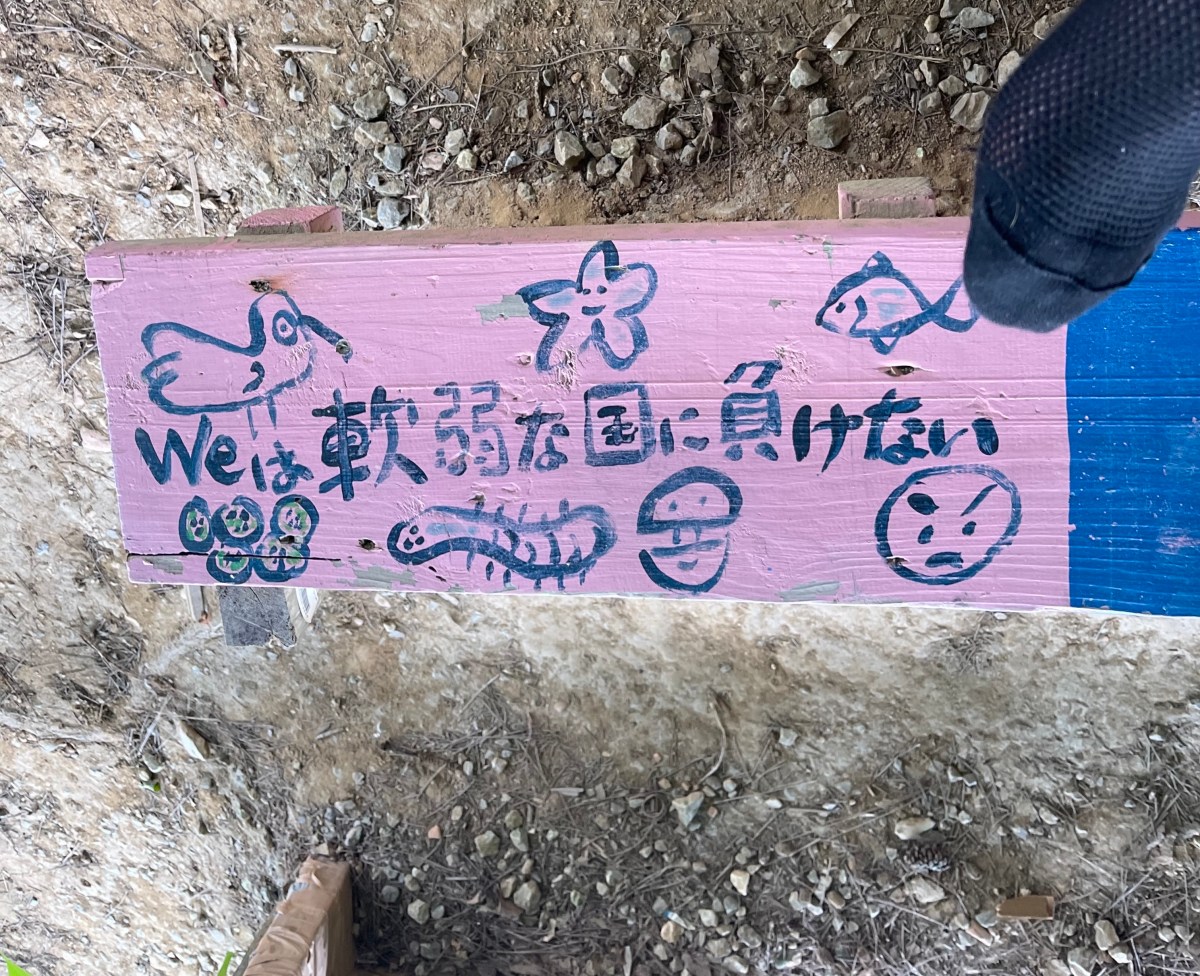
What was conspicuous in this space were several drawings of more-than-human beings that were found on the timbers and benches. The first one was two contrasting conditions of trees depicted on the edge of a bench (Image 2). One of these exposed the tree rings as its trunk was severed. Alongside this chopped tree, there stood another tree with a completely different state; the tree growing up unfinicky, the branches extending in all directions, the emerald green foliage blooming. Its thick trunk was adorned with round eyes and a red-painted smiling mouth as if the tree was animated with emotions, as if it felt happy to live. The second drawing, also depicted on another bench, stroked with a black brush several more-than-human beings such as worms, fish, starfish, and the grimace face of humans (Image 3). These small drawings surrounded a single political message: “We do not lose our fight against the spineless Japanese government”.


Figure 1 (left) shows the drawing of trees on a bench in the barrack. Figure 2 (right) shows various beings drawn on another bench in the barrack. Photos taken by the author in 2024.
These two paintings provoked empathy towards more-than-human beings by inviting viewers to imagine feelings of these beings and place themselves within the interconnected web of the entire ecosystem. The first one bore the vulnerability and pain of a chopped tree as well as the liveliness and happiness of the healthy one. It enabled viewers to imagine the sufferings of more-than-human beings and encouraged them to morally and ethically act to protect them. The second painting situated humans as just one among many living entities that composed the entire ecosystem, linking them through a shared victimhood caused by the presence of U.S. military bases. This perspective allowed viewers in the makeshift camp to comprehend themselves as part of Okinawa’s ecosystem damaged by the presence of U.S. military bases. Together, these two images helped form “ecological relations and systems as subject of justice by rendering morally salient the situated perspectives of many different parts of that system as well as the functioning of the relationships themselves” (Celermajer at al 2020; 482). These ecological relationships were formed via the shared vulnerability to the catastrophic impacts of the U.S. military bases. The paintings enabled protesters with a shared understanding that militarism destroys not only human life but the ecology as a whole. By situating more-than-human beings as historical subjects subjected to imperial and colonial structures, protesters advocated not only for their own liberation but for the liberation of the entire ecosystem from the grip of U.S. imperialism, directing their struggle toward the removal of the military bases that strangle this land and all its inhabitants.
On a rainy day, I was invited by an entomologist named Fumie to join a form of protest different from the usual sit-ins. She wore water-repellent boots, thick nylon pants, and a black shirt that displayed a gray bullet design beneath the typography “Insect Rescue.” With Fumie and two other protesters, we drove to the returned area of the U.S. Marine Corps Jungle Warfare Training Center. Half of the U.S. Marine Corps Jungle Warfare Training Center was returned to Japan in 2016 in exchange for the construction of a U.S. military helipad in Takae Village, despite intense protests from residents. The Japanese government announced the alleged completion of the cleanup in the returned forest, returned the land to its owners, and moved to have the area designated as a UNESCO Natural Heritage site. Nevertheless, after the official declaration of the cleanup’s completion, Fumie exposed the presence of significant amounts of both toxic and non-toxic waste that remain uncleared in the returned forest area, demanding that the U.S. Marines and the Japanese government take responsibility for restoring the forest. She told me that her immense affection for and concern over insects and living creatures in general compelled her to prioritize protecting the natural environment over her research and the pursuit of her career as an entomologist.
After driving through the forest for an hour, Fumie stopped the car in a carved-out space at a forest’s edge adjacent to the public road, a testament to her longstanding efforts to visit this place. Following her, we entered the forest, pushing through branches and carefully descending the slope to avoid slipping until we reached a glade where the trees grew more sporadically. The sparse tree leaves exposed us to more rain, leading some to slightly pull their raincoat hoods over their faces.
I noticed numerous broken glass bottles scattered among the gaps between the fallen leaves, their sharp edges glinting faintly in the subdued forest light (Image 3). After we carefully descended the slope, Fumie described several conspicuous remnants she had discovered during previous visits: hundreds of spent bullets, unused ammunition, and discarded electronic devices such as old televisions. Considering the innumerable toxic and non-toxic materials she has found, she guessed that this place was used as a disposal site. She cautioned us to handle only the fragments of glass bottles to ensure our safety and to be especially vigilant around scattered vials and syringes, which might still contain hazardous chemical substances. These abandoned materials, she emphasized, were a serious threat to the animals that inhabited the forest, disrupting their natural habitat and posing physical dangers. Taking her warnings seriously, we carefully placed each step and warily collected the glass shards, taking great care not to cut our fingers on the jagged edges and touch any chemical substance.

While we retraced the same route after collecting items, Fumie suddenly stopped and pointed to a puddle stretching several meters ahead. No plants were growing around it, as the soil had been dredged. She said cordially, “Please don’t step here. This is where boars wallow and enjoy mud baths to cool down and remove parasites.” Realizing that boars live in this forest, we exchanged smiles and looked at the puddle closely, imagining how they bathed. After taking photos of the puddle, we continued our walk back to the car. Just as we finally exited the forest, one of the protesters suddenly shouted, “There’s a Yanbaru kuina!” Yanbaru kuina is a rare species endemic to Okinawa’s northern forest, currently on the verge of extinction. Though we turned toward where she pointed, nothing registered with us. Excitedly, she explained to Fumie that the bird was hopping across the road. Fumie confirmed her observation, noting that this particular style of hopping is characteristic of the Yanbaru kuina and that she had seen them several times in the area.
During this trip, protesters paid immense attention to the toxic chemicals and sharp grasses that harm living creatures in the forest as well as their traces still surviving in the deleterious condition. Through this process, they engage with the toxicity and devastation that the more-than-human beings face and survive with tenacity every day. This suggests that protesters attuned to ecological flow and interaction by affectively “connect(ing) with and respond(ing) to the signals of other creatures” (Celermajer at al, 2020, 483). They imagined the suffering, perseverance, and resilience of the creatures living in the forest. This imagination is what Bendik-Keymer (2017) argues as “biocentric wonder … to see ourselves in our specific form of surviving alongside other living forms” (346). While such imagination may not fully capture the distinct experiences of more-than-human beings, it was precisely this act of imagining more-than-human life that evoked affective responses in the protesters, allowing them to situate themselves within the ecosystem and fostering empathy and a sense of responsibility to protect the ecosystem.
In conclusion, this short paper takes drawings of more-than-human beings and the forest cleanup activity as a point of departure for thinking about the formation of empathy. I argue that such activity and objects allowed protesters to encounter the toxicity in ecology and imagine the lives of more-than-human beings that are threatened by environmental destruction yet continue to persist with tenacity. In a time of ongoing ecological destruction in Okinawa caused by the construction and maintenance of U.S. military bases, there lies significant necessity for anthropologists to marshal their ethnographic attentiveness to capture the relationality between human and more-than-human beings and translate these insights into the further political mobilization.
References
Bendik-Keymer, Jeremy David. “The reasonableness of wonder.” Journal of Human Development and Capabilities 18, no. 3 (2017): 337-355.
Celermajer, Danielle, David Schlosberg, Lauren Rickards, Makere Stewart-Harawira, Mathias Thaler, Petra Tschakert, Blanche Verlie, and Christine Winter. “Multispecies justice: theories, challenges, and a research agenda for environmental politics.” Trajectories in environmental politics (2022): 116-137.
Khayyat, Munira. A landscape of war: ecologies of resistance and survival in South Lebanon. Univ of California Press, (2022).
Kozue, Uehara. “Minshu no seizon sisou kara kenri wo tou: siseiken hennkan go no kinawan han CTS saiban wo tou” [Asking what right means through philosophy of survival of civilians: regarding trials against CTS at Kina Bay after the reversion of administrative power]. Hosei University Repository (2013). 127-158.
Rima, Higa. “Kore ha Seiji ja nai —
Rubaii, Kali. “This is why we protect the rivers, this is how we love the rivers.” Critical Times 6, no. 2 (2023): 195-201
Pugliese, Joseph. Biopolitics of the More-than-human: Forensic Ecologies of Violence. Duke University Press, (2020).