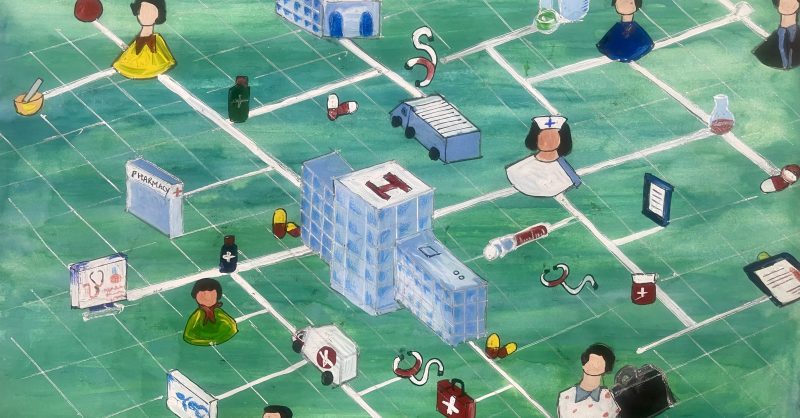
Why should the figure of the middleman matter for scholars of global health? The short answer is: they are impossible to avoid. The long answer is as follows:
Throughout the twenty-first century, claims have circulated that the global pharmaceutical supply chain is awash with fakes, and these claims sparked our curiosity. For nearly a decade, we have been studying such claims and, in particular, their effects on how people understand themselves and their health. In short, we have asked: what’s at stake in the fake? (https://www.fakedrugsproject.org/; Bandora 2023; Calkin 2024; Goodman 2024; Hodges 2024, 2019; Hodges and Garnett 2020; Hodges and Hornberger 2023; Hornberger 2024, 2019, 2018; Hornberger and Hodges 2023, 2024; Hornberger; Hodges, and Chitukutuku 2023; Kufakurinani 2022, 2024; Peete 2023; Rodrigues 2024; Sirrs 2023; Thakur 2023).
In our research into ‘fakes’ within global health, one figure kept popping up: the middleman. These were women and men often with little formal expertise, understated and yet confidently managing matters of health, inserting themselves deliberately at one of many key intersections through which people, goods, and ideas flow. Once we started paying attention to them, our field sites all situated in and related the field of global health suddenly became thick with middlemen and middle-women[1]: people who bought and sold pharmaceuticals, those who ran health care labour recruiting agencies, street theatre audiences commenting on a health education play, diasporic travellers freighted with both care work and curative goods, and even an international taskforce brokering health treaties between unlikely actors.
Yet, middlemen – both the people and the category – presented a puzzle to us because the people whom we encountered in our research did not match what journalists or health policy scholars had warningly written about them, in pieces like: ‘It is time to surgically remove the middleman’ (Brock 2022) or ‘At the pharmers market patients suffer while middlemen profit’ (Pipes 2022). In such accounts, the middleman was a mere culprit, a redundant if not parasitic figure, invoked as a kind of shorthand to explain the persistence of so-called fake drugs.
Health policy scholars and commentators have mostly cast middlemen as vilified profit-seekers who corrupt health interventions. Occasionally, middlemen appear not as villains but as accidental heroes who fill urgent gaps in the delivery of essential services (Dalstrom 2013; Elbe, Vorlíček, and Brenner 2023). In all these accounts, however, whether heroes or villains, ‘middlemen’ were invoked as part of a broader moral landscape. It appeared that in the high moral stakes that suffuse the field of global public health, middlemen can almost only logically exist as a morally overdetermined caricature and is hardly ever given the time of day to be described or analysed in terms of their actual actions. The middlemen we found, in contrast, were real, complex characters, sitting in plain view and conducting the everyday business of global health. They unabashedly looked after their own interests and yet they seemed to play an important role in keeping the rickety show of global health on the road. What were we to make of this mismatch between what experts have said about ‘the middlemen’ in global health and what we found?
Once we rowed out from the discursive shores of global health, many more middlemen came into scholarly view. Anthropologists and sociologists have long recognised the significance of brokers, agents, and fixers (e.g. Bjorkman 2021; James 2011; Platt, Raj, and Kardia 2019; Hunter 2020) while political scientists have their own preoccupations with brokers in party politics and property transactions (Sud 2014; Thachil and Auerbach 2018; Auerbach and Thachil 2020). Like Bjorkman (2021), we found that the strong moral charge surrounding middlemen complicated our capacity to analyse them. We also wrestled with a conceptual challenge: how to define “middlemen-ing” when neither a distinct activity nor a stable identity could capture what they do. Middlemen delivered a vast array of services, yet these services were as varied as the middlemen themselves.
This left us with a puzzle: how could we engage with middlemen as an expansive category without sacrificing the analytical precision our inquiry required? We chose to double down on the one feature that consistently cut across all our cases: their position between two or more poles or parties. In other words, we selected their in‑betweenness—their relationality—as our analytic lens.
In this task, we turned to earlier sociocultural theorists who outlined the basic elements of who middlemen are and what middlemen do. We draw particularly on Sidney Mintz’s ‘higgler’ (1956), Georg Simmel’s (1908) ‘stranger’, and Clifford Geertz’s ([1979] 2022) accounts of those who populate the suq. Eschewing normative definitions of middlemen, these scholars focused on how middlemen performed structural work and held relational power. Importantly, this body of work showed how middlemen’s moral charge (as either villain or heroes, but never just as middlemen) is a direct effect of their particular ‘in-between’ position.
Mintz’s (1956) account of the higgler, or marketplace peddler, provided a useful starting point. He shows how middlemen ground their craft in fine-grained, context-specific knowledge — from the perishability of avocados to transporting eggs in the rainy season. This closely situated market knowledge lets them catch the moment that delivers profit, mastering what any single farmer lacks time to learn. It is through this knowledge that middlemen create value for themselves and others.
In ‘The Stranger’, Simmel (1908) shows that middlemen are structural outsiders, belonging to no particular family or land. This position produces moral ambiguity: their disinterestedness makes them simultaneously suspect and unusually trustworthy. What matters for our purposes is that both possibilities are always latent in the figure of the middleman — transcending any simple claims about their morality.
Geertz’s ([1979] 2022) account of the suq puts flesh on Simmel’s stranger and situates Mintz’s higgler within a market dynamic marked by opacity. He shows how markets need middlemen to function: as prices and availability constantly shift, traders need someone who works not through family ties but through mobility — able to move between and connect market actors, unconstrained.
For us, three key points emerge from the above: middlemen provide situated knowledge (Mintz), they occupy a structurally produced and morally ambiguous role (Simmel), and they produce value, including their own, by navigating what others encounter as opacity (Geertz). We use these three points to show how the middlemen we’ve encountered in our research into fakes and global health are three-dimensional characters, which are structurally specific but open-ended regarding what they know and what service they deliver. Each of the contributions to this series illustrate different ways in which middlemen are formed by and in turn form global health’s institutions, discourses, and practices.
Bandora’s account of suitcase traders in Dar es Salaam’s cosmetics marketplaces shows how traders cultivate situated knowledge of these vibrant commercial spaces. Though cosmetics may seem distant from public health, regulators frequently invoke counterfeit cosmetics as a proxy for fake medicines, and in popular imagination cosmetics occupy a space adjacent to medical products. Suitcase traders leverage a layered understanding of markets, customers’ desires, and their anxieties offering goods with the allure of distant origins while assuaging fears about counterfeits.
Zinati explores three middlemen in Iran’s pharmaceutical trade in times of international boycott: street peddlers (dalals), pharmacists, and diaspora travellers. Dalals vouch for black-market drugs by combining access to illicit suppliers with pharmaceutical expertise. Pharmacists sell not only official Iranian drugs but also under-the-counter brands kept out of reach by sanctions and law. Diaspora travellers, meanwhile, express love for those left behind by bringing back commodities of health and wellbeing.
Peete’s account of Tanzanian retail pharmacies reveals a gap between the formal register of state regulation, which pharmacy workers are trained to uphold, and their customers’ colloquial health desires. Navigating the awkwardly overlapping roles of business owner, pharmaceutical specialist, and customer advisor, pharmacy workers find themselves interpolated into middlemen.
Thakur traces how pharmaceutical wholesalers in north India navigate claims to trustworthiness in a context where fakeness and fraud are assumed to be ever-present. She shows how online and in-person sellers each demonstrate care and attention to customers while casting doubt on the other’s sincerity and safety. Each of them competes for the status of trusted middleman.
Goodman’s analysis of a participatory theatre production about vaccine rumours in Mombasa depicts audiences as middlemen who traffic and connect scales of fakes. In a context where opacity is the norm and public health claims are met with suspicion, audiences share information, cobble together rumours, and debate their validity. They position themselves as arbiters, even if the certainties they produce are ephemeral.
Hanrieder and Januschek examine labour recruiters who face accusations of ‘brain drain’ for recruiting nurses from low-income countries to higher-paying Germany. Though officially sanctioned by the German state, they are simultaneously held at arm’s length and seen as necessary yet suspect. Navigating this ambiguity requires actively performing their ethical credentials to multiple publics, shoring up the reputation on which their business depends.
Hornberger traces the rise and fall of the global health IMPACT taskforce to fight fakes through the lens of the middleman, showing how its moral valence could flip abruptly from indispensable broker to parasitic actor. IMPACT brought together WHO’s standard-setting authority, Interpol’s law-enforcement power, and big pharma’s technical expertise, and was initially celebrated for convening this unlikely trio around a shared problem. Yet this capacity for intermediation became its undoing: once WHO’s links to industry were judged inappropriate, the taskforce’s value as a connector was reframed as undue influence, threatening both WHO’s integrity and equitable access to safe medicines.
***
These contributions draw inspiration from earlier anthropological work on middlemen that not only dissolved the hero/villain binary but also helped us focus on the material, practical, and performative value that middlemen bring to global health. They also showed us how middlemen’s reputational instability is borne of the same source from which they derive their value.
We also realised that we were charting new ways of thinking with middlemen for critical global health as a whole. This matters because global health has grown at a staggering pace and become an object of critical scholarly inquiry, with scholarship exposing a central contradiction: its stated aims of closing health inequities are at odds with its observable outcomes (e.g. Adams 2016; Adams et al. 2024; Biruk 2018; Dilger et al. 2025; Erickson 2015; Graham 2019; McGoey 2015; Hunter and Murray 2019; Kingori and Gerrets 2019; Nguyen 2010; Parker and Kingori 2016). How has global health survived rather than crumbled under the weight of this contradiction? The answer is middlemen, who thrive in environments of structural and moral contradiction, bridging gaps without rocking the boat. Our point is that middlemen deserve scrutiny alongside critical global health’s more familiar personae of patients, clinicians, and philanthropists. What they help us see is that global health is less a superhighway than an unmapped, lucrative, bumpy road that is best navigated through know-how acquired on the fly.
Middlemen boast of making do with flair, acting in the moment, connecting people, things, and markets. Yet a counterintuitive corollary of this agility is their cultivated invisibility: their effectiveness often depends on fading into the background, covering their tracks, evading audit, or letting others claim the credit. This strategic self-effacement is no small reason why middlemen are so frequently misrecognised as redundant or corrupt or simply absent from dominant accounts of global health. Bringing them into view — attending to their situated knowledge, improvisational skills, and the networks they hold together — is, we argue, central to the practice of critical global health scholarship.
Provocations
We offer here a primer for thinking with middlemen within critical global health, organised into a set of provocations that evoke—rather than codify—the shifting, situated ways in which middlemen work and what middlemen are.
1. Middlemen build connections and move across scales and registers
Middlemen do more than connect two points, buyers and sellers, for example; they collect and leverage information across global health’s vast geographical distances, supply chains, and affective registers. Bandora’s suitcase traders operate in a field of uneven regulation, attracting customers by meeting desires for cosmopolitan wellness products while promising safety. Similarly, Goodman’s street theatre audiences mediate concerns about vaccine safety. Both arbitrate fakeness, discerning vexatious rumour from useful information, and both mediate fears of the fake — fears rooted in suspicion of the open borders through which cosmopolitan products necessarily flow.
2. Middlemen are found at the disjunctures in systems
To dismiss middlemen as morally corrupt underestimates their essential role in a wider system. Because of their interstitial and seemingly underdetermined role, middlemen are often and easily portrayed as bad apples who clog up the system. Yet interstices are exactly the site of their work: they insert themselves and do the work that allows an otherwise disjuncted system to deliver. For example, in the context of pharmaceutical scarcity in Iran, Zinati’s street dalals and official pharmacists deliver consumer choice and relative abundance.
3. Middlemen rarely come alone
Middlemen are often depicted (see above) as isolated occurrences. We disagree. Middlemen work in clusters and form chains of transactions with one another. Middlemen work at various points in supply and distribution chains and at various regulatory intersections. On policy level we have Hornberger’s taskforce pave the way for new security interventions into the pharmaceutical supply chain, while further down the line we have Thakur’s wholesalers mediating their customers’ need for care. Sometimes, as middlemen cluster along the supply chain, they do not just cooperate but also compete with each other, and in so doing mobilise the very suspicions that are often levelled against them.
4. Middlemen are nobody and everybody
Middlemen, their practices, and what they know cannot be generalised or characterised through a particular profession or body of expert knowledge. They are not a stable, identifiable category as such; they are always particular and contingent in where they insert themselves and what they do. As global health workers, they develop their skill by handling global health commodities or particular constituencies on either end of the supply chain. They also become global health workers by virtue of having connections that happen to be part of global health networks. Any kind of skill and expertise can be mobilised into a service that can be recognised for its value: here the ambassador’s wife in Hanrieder and Januschek’s contribution stands out. She used her networks to become a nurse broker.
5. Being nobody and everybody, however, means that middlemen constantly have to announce themselves
Because the role of the middleman in global health is radically contingent and ephemeral, middlemen must constantly make themselves seen and heard. In practice, this is about first inventing new idioms of plausible professionalism in the absence of recognisable qualifications. Props and charisma play an important role in their work of performative persuasion: the suitcase of Bandora’s trader, for example, convinces his customers that he is bringing goods with a cosmopolitan appeal. Or it involves the mastery of expert terms, as seen in the pavement traders for Iranian medicines in Zinati’s account. Often it is a combination of all these alongside the invention of self-regulating quasi-professional associations, such as those described in Hanrieder and Janauschek’s account.
6. Global health’s virtues attract middlemen
Middlemen are often the ‘pop-up’ or ad hoc merchants of global health, central to operations but strategically invisible to organisational structures or formal budget lines. As such, their skills remain formally illegible within global health institutions, so much so that their work is regularly read as corrupting or criminal. Yet, for middlemen, this is a reputational risk worth taking. The field of global health offers much-maligned middlemen a chance to burnish their image as global health workers. As Hornberger shows, an international taskforce brokered a reputationally risky collaboration among Interpol, the pharmaceutical industry, and the WHO. This allowed potentially suspect members of the taskforce like police and big pharma to adorn themselves with the shiny moral claims of protecting health.
7. Middlemen do not rock the boat and yet can be read as a critique
Because of their relative invisibility, middlemen don’t rock the boat. They bridge gaps without altering the underlying situation. Found where things don’t add up, they make the incommensurable manageable. Zinati shows how middlemen help Iran maintain its official guise of pharmaceutical self-sufficiency while ensuring that customers can still access international drugs. In Peete’s account, pharmaceutical technicians shift between a nationalistic regulatory register and consumers’ felt entitlement to free choice. In Hanrieder and Januschek’s telling, middlemen secure Germany’s access to health workers from the global South, albeit ‘ethically’. Attending to middlemen makes visible the contradictions between global health’s avowed mission and its observable shortcomings. In absorbing global health’s less palatable aspects, middlemen offer a peculiar form of critique and an anti-politics: this is the middleman’s intervention in critical global health studies.
Conclusion
In our work, we encountered middlemen as lively figures who broadcast a buoyant pride in their craft. At the same time, they were very aware of their often morally embattled reputation. Rather than dismissing or rationalising middlemen and their work, we take account of both their moral and structural positionalities.
Structure matters for middlemen but does not wholly define them. As we lay out in our provocations, the power of middlemen lies in their capacity to make something out of nothing. They excel at producing credibility, value, and usefulness through their sheer effervescent exuberance, navigating across scale and register. And they are masters of deploying both visibility and invisibility in both obvious and the most unlikely of spaces and places.
In overlooking middlemen, we miss much about how global health functions. Global health is both a practical and moral project, yet its various parts rarely add up to a coherent system. Many have blamed this on profit- and market-driven rationales, calling for a reinvention of global health’s mission. Middlemen awkwardly interrupt this diagnosis by showing that health is always already a commodity. When we look at middlemen, we see who does the dirty work that sustains the fiction that health and commodities could ever be separate.
We stumbled onto middlemen through our empirical work on fake drugs. This is not a coincidence. Yet, we did not find middlemen to be the smoking gun behind a global conspiracy to sell fakes. What connects the two is, for lack of a better term, their respective dodginess: both are thick with associations of the illicit, shadowy, and corrupting — that which should not be there. As a result, we speculate, some critical global health scholars may encounter these figures but turn away, finding them distasteful or inconvenient, and relegate them to the margins.
‘Staying with’ this dodginess allows middlemen to emerge from the margins, with their own, albeit peculiar, main character energy. Thinking with and about middlemen allows us to take a much fuller account of the charged moral terrain of global health, rather than simply evaluate the workings of global health as moral or immoral. To stay with the dodginess is to refuse to look away from that which discomforts us and to keep our gaze on the intricacies of the apparatus.
[1] Just to be clear: middlemen are, more often than not, also women, even if the label might suggest otherwise. Going forward, however, we will continue to use the term middlemen. We do this partly for readability, as neologisms such as middle-women or middle-people interrupt the flow and introduce unnecessary linguistic stumbling blocks. But more importantly, we do so because middlemen—much like the broker or the stranger—are first and foremost relational categories, not descriptions of an essential or fixed identity. The term refers to a position within a set of social relations rather than to the intrinsic qualities of the person who occupies it.
References
Adams, Vincanne, ed. 2016. Metrics: What counts in global health. Duke University Press.
Adams, Vincanne, Clare Chandler, Ann H. Kelly, and Julie Livingston. 2024. “A pandemic of metrics.” Medical Anthropology Quarterly 38 (2): 149–63. https://doi.org/10.1111/maq.12842
Ahillan, Tharahnika. 2024, 4 August. “Fifth of medicines in Africa may be sub-par or fake, research finds: Analysis suggests extent of problem UN estimates is causing 500,000 deaths a year in sub-Saharan region.” The Guardian. https://www.theguardian.com/world/article/2024/aug/04/fifth-of-medicines-africa-substandard-fake-research
Auerbach, Adam, and Tariq Thachil. 2018. “How clients select brokers: Competition and choice in India’s slums.” American Political Science Review 112 (4): 775–91. https://doi.org/10.1017/S000305541800028X
Auerbach, Adam, and Tariq Thachil. 2020. “Cultivating clients: Reputation, responsiveness, and ethnic indifference in India’s slums.” American Journal of Political Science 64 (3): 471–87. https://doi.org/10.1111/ajps.12468
Bandora, Rhoda Mkazi. 2023. “Fake-talk, side effects and the trouble with hormonal contraceptives among women in Dar es Salaam.” Medicine Anthropology Theory 10 (3) https://doi.org/10.17157/mat.10.3.7277
Bärnreuther, Sandra. 2020. “Traders of gametes, brokers of values: Mediating commercial gamete donations in Delhi.” Economy and Society 49 (3): 455–73. https://doi.org/10.1080/03085147.2020.1743074.
Biruk, Crystal. 2018. Cooking data: Culture and politics in an African research world. Duke University Press.
Björkman, Lisa, ed. 2021. Bombay brokers. Duke University Press.
Brok, Jay. 2022. “It’s time to surgically remove the middle man.” Physicians for a national Health Programme. 24 March. https://pnhp.org/news/its-time-to-surgically-remove-the-middle-man.
Calkin, Sydney. 2024. “‘It’s not mifepristone, but it’s not poison.’ Finding fakes in Poland’s abortion underground.” Cambridge Journal of Anthropology 42 (2): 47-64. https://doi.org/10.3167/cja.2024.420205
Dalstrom, Matthew. 2013. “Medical travel facilitators: Connecting patients and providers in a globalized world.” Anthropology & Medicine 20 (1): 24–35. https://doi.org/10.1080/13648470.2012.747592
Dilger, Hansjörg, Jérémy Geeraert, Tinashe Goronga, Lucia Mair, Nassim Mehran, Ursula Probst, Raphael Frankfurter, Vivien-Lee Greiwe, Margret Jaeger, Ulrike Kluge, Jillian Pape, Jaleel Plummer, Hannah Strohmeier, Levi Vonk, and Seth M. Holmes. 2025. “Grounding global health in care: Connecting decoloniality and migration through racialization.” Global Public Health 20 (1): 1–16. https://doi.org./10.1080/17441692.2025.2480646
Elbe, Stefan, Dagmar Vorlíček, and David Brenner. 2023. “Rebels, vigilantes and mavericks: Heterodox actors in global health governance.” European Journal of International Relations 29 (4): 903–28. https://doi.org/10.1177/13540661221146533.
Erikson, Susan. 2015. “Secrets from whom? Following the money in global health finance.” Current Anthropology 56 (S12): 181–324. https://doi.org/10.1086/683271
Garg, Sandip. 2020. “The ‘economic health’ of US health care and role of middlemen.” Diabetes Technology & Therapeutics 22 (2): 136–41. https://doi.org/10.1089/dia.2019.0395
Geertz, Clifford. (1979) 2023. Sūq: Geertz on the Market. Chicago: Hau Books.
Goodman, Zoe. 2024. “‘They will not police us’: Fake vaccine rumours in Mombasa.” Cambridge Journal of Anthropology 42 (2): 65–82. https://doi.org/10.3167/cja.2024.420206
Graham, Janice. 2019. “Ebola vaccine innovation: A case study of pseudoscapes in global health.” Critical Global Health. 29 (4): 401–12. https://doi.org/10.1080/09581596.2019.1597966
Hodges, Sarah. 2019. “The case of the ‘Spurious Drugs Kingpin’: Shifting pills in Chennai, India.” Critical Public Health 29 (4): 473–83. https://doi.org/10.1080/09581596.2019.1593948
Hodges, Sarah. 2024. “On the visual culture of policing fakes in India: Spurious drug bust photojournalism.” Cambridge Journal of Anthropology 42 (2): 31–46. https://doi.org/10.3167/cja.2024.420204
Hodges, Sarah, and Emma Garnett. 2020. “The ghost in the data: Evidence gaps and the problem of fake drugs in global health research.” Global Public Health 15 (8): 1103–18. https://doi.org/10.1080/17441692.2020.1744678
Hodges, Sarah, and Julia Hornberger. 2023. “The long shadow of fake drugs and the social lives of fake-ness.” Medicine Anthropology Theory 10 (3). https://doi.org/10.17157/mat.10.3.9065
Hornberger, Julia. 2018. “From drug safety to drug security: A contemporary shift in the policing of health.” Medical Anthropology Quarterly 32 (3): 365–83. https://doi.org/10.1111/maq.12432
Hornberger, Julia. 2019. “Who is the fake one now? Questions of quackery, worldliness and legitimacy.” Critical Public Health 29 (4): 484–93. https://doi.org/10.1080/09581596.2019.1602719
Hornberger, Julia. 2024. “The gospel of fakes: Policing, intellectual property conferences and the problem of persuasion.” Cambridge Journal of Anthropology 42 (2): 15–30. https://doi.org/10.3167/cja.2024.420203
Hornberger, Julia, and Sarah Hodges. 2023. “Fake-talk as concept and method.” Medicine Anthropology Theory 10 (3). https://doi.org/10.17157/mat.10.3.7291
Hornberger, Julia, and Sarah Hodges. 2024. “Policing fakes.” Cambridge Journal of Anthropology 42 (2): 1–14. https://doi.org/10.3167/cja.2024.420202
Hornberger, Julia, Sarah Hodges, and Edmore Chitukutuku. 2023. “Fake-talk and the spaza shop: A fake food furore and the spectre of public health emergencies in South Africa.” Medicine Anthropology Theory 10 (3). https://doi.org/10.17157/mat.10.3.7136
Hunter, Benjamin. 2020. “Going for brokerage: Strategies and strains in commercial healthcare facilitation.” Global Health 16 (49). https://doi.org/10.1186/s12992-020-00578-z
Hunter, Benjamin, and Susan Murray. 2019. Deconstructing the financialization of healthcare. Development and Change 50 (5): 1263–87. https://doi.org/10.1111/dech.12517
James, Deborah. 2011. “The return of the broker: Consensus, hierarchy, and choice in South African land reform.” Journal of the Royal Anthropological Institute 17 (2): 318–38. https://doi.org/10.1111/j.1467-9655.2011.01682.x
Jeong, Sohyun, and Eunhee Ji. 2018, “Global perspectives on ensuring the safety of pharmaceutical products in the distribution process.” International Journal of Clinical Pharmacology and Therapeutics 56 (1): 12-23. https://doi.org/10.5414/CP203151
Kingori, Patricia, and Réne Gerrets. 2019. “The masking and making of fieldworkers and data in postcolonial global health research contexts.” Critical Public Health 29 (4): 494–507. https://doi.org/10.1080/09581596.2019.1609650
Kufakurinani, Ushehwedu. 2022. “Do fakes exist? Trade and consumption of sex enhancers in Harare’s avenues.” Journal of African Cultural Studies 34 (4): 456–68. https://doi.org/10.1080/13696815.2022.2136630
Kufakurinani, Ushehwedu. 2024. “Policing banned sex enhancers in the streets of Harare.” Cambridge Journal of Anthropology 42 (2): 83–96. https://doi.org/10.3167/cja.2024.420207
McGoey, Linsey. 2015. No such thing as a free gift: The Gates Foundation and the price of philanthropy. Verso.
Meador, Mark. 2011. “Squeezing the middleman: Ending underhanded dealing in the pharmacy benefit management industry through regulation.” Annals of Health Law 20 (77). http://lawecommons.luc.edu/annals/vol20/iss1/6
Mintz, Sidney. 1956. “The role of the middleman in the internal distribution system of a Caribbean peasant economy.” Human Organization 15 (2): 18–23. https://doi.org/10.17730/humo.15.2.x5k4022515r6068u
Nguyen, Vinh-Kim. 2010. The republic of therapy: Triage and sovereignty in West Africa’s time of AIDS. Duke University Press.
Parker, Michael, and Patricia Kingori. 2016. Good and bad research collaborations: Researchers’ views on science and ethics in global health research. PloS One 11 (10): e0163579. https://doi.org/10.1371/journal.pone.0163579