Article begins
In the 4×4 on our way to a Cambodian minefield, Tony got a phone call. Tony is the country technical operations manager of MAG International, one of the international demining organizations working in the country. When he hung up, he turned to me and said, “You’re lucky, our crew found an anti-tank mine. You’ll see how we destroy them.”
Soon, I stood about 500 meters away from where the mine lay, gazing at the Cardamom mountains where I knew many more had been planted, a silent but deadly legacy of thirty years of conflict. The Russian TM-46 anti-vehicle mine that was found contained 5.7 kilograms of explosives (see Figure 1). Such a device would destroy a vehicle or a tractor and, likely, kill all passengers on board.
Credit:
Ariane Bélanger-Vincent
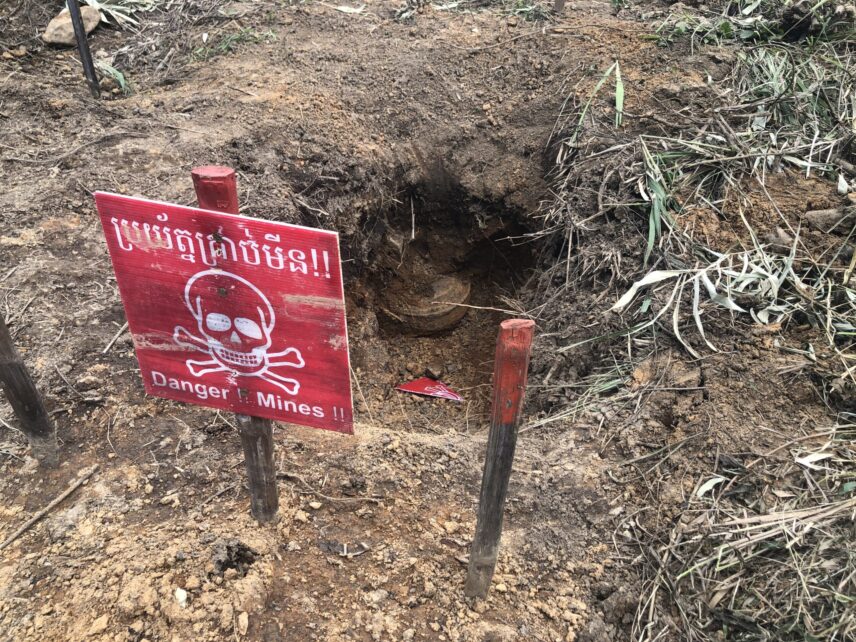
Figure 1. Anti-vehicle mine in a Cambodian minefield, before its destruction.
To destroy the mine, MAG’s explosive ordnance disposal (EOD) specialists added more explosive they call a “demolition charge.” To prepare for the demolition, they deployed an electrical firing cable which allows to initiate the demolition when it is safe to do so. In the meantime, a siren wailed in the background and a megaphone blasted warnings to the population, describing where the mine lay and alerting them to take shelter. During the critical moments it takes for an EOD specialist to link the firing cable to the charge, utter silence is imposed to all walkie-talkies on site, since radio interference could trigger the explosion. As the EOD specialist walks away to the established firing position (Tony called that the “long walk”), the silence is broken. Within a few minutes, the 10-count bilingual Khmer and English countdown conveyed through the megaphone begins. At its end comes the thunderous explosion. Even from the great distance, the shock wave penetrates my solar plexus and makes me gasp for air.
Humanitarians hope that each mine sowed will remain silent until found by professional deminers. As I was catching my breath, I thought of Bavani (pseudonym), one of the thirty-eight women deminers I spoke with while doing fieldwork in the north of Sri Lanka in 2022. In the context of a wider ethnographic project on the implementation of the 1997 Anti-Personnel Mine Ban Convention (APMBC), one focus of my research is how “gender mainstreaming” is implemented in humanitarian demining. At the time, Sri Lanka had the highest proportion of women deminers in the world. Bavani works for the international demining organization the HALO Trust. She started a few years after the end of the civil war that ravaged the country from 1983 until 2009, leaving a deadly legacy of landmine contamination. One day, an unexpected explosion happened near the site she was working on, making her faint. The noise had awakened the trauma of the war, she explained, bringing back memories of the shelling, the explosions, and the deaths. Deminers in Sri Lanka have experienced war firsthand while, in Cambodia, a generation, if not two, have passed.
Bavani has three children and a husband whose health condition prevents him from working. Like most women deminers I spoke with in Sri Lanka, she considers her job a “blessing.” It is a well-paying job by local standards, accessible to those who missed so much schooling during the civil war. It was common for the deminers I talked with to have started their jobs by necessity, to feed their families. Like Bavani, many women in the north of Sri Lanka are the sole breadwinners and often sustain extended families on their wages as deminers. They feel pride, too, in making their community safer.
The (paid) training to become deminer lasts three weeks. As they acquire experience in the minefields, deminers may be invited to further their training and climb the ladder of their organization. At the lower levels, however, the responsibilities are minimal and deminers are expected to follow a very strict protocol. Yet because the salary and the benefits are substantial, many deminers I encountered have been able to acquire property, land, cattle, or poultry. A few are putting money aside to open small businesses such as tailor shops or beauty salons, planning for the day when Sri Lanka will be declared “mine free” and deminers will be out of work.
Days and weeks are exhausting for deminers. Depending on the commuting times it takes to get to their organizations’ field office at the crack of dawn, a day can start as early as three in the morning. Women, as it is often the case, are in charge of the domestic chores, so some also get up early to prepare the meals for the family. Once arrived at the edge of the minefield, they put their personal protective equipment on. It includes, at a minimum, the demining vest protecting the torso, the pelvis, and the neck. And there is the visor. It is designed to protect the face from an explosion experienced from nearby. It is particularly heavy and bulky and needs to be tightly strapped around the head so it stays in place in case of a blast. It muffles the surrounding noises and speech, and needs to be worn at all times in the minefield, except during breaks. For myself, wearing the visor was the hardest part of my fieldwork, but deminers told me you get used to it. That has to take a good while.
The day ends at around 2 p.m., which allows the women I met to go back home and tend their vegetable gardens, their rice paddies, their chickens, and to take care of their children and domestic tasks. This goes on day in, day out for three weeks until a five-day break to rest. The blast that made Bavani faint did not hurt anyone. In fact, accidents are rare in the professional world of humanitarian mine action and most landmines remain silent until they are safely destroyed. The silent sweeping of a metal detector above an area suspected of contamination and the cautious steps the deminer takes in the process may be the most frequent image conjured up. Yet noise is central in the process of finding the mines. Using a metal detector requires precision and silent focus. One can “miss a signal” if the sweep is too slow or too fast, a life-threatening error. Yet, it is a painfully deliberate and repetitive task.
Credit:
Ariane Bélanger-Vincent

Figure 2 – How to indicate the presence of a suspected landmine. Picture taken at a HALO Trust training site in Sri Lanka.
The metal detector turns noise into meaningful beeping signals that suggest the presence of a mine. But there’s more to it than that. Deminers train their ears to locate the exact center of the mine, catching the changing pitch the metal detector makes (see Video 1). Once they find it, they position a small and visible marker on top of it (the red square in Figure 2). In the protocol explained to me when I visited the HALO Trust’s training site in Sri Lanka, they then place a triangle that clearly signals the direction from which to dig. The base of the triangle gauges the safe distance from which to start digging to approach the mine. To uncover a suspected mine, the deminer needs to dig laterally, slowly and at a precise depth (fifteen centimeters in this protocol) starting from the base of the triangle. This lateral approach is safer—because a mine detonates only if pressure is applied directly on it—and explains the importance of training one’s ear to detect its center. Once the deminer starts to unearth the object, they can usually tell if it is a landmine or just a piece of metal. If it is a landmine, the deminer places a triangle that points towards the explosive device, walks backwards, and calls a supervisor who is in charge of evaluating the situation and deciding how to remove or destroy the mine.
The site where I met Bavani is known as the Muhamalai minefield, in the northern Jaffna peninsula. The isthmus was turned into a frontline separating the Liberation Tigers of Tamil Eelam (LTTE) and the Sri Lanka Army (SLA) from 2005 or 2006, until the end of 2008. During that period, SLA controlled the northern part of the peninsula, including the city of Jaffna, the Tamil people’s cultural capital. LTTE controlled the region south of the frontline, as well as the north part of the mainland called the Vanni. At the end of the civil war in 2009, Muhamalai was the most heavily contaminated minefield in the world. However, because it was a frontline, it contains not only anti-personnel mines, but also anti-vehicle mines, improvised explosive devices, and exploded or unexploded ordnance such as hand grenades and mortars.
Imagine the cacophony metal detectors would create in this context. Instead, organizations rely on other forms of sensory signals, using among other things a technique called “Rake Excavation Detection System,” or REDS for short. It involves, as its name hints, the use of at least two rakes. The heavy rake is positioned softly at the surface of the soil to loosen it by shaving a thin vertical layer of dirt off. A light rake then investigates the loosened soil (see Video 2). Metal debris is discarded, while landmines or other unexploded ordnance are dealt with by supervisors.
As it has become clear, humanitarian demining techniques are plentiful, and context matters. Experienced operations managers know how to adapt their demining techniques in order to find the mines. I met Art in 2017, as I was conducting research in Thailand. Art, the project manager of the Japanese-funded Thai Civilian Demining Association, explained that while in the field, it is important to notice the patterns in which the landmines are sowed. “I can read a minefield,” he said, “and tell the story of the conflict that unfolded there.”
Reading the minefield is also about choosing the right demining method. In Cambodia, I was sitting under a tent while MAG’s deminers were busy preparing for the destruction of the TM-46 anti-vehicle mine I was about to witness. The minefield, situated close to the Thai border in the western province of Battambang, was classified as having scattered contamination of both anti-vehicle and anti-personnel mines. It was being cleared using metal detectors and explosive-sniffing dogs in partnership with the Cambodian Mine Action Center (CMAC). A few weeks before my visit, deminers had found a detached component of an anti-vehicle mine, suggesting anti-vehicle mines possible presence nearby. They then started to examine the area using the “large loop,” a metal detector that can find metal at a greater depth than handheld detectors. Tony called this an “evidence-based methodology approach.” Without the inclusion of the large loop, they would have missed the mine; it was buried too deep in the ground for dogs or handheld metal detectors to discover it.
Reading the minefield is the task of operational managers. For most deminers at the lower levels of the hierarchy, workdays go on in attentive silence punctuated by meaningful signals. No matter what demining technique is used, the first blast of a whistle marks the beginning of a ten-minute break after forty to fifty minutes of grueling and silent work. Deminers stop their tasks and start looking at one another from afar, taking in silent cues that everyone has stopped working. With a sigh of relief, they can then walk in the cleared lanes towards the shaded break area that also serves as an emergency medical area. At that point, visors are off and chatter can erupt while deminers take a sip of water. Another whistle will be heard after eight minutes, signaling to the deminers it’s time to go back to their lanes. After another two minutes, a second whistle silences everyone as they put their visors back on for another shift. As they start to work again, I wonder what they’re thinking about, and I hope that silence, not noise, will continue to mark their days.