Graves held finely woven silk, bronze vessels, ceramics, wooden objects, and iron tools. Golden funerary masks and a brocade bearing the characters for “noble” (王侯), hint at the elevated social status for some of the dead. Archaeologists also found barley grains—some alongside remnants of woven bags that once held them—and bones from cattle, sheep, and horses. Perhaps the foods were offerings or part of some other funerary ritual.
The remains within M2 belonged to a female, estimated to be between 25 and 30 years old. Though not unusually large, her tomb was meticulously constructed from three distinct types of stone. Its floor was hardened by fire, and the walls were coated in cinnabar. In addition to the human remains, the tomb also contained two complete horse skeletons, one complete sheep, and a scatter of other animal bones.
In excavation layers above M2, archaeologists found a pit packed with sheep bones—placement that suggests people came with offerings to remember or venerate the deceased after her death.
Although M2’s lavish design seems to confirm its occupant’s importance, her elite status was not immediately clear. By the time the archaeologists excavated M2 in 2014, its female skeleton was broken and incomplete. Though looting in the modern era probably caused the damage, some archaeologists saw the scene and had other thoughts: They wondered whether she was not the tomb’s master but a sacrificed attendant.
Yet multiple lines of evidence contradict this view.
RECONSTRUCTING A LIFE
Archaeologists working at Gurugyam noted that M2’s vault was the largest and most elaborate tomb. Ancient DNA analyses reported in 2020 revealed the person inside shared close kinship ties with other individuals buried at Gurugyam, confirming the place as a family cemetery.
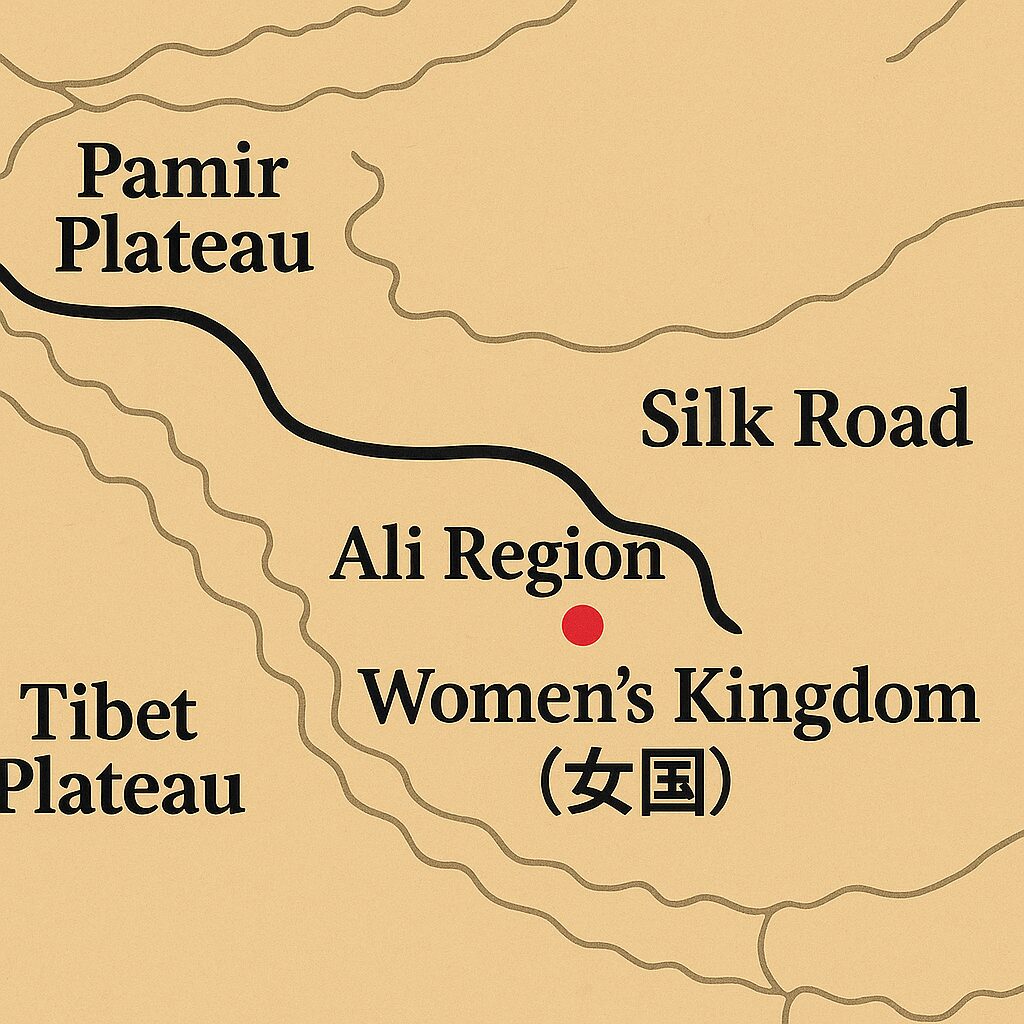
The timing and location of her burial seem to fit the region and era described in Chinese chronicles of a Women’s Kingdom. The earliest clear written reference to a “Women’s Kingdom” appears in the mid-5th century, when it was listed among exotic goods exchanged in diplomatic contacts.
The chronicles speak of salt-rich valleys where caravans wound their way across the mountains through the Women’s Kingdom. Perhaps a depiction of these salt traders, rock art on the plateau shows lines of figures stooped under heavy loads. The salt routes overlapped with Silk Road branches, encounters that would have brought silk, tea, and other goods into the highlands.
Foods from afar likely fed the M2 individual, based on analyses on chemical signatures embedded in her bones. A 2023 study of stable isotopes—atoms of the same element that differ in weight—revealed her bones harbored an unusually high ratio for carbon and low ratio for nitrogen. This combination points to a diet rich in plants like millet and sorghum—crops that do not thrive at high altitudes—and suggests her food likely arrived through long-distance trade. Compared with others buried nearby, her meals were more varied and higher quality, a testament to her elevated social status.