

On 1 January 2027, around 6.3 million employees gain protection against ordinary unfair dismissal in a single day. That is the government’s own count of people with between six months’ and two years’ service, 22% of everyone employed aged 16 and over, according to the Department for Business and Trade’s unfair dismissal factsheet. Anyone who already has six months in the job is covered from 1 January, and everyone else qualifies as they reach it.
Most coverage of January reads like a calendar. This piece is a forecast, and it takes a position: January brings a decision problem, not a claims wave. The protected group changes overnight, while the claims that follow arrive slowly, into a tribunal system already holding a record 70,000 single claims.
What follows is sorted into three kinds of statement: what is confirmed, what the evidence points to, and what nobody knows yet. Where the piece draws a conclusion of its own, it says so.
Explore: ERA Timeline 2026-2027, for the full list of dates.
What’s Confirmed for 1 January 2027
The commencement regulations bring the unfair dismissal package into force on 1 January 2027, and the government’s factsheet says it does not intend to consult further on it. These changes are confirmed for the date:
The existing day-one protections against discrimination and automatically unfair dismissal are unchanged.
Three things people often expect in January are not in it. The tribunal time limit already doubled to six months on 1 October 2026, the harassment duty has its own date, 30 October, and Acas says the government hasn’t announced when in 2027 the zero-hours changes land.
Explore: The Unfair Dismissal Cap: Removed 2027, for the financial exposure behind the removal.
Day One: Who Is Protected Overnight
The change has no phase-in. The government’s factsheet says its commencement approach extends protection immediately to everyone who already has six months’ service, so the whole 6.3 million are covered on the first day.
Probation is where this meets practice. The same factsheet, citing ONS data, says around 40% of businesses run discretionary probation periods, and the vast majority are six months or less. For those employers, probation and the qualifying period now end at around the same time, so a decision at the end of probation becomes a decision about someone with unfair dismissal rights.
That is our reading of the numbers. The government presents the six-month period as leaving employers able to judge a new recruit’s fit in their first months.
One rule catches employers out. Statutory notice counts as service when working out whether a dismissal falls inside the qualifying period, even if the notice isn’t actually given, and for employees with between one month and two years’ service it is one week. Dismissing someone a few days short of six months doesn’t avoid protection if adding that week takes the effective date past the line.
The edge of the date needs the same care. The commencement regulations apply the new rules where someone is dismissed before 1 January but their effective date of termination falls on or after it. BCLP gives an example: an employee dismissed on 28 December 2026 would have their termination date extended by the notice week to 4 January 2027, moving them onto the six-month requirement.
BCLP also says it is not yet clear whether the old cap still applies to people carried over this way, and that estimates of the latest safe date range from 18 December to Christmas Eve.
The government expects the cost to show up in process, not only in claims. Its Economic Analysis says dismissing staff with six to 24 months’ tenure could mean more resource-intensive dismissal processes, and leaves that cost out of its estimate.
Where the change is likely to show up first, on our reading of the rules above:
- Live performance or conduct processes for staff with six to 24 months’ service that are still open on 1 January
- Probation reviews falling at or just after the six-month point
- Fixed-term contracts reaching expiry after 1 January for anyone with six months’ service
Explore: Employment Rights Act 2025: What It Means for Line Managers, for how probation decisions work under the new timeline.
What the Evidence Points To: A Quiet Start, Then Not
This section is our reading of the evidence, not a sourced fact, so each step shows what it rests on.
The government’s own forecast is modest. People Management and VWV both report that the government’s Economic Analysis expects the qualifying period change to bring:
- around 9,000 extra early conciliation referrals a year
- about 3,000 of those becoming tribunal claims
- about 570 needing judicial time
Two caveats apply. VWV notes that the government cannot reliably quantify the effect of removing the cap, so the forecast covers the qualifying period change only. And Trowers & Hamlins disagrees with the government’s view that the cap’s removal is “likely to be limited in the aggregate”, saying the analysis underestimates the real impact.
For the Act as a whole, the Economic Analysis estimates the Acas and tribunal caseload could rise by around 17%, partly offset by the Fair Work Agency.
The system is already under strain, and the trend predates January. The Ministry of Justice’s latest figures show:
- 14,000 single claims received in April to June 2026, up 28% on a year earlier
- 6,100 disposed of, down 6%
- A record 70,000 open single claims, up 51%, though the MoJ says that may be overstated by about 3%
By our arithmetic, that is about 3,000 more claims in one quarter than a year before, the same number the government expects the qualifying period to add across a whole year. January’s effect will be hard to separate from a trend that is already rising.
The timeline is long.
- Early conciliation can last up to 12 weeks for notifications since 1 December 2025, under regulations laid in November 2025. The Department for Business and Trade’s explanatory memorandum says it will review that period in October 2026, and no outcome had been published by mid-October 2026
- Combined with the six-month time limit, Farrer & Co notes the overall window to bring a claim could stretch to nine or ten months, and Clyde & Co says employers could be unaware of a potential claim for nine months or more
- Once filed, the average time from claim to disposal was 59.6 weeks in April, as HR Review reports from a ministerial answer and Legal Futures reports from ARAG’s analysis of HMCTS data
- More capacity is coming, but later: HR Review reports 34 more salaried judges this autumn and 55 more from summer 2027
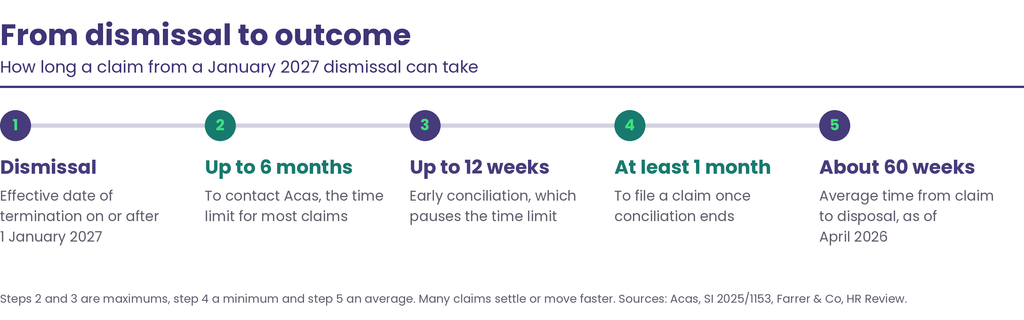
Our reading: claims from January dismissals can start to be filed almost at once, but hearings and rulings under the new rules are unlikely before late 2027 and more likely in 2028. In the meantime, the decisions that determine exposure, whether to dismiss, how, and whether to settle, are made in January by HR teams and line managers.
What Employers Are Already Doing: A Mixed Picture
Employers’ behaviour ahead of January isn’t one story, and the evidence has shifted since the early-2026 headlines.
The cautious signal came first. In CIPD’s winter survey, 37% of employers said they planned to hire fewer permanent staff because of the Act’s reforms, and among them the net employment balance fell to -5. CIPD warned this could push employers toward temporary workers and self-employed contractors.
The latest readings are flatter, not worse.
- CIPD’s summer outlook puts the net employment balance at +9, still near a record low, in what it describes as a “low hire, low fire” environment, with only 62% of employers planning to recruit
- Among employers that used zero- or low-hours workers in the past year, the same report finds 45% expect the zero-hours reforms to be difficult to implement, two-thirds expect more HR and management time and cost, and about a third plan to use more self-employed or atypical workers and make more redundancies as a result
- The KPMG and REC report, a survey of about 400 recruitment consultancies, found permanent placements rising for a second month, at the strongest pace in four years though only marginally, while temp billings grew at their slowest rate in five months
Demand is uneven by sector. Retail has the lowest net employment balance of any industry in CIPD’s summer survey, at -12, and the KPMG and REC report shows the sharpest falls in vacancies in Retail and Hotel & Catering, while demand for permanent staff rose most in IT and engineering. Neither ties these sector figures to the Act. CIPD says the Act is playing a part in weak employer confidence, but that its effect is very hard to separate from other cost pressures.
Our reading: employers aren’t freezing hiring, but they are hiring selectively, and some of the weakest demand sits in hospitality, which is also where 28% of employers expect the Act to raise costs to a large extent. No source connects the two, so treat the pattern as a prompt to look, not a finding.
Fixed-term contracts are no way around January either, since non-renewal counts as a dismissal once someone has six months’ service.
Explore: Recruitment & Employment Strategy Under the New Act, for the full hiring-chill data.
What We Still Don’t Know
A forecast that ignores what hasn’t been decided would be overconfident, and a good deal of 2027 is still open.
Dates not yet announced. Acas says the government hasn’t said when in 2027 most of the remaining changes will happen, from the zero-hours rights to mandatory gender pay gap and menopause action plans for employers with 250 or more workers. The ERA Timeline lists them.
Details still being decided.
Effects nobody has measured.
- The cost of removing the compensation cap, which the government cannot reliably quantify
- How many of the roughly 3,000 forecast tribunal claims will actually arrive, and how quickly, since that figure is an estimate, not a count
Explore: Guaranteed Hours & Cancelled Shift Pay: What We Know So Far and Fire and Rehire Reforms: What “Automatically Unfair” Really Means, for the detail on both.
What HR Teams Should Do Before 1 January
None of these steps has to wait for the date. The government’s own guidance suggests employers may want to seek independent advice when updating policies, and for individual cases that is worth doing.
Find the group
- Identify every employee with six to 24 months’ service, and any performance or conduct process involving them that could end in dismissal on or after 1 January. Dismissals with an effective date before then stay under the two-year rule
- Take advice before any dismissal in December. Trowers & Hamlins advises employers planning exits to make sure the effective date of termination falls before 1 January, but the statutory notice week can carry a late-December dismissal into January, and BCLP says the position on the old cap in those cases is unclear. A dismissal rushed to beat the date also still faces the day-one discrimination and automatically unfair claims, which the Act doesn’t change
Fix the process
Check the paperwork
- List fixed-term contracts that end after 1 January where the employee will have six months’ service, and plan a fair process for each non-renewal
- Be ready for written reasons requests from staff with six months’ service, since the right drops to six months
- Review variation clauses covering pay, hours, pensions and leave, since imposing a new one will itself be a restricted variation
- Watch for guidance on the union-rights duty, since Acas says the detail of how most of these changes work depends on government consultations
Keep the record
How Avado Can Help
If January is a decision problem, the decisions are made by the people closest to the employee: line managers running probation reviews, performance processes and fixed-term renewals. Avado’s HR Compliance for Managers course, presented by employment law specialist Amanda Chadwick, builds that judgement. It covers the Employment Rights Act 2025 changes as they land, including fair dismissal process and the documentation that holds up when a decision is questioned.
Explore HR Compliance for Managers and make sure every manager who will make these decisions is ready before 1 January!