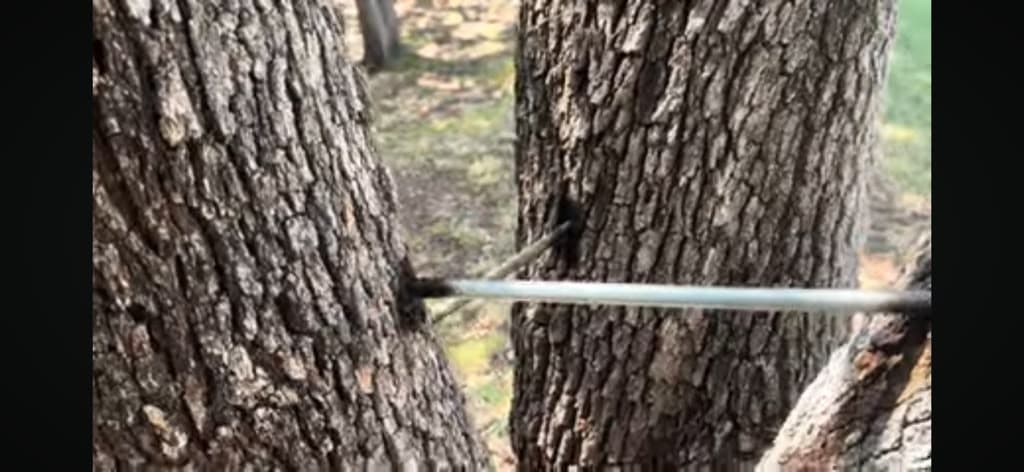
Today we’re here in Southlake, Texas, working with a very large mature Southern Live Oak (Quercus virginiana) that presented us with an important question:
Can this tree be preserved safely, or does it need to be removed?
During our evaluation, we identified a significant structural fracture associated with a major union near the lower trunk and root-flare area. Because of the size of this Live Oak, the amount of canopy supported above the defect, and the proximity of the tree to people and the homestead, this was not something we could simply ignore.
But removal is not always the only answer.
After evaluating the tree’s overall condition, architecture, remaining structural integrity, and potential targets, we determined that this Southern Live Oak was a candidate for preservation using a professionally designed supplemental support system involving structural cabling and bracing.
The objective is not to make the tree “failure-proof.”
No cable, brace rod, pruning treatment, or other arboricultural procedure can guarantee that a tree or branch will never fail.
Our objective is risk mitigation.
By reducing movement between compromised stems, limiting excessive separation at a weak union, redistributing mechanical forces, and combining supplemental support with appropriate structural pruning, we can sometimes retain a valuable mature tree that might otherwise have been removed.
For this Southlake property, that means preserving a tremendous Southern Live Oak while taking reasonable measures to improve safety around the home and pedestrian areas.
⸻
What Is Structural Cabling and Bracing?
Tree cabling and bracing are two related but different methods of supplemental structural support.
Cabling generally uses flexible or engineered support components installed between stems or major scaffold limbs to limit excessive movement and reduce the forces acting on a weak attachment.
Bracing typically uses rigid rods installed through stems or unions where limiting separation or movement requires more direct mechanical reinforcement.
Depending upon the defect, these systems may be used independently or together.
The important word is supplemental.
The hardware assists the tree’s existing structure.
It does not replace it.
A severely decayed tree cannot simply be turned into a safe tree by installing more steel.
Before installing a support system, we first have to determine whether enough sound structural tissue remains for supplemental support to be a reasonable mitigation strategy.
⸻
Why This Southern Live Oak Needed Additional Support
The major concern with this Southlake Live Oak is the significant fracture developing at a major union near the lower portion of the tree.
A union is where stems or major branches connect.
Ideally, those attachments develop strong wood architecture capable of distributing loads throughout the tree.
But trees don’t always grow with perfect structural geometry.
Some develop:
- Codominant stems
- Narrow unions
- Included bark
- Cracks
- Excessive end weight
- Uneven canopy loading
- Previous storm damage
- Structural defects near major attachments
As the tree matures, those defects may become increasingly important.
A union that supported a young tree successfully may experience dramatically different forces once those stems become 15, 20, or 30 inches in diameter and carry thousands of pounds of canopy.
⸻
Understanding the Physics of a Large Tree
A mature Southern Live Oak is an enormous biological structure.
The trunk supports large scaffold limbs.
Those scaffold limbs support secondary branches.
Those branches support foliage.
Every component contributes weight.
But weight alone is only part of the equation.
Leverage matters.
A large branch extending horizontally away from the trunk creates substantial mechanical leverage against its attachment.
As that branch becomes longer and heavier, the bending moment at the union increases.
Now add wind.
The canopy begins moving.
Leaves and branches intercept wind, creating dynamic loading.
The stems bend.
Unions move.
Wood fibers experience tension and compression.
Most healthy trees are remarkably well adapted to these forces.
The concern develops when those forces become concentrated around an existing structural defect.
⸻
What Happens When a Union Begins to Fracture?
Wood responds differently depending upon where forces are applied.
One side of a bending stem may experience compression while the opposite side experiences tension.
At a compromised union, repeated movement can gradually enlarge an existing crack.
This is particularly concerning with codominant stems or major scaffold attachments because both sides may be carrying tremendous independent canopy loads.
Every wind event can produce additional movement.
The crack may remain relatively stable for years.
Or it may progress.
That uncertainty is why structural defects need to be evaluated rather than simply watched from a distance.
⸻
How Structural Cabling Helps
A properly designed cable system connects selected stems or branches above a weak union.
The cable does not normally eliminate all movement.
Trees need some movement.
Mechanical movement is part of normal tree development.
Instead, the cable limits excessive relative movement between supported stems.
Imagine two large stems moving independently during a windstorm.
As they move apart, tremendous tension may develop at their shared union.
A properly positioned cable helps limit how far those stems can separate.
That reduces the magnitude of movement transferred into the compromised attachment.
⸻
Cabling Redistributes Mechanical Forces
This is one of the major benefits of structural cabling.
Rather than allowing the defective union to carry the entire mechanical load independently, the support system helps redistribute a portion of those forces through another part of the tree.
The system essentially creates another load path.
That does not eliminate the defect.
It helps manage it.
This distinction is extremely important.
We are not repairing the tree as though we were welding broken steel.
We are modifying how forces move through a living biological structure.
⸻
How Bracing Rods Work
Bracing rods perform a different function.
Where cables primarily provide support between stems higher in the canopy, brace rods can be installed through a compromised union or stems to reduce separation and provide more rigid reinforcement.
For certain cracks and weak unions, bracing can help hold the affected components together.
The rod passes through sound wood on either side of the defect and is secured using approved hardware.
The number, diameter, orientation, and placement of brace rods depend upon:
- Stem diameter
- Defect location
- Crack orientation
- Union architecture
- Amount of sound wood
- Expected loading
- Overall tree condition
This is why tree bracing should not be improvised.
⸻
ANSI A300 Standards and Supplemental Support Systems
Professional cabling and bracing should follow applicable ANSI A300 tree-care standards for supplemental support systems.
These standards provide a framework for evaluating the tree, establishing treatment objectives, selecting appropriate materials, determining installation locations, and maintaining the system after installation.
The objective is not simply:
“Put a cable in the tree.”
The objective is identifying a specific structural problem and designing a system intended to mitigate that particular problem.
Before installation, we need to understand:
- What defect are we supporting?
- What tree part could fail?
- Where is the load concentrated?
- Which stems need support?
- What type of system is appropriate?
- Where should the components be positioned?
- Is there enough sound wood?
- What targets are beneath the tree?
- What inspection schedule will be required afterward?
Hardware should never substitute for diagnosis.
⸻
Cabling and Bracing Can Help Preserve Valuable Trees
One of the greatest benefits of supplemental support systems is preservation.
This Southern Live Oak is not simply another landscape plant.
A mature Live Oak can represent decades of growth.
It provides:
- Shade
- Property character
- Wildlife habitat
- Cooling benefits
- Stormwater interception
- Carbon storage
- Landscape value
- Family history
Removing a mature tree eliminates those benefits immediately.
Replacement trees may require decades to approach the size and function of the original specimen.
When a structurally compromised tree can reasonably be preserved through pruning, cabling, bracing, monitoring, and Plant Healthcare, preservation deserves serious consideration.
⸻
Safety Around the Homestead Is the Priority
Preservation does not mean ignoring risk.
The tree is located around a residential environment where people, structures, vehicles, and pedestrian areas may occupy the potential failure zone.
Those are targets.
A structural defect becomes more important when valuable or frequently occupied targets exist beneath it.
A compromised branch over an unoccupied field presents a very different management situation than the same branch extending toward a house.
Our responsibility is balancing preservation with reasonable risk mitigation.
That is why structural support systems can be so valuable.
They allow us another management option between:
Do nothing
and
Remove the entire tree.
⸻
Structural Pruning and Cabling Work Together
Cabling should not automatically be viewed as a stand-alone treatment.
Often one of the most effective ways to reduce forces acting on a compromised union is to reduce excessive leverage within the canopy.
This is where ANSI A300 structural pruning practices become extremely important.
Strategic reduction pruning can shorten selected branches and reduce end weight without destroying the natural architecture of the tree.
If we reduce the length of an excessively long limb, we reduce leverage.
Less leverage means less mechanical force acting against the attachment.
Combine that with properly positioned supplemental support and we now have two mitigation strategies working together.
⸻
Reduction Is Different From Topping
Structural reduction does not mean indiscriminately cutting the canopy back.
And it absolutely does not mean topping the tree.
Proper reduction cuts shorten selected branches back to appropriate lateral branches while maintaining natural canopy architecture.
The objective is reducing mechanical loading while preserving enough foliage for photosynthesis.
Remember:
Leaves produce carbohydrates.
Carbohydrates support roots.
Roots support the canopy.
Aggressive canopy removal can therefore create a completely different physiological problem.
⸻
Why Lion-Tailing Should Be Avoided
Another pruning practice we want to avoid is lion-tailing.
Lion-tailing removes excessive interior foliage while leaving most of the canopy concentrated near branch ends.
Structurally, that can be counterproductive.
Instead of reducing end weight, we may actually leave more weight and wind loading farther away from the branch attachment.
That increases leverage.
For a tree already experiencing a compromised union, that is exactly what we do not want.
Proper structural pruning should improve load distribution—not make it worse.
⸻
Dynamic Versus Static Support Systems
Not every cable system behaves the same way.
Some systems are relatively static and are designed to significantly restrict movement.
Others are more dynamic and allow controlled movement while limiting excessive separation.
The appropriate system depends upon the defect and treatment objective.
A severely fractured union may require a different support strategy than a healthy but unusually long scaffold branch.
This is why the hardware should be selected after the defect has been evaluated.
The defect determines the treatment.
The hardware does not determine the diagnosis.
⸻
Cabling Does Not Heal the Crack
This is another important expectation to establish.
Installing a brace rod or cable does not magically fuse a fractured union back together.
Trees respond to injury through compartmentalization and production of new wood around affected areas.
Supplemental support may reduce movement enough to help prevent additional mechanical separation while the tree continues its biological response.
But the original defect remains part of the tree.
That is why continued inspection is mandatory.
⸻
The Importance of CODIT
Trees don’t heal wounds the way human skin heals.
They compartmentalize injury.
This process is commonly described through the CODIT model—Compartmentalization of Decay in Trees.
The tree establishes chemical and anatomical boundaries that help limit the spread of dysfunction and decay.
New wood may eventually develop around the damaged area.
However, the original fractured wood does not become new again.
From a structural perspective, we need to evaluate both the old defect and the new adaptive growth developing around it.
⸻
Supplemental Support Systems Require Inspection
Installing a cable is not the end of the job.
It is the beginning of a long-term management program.
Trees continue growing.
Stems increase in diameter.
Canopies change.
Hardware experiences weather.
Storms occur.
Pruning changes load distribution.
For those reasons, supplemental support systems require periodic professional inspection.
We want to evaluate:
- Cable condition
- Hardware condition
- Attachment points
- Brace rods
- New cracks
- Changes in union movement
- Canopy loading
- Deadwood
- Tree vigor
A supported tree becomes a managed tree.
⸻
Severe Weather Makes Monitoring Even More Important
Southlake regularly experiences strong thunderstorms, high winds, heavy rain, and occasional ice events.
After significant weather, a supported tree should be visually evaluated for changes.
Has the crack widened?
Has hardware shifted?
Did another branch fail?
Has canopy loading changed?
Did the root plate move?
A system designed around yesterday’s tree must continue to be appropriate for tomorrow’s tree.
⸻
Tree Risk Can Be Reduced, Not Eliminated
This may be the most important sentence in the entire discussion:
Tree risk can be mitigated, but it cannot be eliminated.
Every tree has some possibility of failure.
Healthy trees fail during extraordinary storms.
Supplemental support systems reduce specific identified risks.
They do not create guarantees.
The objective is making informed decisions based on:
- Tree condition
- Structural defects
- Targets
- Likelihood of failure
- Consequences
- Available mitigation options
That is responsible tree management.
⸻
Why Removal Wasn’t Our First Choice
With this Southern Live Oak, removal would have eliminated the structural defect.
But it also would have eliminated the entire tree.
Because sufficient viable structure remained and the defect could reasonably be mitigated, preservation became a realistic option.
We were able to develop a strategy involving structural support rather than immediately condemning the tree.
That is exactly why professional evaluation matters.
Not every cracked tree needs removal.
And not every cracked tree can safely be retained.
The answer depends on the individual tree.
⸻
The Financial Value of Preservation
Large mature trees are expensive to replace because, realistically, they cannot be replaced immediately.
You can plant another Live Oak.
You cannot purchase decades of mature canopy development overnight.
Preserving an appropriate candidate through structural support can therefore protect substantial landscape value.
It can also avoid:
- Removal costs
- Stump removal
- Replacement costs
- Loss of shade
- Landscape redesign
- Decades of regrowth
That does not mean cabling is always financially preferable.
It means preservation has value that should be considered when evaluating management options.
⸻
Environmental Benefits of Saving a Mature Live Oak
A mature Southern Live Oak provides ecosystem services every day.
Its canopy intercepts sunlight and reduces surface temperatures.
Leaves capture airborne particles.
Roots help stabilize soil.
The canopy intercepts rainfall.
The tree provides habitat.
Photosynthesis captures atmospheric carbon while producing carbohydrates that sustain the tree.
Preserving mature canopy where reasonably safe therefore has benefits far beyond appearance.
⸻
When Cabling and Bracing Are Not Appropriate
Supplemental support systems have limitations.
If the tree contains extensive basal decay, catastrophic root failure, severe trunk decay, insufficient sound wood, or multiple defects that cannot reasonably be mitigated, cabling may not be appropriate.
Hardware cannot compensate for a tree that has lost the structural foundation required to support itself.
Sometimes removal remains the responsible recommendation.
Knowing the difference is part of the evaluation process.
⸻
Annual Tree Evaluations Are Important
Large mature trees around homes and pedestrian areas should be evaluated regularly.
Structural conditions change.
A small crack can enlarge.
Decay can progress.
Included bark can become increasingly significant.
Deadwood can develop.
Canopy loading can change.
Annual evaluation gives us the opportunity to identify those changes before they become emergencies.
For trees with supplemental support systems, continued inspection becomes even more important.
⸻
Final Thoughts
This mature Southern Live Oak in Southlake, Texas demonstrates why structural cabling and bracing can be such valuable tools in modern tree preservation.
The tree developed a significant fracture at a major union near the lower trunk and root-flare area.
Removal was one option.
But it was not our only option.
After evaluating the tree’s overall condition and structural potential, we determined that supplemental support combined with appropriate structural management could provide a reasonable path toward preservation.
Structural cabling helps limit excessive movement.
Bracing helps reinforce compromised unions.
Reduction pruning can decrease leverage.
Continued monitoring allows us to identify changes over time.
Together, these practices can reduce specific structural risks while allowing valuable mature trees to remain part of the landscape.
At Arborist USA, our goal is never simply to keep every tree standing.
Our goal is to make informed decisions that balance tree preservation, structural integrity, property protection, and public safety.
Sometimes the safest recommendation is removal.
Sometimes the right structural support system gives us another option.
For this Southern Live Oak, that option allowed us to preserve a tremendous tree rather than losing it.
And that’s exactly what responsible tree preservation should accomplish.
For general tree-care best practices, homeowners can also reference guidance from the Texas A&M Forest Service, https://tfsweb.tamu.edu/trees/, a trusted authority on Texas tree health.
Schedule a professional inspection. Early detection and scientific intervention are the difference between preservation and loss. If you’d like to speak to an arborist, please call us at 817-880-6130 or visit https://www.arboristusa.com
Hello Community, this is Henry Friar with Arborist USA. Today we’re in Southlake, Texas, working with a massive mature Southern Live Oak (Quercus virginiana) that developed a significant structural fracture at one of its major unions near the lower trunk and root-flare area. The easy answer would have been to remove the tree. But after evaluating the remaining structure, canopy architecture, fracture, and surrounding targets, we determined that this Live Oak was a candidate for preservation using a professionally designed structural cabling and bracing support system. Tree cabling and bracing are supplemental support systems designed to help reduce excessive movement and redistribute mechanical forces within structurally compromised trees. Cabling helps limit excessive separation and movement between major stems. Bracing rods provide more rigid reinforcement through compromised unions where additional structural support is required.