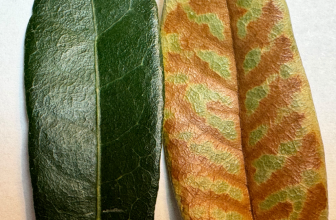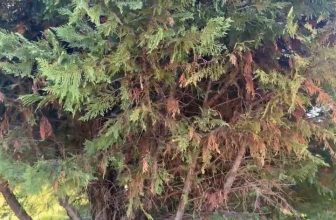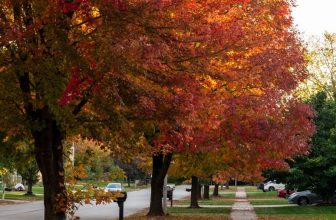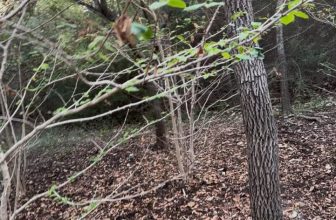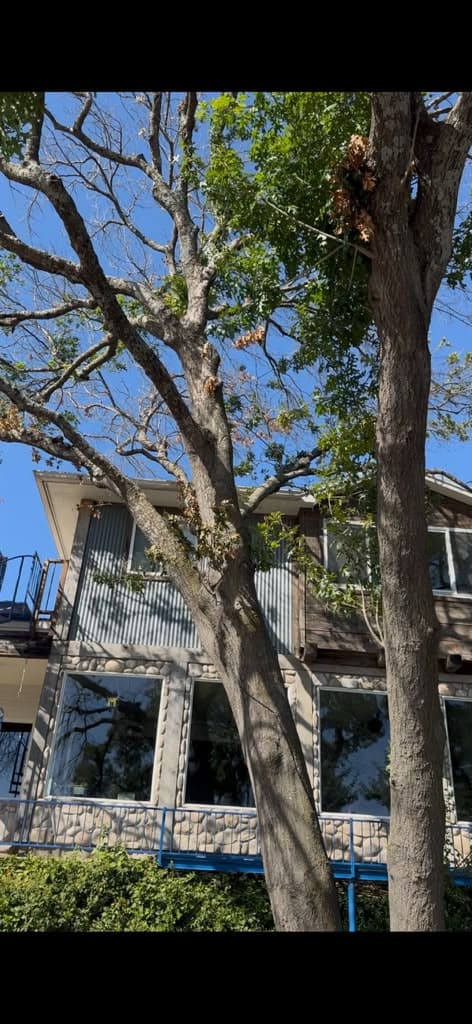
Today we’re here in Granbury, Texas, evaluating a very large mature Shumard Red Oak (Quercus shumardii) located along the lakeside. This is the type of tree I never take lightly when making a recommendation because mature trees like this can represent decades of growth, tremendous property value, shade, wildlife habitat, and memories for the family that owns them.
My preference is always preservation when preservation can be accomplished responsibly.
Unfortunately, there are situations where the structural defects, biological decline, potential targets, and consequences of failure begin stacking against the tree.
This is one of those situations.
During this Tree Risk Assessment, I identified several significant conditions occurring simultaneously:
- Extensive included bark within major stem unions
- One large dead stem
- Evidence of Hypoxylon canker
- Significant canopy and load-bearing weight
- Three large codominant stems sweeping predominantly toward one side
- An unbalanced canopy and structural loading
- Potential targets within the failure zone
When we evaluate these conditions together rather than individually, the concern becomes significantly greater.
Based on the conditions observed, I consider the likelihood of failure probable, the likelihood of impact medium to high, and the potential consequences of failure significant to severe.
For this particular tree, my recommendation is removal.
I don’t make that recommendation casually.
Sometimes the safest tree-management decision is recognizing when preservation is no longer the responsible option.
What Is a Tree Risk Assessment?
A Tree Risk Assessment is much more than looking at a tree and deciding whether it appears healthy.
A large mature tree is a biological structure.
We evaluate the condition of the roots, root flare, trunk, major stem unions, scaffold branches, canopy architecture, deadwood, decay indicators, environmental exposure, and—critically—the potential targets located within the tree’s failure zone.
Tree risk is not determined by one defect alone.
We are trying to understand several things:
What could fail?
How likely is that failure?
What could the tree or tree part strike?
What would the consequences be if that happened?
A structurally compromised tree standing in an isolated pasture presents a completely different risk profile than the same tree positioned near a house, roadway, vehicle, outdoor living area, or other frequently occupied location.
The tree may be biologically identical.
The risk is not.
Understanding TRAQ
When discussing professional Tree Risk Assessment, you may hear the term TRAQ.
TRAQ stands for Tree Risk Assessment Qualification.
It is a specialized framework used within professional arboriculture to evaluate tree risk systematically rather than making recommendations based solely on appearance or instinct.
The process considers the tree, its defects, environmental conditions, potential failure modes, targets, likelihood of impact, and potential consequences.
That systematic approach is extremely important because large trees contain enormous amounts of mass.
A major stem failure is not comparable to a small branch falling from an ornamental tree.
When a large mature Shumard Red Oak loses a major stem, thousands of pounds of woody material can become involved.
That is why risk assessment needs to be based on the entire situation.
One of the most important defects observed on this Shumard Red Oak is included bark.
Included Bark Is a Major Structural Concern
A strong branch or stem attachment develops overlapping wood fibers that create a mechanically sound union.
Included bark develops differently.
When two stems grow together at a narrow angle, bark can become trapped between them.
Instead of developing a strong wood-to-wood attachment, the expanding stems press against one another with bark remaining inside the union.
From the outside, these stems can look enormous and impressive.
Structurally, however, the union may represent one of the weakest locations in the entire tree.
Why Included Bark Becomes More Dangerous as Trees Mature
Included bark becomes increasingly concerning as stems become larger.
Every year the canopy expands.
Branches become longer.
Wood mass increases.
Foliage increases.
Wind loading increases.
The forces acting against the union continue increasing.
The problem becomes even greater when multiple large stems extend predominantly toward one side.
Now gravity and leverage are continuously working against already compromised unions.
This is one of the major concerns with the Granbury Shumard Red Oak.
H2: Three Large Stems Are Carrying Tremendous Weight
This tree contains three major stems that curve heavily toward one side.
That architecture creates significant load-bearing forces.
Think of holding a heavy object directly against your chest.
Now extend that same object several feet away from your body.
The object hasn’t become heavier, but the leverage against your body has dramatically increased.
Trees experience similar mechanical forces.
As large stems extend outward from the trunk, the weight of the branches, secondary limbs, foliage, and water contained within the canopy creates leverage against their attachment points.
During calm weather, the tree may continue standing without any obvious problem.
Add a severe Texas thunderstorm, high winds, saturated soil, or additional dynamic loading and those forces change dramatically.
This is why a tree can appear stable for years and then experience catastrophic failure during one weather event.
The Large Dead Stem Changes the Risk Profile
Another significant finding is the presence of a large dead stem.
Deadwood behaves differently from living wood.
Once vascular activity stops, the tree no longer actively maintains that tissue.
Over time, moisture characteristics change, decay organisms begin colonizing the wood, and mechanical strength can progressively decline.
A small dead twig may represent minimal concern.
A large dead stem on a mature Shumard Red Oak is completely different.
The larger the tree part, the greater the potential consequences if that component fails.
When that dead stem exists alongside included bark and heavily loaded living stems, we are no longer evaluating one isolated defect.
We are evaluating multiple defects interacting within the same tree.
Hypoxylon Canker Is Another Serious Warning Sign
We also observed evidence consistent with Hypoxylon canker, commonly associated with Biscogniauxia species.
Hypoxylon is especially important because it is generally considered an opportunistic or secondary pathogen.
It frequently becomes aggressive after a tree has already experienced substantial physiological stress.
The original stress may include:
- Drought
- Extreme heat
- Root damage
- Soil compaction
- Construction disturbance
- Oversaturation
- Vascular decline
- Significant canopy stress
By the time obvious Hypoxylon fruiting structures or fungal mats become visible, portions of the underlying wood may already be severely compromised.
This doesn’t mean Hypoxylon alone determines whether a tree must be removed.
It means we add that biological information to everything else we are seeing.
On this particular tree, Hypoxylon is occurring alongside major structural defects.
That combination raises my level of concern considerably.
Tree Risk Is About the Combination of Defects
This is one of the most important concepts homeowners should understand.
If this tree only had a small amount of deadwood, we might manage the deadwood.
If it only had minor canopy imbalance, reduction pruning might be considered.
If we only identified an early health problem, Plant Healthcare might be appropriate.
But that isn’t what we’re evaluating.
We’re looking at:
Included bark + major dead stem + Hypoxylon canker + three heavily loaded stems + significant directional weight + potential targets.
Those defects interact.
The risk assessment must therefore consider the entire tree.
Likelihood of Failure — Probable
Based on the defects and structural architecture observed during this assessment, I consider the likelihood of failure probable within the relevant assessment period and conditions.
That does not mean I can predict the exact day or hour the tree will fail.
Nobody can responsibly make that prediction.
Trees are dynamic biological structures influenced by wind, rainfall, soil moisture, decay progression, canopy loading, and future weather.
Risk assessment is about identifying conditions that make failure sufficiently likely that action should be considered.
For this tree, the accumulation of defects has moved beyond what I consider a reasonable preservation risk.
Likelihood of Impact — Medium to High
Failure alone does not determine overall risk.
We must also consider whether the failing tree or tree part is likely to strike something.
That is the target portion of Tree Risk Assessment.
Potential targets may include:
- People
- Houses
- Vehicles
- Roadways
- Boats
- Outdoor living spaces
- Neighboring property
- Utilities
- Other high-value assets
Because of this tree’s location and the areas within its potential failure zone, I consider the likelihood of impact medium to high.
That significantly changes the management decision.
Consequences of Failure — Significant to Severe
Now we consider what happens if failure and impact actually occur.
With a tree of this size, the consequences could be substantial.
A large stem failure can involve tremendous mass and force.
Potential consequences include major property damage, vehicle damage, structural damage, serious personal injury, or worse depending upon what occupies the impact zone at the moment of failure.
For this assessment, I consider the potential consequences significant to severe.
This is the point where preservation has to be weighed against responsible risk management.
Why I Am Recommending Removal
Anyone who knows my approach to tree care knows I do not like removing mature trees unnecessarily.
My job is preserving trees whenever preservation remains biologically and structurally reasonable.
But preservation cannot become more important than safety.
There comes a point where attempting to retain a severely compromised tree transfers an unreasonable amount of risk to the homeowner.
For this Shumard Red Oak, I believe we have reached that point.
The combination of included bark, a major dead stem, Hypoxylon canker, extreme directional loading, three large stems, and meaningful targets makes removal the more responsible recommendation.
Sometimes the safest bet is removing one compromised tree rather than gambling against the consequences of a catastrophic failure.
Why Aggressive Pruning Is Not Always the Solution
Homeowners sometimes ask whether we can simply remove enough weight to make a dangerous tree safe.
Sometimes reduction pruning can meaningfully reduce loading.
Sometimes it cannot.
Removing substantial portions of a severely compromised mature tree can create another set of problems.
Excessive canopy removal reduces photosynthetic capacity.
Large pruning wounds create additional physiological demands.
Structural defects within major unions remain.
Existing decay does not disappear.
Dead vascular tissue does not regenerate.
There is a point where pruning becomes an attempt to manage a structure that has already lost too much biological or mechanical integrity.
That is why each tree must be evaluated individually.
Lakeside Trees Experience Additional Environmental Forces
The lakeside location also deserves consideration.
Trees growing near open water may experience substantial wind exposure because there are fewer structures and trees available to interrupt wind movement across the lake.
During severe weather, wind can accelerate across open areas before reaching the canopy.
A large, heavily loaded tree with significant structural defects deserves additional attention in that environment.
Again, no single factor determines the recommendation.
We look at how all the factors interact.
Why Mature Trees Should Be Evaluated Every Year
One of the strongest recommendations I can make to homeowners with large mature trees is simple:
Have them evaluated regularly.
For high-value mature trees around occupied areas, I recommend an annual professional inspection, particularly following:
- Severe thunderstorms
- High-wind events
- Ice storms
- Lightning strikes
- Construction
- Significant drought
- Major pruning
- Sudden canopy decline
Trees change.
A branch union that appeared acceptable several years ago may begin developing cracks.
Decay can progress.
Deadwood can develop.
Root conditions can change.
Fungal fruiting structures can appear.
Annual evaluations allow us to identify these changes before they become emergencies.
What Homeowners Should Watch For
Between professional evaluations, homeowners should pay attention to visible changes in their trees.
Warning signs include:
- Newly developed cracks
- Large dead branches
- Hanging limbs
- Mushrooms around the trunk or root flare
- Bark separation
- Fungal mats
- Sudden canopy thinning
- New tree lean
- Soil lifting around roots
- Large cavities
- Splitting between codominant stems
- Major changes after storms
Seeing one of these symptoms does not automatically mean the tree is dangerous.
It means the tree deserves further evaluation.
Removal Can Be Part of Responsible Tree Care
Tree preservation and tree removal are not opposing philosophies.
Responsible arboriculture requires both.
We preserve trees that have reasonable long-term potential.
We manage defects when those defects can be mitigated.
And when a tree reaches a point where the risk can no longer be reasonably reduced, removal becomes part of responsible property management.
That is where we are with this Granbury Shumard Red Oak.
I would rather remove this tree under controlled conditions than see it fail unpredictably during a severe storm.
Final Thoughts
This large lakeside Shumard Red Oak in Granbury, Texas demonstrates exactly why Tree Risk Assessments are so important.
The tree contains several major defects simultaneously:
Included bark.
A large dead stem.
Hypoxylon canker.
Three heavily loaded stems sweeping predominantly toward one side.
Significant potential targets within the failure zone.
My assessment places the likelihood of failure at probable, the likelihood of impact at medium to high, and the potential consequences at significant to severe.
When those factors are combined, removal becomes the responsible recommendation.
At Arborist USA, saving trees will always be one of our primary goals.
But sometimes protecting the homeowner, the property, and the surrounding community means recognizing when a mature tree has reached the end of its safe service life.
Having large trees evaluated annually—especially trees located around homes, vehicles, roadways, lakeside recreational areas, and other occupied spaces—can identify developing problems before a storm makes the decision for you.
For general tree-care best practices, homeowners can also reference guidance from the Texas A&M Forest Service, https://tfsweb.tamu.edu/trees/, a trusted authority on Texas tree health.
Schedule a professional inspection. Early detection and scientific intervention are the difference between preservation and loss. If you’d like to speak to an arborist, please call us at 817-880-6130 or visit https://www.arboristusa.com
Today we’re here in Granbury, Texas, evaluating a very large mature Shumard Red Oak (Quercus shumardii) located along the lakeside. This is the type of tree I never take lightly when making a recommendation because mature trees like this can represent decades of growth, tremendous property value, shade, wildlife habitat, and memories for the family that owns them.