Brunei had been on our list for years. This tiny country on the island of Borneo had always made us curious, but we could never quite find the right opportunity to visit. When we decided to spend more than a month in Malaysia, adding a short trip from Kuala Lumpur finally seemed possible.
Brunei is one of the smallest countries in Southeast Asia and is often overlooked by travellers visiting this part of the world. We were curious to see its golden mosques, famous water village, and mangroves, but also to understand what everyday life is like in a country ruled by one of the world’s longest-reigning monarchs.
This trip was also a little different from the others I have written about, not because of the destination, but because of who I travelled with.
It was originally planned as a family trip, but a few rather ridiculous planning issues meant that we had to change our plans. Instead of cancelling and losing the money we had already spent on tickets, Emma and I decided to turn it into our first mother-and-daughter trip.
The boys were busy with activities in Kuala Lumpur during those first few weeks, while Emma and I were relatively free. Everyone was happy with the idea, so we booked the remaining flight and made a girls’ trip out of it.

Getting there was very easy. The flight from Kuala Lumpur took a little over two hours, followed by a short drive from the airport into Bandar Seri Begawan.
We did not arrive with a big plan. We looked up the main things to see and booked a tour that covered many of them (this is the link to the one we did). This made it easy to get around while also learning more about Brunei’s history and culture.
Still, we learned just as much by walking around, asking questions and looking things up as we went. The people we met were extremely friendly and genuinely excited to share their culture and country with us, you simply have to ask.
Before I tell you about everything we saw and share some practical tips for planning your own visit, let me introduce you to Brunei.
A Little History of Brunei
Brunei is a very small country now, but it was once the centre of a much larger and very powerful empire. During its most successful period, between the 15th and 17th centuries, the Sultanate controlled much of Borneo and had influence across the surrounding region. Over the years, wars, disagreements within the royal family and increasing European influence caused Brunei to lose much of its territory.
In 1888, it became a British protectorate. The Sultan remained the ruler, but Britain was responsible for things such as defence and foreign affairs.
Oil was discovered in 1929, and this completely changed Brunei. Oil and natural gas made it extremely wealthy and helped shape the country we see today.
Brunei became fully independent on 1 January 1984. Its complete name is Brunei Darussalam, which means “Brunei, the Abode of Peace.”

The current Sultan, Hassanal Bolkiah, became Sultan in 1967 after his father decided to step down and was officially crowned the following year. He was only 21 years old when he took the throne.
Something I found amazing is that he is now the longest-reigning living monarch in the world. He has held this position since the death of Queen Elizabeth II in 2022.
Another interesting fact I learned is that the Sultan does not only act as Brunei’s head of state. He is also the Prime Minister and holds several other important government positions, including Minister of Defence, Minister of Finance and Economy, and Minister of Foreign Affairs. He is much more involved in running the country than most kings or queens around the world.
We arrived in Brunei just after the Sultan’s 80th birthday, which had taken place on 15 July 2026. Even though his actual birthday had already passed, the country was definitely still celebrating. There were flags, banners, lights and huge portraits of the Sultan everywhere. The streets were still decorated, and it felt like the whole country had dressed up for the occasion.

The Sultan’s birthday is a very important national celebration in Brunei. It includes religious ceremonies, parades and events held in different parts of the country. Being there at this time made us realise how important the Sultan and the royal family are to Brunei’s identity and everyday life.
Next year, on 5 October 2027, the Sultan will celebrate 60 years on the throne. This is an incredible milestone, especially when you think about how much the country has changed during his reign. When he became Sultan, Brunei was still a British protectorate. He then led the country into independence and has been its ruler throughout its entire modern history. Can you imagine what celebrations there will be next year? It might be worth coming.
Omar Ali Saifuddien Mosque and the Eco-Corridor
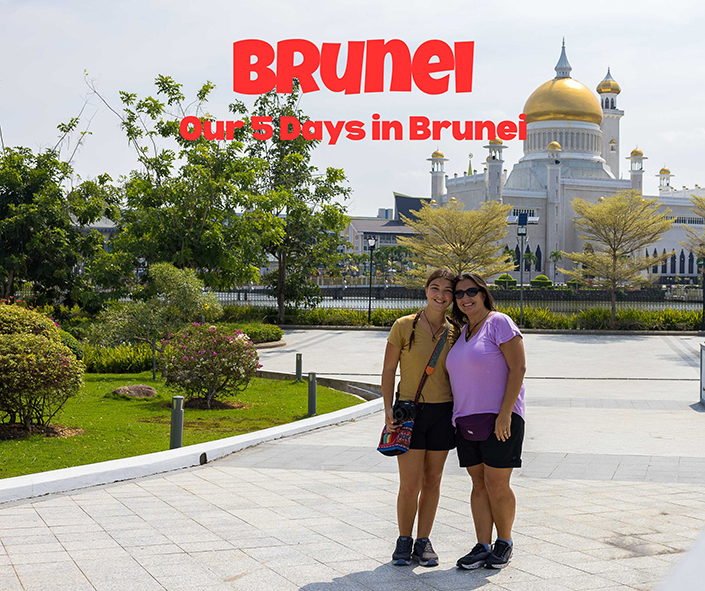
The day we arrived in Brunei, we went for a short walk around the city centre and came across our first breathtaking sight: the Omar Ali Saifuddien Mosque, probably the best-known landmark in the city.
The mosque was completed in 1958 and named after Brunei’s 28th Sultan. It stands beside a man-made lagoon in the centre of the capital, and its enormous golden dome can be seen from several parts of the city. It is especially beautiful when reflected in the water.
Did you know that the dome is actually covered in gold? The mosque is about 52 metres high and was built using materials brought in from different parts of the world, including Italian marble and stained glass. The combination of the white marble, the golden dome, and the lagoon makes it even more impressive in person.
In the water in front of the mosque it is a replica of a 16th-century royal barge. It was completed in 1967 and was originally used for Quran-reading competitions and special religious events. Our guide told us that it can still be used for important occasions today.

We also learned that people living in Kampong Ayer, the water village, once came directly to the mosque by boat. The mosque was deliberately built close to the river so it would be easily accessible to them. In more recent years, the area around it has changed considerably. Parts of the old riverside neighbourhood were cleared or filled in as the waterfront was redeveloped and the Eco-Corridor was created.
The Eco-Corridor is now officially called Taman Mahkota Jubli Emas, which means Golden Jubilee Crown Park. It opened in 2017 to celebrate the Sultan’s 50th year on the throne. The project originally began partly as a way of reducing flooding around the Kedayan River, but the area was then transformed into a large public park. The park connects the centre of Bandar Seri Begawan with the Brunei River. It has wide paths, lawns and plenty of open space, making it a popular place for walking, jogging and spending time outdoors.

One thing that immediately caught our attention was the huge picture frame standing in the park. Known as the BIBD Frame, it is 9.3 metres high and was added in 2019. It was inspired by the much larger Dubai Frame and was specially positioned so that the Omar Ali Saifuddien Mosque appears perfectly inside it. Depending on which side you look through, you can also see towards Kampong Ayer and the river. It is basically a giant photo opportunity, but it is a clever one because it makes the mosque look like a picture inside an actual frame. Of course, we had to stop there and take a few photos of our own!

We walked around this area in the morning and there was absolutely no one there. It felt completely deserted. When we came back in the evening, however, it was like being in a completely different place. There were hundreds of people running, walking, working out, chatting and sitting together on the grass.
The air was much cooler at night, so everyone was outside enjoying it. What we loved most was seeing so many families spending time together and all the children running around, flying kites and playing with bubbles. It was such a simple but beautiful scene of everyday community life. The sunset over the mosque was stunning, but seeing the park full of people enjoying the evening together made it even more special for us.

Sunday Sports Day
Seeing the park so busy in the evening made even more sense when we learned how much people in Brunei enjoy using the city’s outdoor spaces. Every Sunday morning, from 6:00 until 10:00, the centre of Bandar Seri Begawan holds an event called Bandarku Ceria, which means something like “My Happy City.”
The programme started in 2016 as a government initiative to encourage people to exercise, live a healthier lifestyle, and spend more time outdoors. It also helps reduce traffic and pollution in the centre for a few hours. The Sultan has been a big supporter of the programme and has even joined the public for cycling events, together with other members of the royal family. His involvement helped make cycling much more popular in Brunei.

Several roads in the city centre are closed to traffic, giving everyone space to walk, run and cycle. Families come into town to exercise and spend time together, and there are often fitness classes, sports activities and different community events.
While we were there, a scavenger hunt was taking place. We kept seeing groups running around the city carrying bags that said “2026 Scavenger Hunt.” We think they had to find different places and take photos of themselves there, although we never completely worked out the rules. It was fun watching them run around trying to complete all the challenges.
There were also lots of stalls set up along the streets. Many of them seemed to be selling second-hand clothes and all sorts of used items, almost like a small flea market. Other stalls sold food, drinks and snacks.
We loved the idea of turning the centre of the capital into a car-free space for a few hours every Sunday. It was not only about doing sports. People were exercising, shopping, eating and spending the morning together. Once again, it gave us that same lovely feeling of community that we had noticed in the Eco-Corridor the evening before.

Kampong Ayer: The Water Village
As part of the tour we booked, we were taken across the Brunei River to visit Kampong Ayer, Brunei’s famous water village.
Kampong Ayer means “water village” in Malay, but it is not just one small village. It is a collection of different neighbourhoods built on stilts above the river and connected by wooden and concrete walkways. People have lived here for more than a thousand years, making it one of the oldest and largest water settlements in Southeast Asia.
Our first stop was the Kampong Ayer Cultural and Tourism Gallery. It opened in 2009 and was officially inaugurated by Crown Prince Al-Muhtadee Billah, the Sultan’s eldest son. The gallery was created to preserve the history of Kampong Ayer and explain how life in the village has changed over the years. Inside, there are old photographs, traditional objects, handicrafts and displays about the houses, customs and everyday lives of the people who lived here.

One of the things we learned was that Kampong Ayer was once the centre of life in Brunei. Long before roads were built, the river was the easiest way to travel, carry goods and trade with other communities. Much of the land around the river was covered in thick forest, swamp or mud, while travelling by boat was much faster and easier.
Building above the water also allowed people to live close to fishing areas and the trading routes that connected Brunei with the rest of the region.
It was not only fishermen and ordinary families who lived here. The royal family lived in Kampong Ayer too, and the Sultan’s palace was once built over the water. Government buildings, royal residences, shops and places of worship were all once part of this community, which was effectively the capital of Brunei.
As roads and new neighbourhoods were developed on the mainland, more people began moving away from the water village. The government also created housing programmes to help families relocate, especially after fires and concerns about overcrowding and sanitation. Even so, Kampong Ayer is still a living community and not something that has been preserved only for tourists.
We walked around part of the village and saw how much is still here. There are homes, shops, mosques, schools, a police station and even a fire station. There are also electricity, running water and internet connections. Boats work like cars and taxis here, taking residents between the different neighbourhoods and across the river to the city centre.

Something we did not know before our visit is that you do not need to book a tour to walk around Kampong Ayer. You can go to the waterfront in Bandar Seri Begawan, wave to one of the small water taxis and ask the driver to take you across. A short crossing normally costs around BND 1 per person, although it is always a good idea to agree on the price before getting into the boat.
You also need to tell the driver which jetty you want. The jetties are the small landing points where the boats collect and drop off passengers. Because Kampong Ayer is made up of several different villages, there are many jetties, and some villages use the same jetty numbers. This means that saying only “Jetty 2,” for example, may not be enough. It is better to give the driver both the name of the village and the jetty number.
If you want to visit the gallery, you can simply ask to be taken to the Kampong Ayer Cultural and Tourism Gallery jetty. Once you arrive, you can explore the connected parts of the village using the walkways. You should remember that these are people’s neighbourhoods and that you may be walking very close to their homes, so it is important to be respectful and ask before photographing anyone.
Another thing we had not considered was the tide. The river rises and falls with the sea, and at low tide the difference is very noticeable. Large areas of mud appear underneath the houses, and some of the smaller channels between the buildings become too shallow for the boats.

When the water is low, the drivers have to remain in the deeper channels so that the bottom of the boat and its propeller do not become stuck in the mud. This means they cannot always take you through every narrow channel or around every part of the village. We had imagined that the boat would be able to weave between all the houses, but the route really depends on the time of day and the level of the water.
The tide does not stop you from visiting, as the boats can still cross the main river and you can explore many areas on foot. However, if you want a longer boat trip through the smaller waterways, it is worth asking about the tide before you go.
Visiting Kampong Ayer helped us understand a completely different side of Brunei. From the city centre, it is easy to look across the river and think that it is simply a group of houses on the water. Once we crossed over and walked around, however, we realised that it is an entire community with its own history, services and way of life.

Wildlife in the Mangroves in Brunei
After visiting Kampong Ayer, our boat took us farther along the Brunei River and into the mangroves. It was surprising how quickly everything changed. One minute we were surrounded by houses, schools and boats, and just a few minutes later we were moving through thick green forest looking for wildlife.

The animals we most wanted to see were the proboscis monkeys. These unusual monkeys are found only on the island of Borneo and usually live close to rivers, mangroves and swamp forests. The males are easy to recognise because of their very large noses and round stomachs. They are also excellent swimmers and can even swim underwater to cross between different parts of the mangrove. (We traveled to Borneo a few years ago to see them, you can read more about it here Exploring Malaysian Borneo: Wildlife, Ecotourism, and Adventure.)

We were lucky enough to spot some of them moving through the trees. You really have to look carefully because their reddish-brown fur blends in surprisingly well with the branches. Some more familiar-looking monkeys also appeared. They were probably long-tailed macaques, which are also common around Brunei’s rivers and mangroves.
There were birds everywhere too. In one section of the mangrove, we saw a large number of them gathered and nesting together in the trees. Mangroves give birds a protected place to rest, feed and build their nests, and it was amazing to see so many sharing the same small area. As we continued along the river, we spotted even more birds flying above the water or sitting quietly on the branches.

We also saw a small crocodile. Crocodiles are fairly common in Brunei’s mangrove swamps, river mouths and estuaries. The species found here is the saltwater crocodile, although the name is a little confusing because it can live in both salt water and fresh water. It is the largest living reptile in the world, and fully grown males can reach more than five metres in length.
The one we saw was thankfully much smaller and was resting close to the edge of the water. Even young crocodiles are very well camouflaged, so we probably would not have noticed it without our guide pointing it out. Only its head and part of its body were visible, and it looked almost like a piece of wood or mud.
The boat drivers know the river and keep a safe distance, but it is important to remember that these are wild animals. Crocodiles are ambush predators and can remain almost completely hidden and still in the water while waiting for prey. Seeing one in its natural habitat was exciting, even if we were also quite happy to be safely inside the boat!
The trip through the mangroves was one of our favourite parts of the tour. We had come mainly hoping to see the proboscis monkeys, but we ended up seeing macaques, a crocodile and many more birds than we expected. It was incredible to find so much wildlife living only a short boat ride away from the centre of the capital.

The Royal Regalia Museum
Another place we visited was the Royal Regalia Museum, located right in the centre of Bandar Seri Begawan. The museum opened in 1992 to celebrate the Sultan’s Silver Jubilee, marking his first 25 years on the throne. It was later renamed the Royal Regalia Museum in 2017, when he celebrated his Golden Jubilee.
The museum is all about Brunei’s monarchy and the important ceremonies connected to the Sultan. Inside, there are royal clothes, shields, traditional weapons and other objects used during coronations and official events. There are also photographs and displays about the Sultan’s life, his coronation and Brunei’s independence, as well as gifts he has received from leaders and governments around the world. It was fun to look through them to see where each gift came from.
The most impressive object is the enormous golden royal chariot used to carry the Sultan through the streets during his Silver Jubilee celebrations in 1992. Around it are figures showing the large number of people needed to pull and accompany it during a royal procession. After seeing pictures of the Sultan’s birthday celebrations all around the city, it was interesting to see the actual objects used during these events.

Jame’ ‘Asr Hassanil Bolkiah Mosque
We also went to see the Jame’ ‘Asr Hassanil Bolkiah Mosque, the largest mosque in Brunei. It was built to commemorate the Silver Jubilee of the current Sultan’s reign and was completed in 1994.
The mosque has 29 golden domes, representing Hassanal Bolkiah’s position as Brunei’s 29th Sultan. The number 29 appears in other parts of its design too. The building is surrounded by fountains and beautifully maintained gardens, with colourful mosaics, marble details and geometric patterns covering the outside.
Unfortunately, we arrived too late to visit the inside because prayer time had already begun. Non-Muslim visitors are welcome at certain times, but the mosque closes to tourists during prayers. The visiting hours are quite limited, so this is definitely something worth checking before going.
We were disappointed not to see the interior, especially because it is known for its huge chandeliers, stained glass, marble and detailed decorations. Instead, we walked around the outside and explored the gardens. Even without going in, the mosque was incredibly impressive. The golden domes, fountains and mosaics gave us plenty to look at, although I would have loved to see what it looked like inside.

Istana Nurul Iman: The Sultan’s Palace
Our final stop was outside Istana Nurul Iman, the official residence of the Sultan of Brunei and the seat of the country’s government. The name means “Palace of the Light of Faith.”
The palace is not normally open to visitors, so we could only see it from outside and take a few photos near the entrance. From the road, you cannot really understand just how enormous it is because much of the building is hidden behind the gates, trees and landscaped grounds.

Istana Nurul Iman holds the Guinness World Record for the largest residential palace in the world. It covers around 200,000 square metres and contains an incredible 1788 rooms and 257 bathrooms. It also has a banquet hall that can hold 5,000 guests, a mosque, five swimming pools, a garage with space for 110 cars and air-conditioned stables for 200 polo ponies.
The palace was designed by Filipino architect Leandro V. Locsin and completed in 1984, the same year Brunei became fully independent. It is both the Sultan’s home and the place where many important government meetings, royal ceremonies and official events take place.
Although visitors cannot normally go inside, the palace traditionally opens to the public during Hari Raya Aidilfitri. For a few days, Bruneians and foreign visitors can enter the palace, receive food and meet members of the royal family. Apparently, the queues can be extremely long, but it must be quite an experience!
We were not visiting at the right time to go inside, but it was still interesting to stop outside and see the entrance to such a unique building. Knowing the incredible size of what was hidden behind the gates made it even more fascinating.

Gadong Night Market
One evening, we went to Gadong Night Market, also known as Pasar Pelbagai Barangan Gadong. It is one of the best places in Bandar Seri Begawan to try local food and is open every evening from around 4:00 until 11:00.
The market is inside a large covered building, with rows of stalls selling grilled meat, fish, rice dishes, noodles, fruit, cakes, drinks and many different snacks. The food is cooked right in front of you, so the market is full of smoke and all sorts of amazing smells. It can get quite hot inside, but walking around and deciding what to eat is part of the fun.

Our Dart driver gave us a few suggestions of things we should try, including a dessert called ABC. The name stands for air batu campur, which means “mixed ice.” It is made with shaved ice, coloured syrups and milk, but it can also contain things such as sweet corn, red beans, jelly, fruit and other toppings. Every version seems to be slightly different.
We walked around the market, chose a few different things and had a really yummy meal. The food was also incredibly affordable, we ate for about BND 12 for the two of us.

When it was time to go home, we booked another Dart and, by coincidence, the same driver came to pick us up. He immediately asked if we had tried the ABC dessert he had recommended. We told him that we had looked for it but had not managed to find it at the market.
Instead of simply driving us home, he stopped at a restaurant along the way, went inside and bought an ABC for us so that we could try it. He did not have to do that at all, but he really wanted us to experience something he considered part of Brunei.
It was such a small and unexpected act of kindness, but it stayed with us. The dessert was good, but what we remember most is that a stranger went out of his way to make sure we did not leave without trying it. These simple moments of human kindness are often what make a trip special.

Good to Know Before Visiting Brunei
How We Organised Our Trip
Brunei is a very easy side trip from Malaysia, especially if you are already staying in Kuala Lumpur. The flight takes a little over two hours, followed by a short drive from the airport into Bandar Seri Begawan.
Our trip came together in a slightly unusual way. At the airport in Italy, I was told that I needed proof of an onward journey before I could enter Malaysia. Since we had already been talking about visiting Brunei for years, I decided to book a flight there. The ticket was very cheap, and it seemed like the perfect opportunity to finally make the trip happen.
I did not book the return flight at the same time because we still needed to decide how many days we wanted to spend in Brunei. When I went back to book it a few weeks later, the price had increased considerably.
This left us with a choice: cancel the trip completely and lose the money we had already spent for the tickets, or change our original family plans. Since the boys were busy with activities in Kuala Lumpur and Emma and I were relatively free, we decided to go on our own. Everyone was happy with the idea, and our family trip unexpectedly became our first mother-and-daughter trip.
My first tip would therefore be to book both flights at the same time, or at least decide on the length of your stay before prices have a chance to increase!

Before going, we looked up the main things to see and booked an organised tour for one of our days. The tour took us to Kampong Ayer, the mangroves, the Royal Regalia Museum and the two main mosques. It was useful because it included lunch, transportation and gave us much more information about Brunei’s history and culture.
You do not need a tour for everything, though. The centre of Bandar Seri Begawan is quite small and easy to explore on foot. We walked between the Omar Ali Saifuddien Mosque, the Eco-Corridor, the waterfront and the Royal Regalia Museum without any problems. Booking one tour for the places that were harder to reach and exploring the rest independently worked very well for us.
Getting Around Brunei
For places farther away, we used Dart, Brunei’s local ride-hailing app. Grab does not operate in Brunei, so it is a good idea to download Dart before arriving. We found it easy to use, and it was also how we met the lovely driver who made sure we got to try ABC dessert.
Public transportation is quite limited, so Dart is probably the easiest option if you are not renting a car. You may sometimes need to wait a little longer for a driver than you would in a larger city, so do not leave everything until the last minute.
Water taxis are the main way of getting between central Bandar Seri Begawan and Kampong Ayer. You do not need a tour to visit the water village. Simply go to the waterfront and wave to one of the small boats. A short crossing normally costs around BND 1 per person, although you should confirm the price before getting in.
Tell the driver both the name of the village and the jetty number you want. Kampong Ayer is made up of several different neighbourhoods, and some of them use the same jetty numbers, so saying only the number may not be enough.
The tide is also something to consider. At low tide, some of the smaller channels become too shallow for boats. You can still cross the main river and explore the village on foot, but a boat may not be able to take you through every narrow waterway.

Local Food
Food in Brunei has many similarities with the food in Malaysia. Rice, noodles, chicken, fish, coconut milk and sambal appear in many dishes, and the food also has influences from Chinese, Indian and other Bornean communities.
One of the best-known everyday meals is nasi katok. It is a simple dish made with rice, fried chicken and sambal, but it is extremely popular because it is quick, filling and inexpensive. The word katok means “knock.” The name supposedly comes from a time when customers had to knock on a seller’s door to order it. Traditionally, one packet can cost as little as BND 1.
Brunei’s national dish is ambuyat. It is made from starch taken from inside the sago palm and mixed with hot water until it becomes thick, sticky and almost glue-like. It does not have much flavour on its own, so it is served with a sour or spicy dipping sauce called cacah, together with meat, fish and vegetables.
There is also a special way to eat it. You use a pair of joined bamboo sticks called candas to twist the ambuyat around the ends, dip it into the sauce and then swallow it without chewing. It is an interesting experience…

Other local foods to look for include kelupis, a glutinous rice snack wrapped in leaves; pulut panggang, grilled sticky rice that can contain a savoury filling; satay and other grilled meats; and the many different kinds of colourful cakes and sweets known as kuih.
And, of course, there is ABC, the dessert our Dart driver was determined for us to try. ABC stands for air batu campur, meaning “mixed ice.” It normally combines shaved ice, syrup and milk with ingredients such as jelly, sweet corn, red beans and fruit. Every version can be slightly different.
Gadong Night Market is one of the easiest places to see and try a variety of local food without spending very much. Remember to bring cash and, if possible, small notes.

Languages Spoken in Brunei
The official language of Brunei is Malay, or Bahasa Melayu. However, many local people speak Brunei Malay in their everyday lives. It has its own vocabulary and pronunciation, so it can sound quite different from the standard Malay used in official situations.
One thing we immediately noticed was that many signs were written twice. The same Malay words often appeared first in Jawi, an Arabic-based script, and then in Rumi, the Latin alphabet that we are familiar with. At first, we thought the upper writing was Arabic, but it was often actually Malay written using Jawi letters.
Jawi has an important place in Brunei’s Islamic and Malay identity, and you will see it on government buildings, shops, road signs and banners. English is often included too, especially in places visited by tourists.

English is widely spoken and understood, which makes travelling around the country quite easy. Many of the people working in hotels, restaurants and tourism speak English very well.
Brunei is also home to Chinese and Indian communities, so you may hear different Chinese and Indian languages. Several indigenous languages from Borneo are spoken too, including languages connected to the Dusun, Belait, Tutong, Murut and Iban communities.
We did not need to speak Malay to get around, but it is always nice to know a few words. Terima kasih means “thank you,” while selamat pagi means “good morning.”
Safety and Islamic Customs
One of the questions people may have about travelling to Brunei, especially on a girls’ trip, is whether it feels safe. During our visit, we felt very safe walking around Bandar Seri Begawan, including in the evening. The city was quiet, people were kind and helpful, and we never felt uncomfortable.
Brunei is generally considered a safe country with low levels of violent crime. Of course, this does not mean that nothing can happen. You should still keep an eye on your belongings, avoid isolated areas late at night and not leave valuables somewhere visible.
Brunei is an Islamic country, and its customs and laws are more conservative than those in many Western countries. As visitors, we found that being respectful was quite simple.

It is a good idea to dress modestly, especially when visiting religious buildings and government sites. You do not have to cover your hair while walking around the city, but clothing that covers your shoulders and knees is more appropriate in certain places.
When visiting a mosque, you must remove your shoes and remain quiet. Women are expected to cover their hair, arms and legs, but the mosques we visited provided us with robes and head coverings. We did not need to bring any special clothing with us.
Mosques close to tourists during prayer times, so check the visiting hours before you go. We arrived too late to see inside the Jame’ ‘Asr Hassanil Bolkiah Mosque because prayers had already begun.
Friday is especially important when planning your visit. Between 12:00 and 2:00 in the afternoon, businesses, offices, banks, restaurants, shops and tourist attractions close for Friday prayers. It really feels as though everything closes, so make sure you have eaten and are where you need to be before midday. Some attractions and mosques remain closed to visitors for the whole day on Friday.
Public displays of affection are uncommon and may cause offence, so it is better to be discreet. Visitors should also be respectful when speaking about Islam, the Sultan and the royal family, as religion and the monarchy are both very important parts of life in Brunei.
Alcohol is not sold in Brunei. Non-Muslim visitors are allowed to bring in a limited amount, but it must be declared when entering the country and can only be consumed in private.
If you visit during Ramadan, there are additional rules to remember. Eating, drinking and smoking in public during daylight fasting hours is against the law, including for visitors who are not Muslim. Restaurants may also operate differently during the day.

A Few Final Tips
- Carry cash and preferably some small notes. They are useful for water taxis, markets and food stalls.
- Download the Dart app before arriving, as Grab is not available in Brunei.
- Check mosque, museum and attraction opening times before planning your day, particularly on Fridays.
- If you are in Bandar Seri Begawan on a Sunday, visit Bandarku Ceria between 6:00 and 10:00 in the morning. Roads in the centre are closed to cars, and you will find sports, community activities and market stalls.
- Plan outdoor activities for the early morning or late afternoon. The middle of the day can be extremely hot and humid.
- Bring water, sunscreen and something to protect yourself from the sun. Even short walks can feel much longer in the heat.
- Ask about the tide if you are planning a boat trip through the smaller waterways of Kampong Ayer.
- Leave some time to walk around without a plan. We learned a lot simply by exploring, asking questions and seeing how people spent their time.
Brunei was quiet, welcoming and easy to visit. Booking one tour helped us see the places that were harder to reach, while leaving the rest of our time free allowed us to explore the city at our own pace.

My Travel Companion
One last thing I want to talk about is the person I shared this trip with. My lovely daughter Emma was my travel companion for Brunei.
We had been talking about visiting Brunei for a few years, ever since we watched a video online that made us extremely curious about the country. When the opportunity finally appeared, we did not want to miss it. As everything slowly fell into place, it became our first mother-and-daughter trip, and I am so happy that it did.
Did I feel guilty about leaving my husband and my other children behind? A little. We usually do this kind of thing together, and exploring as a family has been such an important part of our lives for years.
But sometimes it is okay to take a step back and do something separately. It does not mean that we love one another any less. Sometimes one child needs a little more one-on-one time, and that is okay too. We try to give each of our children the attention and care they need, but because of their ages, personalities and interests, that does not always look the same.

This time, it came in the form of a trip alone with Emma, while the boys were having a great time doing their own things with their dad.
Emma and I shared plenty of silly conversations, as well as some extremely deep ones. When we were not out exploring, we worked on our own things, watched some girly series and sat together in cafés, matcha for her and coffee and our books.
And yes, you can still enjoy your normal little routines while travelling somewhere new! Not every moment has to be spent rushing from one attraction to another. Sometimes sitting in a café together and doing something completely ordinary becomes one of the best parts of the trip.
I have to thank my husband for giving me these five days with Emma and for making sure the boys had the best time too. And I have to thank my lovely Emma for exploring this little part of the world with me.
It was such a special experience, and I feel blessed every day for the amazing family I have and the life we have built together.

Final Thoughts About Brunei
Brunei was not exactly the trip we had originally planned, but perhaps that is what made it so special.
We arrived knowing very little beyond the few things we had read and watched online. We left having experienced beautiful mosques, a community built on water, wildlife hidden in the mangroves, busy markets, quiet streets and so many small moments of kindness.
Brunei is not a place filled with endless attractions or a city where you need to rush from one thing to another. It is quiet, and that quietness is part of its charm. It gave us time to slow down, look around, ask questions and notice the way people live.

What I will remember most is not only the golden domes or the proboscis monkeys. I will remember the children playing with bubbles and kites in the park, the families spending their evenings together, the Dart driver who stopped to buy us ABC and all the conversations Emma and I shared along the way.
Our family trip may have unexpectedly turned into a girls’ trip, but I would not change it. Brunei gave Emma and me five days together that we will always remember and sometimes the trips that do not go according to plan become the most meaningful ones of all.
Continue the journey with:
If you are planning a trip to Asia, these unique destinations should definitely be on your radar:
I hope our experience helps you plan an unforgettable Asia adventure of your own!