Heads up: some links here are affiliate links. That means if you click and buy something, I may earn a teeny-weeny commission (think chai money, not a private jet) at no extra cost to you. It’s a small way to keep this blog running, the words flowing, and the pages free for you to enjoy. I only recommend things I truly love, use, or secretly wish I invented, because trust matters, and so do good recs. Thanks for supporting the little cozy corner of the internet I call my virtual home.
Unsure how to plan your trip to the Fergana Valley in Uzbekistan. This guide gives you the most straightforward route, the must-visit sites, and an easy-to-follow itinerary.
We’ve entered a phase of travel where culture sits right at the centre of our plans. It started when mini-me hit her teens and began choosing places where she could watch traditions unfold, see how people live, and understand the story behind a region, rather than simply ticking off popular stops.
Since then, our family trips have slowly shifted from the usual tourist circuits (the ones we still enjoy, because some icons earn their fame fair and square) to places where history is part of everyday life.
So when we started mapping Uzbekistan, we went straight into looking for spots where culture still breathes in its natural form. That’s how the Fergana Valley entered the chat. Pottery workshops, silk weaving, old palaces, everyday markets, and a long heritage of craft, all woven into this big green stretch in the east.
I’ll admit, the distance from Tashkent made me rethink it a few times. Long drive, long train, long day… everything long. But the moment we read more about the valley, the hesitation faded.
India has its own strong silk and pottery traditions, and we adore them, but seeing how other countries shape the same crafts offers a fresh perspective. It’s like looking at the same thread through a different set of hands.
The valley sits between mountain ranges and has been a major centre of life for thousands of years, from ancient Silk Road routes and the Kokand Khanate to old trade caravans and the birthplace of Babur.
Yes, the same Babur who shaped Indian history, the region carries a surprising amount of connection to us. You feel it more when you’re actually there, walking through craft homes, palaces, and bazaars.
We wouldn’t have planned it so smoothly without a bit of help, of course. Someone from a Facebook travel group for Uzbekistan stepped in at the right time and helped us figure out the best route, timing, places to stop, and how to make the long travel day feel manageable. The whole thing suddenly went from “looks tough” to “okay, this is totally doable.”
That’s the beauty of the Fergana Valley. It looks far on the map, but once you step in, it becomes one of the easiest and most meaningful parts of the trip. Culture, craft, history, and a slice of real Uzbek life, all in one region that wins you over.
Fergana Valley, Uzbekistan: Complete Travel Guide
Where is the Fergana Valley?
The Fergana Valley spreads across Uzbekistan, Kyrgyzstan, and Tajikistan, with each holding a portion of this rich, busy region.
Uzbekistan has the largest share, covering the provinces of Andijan, Fergana, and Namangan. Kyrgyzstan’s side includes slices of Jalal-Abad, Batken, and Osh, while Tajikistan’s piece lies within the Sughd region.
On the map, the Uzbek stretch sits in the far east of the country, resting between the Tien Shan mountains on one side and the Alay range on the other. This corner runs close to 300 kilometres and stays naturally green because two major rivers, the Naryn and the Kara Darya, meet near Namangan and eventually form the Syr Darya.
With this river system feeding it, the valley turned into one of the most fertile pockets of Central Asia. Cotton, fruits, grains, and vegetables all grow here with ease, and that steady flow of life gives the region its busy, lived-in character.
History that Shaped the Fergana Valley
The Fergana Valley has been busy for thousands of years. Long before borders and passports, this region was an active corridor where traders, farmers, and travelers moved freely. Its fertile land and central location made it a natural stop on early trade routes that later became part of the Silk Road.
The earliest records come from Greek and Chinese sources. After Alexander the Great reached Central Asia, his influence spread toward the western edge of the valley. At the same time, Chinese chronicles described lively towns here more than two thousand years ago, showing just how connected the valley already was.
Over time, different powers controlled the region, from local kingdoms to larger empires, including Bactrian and Parthian groups. The valley saw waves of settlers, merchants, and rulers, each adding their own layer to its identity. Because it produced food, cotton, and crafts, every empire wanted a piece of it.
By the eighteenth and nineteenth centuries, the Kokand Khanate rose in influence. Kokand became a political and cultural centre, building mosques, madrasas, and the grand palace that still stands today. This period shaped much of the valley’s character, with strong craft traditions and growing trade.
Then came the Russian Empire. In the late nineteenth century, Russia expanded into Central Asia and took control of the valley. Under Russian and later Soviet rule, everything changed: borders were redrawn, irrigation systems developed, and the valley became a huge cotton-producing zone. New towns, roads, and canals arrived, and the social map shifted.
When the Soviet Union dissolved in 1991, the valley was suddenly divided between three new countries. Communities that once lived across open land now found themselves separated by new checkpoints and stricter borders. This division created challenges: mixed populations, shared resources, and old villages now split, but the region adapted over time.
Today, the Fergana Valley remains one of the most populated, productive, and culturally rich corners of Central Asia. Its history explains why it feels layered — a mix of ancient trade, craft traditions, khanate stories, Russian influence, and modern-day life spread across three nations.
Present-Day Life and Realities of the Fergana Valley
Fergana Valley’s tangled past still echoes today, especially after the Soviet breakup left this shared region navigating new borders and old complexities.
The boundaries were never drawn neatly, and mixed populations meant that people often lived, farmed, and traded across invisible lines.
Add a dense population and a landscape that depends heavily on its rivers, and you get a region where water and land became sensitive issues whenever resources tightened.
There have been moments of tension in different corners of the valley, especially in areas with mixed ethnic groups or overlapping claims. Water has been at the centre of many disagreements. The valley survives on irrigation, and even a small change in access can affect farms, markets, and livelihoods. It’s a reminder that this is not just a cultural zone but an agricultural powerhouse that depends on balance.
The good news is that the last few years have brought steady improvement. Governments across Uzbekistan, Kyrgyzstan, and Tajikistan have been working on more transparent border agreements, more predictable water-sharing, and joint efforts to reduce friction along the borders. Many of the old flashpoints now see less tension, and cross-border communities continue to live, farm, and trade much as they always have.
Is the Fergana Valley Safe for Travelers
All this background naturally raises the question of safety, especially if you’re planning a trip.
From our experience, Uzbekistan felt very safe, and the Fergana Valley was no different. We explored places, wandered through bazaars, and walked around in the evenings, and never felt uneasy. I would be comfortable sending a sensible family traveler here, too, especially on the Uzbek side of the valley.
The bigger story is in the background. As discussed above, the wider Fergana region has experienced difficult times in the past. There were ethnic clashes in the late Soviet period, and later the 2010 violence in Osh and Jalal-Abad in southern Kyrgyzstan, which changed the lives of many families in that part of the valley.
More recently, the most serious trouble has happened along the Kyrgyzstan–Tajikistan border, not inside Uzbekistan. In April 2021, a dispute over a water facility near the Vorukh enclave led to armed clashes. In September 2022, fighting escalated again, with heavy weapons used on both sides and tens of thousands of people forced to leave their homes.
These flare-ups are rooted in old Soviet-era borders, mixed communities, and the simple fact that water and land are precious in a farming valley. Climate change and pressure on the Syr Darya river system add another layer, so water sharing can quickly become emotional and political.
The good news for regular travelers is that the Uzbek side of the valley, where you are likely to be based (Kokand, Fergana City, Margilan, Rishtan, Namangan, Andijan) has stayed calm for years.
International advisories usually say what we felt on the ground: Uzbekistan is generally safe, but take extra care in border areas and in the Fergana region, mainly as a precaution because of its history and its location next to Kyrgyzstan and Tajikistan.
There is also slow but real progress. Kyrgyzstan and Tajikistan signed a border demarcation agreement in March 2025 to settle almost all of their disputed frontier and reopen transport links, a big step toward easing tensions in the valley.
Alongside that, organisations such as Saferworld and UNESCO are running peacebuilding and youth projects in Fergana communities, focusing on water sharing, climate change, and cross-border trust.
A few sensible tips help keep things simple:
In short, if you stick to common travel sense, as you would anywhere, you’ll be fine here.
Just to be clear, this isn’t meant to scare you. It’s simply good travel practice. Knowing the whys, whats, and wheres of a place makes your trip smoother and safer. Think of it as traveling with your eyes open, not worried.
What to Wear in the Fergana Valley
I’ve always believed in the simple rule — when in Rome, do as the Romans do. In a place like the Fergana Valley, where culture, faith, and tradition still shape daily life, dressing a little thoughtfully goes a long way.
This part of Uzbekistan is more conservative than Tashkent, Samarkand, or Bukhara, so pack clothes that cover your shoulders and knees, for both men and women. Save your shorts, strappy tops, or liberal outfits for cities where they’re more common. Here, modest and comfortable just feels right, and it keeps you from standing out for the wrong reasons.
Women should keep a light scarf in the bag. You’ll need it for mosques and religious spaces, and it’s handy anyway for dust, sun, or chilly evenings.
Weather-wise, summers are hot, so breathable cottons and linens are your best friends. Spring and autumn can surprise you with cool mornings and evenings, so a light jacket helps. Winters get cold, especially near the mountains, so layer well.
Shoes matter more than clothes here. You’ll walk through courtyards, bazaars, pottery workshops, and streets that aren’t always even, so, closed, comfortable footwear saves the day.
Think simple. Think modest. Think practical. The goal is to blend in, respect the local culture, and enjoy your time without worrying about what you’re wearing. It reflects well on you, and honestly, it reflects well on your country too.
How Much Time Should You Spend in the Fergana Valley
If you want a relaxed trip where you actually enjoy the crafts, towns, and conversations rather than rushing from one workshop to another, set aside at least two full days in the Fergana Valley.
One day works only if you’re doing a quick pottery-and-silk run and heading straight back to Tashkent. It’s doable, but it feels like you’re constantly checking the time.
Two days is the sweet spot. You can visit Margilan’s silk workshops, Rishtan’s pottery homes, Kokand’s palace, and still have small pockets of breathing room for bazaars, chai breaks, and slow walks.
We also kept it to two days, and our local guide planned the route so well that we covered Kokand, Rishtan, Margilan, and Namangan at a relaxed pace. For Andijan, you need to add an extra day.
Three days give you space to talk to artisans, try a masterclass, explore smaller towns, and enjoy the valley without a stopwatch running in your head.
In short, ask yourself how deep you want to go. If you enjoy culture and craft-driven travel, the valley opens up beautifully once you give it time.
Best Time to Visit Fergana Valley
Spring and autumn are hands-down the nicest seasons to be in the Fergana Valley.
If you visit in spring, the whole region feels fresh, flowers blooming, orchards waking up, and the weather sitting in that sweet spot where you can walk around all day without melting or freezing.
Autumn has its own charm. This is the season when the valley’s famous fruits show off. Pomegranates, melons, persimmons, grapes, peaches, apples: everything tastes sweeter, fresher, and somehow bigger. The farms look busy, the bazaars smell amazing, and the days stay pleasantly warm.
Summer gets hot. Not impossible, but you’ll feel the heat when you’re hopping between workshops, palaces, or bazaars.
Winter is calm and quiet, but keep in mind that the roads through the Kamchik Pass can get tricky during snow or heavy weather. Trains still run, but driving may slow down or get delayed.
If your goal is comfort, colour, and easy movement, plan your trip for March to May (spring) or September to early November (autumn). Those months give you the valley at its happiest.
How to Reach the Fergana Valley?
Getting to the Fergana Valley looks tiring on the map, but the journey turns out smoother than expected once you know the options.
From Tashkent
Most travelers enter from Tashkent, and from there, you can pick the route that fits your day.
By Train: The rail route through the Kamchik area is the easiest and most comfortable. Several trains run daily between Tashkent and Andijan, stopping at Margilan and Namangan. Margilan is usually the best stop for Fergana City.
Ozbekiston Train, a modern high-speed service, runs twice a day between Tashkent and Andijan and is the fastest. Slower night trains also run the route and have sleeper berths if you prefer to rest along the way.
The ride takes about 4 to 7 hours. Trains are comfortable and reliable, with first and second-class options.
You can book tickets online through the Uzbek Railways website or Android or iOS app. They usually open about two months in advance and fill up fast, so early booking saves a lot of stress.
By Road: If you prefer driving, shared taxis and private cars take the same path through the Kamchik Pass. It’s a long ride (about 5 to 6 hours) but scenic, and drivers familiar with the route keep the journey simple.
We went with a private car, and honestly, it turned out to be one of the best calls on this trip. The local driver who guided us through the valley had a roomy SUV, steady hands on the wheel, and a no-nonsense driving style. He got us from Tashkent to Fergana City in about five hours, and the entire ride felt effortless.
The usual cost for a private taxi from Tashkent to Fergana City sits around 65 to 70 USD one way. It’s fair if you’re traveling as a family and want comfort, flexibility, and fewer breaks in between.
What many travelers don’t realise is that the Fergana Valley isn’t a compact region. The cities are spaced out, taxis don’t come instantly, and switching between shared cars, buses, and g-cabs multiple times a day can eat up both time and patience. If you’re short on time or simply want a smooth experience, booking a planned trip, like we did, makes the whole thing easier.
Our tour covered the full journey from Tashkent, the entire Fergana Valley circuit, transport between cities, and the stay. We paid 108 USD per person, and it took away every bit of planning stress.
Everything was organised, timings stayed tight, and we could focus on the pottery, silk, and history instead of juggling transport. If you’re someone who likes efficiency and comfort, this option is worth every bit.
By Air: If you want to skip the long road or train ride and reach the valley fast, flying is a great option. Uzbekistan Airways and Silk Avia both run regular domestic flights from Tashkent International Airport (TAS) to Fergana Airport (FEG) and nearby cities of Namangan (NMA) and Kokand (OQN) in the valley.
The flights are short, quick, and often land you in Fergana in around an hour. You can book via official websites of Uzbekistan Airways or Silk Avia, however, booking can get tricky for international travelers. We learnt this the hard way.
Our Visa and MasterCard simply refused to go through on the Uzbekistan Airways website. The site only seemed to accept local Uzbek cards, and the payment kept failing without explanation. We emailed the airline for help, and an agent did reach out, but meanwhile we ended up booking our outgoing tickets through Skyscanner.
Yes, I did feel a little silly afterward. I tell my readers all the time, to check Skyscanner first for cheaper fares, always, and in all the rush (and the leftover stress from our last-minute Georgia-to-Uzbekistan trip switch), I completely forgot to follow my own golden rule. Classic me.
Later, in Khiva, we were trying to book our paid seats so the three of us could sit together. Simple thing, right? But the Uzbekistan Airways site again refused to accept our international card. Same error. Same frustration. At this point, even the laptop looked exhausted.
Our hotel manager walked over, clicked one tiny hidden tab meant for international cards, a tab we had clearly stared at a hundred times without seeing, and payment approved in seconds. We just stood there feeling mildly ridiculous. How many facepalm moments can one trip planning session have?
So yes, the site does accept international cards. But the option is tucked away in a corner that most travelers never notice, especially when they’re already frazzled from a last-minute itinerary change.
Take it from me, sometimes, even seasoned travelers miss the obvious. But hey, it makes a good story later.
From what many travelers report online, this is common. If your card doesn’t work, try a different card, use an aggregator, or get a local to help you choose the right payment option.
This option works best for people short on time or those eager to arrive in the valley fresh and ready to explore, without the long drive or complicated transfers.
From Osh in Kyrgyzstan
If you’re coming from Kyrgyzstan, the easiest entry is through the Dostuk (Dostyk) border near Osh. It sits just outside the city, and once you cross, shared taxis and private cars wait on the Uzbek side. From there, Andijan is about an hour away and Fergana City takes roughly two.
From Khujand in Tajikistan
If you’re coming from Tajikistan, you can enter through the Konibodom–Beshariq international crossing. It connects Khujand on the Tajik side with Kokand on the Uzbek side. The onward ride into Kokand takes about an hour, and from there you can continue deeper into the valley.
How to Get Around Fergana Valley?
Getting around the valley becomes much easier when you have your own car and driver. For most travelers, especially families, hiring a private car for a day or two is the most comfortable way to explore.
It gives you freedom to plan your stops, change your timing, carry your luggage without stress, and move between cities without waiting around. If you’re doing the valley as a day trip from Tashkent or staying just one night, a private car also solves the biggest headache of all, where to keep your bags while you explore.
With a driver, you simply move from Kokand to Margilan to Rishtan to Fergana City at your own pace. No hopping between stations, no dealing with multiple taxis, and no worrying about delays. It saves time, cuts the hassle, and keeps the day smooth, especially when you’re traveling with kids, elders, or a tight schedule.
Public transport does exist if you want a more local route. Buses, regional trains, and shared taxis (marshrutkas or minibuses) run between the major towns of the valley. They’re budget-friendly but slower and involve multiple transfers.
Shared taxis leave only when full, and buses can get crowded or take longer routes. For solo travelers or backpackers, this works fine. For families or anyone visiting on limited time, it usually becomes more tiring than expected.
You can also take shorter rides within each city using regular taxis or Yandex, though these work best for point-to-point movement rather than a full sightseeing day.
TL;DR, if you want your Fergana Valley trip to run smoothly without juggling transport or wasting time, a private car with a driver is your best bet.
Where to Stay in Fergana Valley
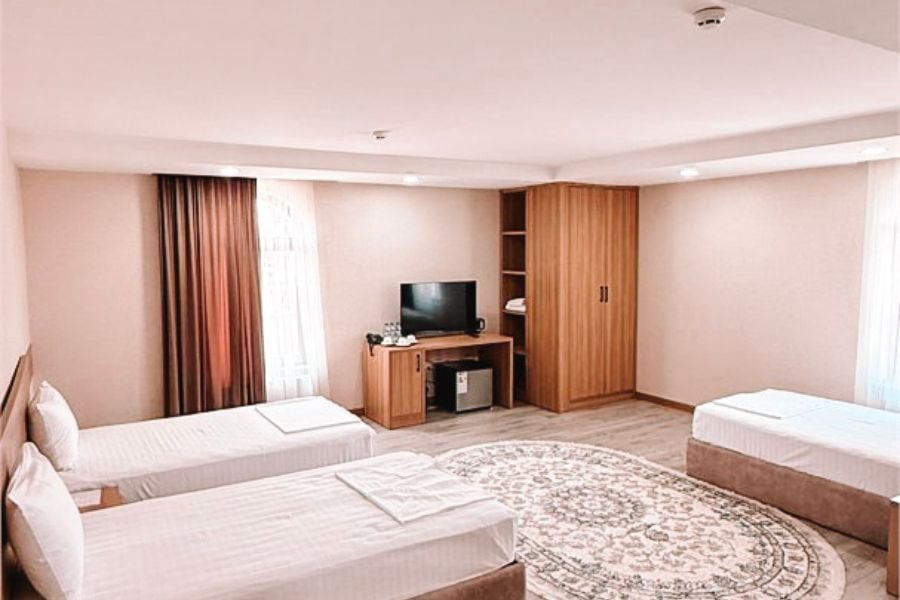
We chose Fergana City as our base, and for most travelers, it’s the easiest choice. It has the widest range of hotels, smoother services, cafés, decent supermarkets, and enough comfort to help you unwind between long travel days. When the itinerary is packed, having a stable base like this keeps everything simple.
We stayed at Saroy Gardens Hotel, a modern, family–friendly hotel in the central part of Fergana. Rooms are spacious and bright, breakfast is decent, and the location makes it very practical for early starts and late returns.
A long-running favourite with travelers, another solid option here is Asia Fergana Hotel, a classic 4-star with a large outdoor pool, on–site restaurant, and a central location close to the main streets.
If you want your stay to feel more local and craft-focused, you can shift your base to the smaller towns.
Margilan, some families connected with the silk workshops and craft centres host guests in their house-workshops, where you sleep under ikat fabrics and eat home-cooked meals between visits to silk looms and the crafts centre. It feels less like checking into a hotel and more like slipping into someone’s everyday routine.
Adras House Hotel, a beautifully restored traditional home with carved wooden pillars and a cosy courtyard, and Ikat House, a small, stylish guesthouse known for its handwoven ikat decor, warm hosts, and easy walking distance to the Yodgorlik Silk Factory, are two of the best places to stay in Margilan if you want a real craft-town atmosphere without losing comfort.
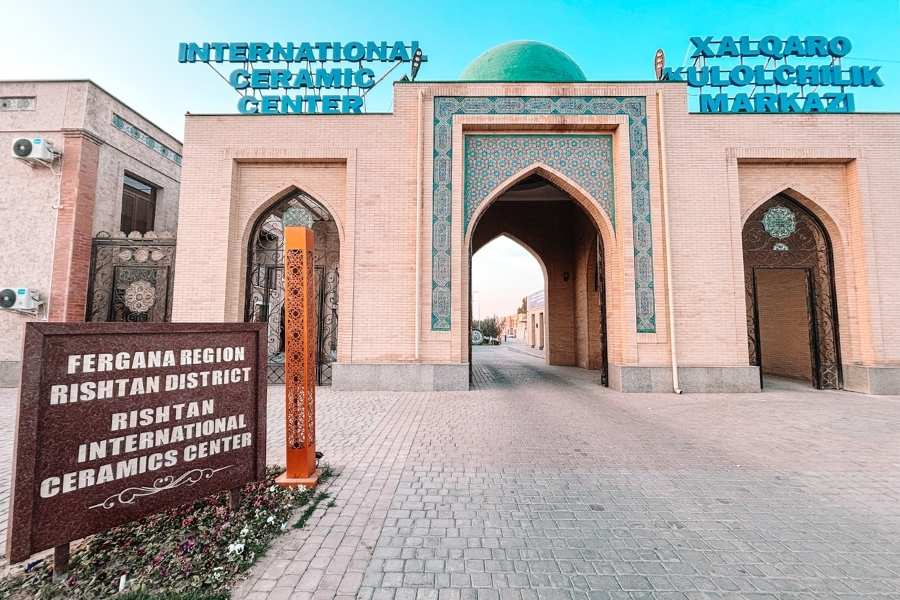
Rishtan is a great stay if pottery is the heart of your trip. The town has a cluster of master potters living around the International Ceramics Center, where homes double as studios. Workshops and shops usually sit on the ground floor, family life happens upstairs, and a few rooms are set aside for visitors who want that close-up, artisan-home experience. You eat local food, watch clay being shaped a few steps from your door, and stay inside the same spaces where generations of potters have lived and worked.
A few artisan-linked guesthouses I’ve heard most often from travelers and guides are places like Guest House Alisher Nazirov and Guest House Said S Ceramics. These don’t always appear on international booking sites, so they’re usually arranged through a local guide or agency. They suit travellers who enjoy simple hospitality and want to live as close as possible to the potters and their daily work.
For travelers who prefer comfort with a cultural touch, Chinor Plus Hotel is the most reliable base right now. It’s a modern hotel and pottery centre rolled into one, with a pool, a restaurant, and ceramics masterclasses built into the complex. It works perfectly if you want the craft experience without giving up your usual hotel comforts.
If you’re entering from Tashkent by road, Kokand is the natural gateway to the Fergana Valley, which makes it a sensible place to stay only if you’re planning two nights in the valley. It works as a warm-up stop before heading deeper, but if you have just one night, you’re better off staying in Fergana City or Margilan so you’re not spending the next day racing through all the towns and then dragging yourself back to Tashkent.
For a comfortable stay in Kokand, Asmald Palace Hotel offers modern rooms, reliable amenities and a cleaner, newer feel than most stays in town, while Silk Road Kokand Hotel gives you a simple, practical base with easy access to central Kokand.
Andijan is one of the valley’s biggest and busisest cities and gives better connectivity if your journey continues toward the Kyrgyzstan border (Osh side). Stays range from budget to mid-range, and the city works well for travelers who want to be close to the border for early-morning crossings.
Bogishamol Hotel and Andijon International Hotel are the two dependable picks here, offering clean, modern rooms with good service and easy access to food and taxis, and a central location that keeps border-day logistics simple.
So the simple way to plan stays is this. Pick Fergana City if you want comfort, choice and an easy base for day trips. Add a night or two in Margilan or Rishtan if you want to wake up inside the world of silk or pottery rather than just visiting it for a few hours.
Top Things to do in the Fergana Valley
The Fergana Valley is perfect if you enjoy seeing everyday life up close. You meet artisans, walk through local markets, watch silk being woven and pottery being shaped, and move through towns that feel lived-in rather than touristy. It’s simple, warm, and easy to explore when you know where to go. Here’s what should sit high on your list when you’re planning a meaningful trip through the region.
Explore the Khanate History in Kokand

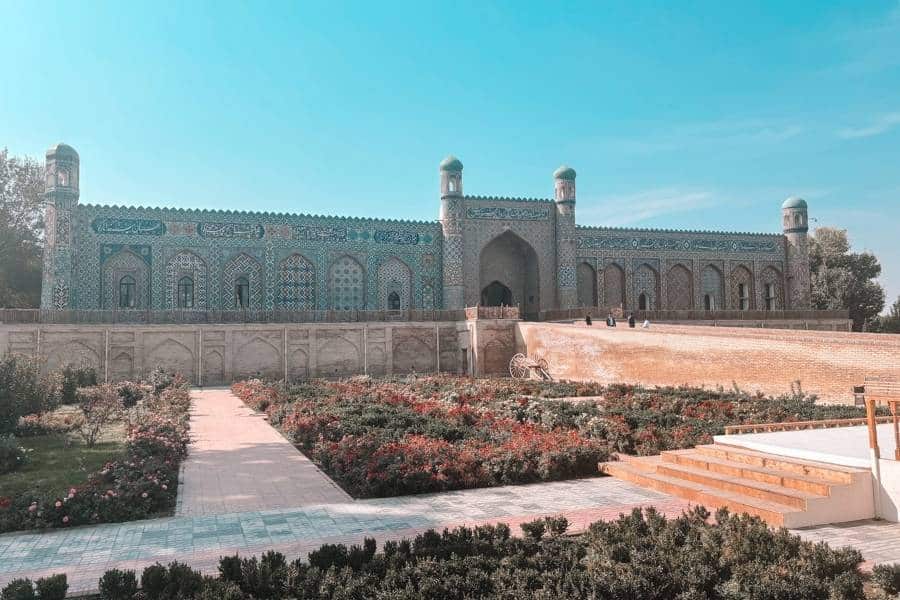
Kokand carries the old royal past of the valley. The Khudayar Khan Palace is the star, with colourful halls, wooden pillars, tiled courtyards, all showing how powerful the Kokand Khanate once was.
Built in the 1870s for Khudayar Khan, it was one of the largest palaces in Central Asia, with almost 120 rooms and an over-the-top level of decoration meant to show wealth and power. Only a part of it survives today, but even that slice is enough to make you stop and stare.
The Jami Mosque and Madrasah on Chorsu Square nearby add a quiet historical layer to the city. One of the Fergana’s largest mosques, Jami Mosque, looks beautiful, with its intricately carved wooden columns.
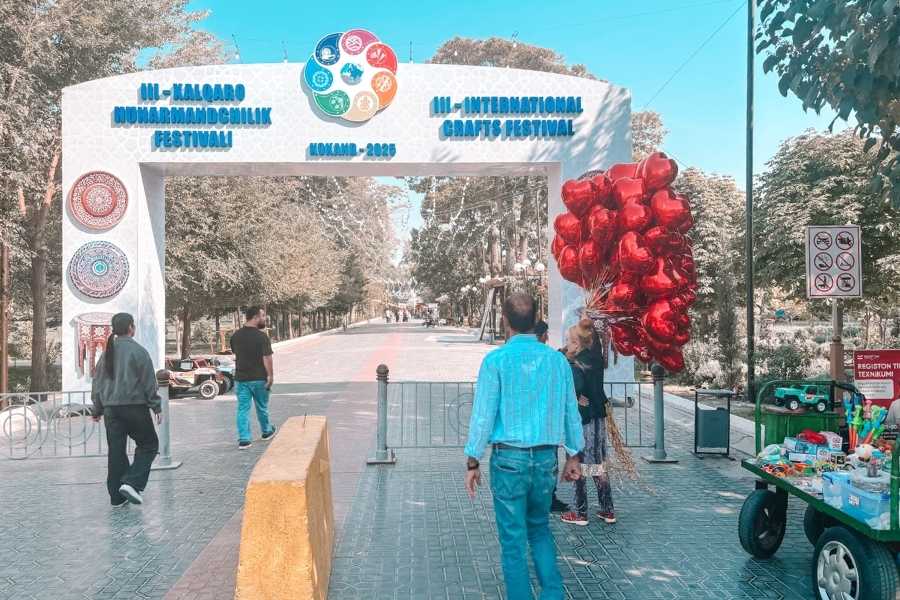
When we visited in September, the Kokand International Festival of Handicrafts was in full swing, and the whole city had this festive buzz. Artisans from across Uzbekistan and many other countries set up stalls around the palace and central streets: ceramics, silk, woodwork, embroidery, metalwork, everything you can imagine in one place.
A few practical things if you want to catch it
• The festival is held every two years (biennial) in Kokand
• The latest editions took place in September
• Most of the events happen around Khudayar Khan Palace, Jami Complex, and the main streets
• Expect crowds, performances, live workshops, and a lot of beautiful handicrafts
For us, it added a fun surprise to the day: local musicians playing outside the palace, travelers and locals wandering through craft stalls, and artisans happily showing how their designs come to life. If your trip falls in early or mid-September, it’s worth checking the dates.
Take a Pottery Lesson in Rishtan
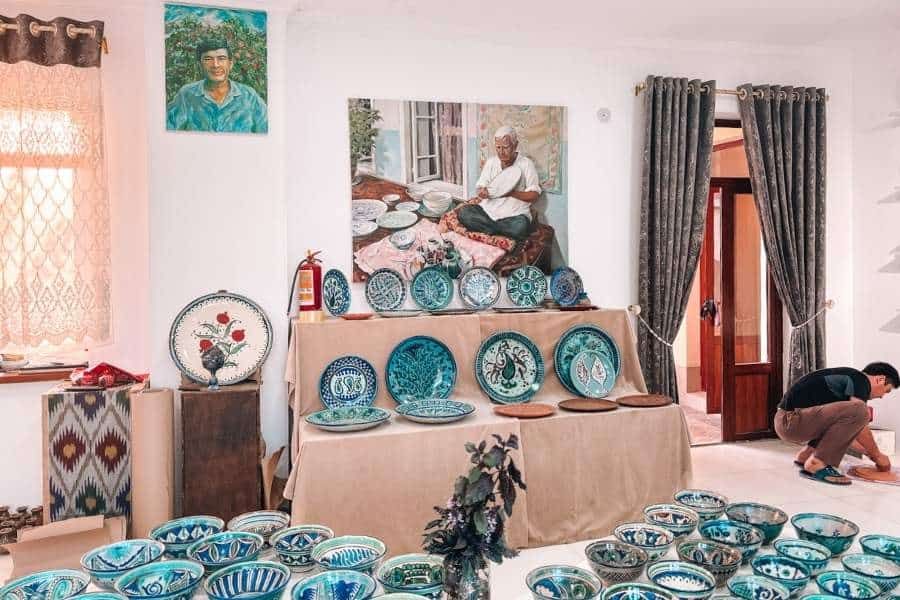
Rishtan is the heart of Uzbekistan’s blue-ceramic tradition, and almost every lane has a potter shaping clay in a courtyard. The town is known for ishkor, a natural alkaline glaze made from local plants, which gives Rishtan ceramics their soft shine and rich turquoise-blue tone.
Rishtan has several well-known masters, and visiting even one of them shows how much skill goes into every bowl or plate. Some of the most respected artisans include Alisher Nazirov, Rustam Usmanov, and Sharofiddin Yusupov, each known for keeping Rishtan’s ceramic tradition alive through their own family styles.
You can visit the International Ceramics Center, where several master potters work, teach, and fire their pieces in traditional kilns. It’s a good place to understand the full process from raw clay to the final glazed piece.
Our guide took us to Sharofiddin Yusupov’s workshop, which sits inside the center. His family has been doing this for years, and you can tell from the way they work. His son gave us a full demo and then encouraged us to try the wheel.
Mini-me froze. I stepped back too, because the last time I touched a pottery wheel in Andretta, Himachal, the bowl I made looked confused about its purpose in life. So this time I played it safe and watched.
Though, the way the clay move under your hands is oddly calming. If you haven’t tried pottery even once, this is a good place to start, even if your bowl ends up looking as unsure as mine.
Watch Traditional Silk Weaving Come Alive in Margilan
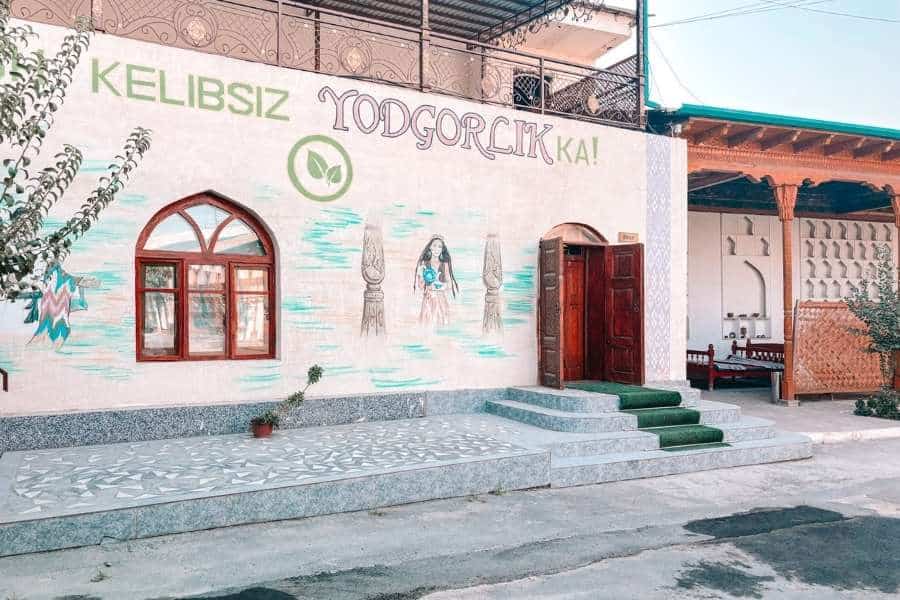
Uzbekistan is the world’s third-largest silk producer, standing right behind China and India, and Margilan is the centre of Uzbek silk, and spending time here feels like stepping into a craft that still runs the way it did generations ago.
The Yodgorlik Silk Factory, the most respected silk centre in the valley, is the main stop. You see everything — cocoons being boiled, threads stretched out, dyes being mixed, and ikat patterns taking shape strand by strand.
Apart from adras (ikat), they also weave khan-atlas, the royal silk with that liquid shine and long, flowing patterns that Central Asia is known for. It was historically worn by royals and still used for bridal wear, festive clothing, and special occasions in Uzbekistan.
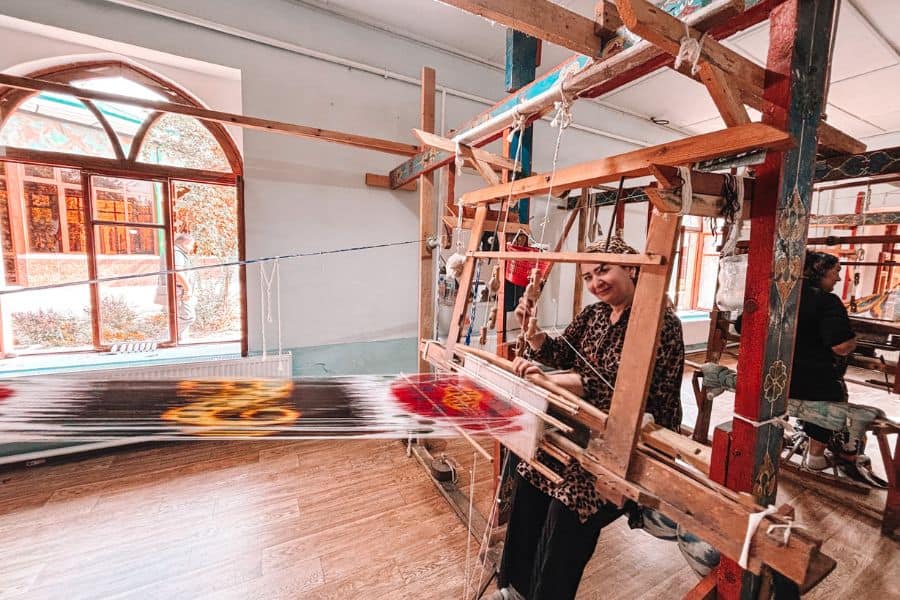
A young guide walked us through the factory, and his enthusiasm made the whole tour even better. He knew every corner, from the rooms where cocoons are boiled and unwound into fine threads, to the dyeing area where colours sit in large vats, to the weaving halls where long wooden looms keep clicking line by line. You see the fabric grow slowly, and it gives you a real sense of how much patience this craft needs.
One of my favourite moments was watching the local women spin yarn. They had the gentlest smiles, looked up, and asked us, “Hindostan?” before greeting us with a cheerful namaste. That tiny moment felt so warm.
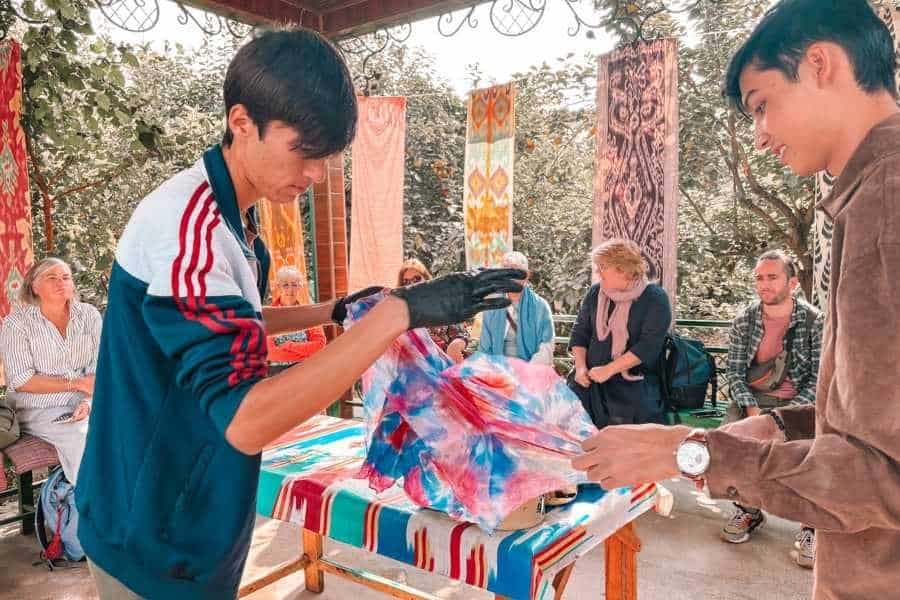
He then took us to an open courtyard where travelers from different countries had gathered. One of the artisans demonstrated the tie-and-dye process on silk stoles and invited everyone to try. Tourists, mostly women from Australia, the US, the UK, jumped in with full excitement, folding silk, dipping dyes, and admiring their own patterns like they had just created art.
For us, the technique wasn’t new. Tie-and-dye has a strong presence back home, especially in Rajasthan and Gujarat, and I’ve grown up seeing it on sarees, dupattas, and stoles. I even have a small collection. But watching others enjoy it for the first time still felt nice, that kind of wide-eyed joy always makes a place feel warmer.
I even had one of my favourite hand-dyed scarves tied to my bag that day. A sweet Italian woman asked if I bought it there, and I proudly smiled, “No, it’s from India.” She admired it, and in that moment I felt this lovely connection between two craft cultures that care about colour and handwork just as much.
The visit ends at the factory shop, where the variety is big but the pricing stays fair. You get guaranteed authenticity here, which helps because Margilan has both real silk and cheaper synthetics floating around in local markets. Many travelers have written that Yodgorlik is the safest place to buy original ikat without guessing or bargaining, and after visiting, I agree.
Explore Andijan
When compared with the rest of the Fergana Valley, Andijan is bigger, busier, packed with people going about their day, and more urban.
Yes, there’s history here. A lot of it. Andijan is one of Uzbekistan’s oldest cities, and the birthplace of Babur.
The Babur Literary Museum is a good first stop if you want to understand Andijan’s biggest historical link. It’s a small, neat place that shows his early life — the writings, the young battles, and the boy he was before he became the Babur we read about in Indian history books.
From there, you can walk to the Jami Complex, Andijan’s main landmark. It’s a long, open mosque with rows of wooden pillars and a calm courtyard. It’s also one of the few buildings that survived the 1902 earthquake, so it feels like a living piece of old Andijan.
A short stroll away is Devanaboy Mosque, another peaceful corner of the city. Right opposite it sits Andijan’s Registan, a wide public square where families stroll in the evenings and kids run around with snacks.
Together, these three make a nice loop if you want a short walk through Andijan’s old heart.
If you’re spending a few hours in Andijan, you can ride a cable car to the top of Bogishamol Hill to visit Babur Memorial Park, dedicated to the founder of the Mughal Empire, Zahiriddin Muhammad Babur.
The park’s home to a mausoleum that holds soil brought from both places tied to Babur’s story — Agra, where he was first laid to rest, and Kabul, where he was later reburied and now rests. The museum next to it has displays on his early life, poetry, and the journey that shaped him long before Delhi and Agra entered the picture.
You can also stop by the Mausoleum of Kuteiba ibn Muslim, a small but important historical site dedicated to the Arab commander who led the early spread of Islam into Central Asia.
Sitting on an old Silk Road route, just 25–30 minutes from Andijan, Shahrixon (Shahrihon or Shakhrikhan), makes for an easy detour if you’re alraedy in Andijan. It’s famous for its fertile farmlands and for being one of Uzbekistan’s oldest knife-making centres. The traditional Uzbek knives, pchak, made here are famous for their sharpness, hand-forged blades, and colorful handles. If you want to pick one up, Shahrixon Bazaar is the place to go.
Explore the Bazaars of the Fergana Valley
If you enjoy local markets, the Fergana Valley won’t disappoint.
Kokand’s Friday Bazaar (if you happen to be there on a Friday) is the classic valley scene — fresh fruit, fabric rolls, doppi hats, nuts, sweets, spices, and the steady rush of people buying their weekly essentials.
Kumtepa Bazaar near Margilan (open on Thursdays and Sundays) is another lively stop if you’re into ikat. It’s a proper silk market where traders bring fabrics, yarn, and handmade textiles straight from local workshops.
Chorsu Bazaar in Namangan has its own charm with a layout that’s simpler to navigate than the bigger valley markets.
In Andijan, Eski Bazaar and Jahon Bazaar are among the biggest and liveliest markets in the valley and give you plenty to explore for those who love local markets. Yangi Bazaar and Dekhon Bazaar are worth a look too.
Wander Around Namangan
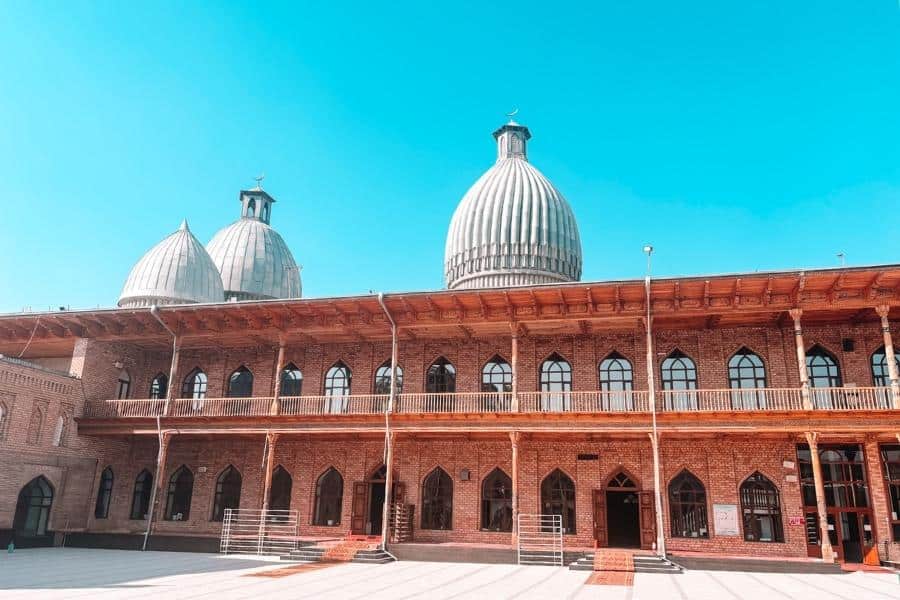
Uzbekistan’s second largest city, Namangan is a busy regional hub and one of the main centres of the Fergana Valley. With a lot of parks, fountains and long walkways, Namangan is known for its green spaces.
Babur Park (Bobur Park), one of the biggest public spaces in the valley, has neat paths, fountains, flowerbeds, and families strolling around in the evenings. It’s also a venue for Namangan’s annual International Flower Festival that takes place around May and June.
Namangan also has a strong cultural side. Not far from Bobur Park, Namangan State Museum of History and Culture showcases the rich heritage, nature, art, and traditions of the Namangan and Fergana region.
The Khoja Amin Cabri Mausoleum in the old part of the city is small, peaceful, and worth a short stop if you enjoy historical corners that haven’t been turned into tourist attractions.
A little further out, the Ota Valikhon Tur Mosque (Atavalikhonture Mosque) stands as one of Namangan’s important mosques. It’s known for its light-blue details, clean courtyard, and steady stream of local worshippers. It’s home to an Art Museum displaying the local craft.
Afsonalar Vodiysi, the Valley of Legends, is Namangan’s big, shiny amusement park — newly built, full of rides and lights, home to Central Asia’s largest ferris wheel, and a fun breather if you want something playful between all the cultural stops.
If you enjoy archaeology, the ancient settlement of Akhsikent sits just outside Namangan and gives you a quick look at how far back this region goes.
Chust and Kosonsoy sit close to Namangan and make easy day trips. Chust, like Shahrixon, is known across Uzbekistan for its knife-making tradition. You’ll find blacksmiths shaping the famous pichoq knives by hand.
Kosonsoy is one of the older towns in the region, with links going back to the Kushan period, and you still see that old-world layer in the fort remains on the northern side. The town sits along the Kosonsoy River with mountains close by, so the whole place has a relaxed, mountain-edge feel. Many people here speak Tajik, which gives the town its own cultural flavour.
Explore Fergana City
Fergana City works best as a base rather than a sightseeing stop. There isn’t a long list of attractions here, and honestly, that’s part of its charm. We spent our time walking around at our own pace (no FOMO), enjoying the calm and little everyday moments.
Akhmad Al-Fergani Park is a huge green space named after the 9th-century astronomer, with a grand monument and a small amusement park tucked inside. The Craft House sits right on its edge, a cosy spot to meet artisans, browse handmade work, and take a breather between walks.
The Soviet imprint is still easy to spot around the city. You see it in places like the old House of Officers, the Soviet-era Drama Theatre, and the buildings around Akhmad Al-Fergani Park with their straight lines and solid geometry. They aren’t “wow” monuments, but they form the visual character of the city.
If you look a little longer, you’ll also find older structures from the Russian Empire period, like the 1877 residence of General Mikhail Skobelev, the Deputy Governor’s House, and the 1902 men’s gymnasium near the Oilworker Stadium.
For something a bit more local, Fergana Central Bazaar, with fresh produce, warm breads, spices, plus Russian and Korean food stalls mixed in, is perfect.
If museums are more your pace, the Fergana Regional Museum of Local History is one of the oldest in Uzbekistan, with collections ranging from archaeology and ceramics to local embroidery and jewellery.
Wine lovers can head just outside the centre to Wine Garden, the valley’s only winery, which offers simple tours, tastings, and a big restaurant to wind down at the end.
If you have a little extra time, Kuva (Quva), a garden-city with fruit orchards and leafy lanes makes an easy detour from Fergana City. It’s one of the valley’s oldest settlements, once sitting right on the Silk Road, and the main draw is its ancient Buddhist site, Zindontepa, an archaeological patch with monastery ruins that remind you how far back the valley’s story goes. It’s also known as the birthplace of the medieval astronomer Ahmad al-Fergani, and there’s a small memorial complex dedicated to him.
Fergana Valley: Suggested Itinerary for 1, 2, and 3 Days
If you’re planning your trip and wondering how much you can actually fit in, these quick itineraries will help you map your days without overthinking it.
1-Day Itinerary for the Fergana Valley
If you’re short on time and have only 24 hours and still want to explore the Fergana Valley, here’s a loop you can follow.
Tashkent → Kamchik Pass → Kokand → Rishtan → Margilan → Tashkent
Start early from Tashkent, drive across the Kamchik Pass, and stop first in Kokand to see Khudoyar Khan Palace, Jami Mosque, and the royal necropolis. After a quick walk through the bazaar, continue to Rishtan for a pottery workshop visit. End in Margilan for a tour of the Yodgorlik Silk Factory and the bazaar before returning to Tashkent in the evening. It’s a packed day, but you get a solid taste of the valley’s crafts and history.
Between us, I’d still pick a guided tour for a one-day trip. The distances are long, the timing is tight, and a local guide keeps everything smooth. Most tours follow this exact route with hotel pick-up, a comfortable car, and someone who knows all the shortcuts, so you don’t waste a minute figuring things out.
Here are a few solid one-day options you can look at:
➢ Tashkent to Fergana Valley Full-Day Private or Group Tour (Kokand + Rishtan + Margilan)
➢ Tashkent to Fergana Valley Full-Day Private Tour (Rishtan + Margilan)
2-Day Itinerary for the Fergana Valley
We spent two days in the valley and it felt just right, enough time to enjoy the gems of Kokand, Rishtan, Margilan, Namangan, and Fergana City.
Day 1: Tashkent → Kamchik Pass → Kokand → Rishtan → Fergana City
06:00 ➢ Departure from Tashkent: Drive through Kamchik Pass enjoying scenic mountain views
11:00 ➢ Arrival in Kokand: Visit Khudoyar Khan Palace, Jami Mosque, Dakhma-i-Shahan, Norbut-biy Madrasah, and Kokand Bazaar
13:00 ➢ Lunch in Kokand
14:30 ➢ Continue to Rishton: Visit famous ceramics workshop and meet master craftsman
17:00 ➢ Drive to Fergana City: Check into hotel, Freshen up
19:00 ➢ Dinner in Fergana City, Overnight in Fergana City
Day 2: Fergana → Margilan → Namangan → Tashkent
08:00 ➢ Breakfast at hotel, Check out from hotel
09:00 ➢ Drive to Margilon: Visit Yodgorlik Silk Factory and Margilon Bazaar
12:00 ➢ Lunch in Margilon
13:00 ➢ Continue to Namangan: Visit Kansansay Bazaar and Babur Park or detouring to Kosonsoy or Chust, if time allows
15:30 ➢ Return drive to Tashkent via Kamchik Pass
20:00 ➢ Back to Tashkent
If you don’t want to plan everything on your own, two-day group and private tours are also available. Here are the few recommendations:
➢ Fergana Valley Tour from Tashkent (1 night 2 days)
➢ Tashkent-Khujand-Fergana Valley-Tashkent Tour (1 night 2 days)
➢ Fergana Valley 2-Day Private Tour
3-Day Itinerary for the Fergana Valley
If two days feel a bit tight, add one more and thank yourself later. We did the classic two-day loop and it worked beautifully, but honestly, stretching it to three gives you room to breathe. You can spend longer in Margilan or Rishtan, add Andijan or Chust, or just stop wherever something interesting catches your eye.
Day 1: Tashkent → Kamchik Pass → Kokand → Rishtan → Fergana City
06:00 ➢ Departure from Tashkent: Drive through Kamchik Pass enjoying scenic mountain views
11:00 ➢ Arrival in Kokand: Visit Khudoyar Khan Palace, Jami Mosque, Dakhma-i-Shahan, Norbut-biy Madrasah, and Kokand Bazaar
13:00 ➢ Lunch in Kokand
14:30 ➢ Continue to Rishton: Visit famous ceramics workshop and meet master craftsman
17:00 ➢ Drive to Fergana City: Check into hotel, Freshen up
19:00 ➢ Dinner in Fergana City, Overnight in Fergana City
Day 2: Fergana City → Kuva → Andijan → Fergana City
08:00 ➢ Breakfast at hotel
09:00 ➢ Stop by Kuva
11:00 ➢ Continue to Andijan: Visit Babur Literary Museum, Jami Complex, Devanaboy Mosque, Registan, and Babur Memorial Park
14:00 ➢ Lunch in Andijan
15:30 ➢ Return drive to Fergana City: Visit Akhmad Al-Fergani Park, Check out Soviet-era Buildings
19:00 ➢ Dinner in Fergana City, Overnight in Fergana City
Day 3: Fergana City → Margilan → Namangan → Tashkent
08:00 ➢ Breakfast at hotel, Check out from hotel
09:00 ➢ Drive to Margilon: Visit Yodgorlik Silk Factory and Margilon Bazaar
12:00 ➢ Lunch in Margilon
13:00 ➢ Continue to Namangan: Visit Kansansay Bazaar and Babur Park or detouring to Kosonsoy or Chust, if time allows
15:30 ➢ Return drive to Tashkent via Kamchik Pass
20:00 ➢ Back to Tashkent
If you’re aiming for a full three-day experience, ready-made tours are rare, but local operators can easily customise one for you. This 3-day tour I found is close to what most travelers want, and you can tweak it to match your pace and interests.
➢ Fergana Valley Ethnographic and Gastronomic Tour (2 nights 3 days)
The Fergana Valley surprised us in the sweetest way. Small towns, gentle faces, workshops buzzing with real craft, and days that somehow felt fuller than what we wrote in our itinerary. If you enjoy slow stories, handmade things, and places that show you their everyday life without trying too hard, this corner of Uzbekistan stays with you.
If you’re planning your own trip and need help figuring out routes, stays, or how many days you should keep, just drop a comment. I’m always happy to help a fellow traveler map out their travels.
Save this Guide to Ferghana Valley to Pinterest