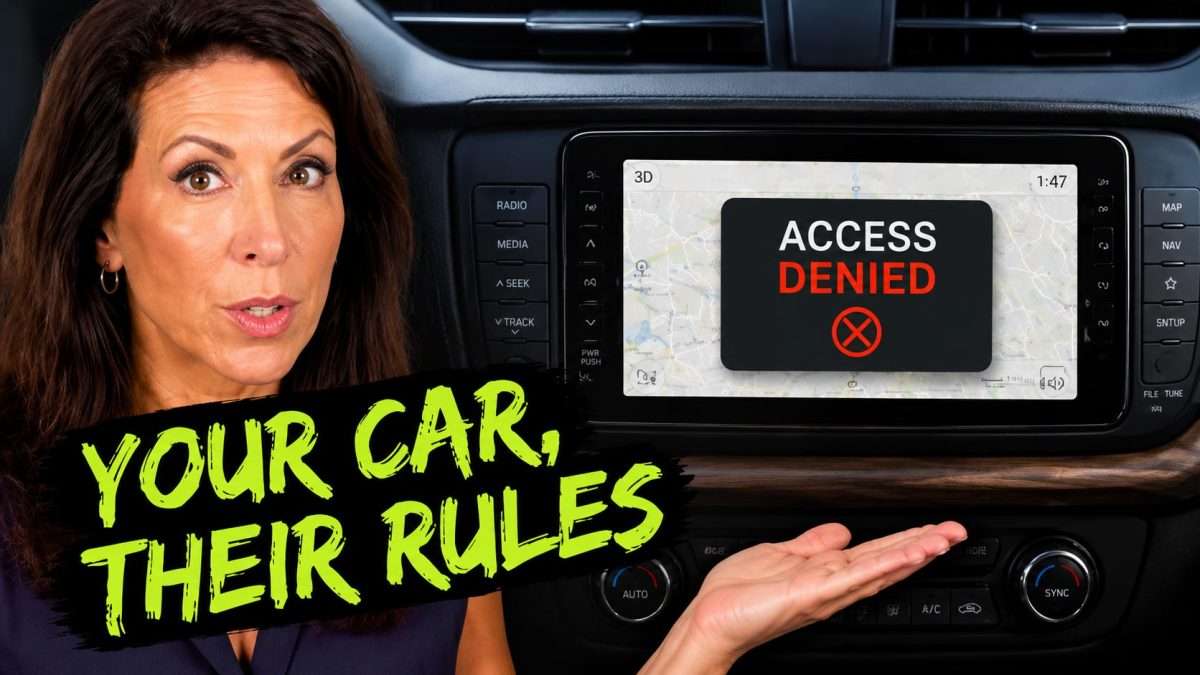
You paid for the car. You insure it. You fill the tank. The title has your name on it.
So why does fixing a broken sensor or updating a module increasingly require the manufacturer’s blessing?
That question gets to the heart of the Right to Repair debate. For decades, independent repair shops and vehicle owners could access the parts, tools and information needed to keep a car on the road. Dealerships were not the only game in town.
Then the computers took over.
Modern Cars Are Rolling Data Centers
Today’s vehicles are rolling data centers, packed with dozens of processors, driver-assistance systems, remote software updates and wireless connections to manufacturers’ servers.
The wrench still matters. But access to the software, diagnostic information and vehicle data behind that wrench matters even more.
Without that access, an independent repair shop can become a spectator while the dealership becomes the only option capable of completing certain repairs.
Congress just offered another reminder of how slowly the Right to Repair movement can advance when competing interests and lobbying efforts enter the room.
The REPAIR Act Gets Narrower
The original REPAIR Act sought broad access to vehicle-generated data, including telematics information transmitted wirelessly.
That version is dead.
On May 21, the House Energy and Commerce Committee advanced H.R. 7389, the Motor Vehicle Modernization Act, by a 48-1 vote. Lawmakers folded a narrower right-to-repair provision into a larger safety bill and removed one of the most important pieces for independent repair shops: direct wireless access to the vehicle data increasingly needed to diagnose and complete repairs.
What remains is essentially the 2014 voluntary agreement between automakers and independent repair groups, but with enforcement by the Federal Trade Commission.
Independent shops would receive the same diagnostic information available to dealers, along with a standardized interface beginning with 2018 models.
That is useful, but limited.
The larger fight over telematics data has effectively been pushed down the road. The FTC has until 2030 to study privacy, cybersecurity and safety concerns and issue a report.
By then, the vehicles being designed today will be even more dependent on software, connectivity and manufacturer-controlled systems.
That is progress at the speed of bureaucracy.
Automakers, Dealers and Independent Shops Take Different Positions
The lobbying lines are clear.
The National Automobile Dealers Association, or NADA, supports keeping the bill narrow. Dealers have raised concerns about privacy, cybersecurity and safety if third parties gain access to connected vehicle systems.
NADA represents automobile dealers and their interests.
SEMA and the Auto Care Association argue that the committee version is better than nothing but still leaves manufacturers with significant control over the information required to repair modern vehicles.
They represent the automotive aftermarket and repair industries.
The concern is straightforward: If the company that built the vehicle controls the data required to diagnose and repair it, the dealership network can effectively control the service market.
That could put independent repair shops at a serious disadvantage and force some businesses to close their doors.
Both sides have legitimate concerns.
One side emphasizes controlled access to increasingly connected vehicle systems. The other emphasizes competition and consumer choice.
The technology is sprinting while the rules crawl.
The SAFE Repair Act Adds Another Layer
Another proposal has received far less attention from drivers: the SAFE Repair Act.
The proposal came from the Alliance for Automotive Innovation, the Automotive Service Association and collision-repair groups. It emphasizes safety, consumer choice, transparency and access to information needed to perform necessary repairs.
It is not the bill currently moving through Congress.
It does, however, demonstrate how much the Right to Repair debate has changed.
The fight is no longer simply about whether independent shops can obtain service manuals.
The bigger question is this:
How much of a vehicle’s data stream should the owner and the person repairing the vehicle actually control?
Vehicle Data Creates a New Privacy Problem
Collision repair shops have already raised concerns about privacy.
Modern vehicles can collect information about driving behavior, contacts and other personal data that may have nothing to do with replacing a bumper or repairing a damaged vehicle.
That means the debate is no longer simply automakers versus mechanics.
It is a three-way struggle over what information belongs to the person who purchased the vehicle, what information a repairer needs to do the job, and what data a manufacturer can keep behind a digital gate.
The Right to Repair debate has become a data ownership debate.
Which Cars Still Let You Be the Owner?
Meanwhile, a different conversation is taking place in garages and driveways.
Drivers are asking a question manufacturers may not want to hear:
Which model year still lets me own the car without constant connectivity, remote updates and server-dependent features?
There is no single cutoff year.
Telematics systems arrived at different times depending on the automaker, model and trim level. Some older vehicles also have limited connected systems that may stop working as cellular networks are retired, including systems that depended on 3G networks.
The larger point is that a growing number of buyers no longer see constant connectivity as a feature.
They see it as a potential liability.
There is a difference between choosing technology and being dependent on it.
When a manufacturer can remotely push software updates, collect vehicle data or disable certain functions, the title in your name can start to feel less like traditional ownership and more like a long-term lease with extra steps.
The EPA Draws Its Own Line
The Environmental Protection Agency has also drawn a line in the Right to Repair debate.
On July 1, the EPA told manufacturers they must provide the emissions-related diagnostics, tools and information needed for independent repairs. Manufacturers also cannot require their own branded parts for those emissions-related systems.
Proprietary software code remains protected.
Even so, the policy recognizes an important principle: Emissions-control systems should not become a captive repair market.
Separate fights continue over software, aftermarket parts, advanced driver-assistance system modifications and cybersecurity.
SEMA is also pushing for National Highway Traffic Safety Administration studies examining how common vehicle modifications interact with advanced safety systems.
In other words, there are multiple battles being fought under the single banner of Right to Repair.
The Right to Repair Is Really About Ownership
The technology keeps accelerating.
The law keeps lagging.
Manufacturers, dealers, independent repair shops, aftermarket companies, insurers and lawmakers all have legitimate interests to protect. The complexity of the issue, however, does not change the basic principle.
You bought the car.
You should be able to maintain it, repair it and keep it running without asking the company that sold it for permission.
That is not radical.
That is ownership.
And ownership is supposed to mean something.
Support Lauren Fix: Buy me a cup of coffee and show your support: [Buy Me a Coffee]
More automotive news: [Car Coach Reports]
Listen to The Drive Car Show: [YouTube]
Lauren Fix is an automotive expert and journalist covering industry trends, policy changes and their impact on drivers nationwide. Follow her on X, @LaurenFix, for the latest car news and insights.