Kid Lit Review of “The Women Who Caught the Babies: A Story of African American Midwives” by Eloise Greenfield

Children’s book author and poet Eloise Greenfield (May 17, 1929 – August 5, 2021) was well-known and much loved for her positive depictions of Black family life. When she first started writing poetry, she saw there were too few books for children that showed African Americans in a favorable light. She decided to change that herself:
“Then and there, I decided to make that my mission. I wanted my books to enable Black children to realize how beautiful and smart they are. I wanted to write books that inspired and uplifted them, that made them laugh and be happy.”
She succeeded to much acclaim, winning many awards over her lifetime, and mentoring others.

In this collection of poems, she begins with an introduction in which she gives the history of Black midwives, beginning with those who came from Africa as slaves.
Greenfield explains:
“Midwives have been in the world probably as long as there have been human babies on earth. With this book, thought I want to take you back only as far as the Africa of a few hundred years ago. That’s when millions of Africans were forced from their homelands, brought to America and enslaved. Some of the enslaved were midwives.
What are midwives? They are women (and some men) who help to bring babies into the world. Midwives use the word ‘catch’ to describe what they do. They say they ‘catch’ the babies, as they are being born.”

One of many photos included in the book at the front and back
Although, she observes, most babies in America today are born in hospitals, there are a substantial number of women who prefer to have their babies born at home, with the aid of a midwife.
Greenfield’s poems are a tribute to these women who “caught the babies, and catch them still, welcome them into the world, for loving.” The first poem begins “somewhere in the African past,” and they continue with the trans-Atlantic slave journey, and seminal times in America continuing through the early 2000s.
The last poem, though, looks back a bit to 1929:
“If you had asked anybody
in or near the little town
of Parmele, North Carolina,
‘Who catches the babies
Around here?’ They’d
Have said, right away,
‘Miss Rovenia Mayo. She lives
Over yonder.’ And they’d have
Pointed across the fields,
In the direction of her house.
On the evening of May 17, 1929,
Miss Rovenia Mayo caught me,
Eloise.”
Archival photos are included at the beginning and end of the book.
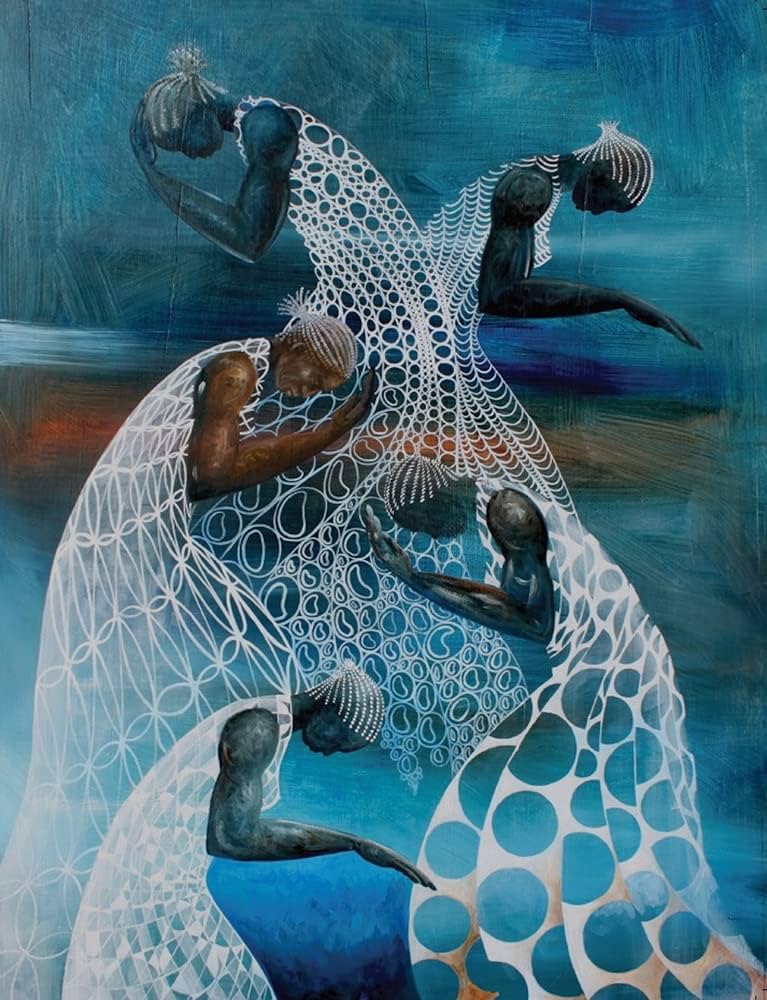
Stunning illustrations by Daniel Minter draw heavily on African cultural lore and historic practices. His palette is dominated by blues, reflecting the intersection of the color blue with Blacks through history, from the cultivation of indigo in Africa to the cultivation of blues music in America. He includes, with one poem, his picture of “Mother Ocean,” or Yemoja, the revered Yoruba deity of the ocean, rivers, motherhood, and fertility.

(The Yoruba people are a West African ethnic group, making up some 50 million people in Africa. Many Yoruba were among those taken as slaves to the Americas.). Yemoja’s sacred colors are blue and white – blue the color of the ocean and white the sanctifying, cleansing color of rebirth.
These themes underscore Greenfield’s emphasis on the continuous, intergenerational line of African and African-American midwives:
“They caught the babies,
and catch them still,
welcome them into the world,
For loving.”

Evaluation: Greenfield said in 2016 when she was receiving yet another award, the Teaching for Change Education for Liberation Award, that she wanted to continue her commitment to helping children “see themselves in books, see their beauty and intelligence, see the strengths they have inherited from a long line of predecessors, see their ability to overcome difficulties, challenges, pain, and find deep joy and laughter in books, in characters they recognize as themselves.” She has definitely done so here.
Rating: 4/5
Published by Alazar Press, an imprint of Royal Swan Enterprises, 2019