The World of Jesus, book review

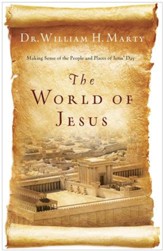
 The intertestamental theme continues, with a book review.
I felt bad (previous post) saying that H.A. Ironside’s book on the 400 silent years left something to be desired. He did cover the intertestamental period well, but I found it an information overload, and suggested some ways it could have been a bit more accessible. Well, I had another book on my shelf – The World of Jesus by Dr. William Marty – that does just this! I highly recommend this book for everyday Christians that want to be better understand the intertestamental period and New Testament era.
Does this mean it is 100% an easy read? No. You are learning about ancient history, and sometimes certain facts simply have to be presented as is. However, Marty really does succeed at presenting the material in plain English, with various “helps” and presentation methods to make it more accessible. There are time lines, material set off in blocks that delves deeper into a person or event, and a glossary of important words (people, places). As the book progresses, Marty provides brief reviews or reminds you in parentheses who an individual is, and I found this tremendously helpful. It was not simply repetitive, but Marty clearly realized that all the people, places, and events can become overwhelming and mixed up in the reader’s mind. Also, he succeeds in making the book relevant…
He makes it relevant because every chapter, at some point, brings in material about Jesus, the Gospels, or other parts of the New Testament. This helps you see how the historical facts you are learning aren’t just boring ancient history but shed light on Jesus and the New Testament! You’ll gain insight and fresh perspective. The end of each chapter also has questions for discussion or personal thought.
I acquired this book a while back and it was published in 2013. Sadly, I sometimes find really great books go out-of-print. But it is still in print! Yeah! Not only that, it has over 300 reviews on amazon, and that is a lot of reviews for such a book!
Now I’ll simply share specific parts I appreciated or excerpts, keeping in mind that what stood out to me could be different for you.
♦ I appreciated a set off block section that spread 5 pages, providing a review of each of the Roman Emperors from Augustus to Festus. I will grab this off my shelf when I need a quick reminder in the future.
♦ Okay, I already knew that prior to their exile, God’s people were known as Israelites, and after exile they were known as Jews. Israel – Israelites, this makes sense. But where does the term Jew come from? I’d never even thought about it. Remember that first the northern kingdom (Israel) was conquered by the Assyrians, and then later the southern kingdom (Judah) was conquered by the Babylonians. From page 29:
“Why were they all called ‘Jews’ therafter? Apparently it was difficult to pronounce ‘Judahites’ in Aramaic so the Babylonians shortened the term.”
– That makes sense, right? Judah and Judea refer to the same geographical area, and Jew would be a natural shortening of it.
♦ Besides providing insight into the Gospels, Marty also shows how insight can be brought to other parts of the New Testament. On pages 119 to 120, he explains the details of a Roman “victory parade” and how it was the highest honor that could be paid to a conquering general. Then he shows how the apostle Paul used the imagery of a Roman Triumph to explain the paradox of victory in ministry through suffering and death. (2 Corinthians 2:12-17, 1 Corinthians 4:9)
♦ Finally, on page 137, Marty shares his view that:
“From a human perspective, Herod was a ruthless tyrant. Still, God can accomplish his good purposes through evil human intentions and actions. It is unlikely national Israel would have survived Roman conquest and domination without Herod the Great – the Romans would probably have totally destroyed Israel and dispersed the Jews all over the world much sooner than they eventually did in AD 70. God used Herod to preserve his chosen people and keep the nation intact until the time came for him to send his Son, the promised Messiah, the world’s Savior.” (Italics in original)
Look at the recent posts before this one for more about the intertestamental period.
⇒ People are not reading blogs much anymore (actually people are not reading much at all anymore!) so I appreciate that you read this post. Thanks for your visit. Feel free to look around while you are here. Please tell anyone you think would appreciate Enough Light about this site. I do NOT use AI to write and pledge not too. Grace and Peace, Laura Martin