April 2025 Dividend Income Update
Hello!
Welcome to our latest update: our April 2025 dividend income update.
A reminder for anyone new to the site, this series is a monthly update related to our hybrid investing approach for semi-retirement funding:
- We invest in Canadian and U.S. dividend paying stocks – about 25-30 stocks that collectively deliver income and growth over time…and
- We invest in some low-cost equity ETFs – that deliver long-term growth for extra diversifcation.
You can always read a bit more about what we own, why and where (i.e., in what accounts) on this dedicated My Dividends page I keep updated here.
April 2025 Dividend Income Update
This time last year, I was picking up some oil and gas stocks for our portfolio along with adding more low-cost ETF XAW throughout 2024 for extra diversifcation.
In 2025, with oil prices now tanking, I might do the same thing!
Oil prices have plummeted recently based on expectations that the global economy will slow in reaction to Trump’s ongoing trade war, and more recently on news the group of oil producing countries known as OPEC+ and led by Saudi Arabia could boost global oil production by about 2.5 million barrels per day by this fall of 2025 – greatly increasing supply at a time demand is on the decline. So, if that does in fact happen, everyone else might suffer.
And…if lower oil prices do occur, which are expected in the coming months, then you-know-who might take credit for that (well, of course he will) since Americans will be paying less for oil/Canadian oil.
We’ll see how all of this plays out of course since the U.S. President loves to take credit for pretty much anything when things can be spun in his favour…
Since the end of 2024 and this post, not much has really changed in my portfolio.
I/we:
- Remain invested in some defensive stocks in our portfolio, names like Waste Management (WM) and Waste Connections (WCN) and Walmart (WMT) of late have done very well.
- While I was enjoying a nice tech-kicker run from owning low-cost ETF QQQ for approaching 10 years now, QQQ has tanked in value but then again, lower prices in my other main equity ETF I own (XAW) has triggered some buying opportunities over the last month. So, I did buy more.
- And finally, I have been buying more local and shopping more local during these trade wars too – something I probably should have done more beforehand anyhow…
These ongoing trade wars have, in my opinion, created more buying opportunities for disciplined investors. A well-structured, diversified global mix of stocks including those with some U.S. assets can still be very smart purchases if your overall investing timeline is measured in decades.
Ours is.
So, while I’ve sold off a couple of U.S. stocks in recent months for mainly portfolio simplification I’ve also used the proceeds to invest in more XAW in particular while boosting our cash wedge this year for 2026 and 2027 spending needs – since my part-time work with my employer is now here.
Why?
Well, in asset decumulation, I personally fear some poor sequence of investment returns risks. I also don’t want to rely on just dividend income to meet my spending needs. Dividends are great, I own many dividend paying stocks, they are a fine form of optionality for investors but they are never guaranteed.
An investor like me without any employment income soon (2026?) who experiences a series of negative early returns in retirement and/or some dividend cuts could be faced with at least two issues if not three:
- capital must be sold for income needs at the worst times,
- an income only focus could experience dividend cuts and therefore less income, and depending on inflation,
- you have less capital at work with less purchasing power.
One of the key ways I will thwart sequence of returns risk in my 50s is by keeping all near-term spending for the next 1-2 years in cash/cash equivalents. This way, I spend from that and I won’t be selling any stocks nor equity ETFs to fund our lifestyle.
As we spend that cash in the coming 1-2 years, it is my expectation that the stocks and the equity ETFs we own will appreciate somewhat in value over that time. That, when combined with reinvested dividends and distributions “turned off” in most investing accounts now, cash/cash equivalents should build up again during 2026 and 2027 for future spending needs after that in 2028+.

This is somewhat of a “live off dividends” and distributions approach for the next few years (which if you have been following along has been a bit of our asset decumulation plan all along).
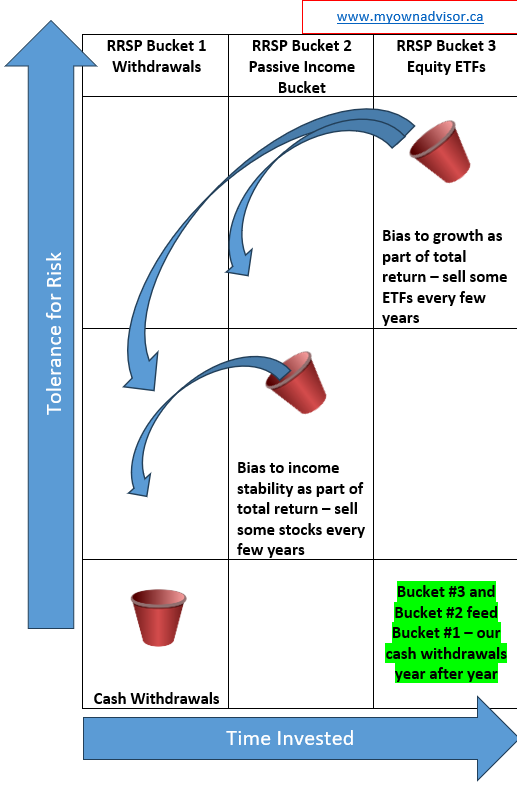
So, essentially I have an RRSP Bucket Approach ready to roll:
- The RRSP cash bucket – This holds at minimum, Year-1 of our RRSP withdrawals. No need to sell stocks or ETFs on a whim. Cash withdrawals are ready in cash-alternative ETFs or money market funds or other liquid assets.
- The RRSP passive income bucket – This passive bucket should generate thousands of income/cash per year via dividend stocks for future RRSP withdrawals.
- The RRSP growth bucket – This bucket generates some distributions but more importantly maybe long-term equity returns for future withdrawals. I continue to hold riskier investments in here (e.g., QQQ or XAW) to sell a bit as I age.
April 2025 Dividend Income Update
I have no idea what the rest of the investing year might bring but I continue to stick with my hybrid investing approach in a mix of dividend stocks and low-cost ETFs for total returns across the portfolio.
So far, so good to meet our objectives.
With some minor recent tweaks made across our portfolio and potentially a few more adjustments to simplify and raise even more cash equivalents in 2025 on the way, we seem to be getting more organized than ever before should we both stop working in the months ahead.
This time last year, in April 2024, (just one year ago) we earned this:

In April 2024, that was like averaging about $3,766 per month.
A year later, thanks to a few more purchases but mostly more dividend raises over that timeframe, our projected annual dividend income update as of April 2025 looks like this below.
That’s averaging $4,192 per month. This includes factoring a huge dividend cut (>50%) that may occur with my remaining BCE position whereby we only have a few shares left in our portfolio for any potential rebound long-term.

A reminder I share these posts not to brag (hardly) nor to replicate what I am/we are doing.
I know of folks that are just starting out on their investing journey in stocks and ETFs, and earn far less. I also know some DIY investors who have been at their own portfolio management work for decades and who are earning in some cases, over $100,000 per year in dividend and distribution income from their portfolio! Incredible.
Both are A-OK with me of course. We all start somewhere and over time we all need to define and maintain our own long-term investing path.
I continue to share these monthly income updates as one way for readers to see the pros and cons of my journey; how we are progressing, how I/we invest, one way to construct an income and growth-oriented hybrid portfolio – but there are certainly many other ways to invest.
This is also a good time to remind you that our forecasted annual dividend income tally is from a blend of our taxable accounts (x2) + our RRSP accounts (x2) + my small LIRA (x1). It excludes all TFSAs. It ignores any pension plans from work including my small DB (defined benefit) pension plan and my wife’s LIRA too. Finally, it excludes future government benefits like CPP or OAS since I’m far too young to start those anyhow.
You can read more on my FAQs page about these updates.
I share my updates this way largely because the taxable accounts, the RRSPs, and my LIRA (Locked-In Retirement Account) will be the first accounts we tap for retirement spending along with my corporation. TFSAs will be left alone for many years to come…and again, I’m far too young for any government benefits.
I will continue to monitor trade wars of course, as damaging as they are to everyone in many ways, but I will put more focus on the things I can control in 2025 over the coming months. That includes portfolio simplification and related adjustments for retirement spending, it could also include the opportunity to buy more stocks or ETFs on sale per se, and finally raising more cash/cash equivalents where I see fit for an unknown future.
I welcome your questions on this update and I also want to hear from you how things are going so far in 2025. Do share in a comment on the site!
Mark
Related Reading:
Why do Made-in-Canada dividends make sense over the U.S. market for growth? Read on.
“What drives this difference? There are two main reasons:
- The S&P/TSX Index is tilted more towards value companies in cyclical sectors. Energy, Financials, Industrials and Materials make up roughly two-thirds of the Canadian index.
- South of the border, the U.S. S&P 500 houses some of the world’s best growth companies. The Information Technology sector currently makes up more than 25% of the Index.
Value companies tend to distribute cash to shareholders in the form of dividends. Growth-oriented companies tend to preserve their cash flow for opportunities to expand their operations. As these companies mature, they may deliver a higher rate of dividend growth. However, the general rule still holds true: the concentration of value companies in the Canadian index means Canadian equities as a whole tend to offer a higher yield than U.S. equities.”
Food for thought to own Canadian dividend stocks for income + low-cost ETFs for ex-Canada growth investing. 🙂
Mark

My name is Mark Seed – the founder, editor and owner of My Own Advisor. As my own DIY financial advisor, I’ve reached financial independence. Now, I share my lessons learned for free on this site. Find out what I did and how I reached financial independence to tailor your own path. Join the newsletter read by thousands.