You’re opening a shop, signing a lease, or hiring your first few employees in Gainesville, and the policy you bought last year suddenly doesn’t look as solid as it did on paper. That’s the moment most owners realize business insurance Gainesville isn’t a form you file once and forget. It’s a moving risk decision shaped by Florida law, inland wind exposure, tenant-heavy demand, payroll changes, and the kind of property you operate.
Table of Contents
Why Gainesville Business Owners Need a Local Insurance Strategy
A Gainesville café owner thinks the policy is fine until a kitchen fire shuts down service and the landlord starts asking hard questions about the damaged unit next door. A contractor has a van, tools, and a few helpers, then learns the hard way that the vehicle form does not automatically cover the rest of the operation. I see that pattern constantly, the owner believes they bought “coverage,” but what they really bought was a partial answer.
Florida makes that problem worse because the market is large, tightly regulated, and expensive to operate within. The Florida Office of Insurance Regulation reported 2,052 total licensed domestic and foreign insurers in calendar year 2024, and total direct premium written in the state has increased every year since 2015. The same report places the cost of regulation at $0.31 per $1,000 of written premium in the Florida market report, which shows how much of the price structure comes from compliance and oversight, not just claims.
Gainesville still gives business owners a better property-insurance starting point than coastal Florida. Inland Florida property premiums in cities including Gainesville were placed at $0.65 to $1.10 per $100 of total insured value, while coastal Atlantic locations can run $2.10 to $3.40 and the Florida Keys $3.50 to $6.00+ in a 2026 market guide from the same Florida market data source. Lower than the coast does not mean cheap, and it does not mean you can buy casually.
Practical rule: If your business would suffer both physical damage and a liability claim from the same event, build the insurance as a system, not as separate fragments.
Gainesville owners get better results when they treat insurance as a planning conversation tied to the business they run. A restaurant near campus, a professional office, a contractor with vehicles, and a specialty retailer all need different structure, different limits, and different deductibles. A one-size-fits-all package usually leaves gaps where Florida exposure shows up first. If you want a plain explanation of how a Business Owners Policy is meant to work, start with this overview of BOP coverage, then match it to your industry before you buy anything.
The Core Coverage Lines Every Gainesville Business Should Understand
Start with the policy that actually fits small and mid-sized operations
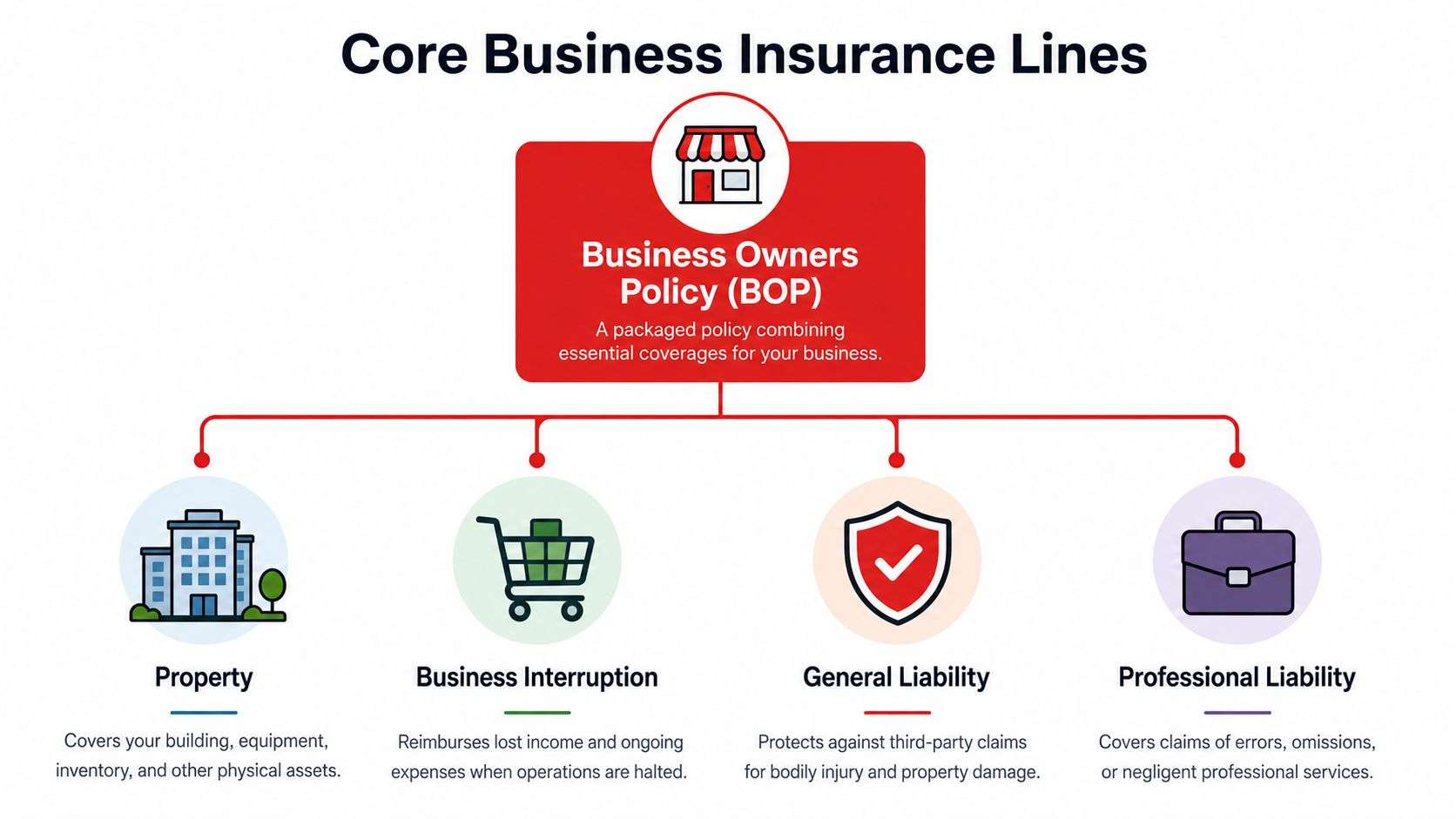
For many local businesses, the most efficient foundation is a Business Owners Policy, or BOP. It bundles commercial property and general liability into one form, which cuts down on coverage gaps and makes claims cleaner when one event damages your space and injures someone else at the same time. That matters for a retail storefront, a small office, or a restaurant where one loss can trigger more than one problem.

General liability pays when a customer slips, a contractor’s ladder damages someone else’s property, or a client claims your operation caused an injury. Commercial property pays for the building you own or the contents you use to run the business, such as fixtures, inventory, desks, and equipment. A fire in a small office doesn’t just burn drywall, it can wipe out the things that keep revenue moving.
Match the vehicle and employee exposures to the right form
Commercial auto belongs on vehicles titled to the business or used regularly for business work. If a delivery van backs into a parked car or a service truck causes an injury crash, the business auto policy is the part designed to respond. For employee-heavy shops, workers’ compensation isn’t optional when Florida’s employee-count rules apply, and it exists because payroll, job duties, and injury severity create a different kind of loss.
Florida law requires workers’ compensation coverage for a non-construction business with four or more employees and for a construction business with at least one employee under Florida’s small business guide. The state’s official guidance also says those employee counts apply even if workers are full-time or part-time under coverage requirements guidance. That’s a compliance trigger many owners miss.
Use higher layers for bigger losses
A commercial umbrella adds liability capacity when the base policy limit isn’t enough. That matters for businesses that host the public, work on customer property, or operate with multiple employees and vehicles. Specialized coverage can also make sense for flood exposure and equipment that moves between jobsites, because a standard package won’t solve every loss.
For a plain-language breakdown of how the base package works, this business owners policy guide is useful if you want to see how those core pieces fit together.
Gainesville-Specific Risks That Drive Coverage and Pricing
Inland doesn’t mean low-risk
Gainesville gets a pricing break compared with the coast, but it still sits in Florida, and Florida still lives with wind exposure. A storm doesn’t need a beachfront address to rip off roofing, drive water into a storefront, or knock out a business for days. That’s why I push owners to think in terms of business interruption, not just building repair.
Assuming that because your property isn’t on the Atlantic, your downtime is short and your loss is small is a mistake. A storm that damages power, internet, refrigeration, or access to your space can stop sales even when the structure itself looks mostly intact. That’s especially painful for restaurants, clinics, and service firms that depend on daily foot traffic.
If one event can stop revenue and create a claim, the policy needs to cover both sides of the loss.
Student housing and rentals change the risk picture
The University of Florida and Santa Fe College shape demand for rentals, mixed-use spaces, landlords, and property managers. That creates a different insurance conversation than the one a standalone office building would have. Tenant turnover, lease obligations, and the chance of damage moving from one unit to another all raise the need to look beyond a generic property form.
That’s where a lot of local owners underbuy. They carry a policy that looks fine until a unit becomes uninhabitable, a tenant blames the property owner for a loss, or a rent-dependent business has no replacement for the income that disappears during repairs. If your revenue depends on occupied space, business income coverage deserves real attention.
Cyber and employment claims are no longer side issues
Clinics, nonprofits, and professional offices in Gainesville carry exposures that don’t always show up in a standard BOP. Email compromise, ransomware, employee-related disputes, and income disruption can create losses that feel detached from the building itself, but they still hit the balance sheet. Owners who ignore those exposures are usually buying coverage for last decade’s risk profile.
If you want the employee side of the equation spelled out further, this workers’ compensation guide for Alachua County gives a useful local starting point. The point is simple, Gainesville policies should reflect Gainesville operations, not a national template.

Industry-Specific Recommendations for Gainesville Businesses
Restaurants and hospitality need more than base liability
Restaurants live and die on a tight margin between property damage, customer injury, spoilage, and downtime. A BOP is a starting point, not a finish line, because food loss, liquor exposure, and interruption risk can overwhelm a stripped-down policy. If you serve alcohol, handle perishable inventory, or rely on weekend traffic, I’d build the quote around those realities first.
Contractors should focus on the vehicle, the crew, and the tools
Contractors often overpay attention to the truck and underpay attention to everything else riding in it. Commercial auto, workers’ compensation, and tools-and-equipment coverage usually matter more than a flashy general package. If your crew moves between job sites, the vehicle policy only handles one slice of the risk.
Trucking and mobile service operations need specialized auto treatment
A mobile operation can’t be treated like a storefront. Trucks, trailers, route exposure, and off-site service work create a profile that usually needs commercial auto, non-owned vehicle review, and the right liability structure tied to actual use. If you’re moving people or products across Gainesville and beyond, the auto conversation has to be precise.
Landlords and mobile home park owners need tenant-focused protection
Landlord-adjacent businesses, especially rental property owners and park operators, need specialized attention for tenant claims, property damage, and income loss from uninhabitable units. A generic liability form won’t answer every lease question. For these owners, the policy should match how income is collected and how much of the operation depends on occupancy staying steady.
Fitness studios and veterinary practices need separate professional limits
Fitness studios face member-injury exposures and equipment losses, while veterinary practices face animal handling, treatment errors, and liability tied to professional services. A flat BOP can’t solve those problems by itself. You need the correct liability line for the work you do, not the work a generic office does.
Bottom line: The more your revenue depends on specialized service, the less useful a one-size-fits-all package becomes.
For local owners in clinics, nonprofits, and professional offices, cyber and employment practices coverage is increasingly part of the conversation too. That doesn’t mean every account needs every endorsement, but it does mean the old “property plus liability and done” mindset is too thin for Gainesville today.
What Drives the Cost of Business Insurance in Gainesville
The numbers set the starting point, not your final quote
Florida pricing runs high, and Gainesville owners should plan for that from the start. A statewide benchmark puts Florida small-business insurance at about $128 per month or $1,538 per year, and calls Florida the most expensive state in the Southeast in that study according to the Florida cost benchmark. Another Florida pricing report breaks out general liability at $144 per month or $1,732 annually, with a zero-employee business averaging about $55 per month and a business with 20 to 49 employees averaging $736 per month in the Florida business insurance pricing data.
Those figures do not price your account. They do show why guessing is a mistake. A small payroll, a simple layout, and a low-hazard operation can land in a very different place than a larger crew working in customer homes or handling pricier inventory.
| Coverage or Factor | Approximate Florida Monthly Cost | What Drives the Price |
|---|---|---|
| Small-business insurance | $128 | Industry mix, size, and loss exposure according to the Florida cost benchmark |
| General liability | $144 | Public interaction, premises risk, and limits in the Florida business insurance pricing data |
| Zero-employee operation | $55 | Minimal payroll and fewer worker exposures in the Florida business insurance pricing data |
| 20 to 49 employees | $736 | Higher payroll, more exposure, and larger claim severity in the Florida business insurance pricing data |
| Inland Gainesville property | $0.65 to $1.10 per $100 of total insured value | Lower hurricane and wind exposure than the coast Florida market report |
What really moves the premium
Payroll drives workers’ compensation. Employee count matters because Florida’s legal trigger changes with business size. Job classification matters because a roofer, a receptionist, and a veterinary tech do not carry the same injury profile. Revenue, occupancy type, building age, construction, claims history, coverage limits, and deductibles also move the number.
For fitness operations, the risk shape matters before you price the policy. The guide to gym business risks is a useful reminder that equipment, member injury, and income interruption belong on the same underwriting file. Use that same approach for any Gainesville business that sees regular public traffic.
The cleanest way to control cost is direct. Raise deductibles where the business can handle more out-of-pocket risk, bundle a BOP only where the operation fits, tighten loss control, and keep every submission consistent so the carrier sees the same clean story at renewal.
How to Get Insured Locally Without Missing Anything
Start with the facts the carrier will ask for anyway
Before you ask for quotes, pull together the numbers and documents that shape underwriting. Have revenue, payroll by class, owned and leased locations, vehicle schedules, equipment values, prior losses, and contract requirements ready. If you skip this step, the quote will look easy but the coverage will be vague.
Build the file once and use it everywhere
A clean submission should include:
- Loss runs: Prior claims history so the carrier can price your actual risk.
- Prior policies: Old declarations pages help identify missing endorsements.
- Certificates of insurance requests: These show what landlords, lenders, or clients are demanding.
- Lease or franchise requirements: These can change coverage limits and named insured wording.
- Vehicle and equipment records: These prevent gaps on autos, trailers, or movable gear.
The cheapest quote is often the one with the most missing details.
Know what happens during the quoting process
An independent agency compares multiple Florida-admitted carriers and matches the structure to the business instead of forcing one form on every account. That matters because a BOP, a commercial auto policy, and an umbrella often work better together than they do separately, especially when the business has employees, vehicles, and a public-facing space. One agency may also bundle account pieces so you’re not juggling three different renewal dates and three different claims pathways.
Florida-specific compliance has to be checked before you bind. Workers’ comp thresholds apply by employee count and industry, and business-owned vehicles need the required Florida auto minimums of $10,000 in Personal Injury Protection and $10,000 in Property Damage Liability under Florida’s published business vehicle guidance. If you have drivers, vehicles, or jobsite requirements, don’t wait until after signing to find out the policy is too thin.
The best file also reflects risk control. Roof condition, wind mitigation, alarm systems, and employee training all help the carrier see a business that manages loss instead of just hoping for the best. That’s where preparation pays off, because insurers reward better documentation far more often than they reward optimism.

Why a Florida-Focused Independent Agency Changes the Outcome
A Florida-only independent agency gives you options a direct writer can’t. It can shop multiple Florida-admitted carriers, sort out hurricane and flood concerns with local context, and push back when a quote leaves out the landlord, rental, or employee exposure that matters in Gainesville. That’s not a luxury, it’s how you avoid buying the wrong policy at a fair price.
The value shows up after the sale too. When a claim hits, an advisor who knows the difference between a student-rental property, a contractor account, and a neighborhood office can spot the gaps faster and push for a clean fix. That matters more than slick marketing, because claims are where coverage either works or fails.
Schneider and Associates Insurance Agencies is one Florida option for that kind of review, and it’s the kind of agency that can place Florida business insurance, workers’ comp, commercial auto, and related property coverage with a local lens. If you want a deeper look at the model itself, this independent agency overview explains why the structure matters.

A Gainesville business doesn’t need a random policy, it needs a Florida-built plan that fits the building, the payroll, the vehicles, and the way money comes in. If you want a straight answer on what should be on the policy and what can be left off, visit Schneider and Associates Insurance Agencies and ask for a local business coverage review.