In enterprise sales, who you’re selling to matters as much as what you’re selling.
Organizations are divided into two fundamental types of business units: cost centers and revenue centers.
Recognizing this distinction is crucial because it fundamentally changes your approach to pricing, value proposition, and sales strategy.
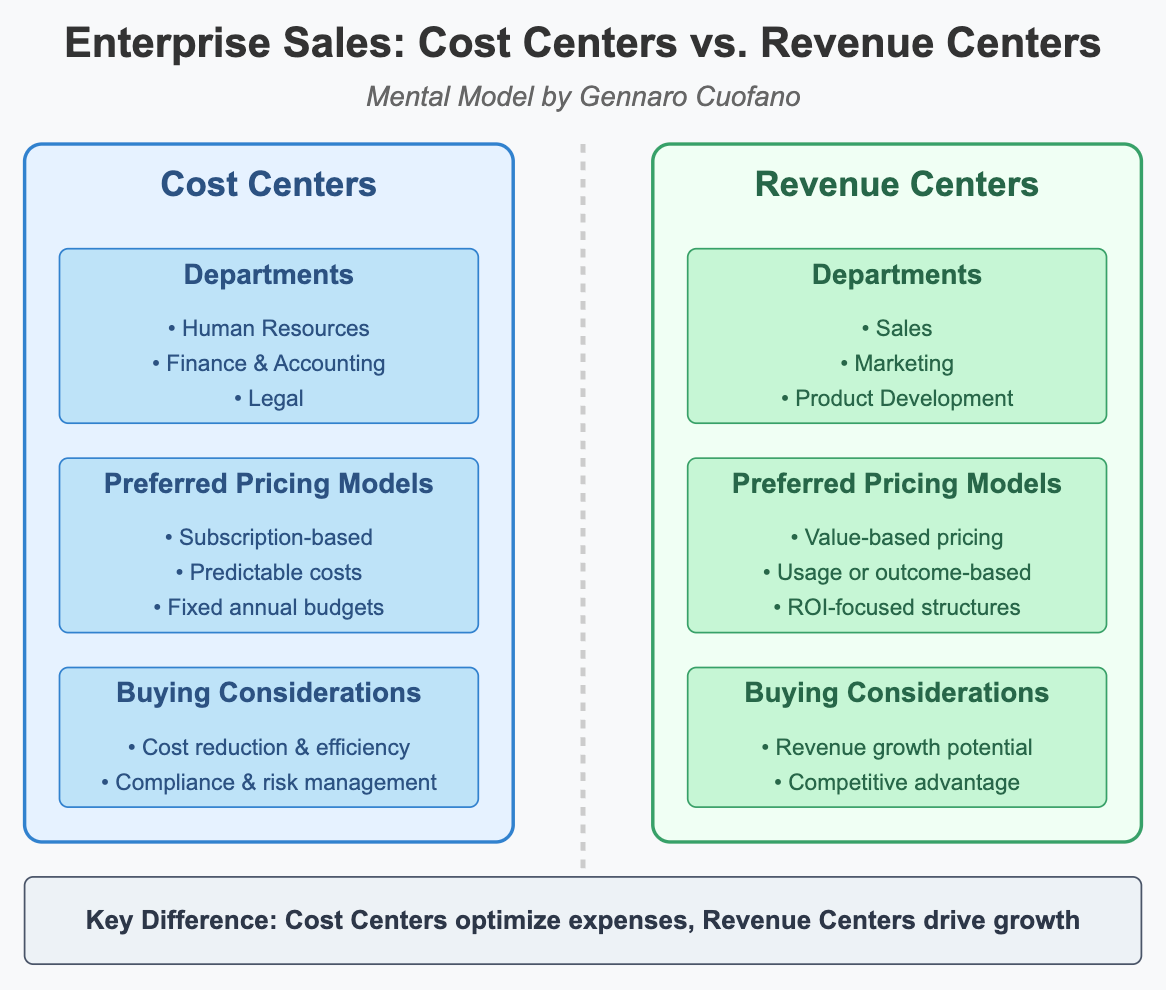
More precisely, we can tie enterprise sales to two of a company’s core functions: cost centers and revenue centers.
Selling to one or the other will change your sales strategy, organizational structure, marketing positioning, and more.
Let’s see why and how.

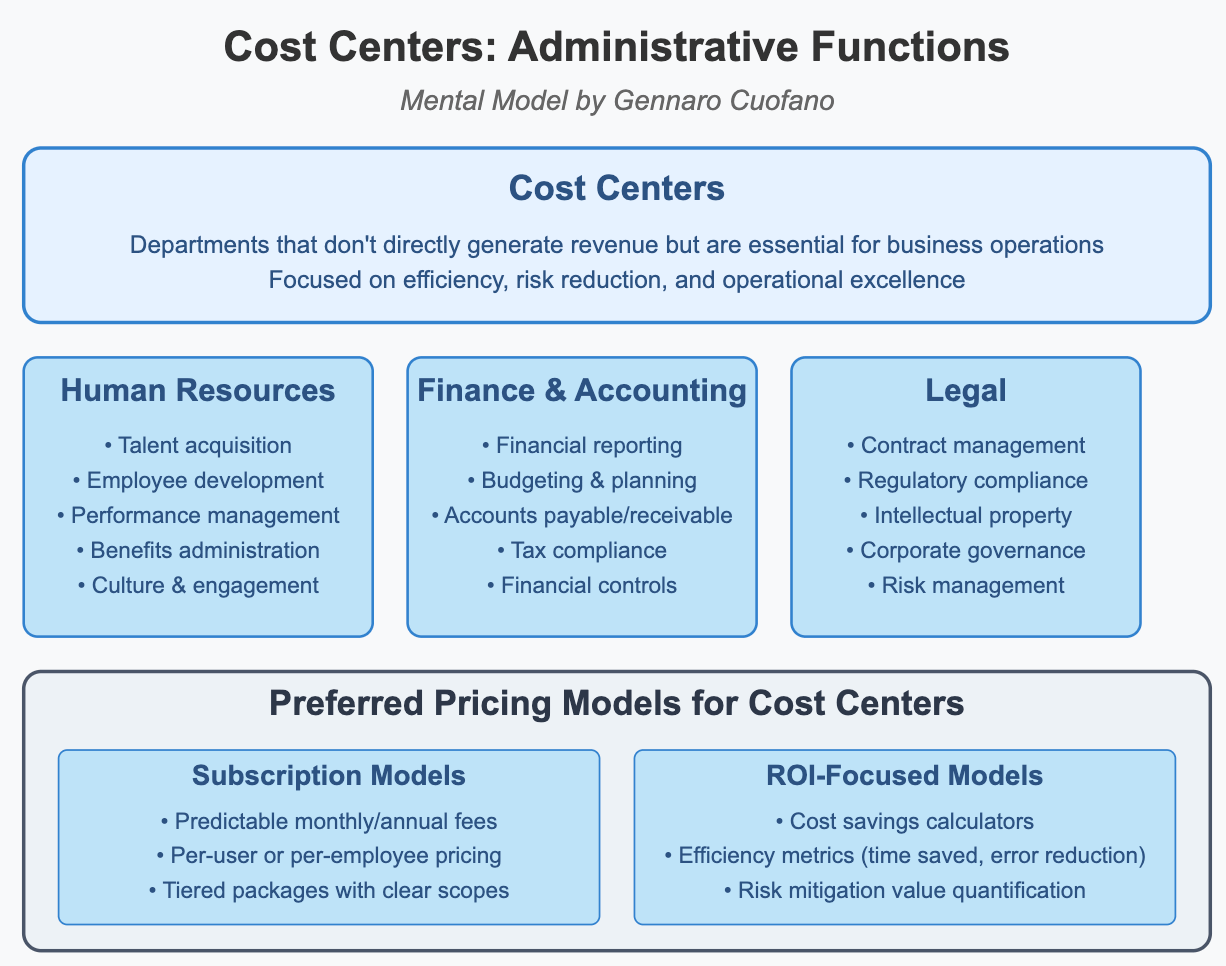
Cost centers are departments that don’t directly generate revenue but are essential for the organization’s operations. These typically include:
-
Human Resources: Manages employee relations, recruitment, and workforce development
-
Finance & Accounting: Handles financial reporting, budgeting, and compliance
-
Legal: Manages risk, ensures regulatory compliance, and handles contracts
-
Budget Constraints: Cost centers operate with fixed annual budgets that are closely monitored and often subject to reduction initiatives.
-
Buying Motivations: Decision-makers in cost centers primarily seek:
-
Cost reduction and efficiency improvements
-
Risk mitigation and compliance adherence
-
Process standardization and automation
-
Measurable operational improvements
-
-
Purchasing Process:
-
Usually requires strong ROI justification
-
Focuses on cost predictability
-
Often involves longer approval chains
-
Typically requires demonstrating “cost avoidance” rather than revenue generation
-
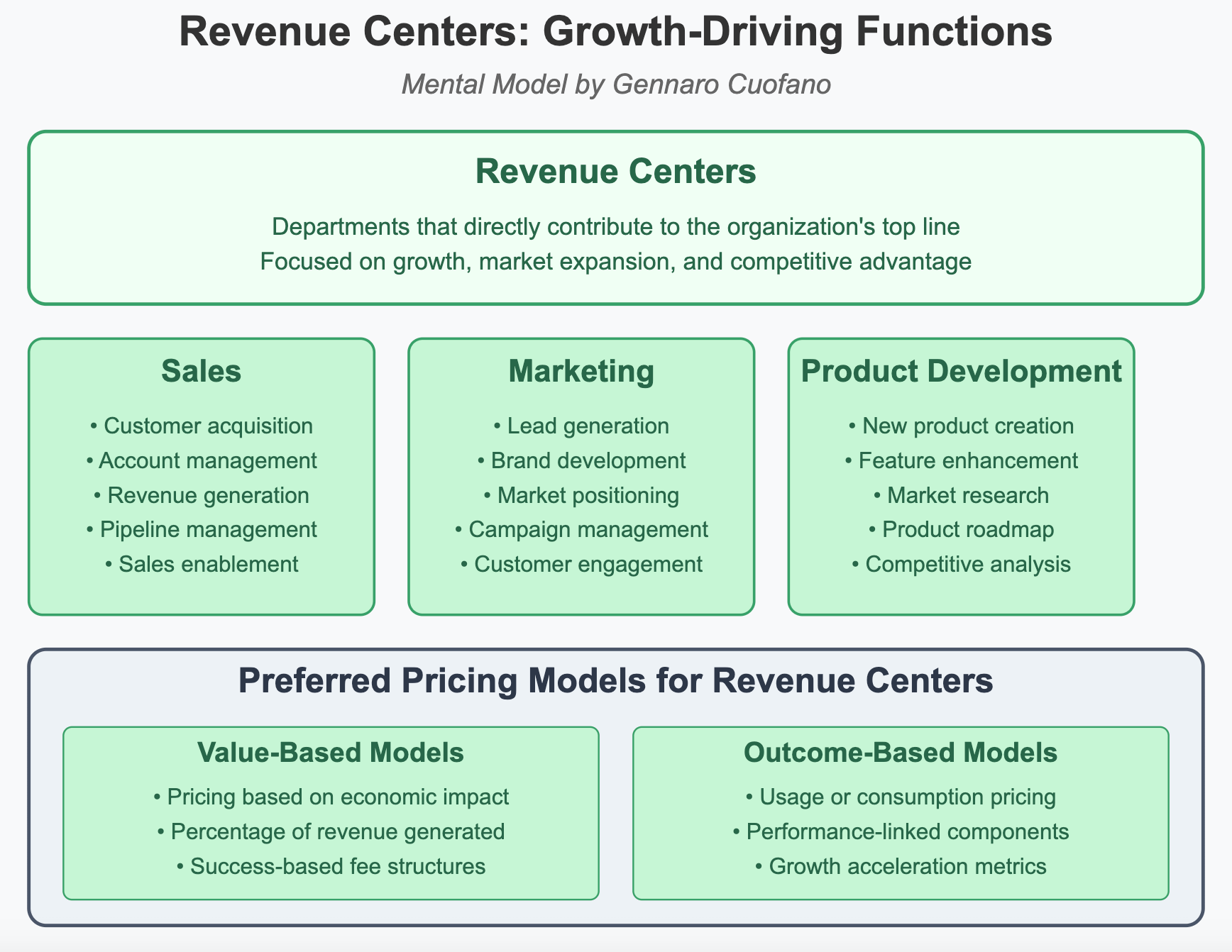
Revenue centers directly contribute to the organization’s top line. These include:
-
Sales: Directly responsible for generating revenue through customer acquisition
-
Marketing: Drives lead generation and supports revenue growth
-
Product Development: Creates and enhances offerings that generate revenue
-
Growth-Oriented Budgets: Revenue centers often have more flexible budgets that can expand when tied to revenue growth.
-
Buying Motivations: Decision-makers in revenue centers primarily seek:
-
Revenue growth enablement
-
Competitive advantages in the market
-
Acceleration of sales cycles
-
Enhanced customer acquisition and retention
-
-
Purchasing Process:
-
More receptive to investments that drive growth
-
Often more willing to experiment with new solutions
-
Evaluate offerings based on potential revenue impact
-
Can have more autonomy in purchasing decisions when tied to growth targets
-
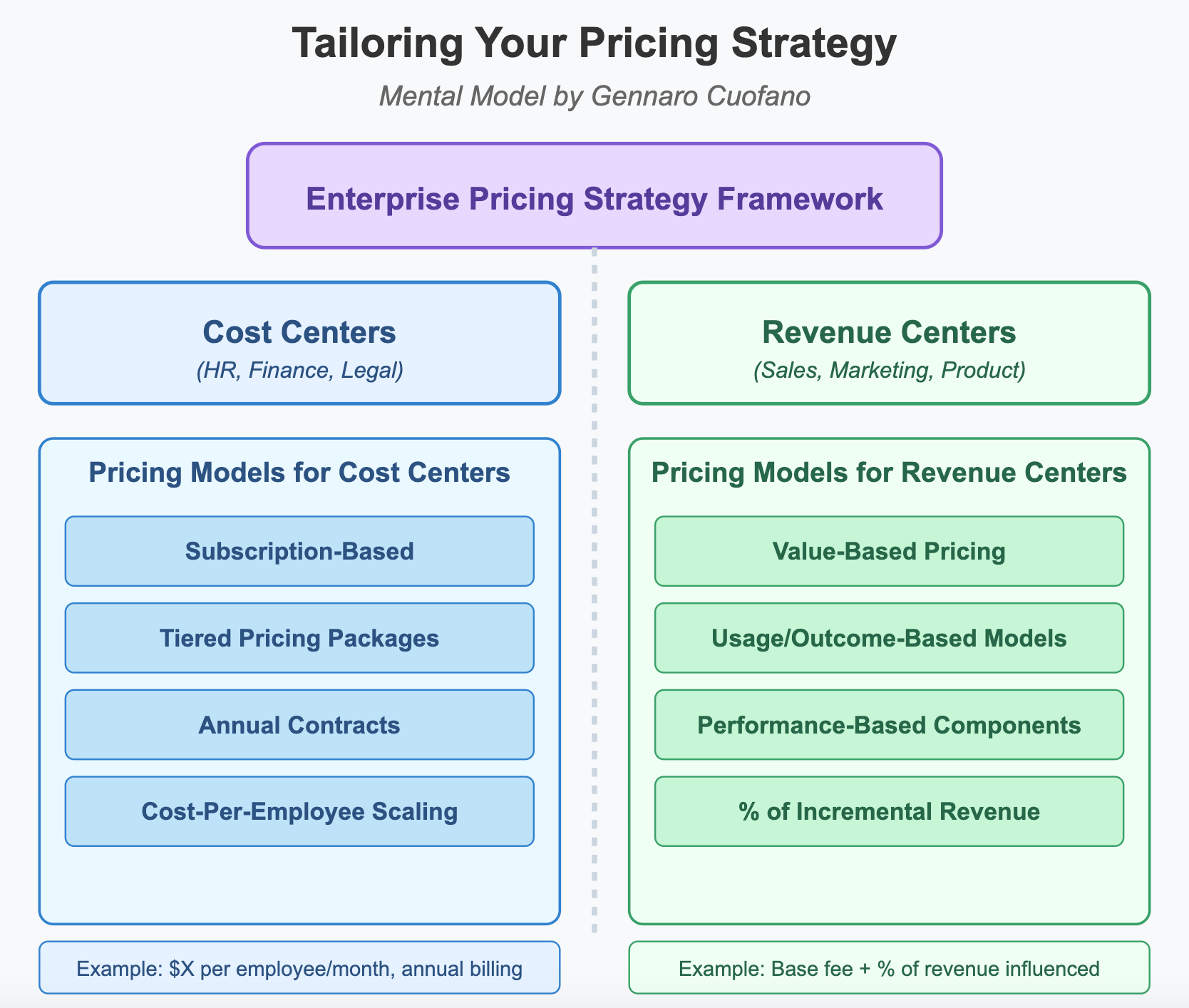
Understanding whether you’re selling to a cost center or revenue center should directly influence your pricing strategy:
When selling to HR, Finance, Legal, or other administrative functions, consider:
-
Subscription-based models that provide predictable, fixed costs
-
Tiered pricing packages with clear categorization
-
Annual contracts that align with budgeting cycles
-
Cost-per-employee or similar predictable scaling metrics
-
Efficiency metrics that clearly demonstrate cost savings
-
ROI calculators focusing on resource optimization and cost avoidance
Example: An HR software solution might be priced at $X per employee per month on an annual contract, with clear demonstration of how it reduces administrative work hours by Y%.
When selling to Sales, Marketing, or Product teams, consider:
-
Value-based pricing tied to the economic benefit your solution provides
-
Usage or outcome-based models that scale with success
-
ROI-focused structures emphasizing revenue generation
-
Performance-based components that align your success with theirs
-
Competitive positioning that emphasizes market advantages
-
Growth acceleration metrics that demonstrate faster revenue capture
Example: A sales enablement platform might use a base subscription plus a percentage of incremental revenue attributed to the solution or tiered pricing based on revenue influenced.
The cost center vs. revenue center distinction carries several important strategic implications:
-
Value Proposition Framing: For cost centers, emphasize efficiency, reliability, and risk reduction. For revenue centers, focus on growth enablement, competitive advantage, and revenue acceleration.
-
Decision-Maker Approach: Cost center executives respond to concrete cost-saving projections and operational improvements. Revenue center leaders respond to growth narratives and competitive positioning.
-
Implementation Timeline: Cost centers often have longer procurement cycles but can be more process-driven in implementation. Revenue centers may move faster on purchases but demand quicker time-to-value.
-
Customer Success Metrics: Success for cost centers is measured in operational efficiency and cost reduction. For revenue centers, success means demonstrable revenue growth and market advantages.
Some enterprise functions straddle the line between cost and revenue centers:
-
Customer Service: Reduces costs through efficiency but also drives revenue through retention
-
IT/Technology: Traditionally a cost center but increasingly viewed as a strategic enabler of revenue
-
Operations: Focuses on efficiency but directly impacts the ability to deliver revenue-generating products/services
Flexible pricing models that address both cost efficiency and revenue generation aspects should be considered for these hybrid functions.
Understanding whether you’re selling to a cost or revenue center isn’t just an academic exercise—it’s a critical strategic insight that should inform your entire go-to-market approach.
By aligning your pricing model and value proposition with the fundamental motivations of your target department, you can significantly increase your chances of success in enterprise sales.
Cost centers respond best to subscription-based models with predictable costs and clear efficiency gains. In contrast, revenue centers are more receptive to value-based and outcome-driven pricing tied to growth.
The most successful enterprise sales professionals adapt their approach—from initial outreach to pricing discussions to implementation planning—based on this crucial organizational distinction.
Enterprise sales success hinges not just on the product, but on aligning with the internal structure of the organization—particularly whether you’re selling to a cost center or a revenue center.
-
Cost Centers: Functions like HR, Finance, and Legal; do not directly generate revenue but are essential to operations.
-
Revenue Centers: Functions like Sales, Marketing, and Product; directly drive growth and revenue.
-
Cost Centers:
-
Revenue Centers:
-
Growth-oriented, faster cycles
-
Open to innovation
-
More autonomy in decisions
-
-
Cost Centers:
-
Predictable pricing models (e.g., per employee, annual subscriptions)
-
Emphasize operational savings
-
-
Revenue Centers:
-
For Cost Centers:
-
For Revenue Centers:
Some functions like IT, Customer Support, and Operations blur the lines:
-
Tailor messaging, ROI metrics, and timelines based on buyer type
-
Align internal teams (sales, product, customer success) with department-specific outcomes
-
Use the cost/revenue distinction to shape the full go-to-market and customer journey
This distinction isn’t academic—it drives how you position, price, and close enterprise deals. The best enterprise sellers adjust their entire approach based on whether the buyer is managing costs or driving growth.
With massive ♥️ Gennaro Cuofano, The Business Engineer