The International Harry Schultz Letter (HSL) (click on image to enlarge).
He also published several books, including:
- “Bear markets: how to survive and make money in them” (1964)
- “Treasury of Wall Street Wisdom” (1966)
- “Handbook for Using & Understanding Swiss Banks” (1970)
- “Panics & crashes and how you can make money out of them” (1972)
- “Financial Tactics and Terms for the Sophisticated International Investor” (1974)
- “Bear market investing strategies” (2002)
For the most part, these publications provide a view into a world that (from today’s perspective) seemed simpler and slower.
One of his books, however, proves my point about the value of sifting through old books to discover ideas that will make a comeback – such as the subject of creating new nations, free cities, and sovereign entities which has become quite fashionable again. Folks like Balaji Srinivasen make it appear like they came up with an amazing new concept, when in reality they merely took an old idea and extended it using today’s possibilities.
Schultz was already all over the subject decades ago. He funded an effort to establish small libertarian states in the 1970s, and subsequently proposed to dramatically reduce large nations in size because smaller states were better for the people that inhabit them (check back to “On Re-making the World: Cut Nations Down to Size” from 1991).
There really is nothing new under the sun…
Schultz is also the godfather of the legendary “PT” concept, that of being a “Perpetual Tourist” who only ever passes through countries but doesn’t have other ties. The idea, originally, was to spend no more than three months in a country so that you were treated as a tourist and not liable for tax.
This later became known as the “five flags” concept:
- Flag One: Where you lived
- Flag Two: Your country of residency (i.e. which passport(s) you held)
- Flag Three: Where your businesses were based
- Flag Four: Where your assets were based
- Flag Five: “Playgrounds”
What’s an investor to take home as a learning from Schultz?
The answer is printed at the top of each page of HSL.
HSL wasn’t aimed at investing but “Life Strategies”.
“Uncle Harry”, as Schultz was affectionately known, was the ultimate renaissance man. He didn’t just research investments but tried to educate himself about any and all aspects of living a successful, happy life. His readers fuelled his work, and Schultz took them along for the journey.
He wrote about health, avoiding bureaucracy, and how to keep good relations with family – all of which he believed were vital for maximising the returns you can achieve on your investments and also for protecting your wealth.
Given how many people I meet in finance who have an extreme niche talent and don’t pay much attention to other areas, I’d say it’s a point worth bringing up.
Schultz also wanted people of lesser wealth to read his work and be inspired. At the bottom of each issue, he put: “The Letter for Millionaires – current & prospective (& former)…“
All of this seemingly has gotten Uncle Harry through live rather well.
Schultz married a Princess (or so he claimed.)
According to mainstream media publications like The Times, his subscribers included Richard Nixon, Margaret Thatcher, and the Saudi Arabian oil minister, Ahmed Zaki Yamani. Speak of a two-legged publishing operation creating a must-read!
Schultz could afford to live in Monaco, a place whose climate and overall vibes must have contributed to his longevity.
He made it to 99 ½ – just short of the 100 years that many of his readers had wanted him to achieve, but he had a great run in any case!
There is an obituary where you can read more about him.
Sylvester Stein – 1920-2015
Of the three gentlemen featured herein, Sylvester Stein will be the least known.
Stein’s work in investment newsletters goes back to the early 1960s and involves real estate rather than stocks. Stein didn’t just create the first newsletter about investing in real estate, he literally created the newsletter industry in the UK. The concept of subscribers auto-extending through a direct debit mandate with their bank was ‘invented’ by Stein, as far as the UK market was concerned.
Selling his publication and reinvesting the money into new ones, Stein got wealthy.
When I met him, he was already in his 80s but still involved with a newly created newsletter business. It was affiliated with the UK’s Fleet Street Publications, to this day the country’s leading publisher of investment newsletters.
Stein and I shared a few glasses of his beloved port wine in his mansion in Belgravia.
The biggest learning we can take from him?
Like the other two gentlemen, Stein lived to a ripe old age – something he actively aimed at and worked for. Aged 67, he authored “99 ways to reach 100 – step-by-step advice for a long, healthy and happy life“.
With such out-of-print works, parts are inevitably outdated. In other aspects, they can offer a refreshingly different perspective. Stein’s 1987 book warned of the danger of driving, citing that by the year 2000, more people would have been killed in car accidents than during the Second World War. His prediction of 45m dead turned out too low, as the total tally is 60m according to online sources. Yet, no one is afraid of going on the road – except yours truly, who doesn’t have a driving license.
Stein believed that running after the age of 35 was the best recipe for longevity. He himself kept running in international races to a very old age. In 2003, at the age of 82, he won two gold medals in the British Masters Championships. At the age of 89, he had a pulse rate of 52, 20 points below the national average.
In his words: “Running is the surest, safest, cheapest, best way to fitness.“
In this day and age of Hot Yoga, Hula Hooping and Pole Dance, old-fashioned running may seem unsophisticated, but it did work for Stein. He lived to the age of 95.
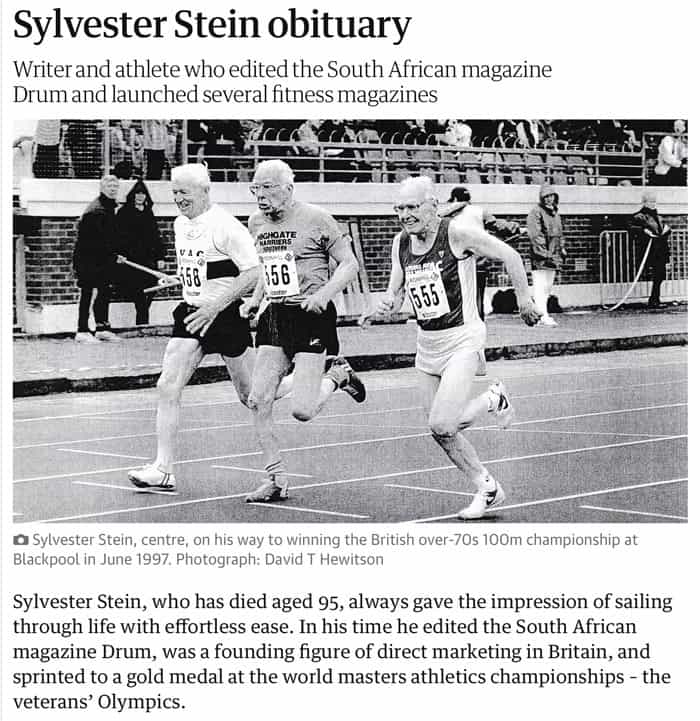
Source: The Guardian, 3 January 2016.
As someone who recently turned 50, I might take him up on that advice!