Finance is becoming ever more quantitative. The sheer amount of data available grows exponentially and the tools to analyse it are becoming ever more complex. If you are young today and want to have a career as an investor, you’d be forgiven to wonder if you should study computer science or another STEM degree rather than business and economics. A Chinese-Canadian research team has used more rigorous analysis to assess the impact of ‘quants’ on the performance of investment firms, so let’s look at what they have to say.
Ling Cen and his colleagues examined the career tracks of 124,947 data scientists employed by 1,957 different investors between 2008 and 2021. They then looked at the trading and investment profits of these almost 2,000 firms and institutional investors to see if there was an increase in abnormal returns after they hired data scientists.
The chart below shows that the CAPM alpha rose on average by 0.5bps for every data scientist a firm hired if the data scientist was engaged in data analysis. Hiring data scientists for data collection did not statistically change the returns of the firm, but on average had a slightly negative influence. Hiring data scientists for data and model maintenance increased alpha by about 0.4bps. That doesn’t sound like much, but it is more than a 10% boost in the quarterly alpha a company achieved before it hired a data scientist.
Increase in CAPM Alpha after hiring a data scientist
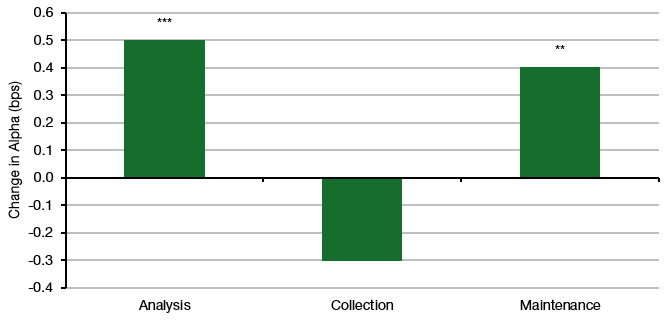
Source: Cen et al. (2024). Note: *** and ** denote statistical significance at the 1% and 5% level, respectively.
They even found that if a local university launched a data science degree, then four years later, local firms would start to hire more data scientists and saw their investment performance improve.
One pathway that drives this increased performance is that firms with more data scientists tend to shift their portfolio allocations towards more concentrated portfolios, allowing data scientists to develop deeper insights into specific investments.
Notably, though, these developments come with a flip side. When data scientists are concentrated among a few institutional investors, stock prices become less informative about future earnings. Data scientists tend to look at data, but not all information can be neatly quantified (though that is rapidly changing with the rise of large language models). Hence, if a company is mostly tracked by institutions that use data science to examine the company, a lot of the qualitative information the company provides does not get incorporated into the share price, making stock market less efficient. This creates possibilities for conventional analysts (or analysts using AI to ‘quantify’ qualitative information) to generate excess returns.
But going back to the original question if data scientists are better investors than people with a background in business or economics, at least this research seems to establish that this is so.