


In October 2023, the EU introduced its Carbon Border Adjustment Mechanism (CBAM). It requires EU companies that import high-carbon products like aluminium or cement from outside the EU to measure the emissions caused by these products abroad. Similarly, non-EU countries that export to the EU have to document the emissions of their products. Starting in 2026, the EU will then charge these imports with the same carbon price as the EU emissions certificates that domestic producers have to buy. But how much will this CBAM add to costs in the EU?
The goal is to eliminate the arbitrage opportunity from shifting carbon-intensive production from the EU to a non-EU country where the producers have lower emissions standards and don’t have to pay for emissions.
Of course, as with all environmental regulation, there has been opposition to these measures from producers who argue that this will increase costs dramatically. So, let’s look at the detailed analysis by Geoffrey Dolphin and Gianluigi Ferrucci to see how much exactly costs will increase from the CBAM.
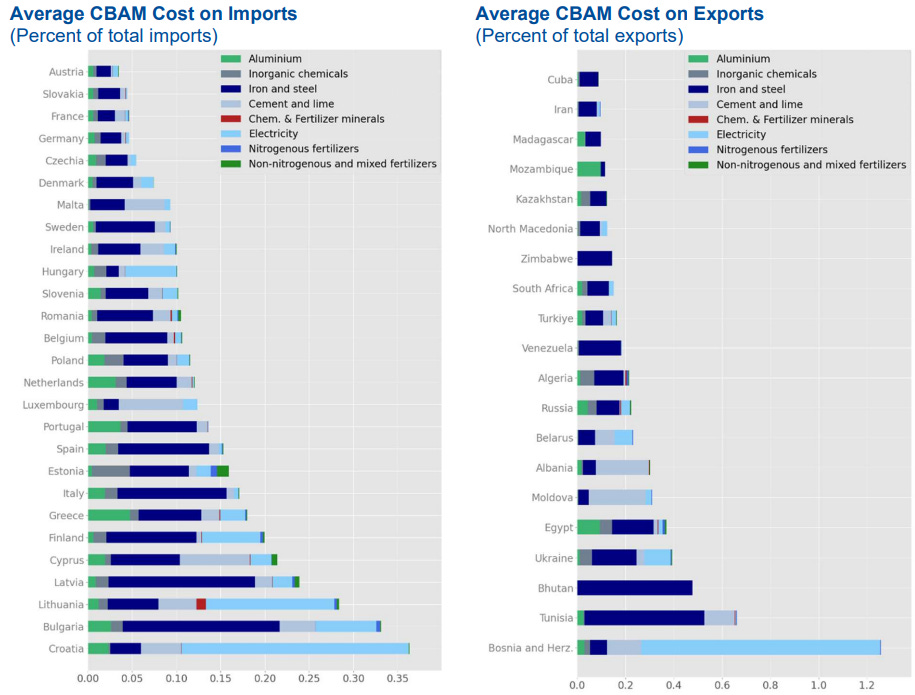
The chart below shows the estimated price increase as a percentage of all imports from the CBAM for each EU member. The average across the EU is a price increase of 0.1%, though it ranges from 0.025% for Austria to 0.3% for Croatia. Croatia is affected mostly by electricity imports from neighbouring North Macedonia and Bosnia, which generate electricity using coal power plants.
The right-hand panel below shows the average increase in export prices for the 20 countries outside the EU where costs are largest. Here, the average is a mere 0.04% cost increase to exported goods, but for Bosnia, it is as high as 1.2%.
Estimated increase in import prices (left) and export prices (right) from EU CBAM
Source: Dolphin and Ferrucci (2025).
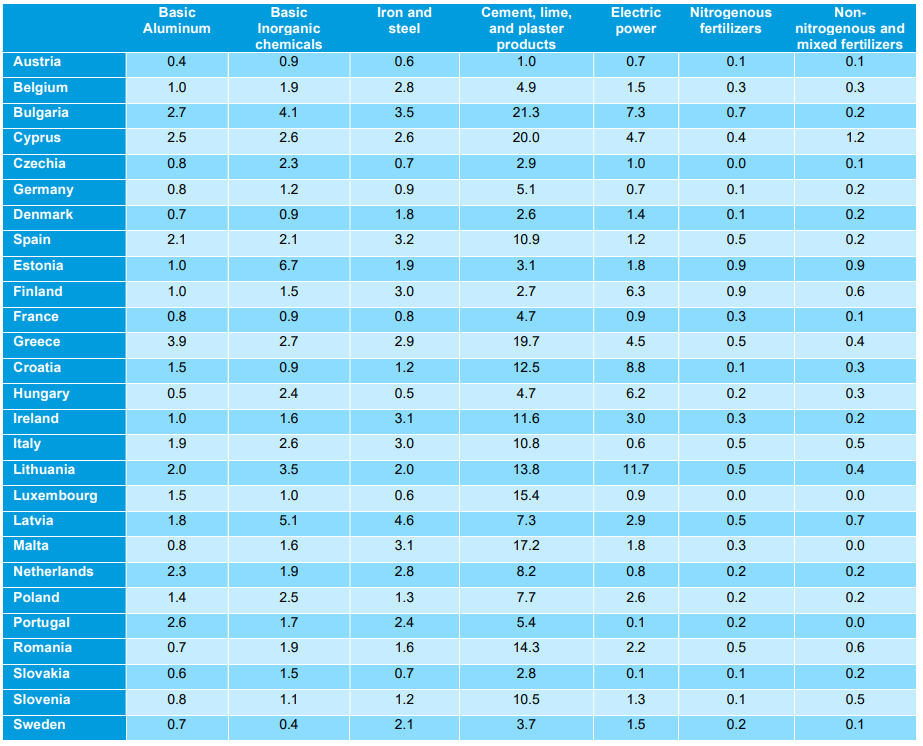
The average increase in import and export prices is minuscule, then. But hiding behind these tiny average increases are significant variations depending on the product and the country you look at. The table below shows the estimated increase in import prices by product for each EU member country. Note that countries that import a lot of cement from Moldova or Ukraine, where the production is based on outdated factories and powered with dirty coal, can experience a significant increase in import prices. Bulgaria, for example, may face an increase in imported cement prices of 21.3% if it doesn’t start importing from other sources. Germany, meanwhile, which buys cement from cleaner producers, faces a mere 5.1% increase in import prices.
Estimated increase in import prices of products from the EU CBAM
Source: Dolphin and Ferrucci (2025).
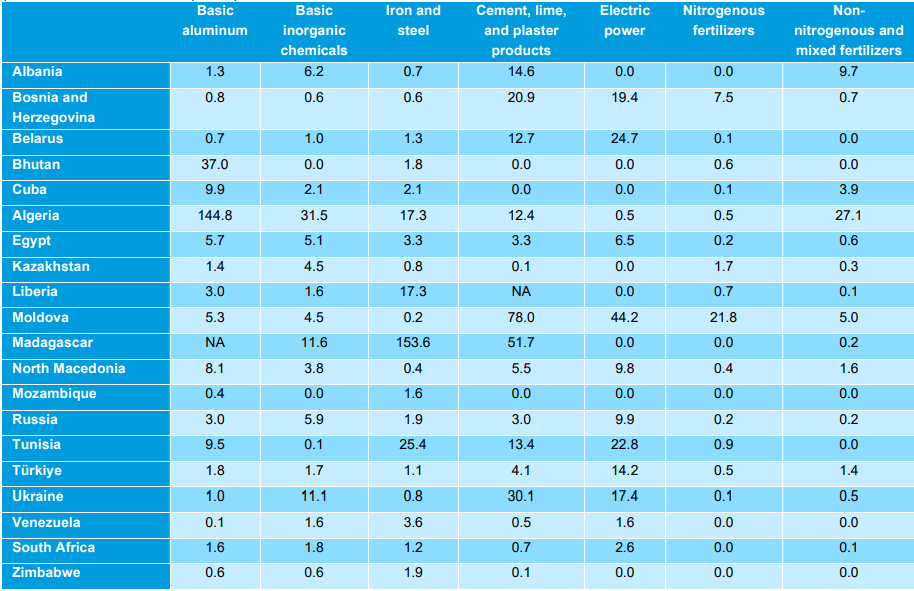
Conversely, we can look at the export prices of these products to the EU for the 20 largest exporters. You can see here that Ukraine’s cement exports to the EU will become 30.1% more expensive, rendering them essentially uncompetitive unless Ukraine improves its production methods. This is why Ukraine’s reconstruction efforts already today are planning to upgrade Ukrainian facilities to EU standards, so the infrastructure and manufacturing sector in that country can become more competitive after the war.
Estimated increase in export prices by products from the EU CBAM
Source: Dolphin and Ferrucci (2025).
If you ask me, when I look through these numbers, I will say the EU CBAM does precisely what it is supposed to do. It increases costs for polluting imports so much that importers are incentivised to look for cleaner alternatives, but it doesn’t create a significant increase in overall import prices and thus does not increase inflation or reduce profit margins of businesses in any meaningful way.




![A deep dive into FX hedging [Members]](https://som2nynetwork.com/wp-content/uploads/2026/07/Moguls-Social-336x220.jpg)

