We all know that to be persuasive and motivate people to take action, you have to express certainty and urgency. But have you ever noticed that when you write things down, you ‘sound’ more confident and certain about things than when you talk to someone and debate an issue. In the latter setting, you may feel the need to ‘hedge’ your statements and say something like ‘This post might change your life’.
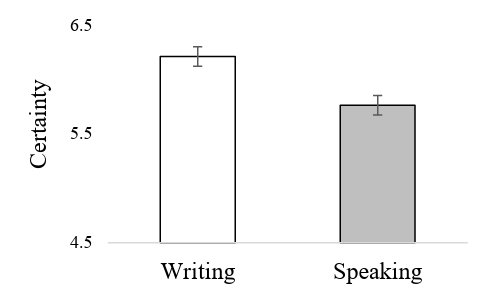
You and I may not have been aware of this tendency before (and I cannot tell you how hard it is to write these lines right now because I am so self-conscious about every word…). But if you read this study by Giovanni Luca Cascio Rizzo, Jonah Berger and Matthew Rocklage you will learn that people who are writing about a restaurant, a product they purchased or the like express a higher degree of certainty abut its qualities and defects than if they are speaking about them.
Degree of certainty expressed in writing vs. speaking
Source: Rizzo et al. (2024)
Their study tested whether this difference in certainty could be the result of people not remembering key information about a product or service and that that may influence their choice of words, but that does not seem to be the case. Rather, what seems to happen is that when we say something, we also hear it at the same time and that induces us to think about the accuracy of our statements and automatically causes us to express a lower degree of certainty. This is also reflected in written statements. When people are given a chance to edit their written opinions, they tend to tone it down and make them sound less certain.
This has important implications for communication. Spoken reviews of products or spoken arguments for public policies tend to be less persuasive than the same review or argument expressed in writing. Similarly, this kind of research helps explain why there is no nuance on social media. Social media posts are a written form of communication that hardly ever gets edited before people hit the ‘send’ button. Compare this to a research report which is often edited several times before it is being published and couched in uncertainty because it is part of a good research report to analyse all angles of an investment case. This may reduce its persuasiveness, but it most certainly increases its accuracy.
But are people who are able to speak in certainties and express no doubt about their opinions more persuasive (you know who I am talking about)? I would say no, but I may not be most people in that respect.
To me, when it comes to the world of investments, financial markets, and politics, expressing a high degree of certainty is simply not possible. Hence, when I encounter a politician or an investment analyst who always expresses a high degree of certainty and shows no signs of doubt, my respect for them immediately diminishes and I instinctively tend to ignore them. Indeed, my instinct is to think of them as stupid and not very thoughtful – the very opposite of persuasive.
This is because in my experience, investors tend to lose a lot of money when they think that a stock can only go up, or interest rates can only go down. Indeed, when at the start of each year, you read about consensus forecasts for the coming year and everybody agrees that bonds are a sell or energy stocks are a buy, it’s usually a good sign to buy bonds and sell energy stocks.
Similarly, if you encounter a politician who is certain that a policy will be easy to implement and ‘good for the country’, you can be sure that it will be fiendishly difficult to enact in real life and likely a mess for the country.
So, if you read the news, watch CNBC or Bloomberg TV and encounter someone who speaks in certainties, remember this post and the study cited above and realise that it is probably a very bad idea to believe what they say. It might just change your life for the better.