Summary
- SMS works best when each message is mapped to a lifecycle moment and a timing signal, not treated as a standalone promotional channel bolted onto ecommerce
- The twelve use cases below split into three groups: ecommerce revenue recovery, operational and service alerts, and retention and lifecycle messaging
- Cart recovery, flash drops, and appointment reminders each need different send windows and different pairing with email or push
- Healthcare, finance, and travel have disclosure and timing requirements that a generic retail playbook does not cover
- Two-way conversational SMS is replacing the one-way blast, which changes the metrics that matter from click-through to response and resolution
- Carrier registration and RCS Business Messaging both affect whether time-sensitive sends arrive at all, so deliverability belongs in the strategy rather than in legal housekeeping
Short message service (SMS) marketing works when a brand treats it as one coordinated layer inside a broader engagement strategy, not a one-off blast reserved for discount codes.
For lifecycle, customer relationship management (CRM), and retention marketers, that means mapping each text to a specific moment: an abandoned cart, a missed appointment, a lapsing loyalty tier, a service disruption.
This article is built for teams at mid-market and enterprise brands who already run SMS in some form but suspect it is underperforming because it is siloed from email, push, and on-site data.
We will walk through twelve use cases spanning retail, healthcare, finance, and travel, then cover the deliverability and compliance groundwork, including carrier registration and RCS Business Messaging, that determines whether a text drives revenue or gets filtered before it arrives.
What separates a working SMS program from a discount blast
Two variables decide whether SMS earns its cost: what triggered the message, and what the platform knew about the recipient when it fired.
A text triggered by a date on a content calendar has to guess at relevance. A text triggered by an abandonment event, a delivery status change, or a predicted replenishment date does not.
That distinction runs through every use case below, and it is also why the same message can read as helpful at one hour and as noise at six.
The second variable is suppression. Most duplicate-message problems are not send-time mistakes. They happen because the email platform, the SMS platform, and the on-site personalization layer each hold their own version of the customer and none of them knows what the others just sent.
A unified customer data layer is what collapses those three versions into one.
Ecommerce revenue recovery use cases
1. Cart abandonment recovery
SMS abandonment recovery works when the send window matches shopping intent instead of a fixed delay applied to every user. A text sent within minutes of cart abandonment reads as helpful.
The same message six hours later, after the shopper has already moved on or bought elsewhere, reads as noise.
High-intent categories such as flash-sale apparel or limited-stock electronics call for a near-immediate nudge, typically within 15 to 30 minutes of abandonment.
Considered purchases like furniture or travel bookings tolerate a longer window, often several hours to a full day, because the decision cycle is naturally slower. Getting this wrong in either direction suppresses conversion and, over time, trains subscribers to ignore the channel.
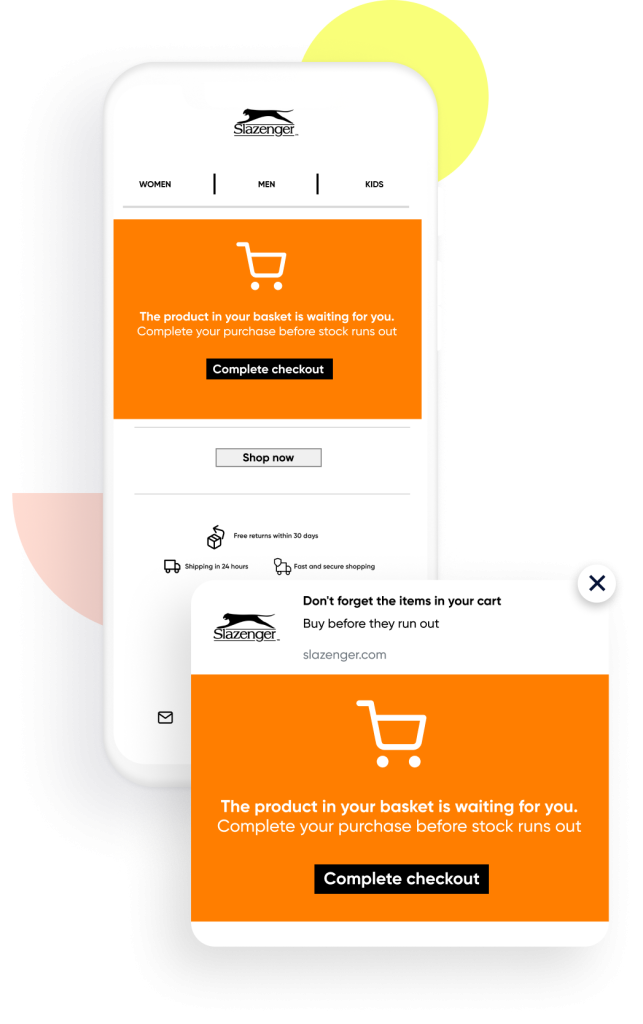
Slazenger built its cart abandonment sequence across email, web push, and SMS on a single journey rather than as three separate campaigns, reaching a 49x return in eight weeks.
The messaging logic that sits behind sequences like this is covered in more depth in our guide to high-converting abandoned cart emails.
Coordinating with email and on-site so the same shopper is not double-messaged
The bigger risk is not a single badly timed send. It is three channels firing the same cart reminder within an hour because the email platform, SMS platform, and on-site personalization engine do not share suppression logic.
Journey orchestration that sequences channels against a single customer record prevents that overlap and lets the highest-intent channel go first.
2. Browse abandonment recovery
Browse abandonment is a different flow with different economics, and treating it as cart abandonment with a longer delay is where most of its value leaks away.
The shopper never committed to a cart, so the message cannot assume purchase intent. It can wait longer, often a full day, and it should lead with category context or a related product rather than a reminder of something the shopper did not actually choose. Reserve any incentive for later in the sequence, if it appears at all.
Where browse abandonment sits relative to the other automated flows, and why it should be built third rather than first, is set out in our breakdown of the five retail flows that drive revenue.
3. Flash sales and limited-time drops
SMS is frequently the channel subscribers act on before they open email or tap an app push, which makes it well suited to drops with a hard countdown. The tight character limit forces clarity: an offer, a deadline, a link.
A flash sale lives or dies in its first hour, and SMS gets read closer to real time than most other owned channels. Retention teams increasingly lead time-boxed drops with a text, then let email carry richer product detail and app push handle in-session nudges once the shopper is already browsing.
Protecting deliverability during high-volume sends
Sending an identical flash-sale text to an entire list at once strains carrier throughput and increases the odds of filtering. Splitting the send solves both problems:
- Stagger the general send in waves rather than a single blast to smooth carrier delivery load
- Exclude recently purchased or already-converted segments so the same shopper does not get a redundant nudge
- Route lower-intent segments to email first and reserve SMS for users who have engaged with SMS recently
4. VIP early access tiered by customer lifetime value
Customer lifetime value (CLV) should determine sequencing, not just discount depth. High-CLV subscribers earn earlier access to new drops and richer perks, typically 15 to 30 minutes ahead of the general list. General subscribers still get the offer, just later and often smaller.
This only works if CLV, purchase history, and loyalty status sit on the same customer record that email and push already read from. Several worked examples of tiering built this way appear in our collection of omnichannel marketing examples.
Operational and service alert use cases
Appointment and service alerts are where SMS earns its keep outside ecommerce, because a missed appointment, a missed payment, or a missed itinerary change carries real operational cost.
5. Appointment reminders and confirmations
A confirm-or-reschedule text sent 24 to 48 hours ahead, with a same-day follow-up, consistently reduces no-shows more effectively than email alone, since texts get opened and acted on faster.
The pattern travels well beyond clinics and salons. Any category where the booking itself is the conversion event, from test drives to mortgage consultations to service appointments, depends on the same mechanic: a reminder that carries a one-tap confirm or reschedule rather than a line of text asking the customer to call.
6. Two-way confirm and reschedule replies
Two-way SMS lets a patient confirm a clinic visit, a customer reschedule a service call, or a borrower acknowledge a payment due date without picking up the phone.
Building that reply logic into the flow, rather than sending one-way reminders, turns a passive alert into a low-friction action step that closes the loop in seconds. It also changes the staffing picture, since a reschedule handled inside the message thread is a call the contact centre never receives. The same two-way conversational patterns apply across messaging channels, not only SMS.
7. Payment due-date and account status alerts
Financial services messaging trades urgency for precision. A payment reminder has to be timed to the billing cycle, reference the correct account, and carry whatever disclosure language the product requires, all without exposing account detail in a message that may be read on a lock screen.
The value is straightforward: a due-date reminder that arrives three days early recovers a payment that a late notice only penalizes. The constraint is equally straightforward, and it is covered in the compliance section below.
8. Service disruption and travel itinerary alerts
When a flight moves, a delivery slips, or a service goes down, SMS is usually the only channel fast enough to matter. These messages are not marketing, but they shape retention more than most campaigns do, because they are read at the exact moment a customer is deciding how much the brand can be trusted.
Travel adds a second requirement: the alert has to carry the next action, not just the news. A delay notice that includes a rebooking link or a gate change resolves the problem in one message. One that only reports the delay generates a support call.
This is also where real-time event triggers matter most. A flight delay, a cancelled booking, or a failed delivery is an event arriving from an operational system, and the messaging layer has to react to it in seconds rather than on a scheduled sync. Richer formats help here too, since a branded, interactive message can carry a rebooking button rather than a shortened link.
Retention and lifecycle use cases
Loyalty and win-back SMS works when the trigger comes from actual purchase and browse behavior, not a generic calendar reminder. A birthday text with no purchase context feels like spam. A lapsed-customer text referencing the exact category someone browsed three weeks ago feels like the brand noticed.
9. Birthday and milestone messages
A unified customer data platform (CDP) holding purchase history, browse behavior, and loyalty status in one place is what makes this kind of timing possible.
Without it, birthday and milestone sends default to the same generic offer for every subscriber, regardless of whether they are a first-time buyer or a five-year loyalty member. Insider One’s Customer Data Management layer keeps that history in one place so SMS triggers pull from the same record email and push already used.
10. Lapsed-customer win-back
The win-back trigger should be based on a customer’s own purchase cycle rather than a flat inactivity window. A shopper who buys quarterly is not lapsed at 60 days. A shopper who buys weekly is lapsed at 30.
Reference the last category browsed or bought, and hold the incentive back for the second or third message. Leading with the discount teaches the segment that going quiet is profitable. Predictive models can set that window per customer rather than per segment, scoring churn likelihood instead of counting days.
11. Loyalty tier and points-expiry nudges
Expiring points and slipping tiers are among the few genuinely time-bound reasons to text a customer, which is why they convert well and why they are easy to overuse.
The rule is that the message has to tell the customer something they could not already see: how many points, expiring when, and what that amount is actually worth against a specific product. A generic “your points are expiring” text with no balance is a notification, not an offer.
12. Conversational order status, FAQs, and upsell prompts
Conversational SMS, where a subscriber can ask a question or confirm an order status and get an automated, relevant reply, is replacing the one-way blast as the standard for engagement quality.
That shift changes what SMS effectiveness means. Response and resolution rates, not just click-through, become the metrics that matter.
A well-built conversational flow can handle order-status questions, appointment changes, and light upsell prompts without pulling in a live agent for every reply.
Insider One’s journey orchestration supports these branching, two-way flows across SMS alongside other channels, and our WhatsApp marketing guide covers the same conversational logic applied to a richer messaging format.
For a wider view of how these flows work across channels, see our guide to conversational commerce platforms.
Deliverability and compliance groundwork for 2026
Compliance is not a separate workstream from performance. A message that is filtered, or that cannot legally carry the detail the customer needs, does not convert regardless of how well it is timed.
Consent and opt-out handling. The baseline across all markets is documented consent at the point of collection and a working opt-out on every send. Pre-approved opt-in forms and templates shorten this work considerably compared with building consent capture from scratch.
Carrier registration in the United States. Ten-digit long code (10DLC) registration has been enforced by US carriers for several years, and unregistered senders face throttling or outright filtering.
This is not a new 2026 requirement, but it remains a common cause of unexplained delivery failure, particularly for brands that expanded into SMS through a new vendor and never completed registration for the new sending numbers.
Healthcare. Messaging that touches protected health information needs careful handling of what appears in the message body, since a text is often read on an unlocked preview screen. Appointment reminders can usually reference time and location without naming the service.
Financial services. Texts referencing rates, terms, or account status often require specific disclosure language, which sits awkwardly inside a character limit and is one of the clearer arguments for RCS in this sector.
RCS Business Messaging. Rich Communication Services is a richer format supporting branded sender verification, images, carousels, and interactive buttons.
Carrier and device support is still expanding, so the practical approach is channel-preference scoring with automatic SMS fallback, so customers on unsupported devices receive a standard version of the same campaign without a duplicate workflow.
Our RCS versus SMS guide covers where the format earns its place, and our RCS retention guide works through the flows in detail.
Why choose Insider One for lifecycle SMS
Most SMS underperformance traces back to the same cause: the platform sending the text cannot see what the other channels just did.
In Architect, SMS and RCS are steps on the same canvas as email, push, and on-site messaging, firing from one trigger against one profile. A shopper who converts on the website exits the sequence, and frequency caps apply across the whole profile rather than per channel, which is what removes the duplicate cart messages described above.
The Actionable CDP holds the purchase history, CLV, and loyalty status that birthday, win-back, and tiering triggers depend on, so an SMS reads from the same record email already used. Next Best Channel then decides whether a given step reaches a customer by text or by email, and Send Time Optimization sets the hour per subscriber.
Explore SMS and RCS alongside the wider platform, or browse customer results by industry.
FAQs
SMS remains effective when messages are timed to lifecycle moments and coordinated with other channels rather than sent as standalone blasts. Effectiveness now depends more on relevance, timing, and deliverability readiness than on raw send volume or blanket discount offers.
Appointment reminders, payment due-date alerts, service disruption notices, and two-way confirmations all perform well in healthcare, finance, and travel. These use cases rely on operational timing and disclosure handling rather than promotional offers, which makes them distinct from retail cart-recovery or flash-sale sends.
RCS Business Messaging supports branded sender verification, images, carousels, and interactive buttons, unlike plain-text SMS. Carrier and device support is still expanding, so brands should treat it as an addition with SMS fallback rather than a full replacement in the near term. Our RCS versus SMS comparison sets out the trade-offs.
Ten-digit long code (10DLC) is a carrier registration requirement for businesses sending application-to-person SMS from standard phone numbers in the United States. It has been enforced for several years. Unregistered senders risk throttling or filtering, which makes registration a direct factor in whether time-sensitive campaigns arrive.
Duplicate messaging usually happens when channels do not share suppression logic against a single customer record. Coordinating sends through a shared customer data platform and journey orchestration layer lets one channel fire first and suppresses the others once a subscriber has engaged or converted.
Cart abandonment recovery, because it fires on an explicit purchase signal and the audience is already warm. Appointment or service alerts come first instead for brands where a missed booking costs more than an abandoned cart.