

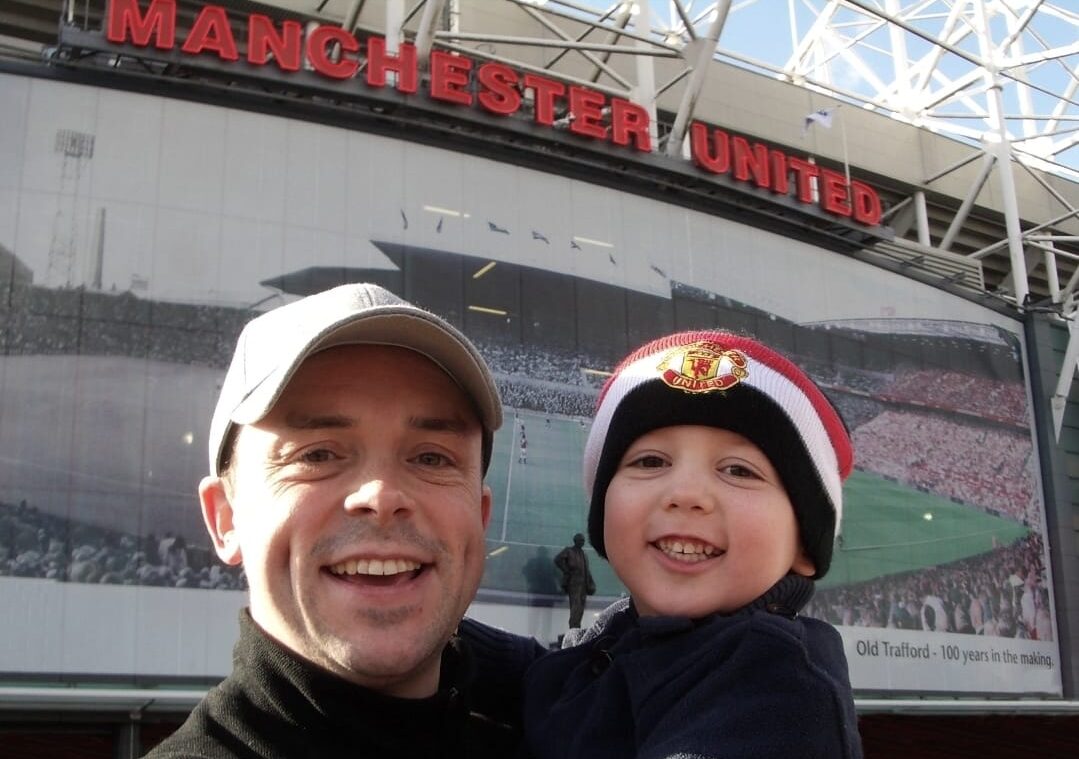
United People is a new series about the people who make Manchester United what it is: the supporters, characters and communities whose stories exist beyond the pitch. In the first of the series, I meet Jon Nield and his son Alex — and discover a story about football, family and making memories together.
Jon Nield and his son Alex are closing in on visiting all 92 grounds in the Premier League and EFL. But their story is about much more than ticking stadiums off a list. It is about fathers and sons, the things we inherit, and the lengths we go to in order to pass them on.
There are 11 left: Charlton. Portsmouth. AFC Wimbledon. MK Dons. Peterborough. Plymouth. Wycombe. Bristol Rovers. Exeter. Gillingham. Port Vale.
Jon Nield knows the list. Alex, his son, probably knows it better. They are closing in on the 92: every ground in the Premier League and EFL. Yet the strange thing is that, until relatively recently, they weren’t particularly trying to do it. They were just going to football.
Manchester United, obviously. First team, women’s team, Under-21s, Under-18s. Salford City. Grassroots football. Wherever there was a game to be watched, there was a decent chance Jon and Alex would watch it. Then they started logging the grounds they had visited on the Ground Hopper app and, last season, realised they were only about 20 short.
“Wow,” Jon remembers thinking. They had “almost knocked it off without even trying”.
Now they are trying. Bromley was ticked off on a Friday night. They were already staying in London the following day for something United-related when Alex realised there was an opportunity. Why not get another one? Millwall were at home. So off they went to the New Den.
That’s Alex: Jon reckons his son would happily watch two kids kicking a ball around a park with jumpers for goalposts.
“You can’t teach passion,” he says. Which is something I understand, because nobody really taught me either.
Jon’s United story begins, as so many of ours do, before he can properly remember it. His dad began going regularly around 1960. In 1965, he became a member of the Manchester United Development Association, selling tickets and, through doing so, eventually gaining the opportunity to buy more season tickets for the family.
Jon started going in 1983. Initially, he and his younger brother Nigel shared a season ticket, effectively taking turns at home matches. As the family acquired more tickets, they were eventually able to go together.
But there is a difference between going to United and United becoming part of you. For Jon, that happened around 1985. United had won the FA Cup. A huge team poster went up on his bedroom wall. Suddenly he knew everybody in the team. There was Match, Shoot, annuals, stickers. The other football he had played and followed began to recede. United filled the space.
It’s familiar territory. My dad didn’t sit me down one day and instruct me to support Manchester United either. It was simply there, part of the fabric of growing up. Then, somewhere along the way, something inherited became something of your own.
Jon’s dad opened the door and Jon walked through it. By nine or ten, he was going home and away. When he was old enough to earn money from a part-time job, much of it disappeared into United. He travelled to places such as Liverpool and Leeds without tickets, trusting that somehow he’d get sorted when he arrived.
Go first, work out the obstacles afterwards. There is an echo of that attitude in the man Jon became.
There was another world-changing trip in 1991: Rotterdam. United against Barcelona in the European Cup Winners’ Cup final. (You’ll be able to read about the run to that final in another feature in this ‘United People’ series when I interview author Daniel Williamson, author of the excellent If I Hadn’t Seen Such Riches). Jon was 15, approaching 16; Nigel around 13. They travelled on a Red Issue coach, armed with the paper passports you could obtain for a year in those days.
Neither brother had ever been abroad before. Family holidays had meant Wales, Scotland, elsewhere in Britain. Then Manchester United put two teenage brothers on a coach and carried them across Europe to watch their team win a European final.
Football made Jon’s world bigger. It would not be the last time.
There are objects which acquire their own histories when you’ve followed a football club long enough. For Jon, one of them is a flag. The original was NEW MILLS REDS. I knew that flag before I knew Jon: growing up in New Mills, I’d seen it at United and noticed it. There was something oddly reassuring about finding the name of your own little part of the world represented among all those other United flags.
Only years later did I discover the man behind it. Jon still has that original flag, a proper heavy-duty thing. He sourced the letters and stitched them on himself. Whoever said those Fashion Textiles classes they made us do at New Mills School were waste?
There is a newer flag these days: NIELD REDS. That one has occasionally caused confusion. Other supporters have assumed Nield must be a place and asked Jon where it is.

Above: United’s own post on X prior to the game against Fulham on 20 September
In a sense, though, perhaps the progression from the two flags tells its own story. First the place you come from, then the family you create.
Alex was born in 2007 and was three when Jon first carried him into Old Trafford in around 2010. If Jon had any expectation that his son would become a United supporter, he didn’t have to work particularly hard at convincing him: the passion was already there. While other children might lose concentration during a game, Alex would sit and watch. And watch. And then watch some more.
United became his club, but football became his obsession: not just the men’s first team. The women. The academy. Salford. Grassroots. Football on television. Football in grounds. Jumpers for goalposts if necessary.
“You can’t teach passion.” There is the inheritance again: a father can take his son to Old Trafford. He can buy the ticket, make the journey, introduce him to the rituals and the people. He can give him the opportunity. He cannot make him care. Jon’s dad couldn’t do that for Jon. Jon couldn’t do it for Alex. They didn’t need to.
Alex is now a familiar face around United. That matters more than the photographs with players or the famous names he has encountered over the years. Jon’s point is that some of the people around the club genuinely know Alex. They recognise him because he has been there, again and again, following United at different levels.
On one occasion, a sizeable group of supporters started singing: “There’s only one Alex Nield.”
It happened once. There is no need to turn it into anything bigger than it was. Then again, how many of us have ever stood at a football match and heard a crowd of people singing our name? Jon still talks about it with something approaching disbelief.
These days, he and Alex have excellent seats close to the tunnel at Old Trafford. NIELD REDS hangs nearby. They have their patch, their place.
Loving Manchester United, of course, does not necessarily mean loving everything Manchester United does. Jon knows that distinction particularly well. His family’s old seats were once on the back row of K Stand. When changes around the private boxes affected them, he says the family discovered what was happening through Red Issue, rather than directly from the club. His dad called United, but eventually their block of seats was broken up and the family dispersed across several rows.
That story hit home with me. My own dad is now 79. Our family were moved to seats behind the goal where people stand throughout the game. Fair enough, but he couldn’t comfortably stand for 90 minutes, which meant that simply being able to see became a problem. We asked to move again and, eventually, United found us better seats that are much more appropriate for him.
But these experiences illustrate something about the strange contract between supporters and football clubs. If your mobile phone company treats you badly, you find another one. If an energy supplier lets you down, you can switch. Football doesn’t work like that, your football team is your football team.
Jon can be deeply frustrated by Manchester United the organisation while remaining completely bound to Manchester United the thing: the club his dad gave him, the journeys he made with Nigel, Rotterdam, the flags, the people, the memories, and now Alex.
Perhaps the criticism sometimes comes because the attachment runs so deep.
Following football with Alex also requires rather more organisation than simply deciding where to go next. Alex uses a wheelchair. That is part of his story but it isn’t the definition of him. Jon is matter-of-fact about it, and so is Alex. Football should be accessible to everybody. The problem is that, in practice, another ground can mean another administrative exercise.
Create an account with the club. Register the access requirements. Provide the necessary evidence. Speak to a ticket office because an accessible ticket often can’t simply be bought online. Work out the transport. Find suitable accommodation if they’re staying overnight. Establish what will happen with the wheelchair.
Alex can transfer from his wheelchair into a standard seat, which can sometimes make things easier if somewhere safe can be found to store the chair. On occasions when an environment has proved awkward, Jon has physically carried him.
None of this is presented as heroic. It is just the work. And most people never see it. They see Jon and Alex at Old Trafford. At an away game. At an academy match. At Salford. At Bromley. At Millwall. They see another photograph from another football ground. They see Alex smiling. They don’t necessarily see everything required to get him there.
Jon has his own disability, which can bring practical considerations of its own. Yet his instinct is what he describes as “can-do”. He becomes frustrated when organisations begin with the wheelchair and produce reasons why something cannot happen, rather than starting with what Alex actually can do.
“He just wants to be like everybody else,” Jon says.
When Alex celebrates a goal, his mate Adam will sometimes help him out of his wheelchair so he can disappear into the same joyous mess as everybody around him. That’s not inspiration. That’s going to the match.
There is an irony here because Jon worries that football itself is moving in the opposite direction: too much football; kick-off times dictated by television; increasingly expensive premium experiences; a sport in danger of becoming something consumed rather than attended.
For Jon and Alex, football remains stubbornly physical. It is something you go to. You travel. You arrive. You sit among people. You meet people. You watch the game. Then you get up and do it again.
Perhaps that is why the 92 suits them so well. Not because either of them grew up dreaming of completing it. They didn’t. They got close almost by accident because they kept saying yes to football.
Now there are 11. Charlton might be ticked off watching United Women away, potentially on the supporters’ coach. Others will require rather more driving.
Eventually there will be one left. Then none. And I suspect that won’t change very much at all. The app will say 92. Jon and Alex will have completed something genuinely special together. Then there will be another game somewhere.
Because the 92 was never really the point.
There is something else Jon says which stays with me. People see them “here, there and everywhere”, he says, but it is hard work. There are accessible hotels to find, transport to organise, tickets to arrange, calls to make, situations to anticipate.
And Alex? “Happy-go-lucky,” says his dad. Always smiling. Jon doesn’t say any of this to solicit praise for himself. In fact, the opposite is what makes it moving. The work is supposed to disappear.
If Jon gets it right, Alex doesn’t have to experience his life as a logistical operation. He gets to experience the football. Perhaps that is what fathers do. Jon’s dad gave him United. He created the opportunity, and Jon made the passion his own. United took a kid from New Mills around England and, eventually, across the water to Rotterdam.
Now Jon is opening the world for his own son. He can’t give Alex his passion. Alex has more than enough of that already. What he can do is find the ticket. Make the phone call. Plan the journey. Solve the problem. Get him through the door.
Eleven more grounds will come and go. And after talking to Jon for an hour, I realise the 92 isn’t really the destination at all. The destination is wherever Alex wants to go next.
As Jon puts it: “If Alex wanted to go to the moon, I’d try and make it happen.”
By Andrew Kirby, Sports Storytelling & Communications | Andrew Kirby


