I Hear the Snow, I Smell the Sea

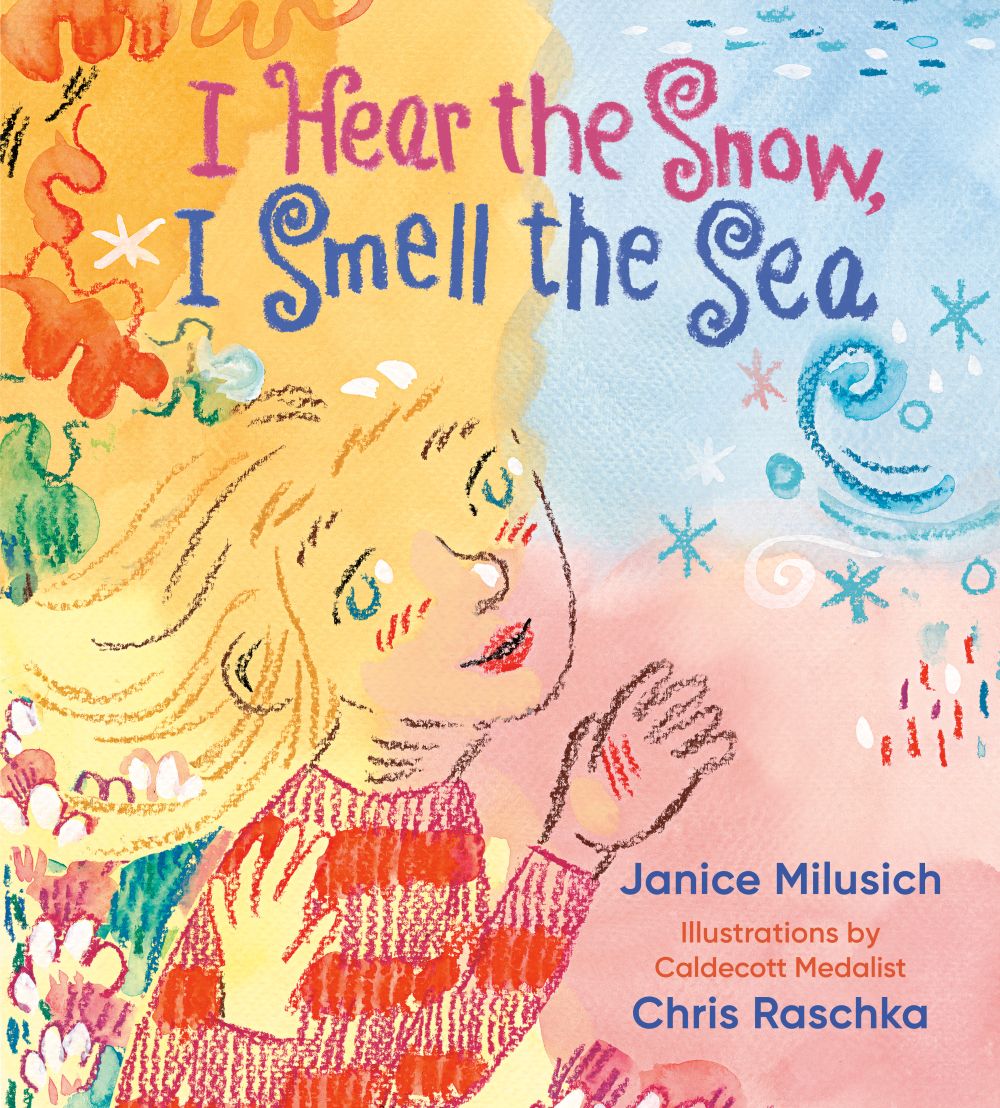
I invited Jan to join me this month on Children’s Book Corner after reading her book and learning of her classroom connection to visually impaired children. It’s an ideal choice to shed light on visual impairment, but also to encourage children to be “in the moment” and appreciate their natural surroundings throughout the seasons as well as to foster creativity.
Judy Bradbury: Tell us about this project: What seeded its creation? How did you conceive of the theme/focus of I Hear the Snow, I Smell the Sea?
Janice Milusich: The idea for the story that became I Hear the Snow, I Smell the Sea came about from my experiences working as a teacher for the visually impaired and blind. For the past 17 years I’ve worked with preschool aged children facilitating their exploration, working to scaffold their growing concept development, encouraging their use of compensatory skills including tactual discrimination, identification and recognition, and auditory identification, localization and differentiation, all the while supporting their self-advocacy skills within the classroom and school.
Out of all the grade levels, preschool celebrates the exploration of seasonal changes. While engaged in activities in the classroom, or individually with a child, I encourage my students to explore and question. We share our perceptions and wonder is always a part of those experiences. Some of my favorite sessions occur during classroom push-in sessions when my students and their peers work together and learn from each other’s differing perspectives. That sharing is what I hoped to capture in writing this story.
JB: You are a full-time teacher who also writes for children. Tell us about your writing journey.
JM: At present, I’m working as a contracted teacher for the visually Impaired at two sites of a Special Education preschool and so it allows me some flexibility, which prior to my book being released let me have some writing time on the days I wasn’t seeing students, and now it’s allowed me to follow up on all the details that go into promoting a new picture book.
My writing journey has been a hard-fought journey to find balance, but it’s that way for many writers with family, children and work responsibilities. It’s been a journey in which perseverance has been a constant.
I’m extremely lucky to have the opportunity to work in a field that I love and it’s an extra special joy to create and publish a story in which the children I teach, children who are visually impaired and blind, can find themselves represented by a confident and spirited character.
JB: Tell us about a challenge you faced in the creation of I Hear the Snow, I Smell the Sea, or provide a memorable (or humorous!) anecdote related to the writing of the book.
JM: The manuscript was originally written in third person, but when Anne Schwartz showed interest in the manuscript, her caveat was that she’d like it revised to first-person POV. I was both excited that she was interested in the manuscript and worried about writing it in first-person POV.
I immediately reached out to one of my first students, who is blind, a writer and poet, and who was my sensitivity reader for the version of the story in third person, to ask her how she felt about me as a sighted teacher for the visually Impaired, writing the story from the POV of a character who is blind. Her support of my writing the story as an experienced TVI was what I needed to get to work.
JB: What is one unexpected joy that came from the creation of I Hear the Snow, I Smell the Sea?
JM: I’ve been lucky to experience many joys from the creation of I Hear the Snow, I Smell the Sea. Two memorable ones have been its inclusion in National Braille Press’s Children’s Braille Book Club for 2026 and its inclusion in the American Action Fund for Blind Children and Adults, Braille Pals Program, also for 2026. Both of those programs use a clear braille overlay on top of the pages of a picture book allowing its accessibility for both print and braille readers.
JB: Chris Raschka, the illustrator of I Hear the Snow, I Smell the Sea, is a Caldecott Medalist. What is your favorite illustration in the book? Why?
JM: The illustrations in the book are beautiful. I have a hard time deciding which is my favorite. Overall, I appreciated the subtle way that Chris expressed the main character’s disability with her lack of pupils and also the way he expressed her exploration through each season by making her skin color match the season she was in. What a lovely way to show her absorption in her surroundings.

Illustration © Chris Raschka
JB: What would surprise readers to learn about you or about the writing of I Hear the Snow, I Smell the Sea?
JM: Hmmm…I guess my collection of Converse Chucks! I have them in a rainbow of colors, and they have been my favorite footwear since I was a kid.
JB: Who do you perceive your target audience to be and why?
JM: Children ages 5-8, their families, teachers, and librarians. In I Hear the Snow, I Smell the Sea they may experience an increased awareness of the nuances our senses of touch, taste, hearing and smell have to offer us.
JB: What do you hope young listeners / readers will take away from I Hear the Snow, I Smell the Sea / What need(s) does this story satisfy?
JM: I hope readers will take away a greater appreciation for what the senses, other than sight, have to offer to their perception of the environment. This story speaks to the need for positive representation and through it I hope that visually impaired and blind children will find themselves represented in a way that empowers their understanding of and exploration of the world around them.
JB: How do you see I Hear the Snow, I Smell the Sea connecting to curriculum or being used in learning settings?
JM: I’ve created a teacher’s guide, edited with help from my sister, a retired 2nd grade teacher, and in it I’ve provided ways in which classroom teachers could integrate the concepts explored by the main character in the areas of science, math, social studies and English Language Arts. I Hear the Snow, I Smell the Sea could also be used to increase disability awareness.
JB: If you could ask your young audience a question, what would it be?
JM: I’ve been fortunate to be able to ask the children who’ve participated in my library and bookstore programs to join in sensory exploration activities that don’t involve the use of sight, and I enjoy asking and hearing their reply to questions such as, “How does it feel to you?” when offered a touch box and asked to explore an unknown object by touch, or “How does it smell to you?” when I’ve offered them a scent jar with an unknown item in it, and finally, “How does it sound to you?” when I’ve played a sound that they don’t expect. I love to see the curiosity in their faces as they think about the attributes of the items. It’s precious.
JB: What project(s) are you currently working on?
JM: Since my picture book was released, my writing time has been curtailed, and I haven’t found a balance between work, promotion and writing, but I am in the process of beginning a story about how a young blind boy navigates the changes that going to school creates in his day to night schedule.
JB: What is one question you wish I had asked, and what is your answer?
JM: I think your questions were thorough and considered. This is one of my first times being on the response side of an author Q&A, and I think you’ve done a fantastic job as an interviewer.
JB: Thank you for joining us, Jan!