Key Republican says he will vote for Todd Blanche to become attorney general after other senators defect – live | Republicans

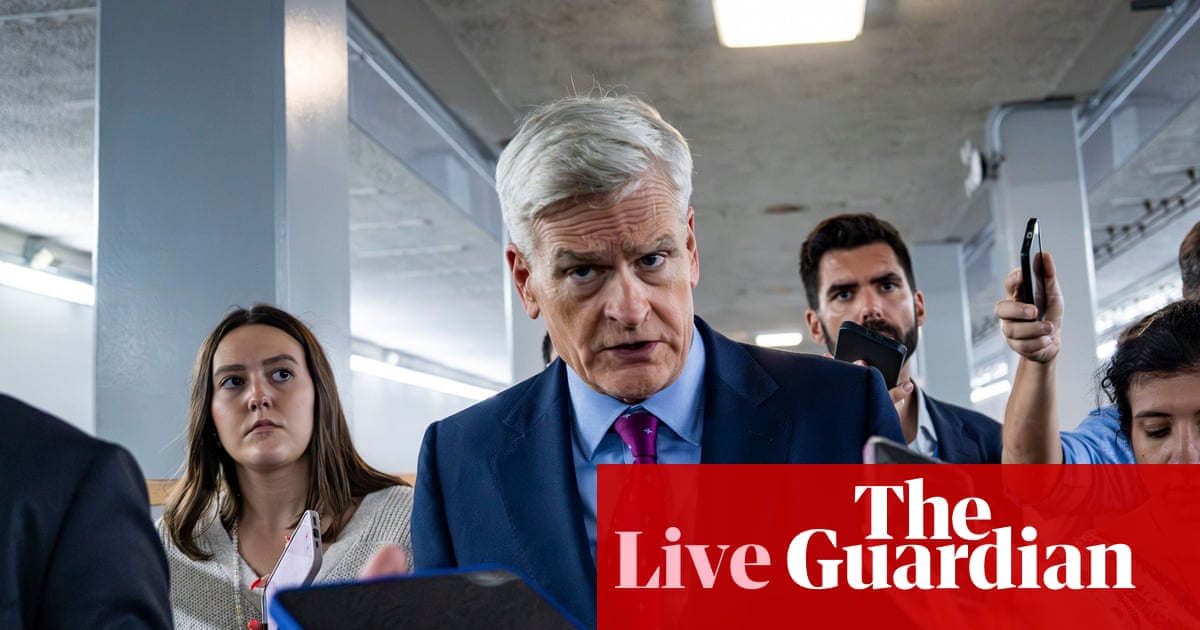
Cassidy says he will vote to confirm Todd Blanche as attorney general: ‘I will be criticized for this vote’
Senator Bill Cassidy, the last Republican who was undecided about Todd Blanche’s nomination as attorney general, said he would vote to confirm Blanche.
He noted that while Blanche, who previously served as Donald Trump’s personal lawyer, is “not perfect”, it is ultimately a decision between him or “another acting attorney general who may not run the department effectively”.
“This is not a referendum on President Trump. It is a decision regarding Mr Blanche in very specific circumstances,” Cassidy said on the Senate floor, explaining his decision process. His “yes” vote, will now likely clear the way for Blanche to receive the 50 votes needed. Vice-president JD Vance will then cast a tie-breaking vote that will ensure Blanche’s confirmation.
Key events
Richard Luscombe
Officers for Immigration and Customs Enforcement (ICE) will be equipped with much-delayed body cameras by the end of next month, it was reported on Friday. But experts have questioned the transparency of a policy that allows the ICE director to restrict the public release of footage unless “it is in the best interests of the agency”.
Pressure has mounted on the Trump administration to provide body cameras after people caught up in encounters with federal immigration personnel suffered death or serious injuries.
Two men were shot and killed by ICE agents, in Texas and Maine, last month in circumstances similar to the death of another man during a traffic stop in Illinois last September. None of the officers involved was wearing a camera.
Tom Homan, Trump’s so-called border czar, said last month that ICE officers would be required to have at least one body camera recording during future vehicle stops. Policy for body-worn cameras was first established in a February 2025 ICE directive, but funding for their provision was held up by this year’s partial government shutdown, Homan said.
Ramon Antonio Vargas
Louisiana congressional candidate Blake Miguez, a Republican state senator who was the subject of a police report accusing him of a rape that he denies, waited until the final day of a three-day qualifying period to make clear his intentions for the upcoming midterm elections.
Miguez on Friday afternoon signed up to run in Louisiana’s sixth congressional district – despite knowing, if he did so, he would have to again compete for a coveted Donald Trump endorsement which he had previously secured while campaigning for another US House seat.
Miguez had first signed up to run for Louisiana’s fifth US House district seat for a primary initially scheduled for May, and he had won the president’s endorsement. But that race was postponed until the November midterms after the US supreme court’s landmark voting rights decision in Callais v Louisiana prompted the state to redraw the boundaries of its congressional districts.
Those redrawn boundaries pushed a residence that Miguez bought in March in the state capital of Baton Rouge from the fifth district to the sixth, as the Louisiana Illuminator news outlet reported.
In late July, after his campaign website had temporarily become blank and password protected, a spokesperson for Miguez acknowledged to the Guardian that the state senator was left hoping to again “earn” Trump’s endorsement as he weighed announcing a run for office “under the new district lines”. Politico, citing sources with direct knowledge of the matter, reported a day later that Miguez was mulling a run in the new sixth district.
The outlet furthermore reported that Trump officials had told Miguez privately that he would not have the president’s endorsement — at least not immediately — if he opted for a sixth district run.
In safely Republican districts like the sixth in Louisiana, Trump’s endorsement is eagerly sought by candidates from the party he has led across two presidencies.
Another Republican candidate who has also formally signed up to run in Louisiana’s sixth district has already expressed his confidence that Miguez won’t have Trump’s endorsement.
“What I do know is he’s not getting the president’s endorsement in the sixth district,” Louisiana state senator Rick Edmonds said to reporters after signing up to run there on Wednesday.
Miguez’s website was reactivated on Friday. It had replaced a prior mention of his Trump endorsement with a pledge to work alongside the president if eventually elected.
He also didn’t mention having Trump’s endorsement in a social media post announcing his signing up to run in the sixth district, saying he qualified there because that area had “given so much” to him through the years.
An additional complication with which Miguez has had to grapple is a 2007 police report containing a rape allegation made against him by an ex-girlfriend. He denies the claim, and it never led to formal charges.
But that document’s existence first became public when the Atlantic and the Guardian each published separate stories on 11 March, after Miguez had locked down Trump’s fifth district endorsement. The Atlantic also wrote that the police report raised concerns within the president’s team that Miguez “either wasn’t fully vetted or wasn’t forthcoming about discoverable documents from his past” while he successfully pursued Trump’s endorsement.
Miguez’s opponents are bound to invoke that police report ahead of a 3 November open primary – and a 12 December runoff if necessary. In fact, his qualification on Friday was immediately met with a mass text from a federal super political action committee calling itself End Predator Abuse that provided recipients a link to a website with the police report.
“Blake Miguez CANNOT be our congressman,” the group’s text read.
In the months since the disclosure of that police report, US House members Eric Swalwell and Tony Gonzales – a California Democrat and a Texas Republican, respectively – heeded bipartisan calls to resign over allegations of sexual misconduct against both.
Then, on 10 July, Democratic US Senate hopeful Graham Platner of Maine withdrew his candidacy after detailed sexual assault allegations were made against him. And Republican congressman Max Miller of Ohio has been met with growing calls to resign over domestic abuse allegations.
By an overwhelming majority, the Senate just advanced legislation that would extend government funding through 11 December – after the midterm elections.
Current spending expires on 30 September.
As a reminder, before the House went on recess last month, lawmakers approved a stopgap measure to head off a government shutdown until 4 December, sending it to the upper chamber for consideration.
Top congressional Republicans have argued that an extension to the continuing resolution is necessary to ensure that Democrats do not block government funding measures in the Senate.
They did so last year for a record 43 days in protest against the expiration of tax credits that lowered some healthcare costs, and twice again this year, to push for reforms to immigration enforcement operations after the killings of two US citizens in Minneapolis.
Senator Elizabeth Warren, the top Democrat on the banking committee, has slammed reports that Donald Trump is attempting to fire Federal Reserve governor Lisa Cook again, despite an earlier supreme court ruling this year that protects her from dismissal while she fights the Trump administration’s allegations that she has committed mortgage fraud.
Warren said that the president “is tanking the economy, and he is desperate to shift the blame for higher costs and higher interest rates. So he’s once again trying to illegally take over America’s central bank.”
She added: “If he [Trump] is successful, it will be working families who pay the price. We will fight back to make sure he fails.”
Donald Trump has started his state department roundtable on American mining, we’ll bring you the latest lines as it gets under way.
A number of Donald Trump’s other nominations were also confirmed in the Senate today.
By a vote of 51-47 along party lines, the upper chamber’s confirmations included David Cummins to lead the Transportation Security Administration (TSA), and the new Federal Emergency Management Agency (Fema) administrator, Cameron Hamilton.
Here’s a recap of the day so far
-
Senator Bill Cassidy, the last Republican who was undecided about Todd Blanche’s nomination as attorney general, said he would vote to confirm Donald Trump’s pick to lead the justice department. His “yes” vote, will now likely clear the way for Blanche to receive the 50 votes needed, effectively saving his nomination.
-
This comes after Senator Lisa Murkowski, a moderate Republican from Alaska, said earlier that she would oppose Blanche’s nomination. “The politicization – even weaponization – of the Department did not start with this administration but has accelerated during it,” she said in a statement, adding that she does not have confidence that Blanche would be able to “check the worst impulses of this administration”.
-
A US federal appeals court has ordered the Trump administration to halt construction of the US president’s $400m White House ballroom, in a fresh blow to the controversial project. Trump, who demolished the historic East Wing of the White House last year to make way for planned ballroom, has repeatedly touted it as “a gift” to the US people. The president has said his administration will be “immediately appealing” the decision to the supreme court.
-
US employers unexpectedly lost 23,000 jobs in July and job gains for the previous two months were revised down sharply, as the summer slump in job growth continued amid ongoing conflict in the Middle East. The unemployment rate, however, held steady at 4.1%. Economists had projected an unchanged unemployment rate and 83,000 new jobs for the month.

Chris Stein
By a large, bipartisan margin, the US Senate on Friday approved a bill intended to punish Russia and countries that buy its petroleum exports over the invasion of Ukraine, capping a legislative push that was spurred by the death of its champion, the Republican senator Lindsey Graham.
The measure, renamed the Lindsey O Graham Sanctioning Russia Act in honor of the late senator’s work on the issue, was approved by an 86-11 vote.
The bill would impose new sanctions and visa bans on Russia’s president, Vladimir Putin, and top military commanders, as well as put tariffs of up to 500% on the country’s exports. It would also allow Donald Trump to impose levies of up to 100% on goods from countries that are the top five importers of Russian oil and gas.
The bill now heads to the House of Representatives, which may consider once it returns from recess at the end of August.
Some Democrats have warned that the bill would give Trump new tariff powers at a time when he has put such levies at the center of his trade policy.
“This bill gives him so much discretion that Trump can ultimately decide what countries to tariff, or what countries to exempt. And he can modify tariffs at his will,” said Ron Wyden, a Democratic senator who opposed the bill.
Trump vows to ‘immediately’ appeal court’s decision to block ballroom construction to supreme court
Following an appeals court’s ruling to temporarily stop construction of Donald Trump’s sprawling $400m ballroom, the president has said his administration will be “immediately appealing” the decision to the supreme court.
In a post on Truth Social, Trump went on to defend the new complex, which includes a “desperately needed military center” as well as a new “totally secure” ballroom.
“The Military and Secret Service are viewing this horrendous, politically motivated, and unlawful ruling as a National Security threat to our Nation,” the president wrote, while noting that the project is privately funded. “Much is already on site, or being delivered … There will be no expense to the American Taxpayer. This unjust decision must be overturned by the Supreme Court in its entirety,” Trump added.
As my colleague Robert Tait notes, the latest ruling by a US appeals court for the Trump administration to temporarily halt construction on its sweeping ballroom project, supports an earlier decision issued by a federal judge in April. This limited the construction project only to the undergound part of the project deemed necessary on national security grounds while blocking the hospitality facility envisioned by Trump for entertaining guests.
At the time, Trump lambasted that decision, by Judge Richard Leon – appointed to the bench during George W Bush’s presidency – as the work of a “Trump Hating” judge who he alleged had “gone out of his way to undermine National Security, and to make sure that this Great Gift to America gets delayed, or doesn’t get built”.