This article is part of TPM Cafe, TPM’s home for opinion and news analysis. It was originally published at Balls and Strikes.
A key component of President Donald Trump’s plan for preserving the Republican Party’s power and influence is making it as difficult as possible for Democrats to vote. As the 2026 midterms approach, he is still pushing the unhinged lie that widespread fraud both cost him the 2020 presidential election and also explains every Republican loss in every election since.
This delusion is partially responsible for his obsession with mail-in voting. In March, Trump told Republican lawmakers that passing legal restrictions on mail-in voting would “guarantee the midterms.” Their failure to do so, he continued, would mean “big trouble.”
That same month, Trump did his part, issuing an executive order that would impose onerous requirements on states that allow their residents to vote by mail. And in an unsigned opinion on Monday, the Supreme Court did him yet another favor, turning away a legal challenge that had temporarily blocked the order from taking effect.
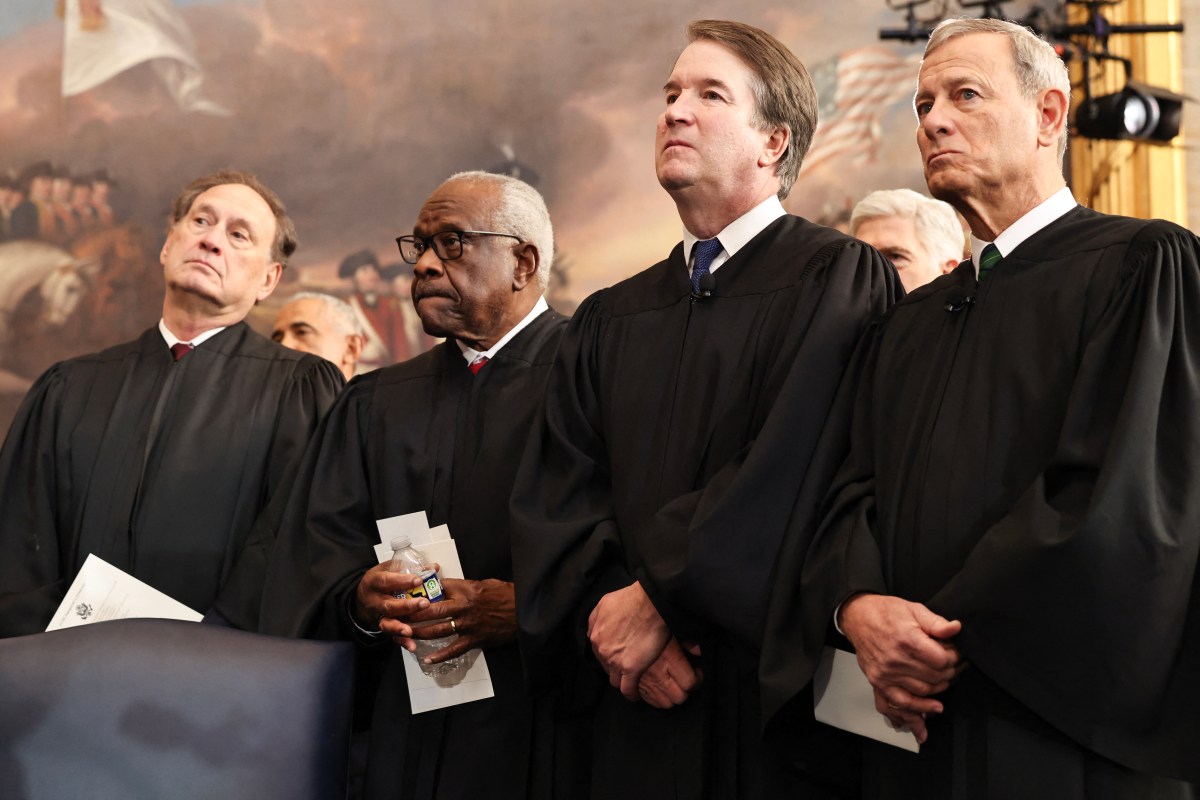
The result in Trump v. California does not give Trump everything he wants. But it shows just how far this six-justice conservative supermajority is willing to go to help its favorite president’s political movement—all while reserving for itself the right to decide how much of the Constitution remains in place for the midterms, and how much Trump gets to rewrite as he sees fit.
Trump’s order seeks to do three main things. First, it requires the Department of Homeland Security to provide states with lists of voters whom the federal government has “confirmed” as eligible to vote. Second, it directs Attorney General Todd Blanche and the Justice Department to “prioritize” investigations of state officials who provide ballots to anyone who is not eligible to vote. Finally, it orders the U.S. Postal Service to propose a rule that would require states to send mail ballots in a particular type of envelope and with a special barcode, ostensibly for the purposes of “tracking” the ballot. Trump’s order specifically requires that the Postal Service’s rule prevent the agency from processing a ballot—as in, submitting it for counting—unless a voter has been “enrolled” by the Postal Service first.
This is admittedly confusing, because the order is kind of an executive power matryoshka doll: Instead of directly requiring the Postal Service to refuse to deliver certain mail ballots, it adds a step, requiring the Postal Service to come up with an administrative rule for when it will refuse to deliver those ballots. Perhaps even the Trump brain trust understood that a president ordering an agency with a statutory obligation to provide “prompt, reliable, and efficient services” to “all communities” to simply ignore votes in blue states would be, legally speaking, not a good look.
That said, given that Trump’s order prescribes the content of the Postal Service’s “proposal” in exacting detail, the real-world impact is the same. Under the Constitution, states have the power to administer elections. If Trump gets his way, his federal government would be deciding who does and does not get to vote.
I am not speculating here: In June, Postmaster General David Steiner confirmed to Congress that under the rule, which was still being drafted at the time, the Postal Service would not deliver ballots in states that refuse to hand over their voter rolls to the Trump administration—a move that, if the rule were to take effect, would effectively disenfranchise tens of millions of people for the crime of living in a state Trump does not like. Sure enough, last Friday, the Postal Service released a proposal that does exactly as Steiner promised.
Earlier this year, a coalition of voting rights groups and a coalition Democratic-led states filed separate legal challenges to the executive order in federal court. In the states’ case, in July, Massachusetts District Court Judge Indira Talwani blocked the order from taking effect before the 2026 midterms, basically preserving the status quo while legal challenges continue to wind their way through the federal court system.
In its ruling on Monday, the Court decided that Talwani went too far. The thrust of the majority opinion is that because Trump’s order doesn’t impose obligations on states, states are not “harmed” in any meaningful sense. For example, the opinion casts the Department of Homeland Security’s creation of Trump-approved voter eligibility lists as a mere “internal directive from the President to a subordinate” that does not affect states one way or the other. The requirement that the Justice Department focus its attention on certain state officials, the Court says, is within Trump’s Article II power to set “prosecutorial priorities.” The provision that requires the Postal Service to draft a restrictive mail-in balloting rule merely “initiates” a “process” that “might bind the States in the future,” but “imposes no legal requirements” on them now.
The Court allows that the Postal Service’s rule—again, a rule the Postal Service issued at Trump’s direction and according to his specifications—will not “necessarily” be lawful, and that states are free to challenge it. But at this stage of litigation, the majority concluded, blocking the executive order would cause Trump “irreparable harm,” because it improperly “interferes with the internal operations of the Executive Branch.”
This framing only tracks if you possess the critical thinking skills of a goldfish. As Justice Sonia Sotomayor pointed out in a dissent joined by Justice Elena Kagan, the order must be read as a “unified whole.” By simultaneously mandating the creation of Trump-approved eligibility lists and targeting state officials who allegedly issue ballots to ineligible voters, the White House is sending a clear message to its political enemies: Use its list, or else. The Court’s treatment of these provisions as independently innocuous is roughly analogous to arguing that because a bank robber hasn’t actually opened fire, the teller staring down the barrel of his gun should not understand “empty the safe” as a threat.
In a separate dissent, Justice Ketanji Brown Jackson highlighted a different, equally silly aspect of the majority’s argument: that Trump will be “irreparably harmed” if a court prevents him from infringing on states’ power to administer elections. “The President is only conceivably harmed by an injunction barring executive action if that court order is preventing him from doing something the law permits him to do,” she wrote. Given that nothing in the Constitution empowers him to prescribe the form of mail-in ballots in California or anywhere, Jackson concluded, the holding in Trump v. California is tantamount to asserting that “the President must be injured whenever he is prevented from doing something as he wishes.”
In her opinion’s most important section, Jackson took aim at what she (graciously) called the Court’s lack of “situational awareness.” State officials have been preparing for the 2026 general election since the 2024 general election ended. They have spent time and money buying equipment, printing ballots, checking voter rolls, and training staff to work at polling places. Eight months before Election Day, Trump issued an illegal executive order that would disrupt all that careful preparation, and only on Friday did the Postal Service unveil its plan for implementing that order. Now, with just ten weeks to go until Election Day, the Court is essentially telling states, so sorry, you actually sued too early, better luck next time.
The government’s strategy—slow-rolling a rule while fast-tracking a demand for the Supreme Court’s preemptive blessing—is “tailor-made to weaponize this case as a means of destabilizing the nation’s vote-by-mail systems through court-assisted procedural maneuvers,” Jackson wrote. Trump’s actual objective, she continued, is to “foment chaos.”
Trump v. California does not guarantee that the Postal Service’s rule will take effect before November. Thanks to a separate injunction in the case brought by the voting rights groups, Trump’s executive order is still on ice. And now that, as of four days ago, the parties have an actual, concrete Postal Service rule to deal with, it would not be especially complicated for Talwani to block it, too, on the grounds that the proposal is as cartoonishly unconstitutional as the half-baked executive order that gave rise to it.
The basic problem, though, is that by kicking the can down the road, the Court is reserving for itself the option to overrule lower court rulings that are not as deferential to Trump as the justices would like. In recent years, the Court has urged judges not to allow officials to make last-minute changes to election rules, ostensibly in order to prevent “voter confusion.” In practice, the conservative supermajority has selectively invoked this concept, known as the “Purcell principle,” to uphold election rules that Republican politicians want. To give you a sense of just how flexible Purcell is, the opinion in Trump v. California, a case about whether the Trump administration can take over mail-in voting nationwide, does not even mention it.
In the context of the shrinking timeline, Purcell remains a dire threat to the integrity of the 2026 midterms. No matter how quickly lower courts move on the Postal Service’s proposal, as the calendar changes over to September and then to October, it is not hard to imagine this Court suddenly rediscovering the virtues of Purcell and declaring that with Election Day so near, it is too late for judges like Talwani to intervene.
The cool thing about being on the Supreme Court is that as long as you have five votes, you can do anything you want. If the conservative justices wanted to put an end to Trump’s mendacious, embarrassing efforts to hijack the democratic process, I promise you they could cobble together a legal justification for that result. By declining to do so, they are once again demonstrating that they do not give a shit about the “integrity” of the election. They just want to give their fellow Republicans a better shot at winning it.