Bathers proliferate art history, whether they’re swimming, lounging or washing. But beneath the surface, these paintings symbolise much more than life study. From the cleansing rituals of antiquity to hospitality, vulnerability, leisure and class – bathing persists as a universal experience, that maintains a fluidity of meaning across time and cultures. The Art Through Symbols series explores the interpretation of symbols throughout art history – whether cultural, religious, folkloric, or personal. Each article analyses a selection of artworks before offering an art-making tutorial inspired by the symbol for you to try.

Paul Cézanne
Oil on canvas, 210.5 x 250.8 cm | 82.9 x 98.7 in
Philadelphia Museum of Art
Interpreting Bathers
‘Water in swimming pools changes its look more than in any other form (…) the look of the swimming pool water is controllable – even its colour can be manmade – and its dancing rhythms reflect not only the sky, but because of its transparency, the depth of the water as well.’ – David Hockney
Bathing and swimming in art appeals to our innate connection with our own wellbeing – the enjoyment of cleanliness, health, and leisure that is facilitated by water. The Romans embedded ablutions into daily life through their communal bathing culture, whose art inspired the Neoclassical bathers in centuries to come. Beyond physical health, water is broadly understood to have spiritual cleansing properties, seen in Christian baptism, Hindus cleansing in sacred rivers, and the Shinto washing ritual completed before talking to God. Beyond healing and renewal, our primitive impulses also imbue bathing with danger, and throughout the world folkloric creatures have been conjured to warn people of the perils of unfamiliar waters.

Bathing changes character depending on the hour and season – where the same pool may shimmer with life and warmth on a summer afternoon, it soon appears treacherous in dull winter light. Artists control the symbolism of water depending on its welcome, the control the body has within it, and what it conceals or reveals.
In Homeric writing, bathing evolved into a symbol of welcome, and a means of self-recognition. Yet bathers can also be rendered without personal agency, in the voyeuristic or idealised figuration seen in Degas and Renoir’s bathers. Intimacy and vulnerability are indelibly linked in the genre, exemplified by Frida Kahlo’s bath full of memories in What the Water Gave Me, and the fatal physical vulnerability in The Death of Marat by Jacques-Louis David.
For contemporary artists like Hurvin Anderson and David Hockney, the swimming pool provides a rich framework for exploring ideas of memory, identity, class, and luxury, while also presenting a fascinating formal challenge: capturing its hard edges, heat, and atmosphere. On the whole, the bather as a genre includes three of art history’s great concerns – the figure, the landscape, and the interior – making it an irresistible subject for artists.

Spiritual Cleansing and Devotion
The Bible describes the day when Jesus was baptised in the River Jordan by his cousin, John the Baptist. After he was lowered into the water and rose out of it, ‘… heaven was opened, and he saw the Spirit of God descending like a dove and alighting on him. And a voice from heaven said, ‘This is my Son, whom I love; with him I am well pleased.’ (Matthew 3:16–17)
This moment recurs in medieval manuscripts, altarpieces, Renaissance paintings, and beyond – enforcing water as a persistent symbol for spiritual cleansing, and a statement of devotion to Christianity. The Baptism of Christ by Piero della Francesca is amongst the most impactful depictions of the scene. The composition was devised to create mathematical visual harmony, with the dove positioned to fly out toward us. The combination of their serene expressions and neutral poses, with the trickle of cleansing water poured over Jesus’ head, gives the painting a soothing effect. A similar action is seen in the illuminated manuscript below.

Master of Sir John Fastolf
Illuminated manuscript with tempera, gold leaf, and ink, 12.1 x 9.2 cm | 4.8 x 3.6 in
Getty Museum
Bathing was embedded in Roman culture, where ablutions were key to their daily religious, social, and leisure practices. They believed in the healing properties of water and worshipped deities linked to healing at springs in their bathhouses. For example, at the Roman Baths in Bath, England, settlers worshipped the goddess Sulis Minerva – a fusion of the Celtic water deity Sulis, and Minerva, the Roman goddess of wisdom.
At the time, it was widely believed that the ‘four humours’ or key bodily functions – blood, yellow bile, black bile, and phlegm – had to be kept in balance for a person to be healthy, and that visiting the bathhouse regularly could realign them. Their ritual for bathing was carefully structured – by moving from the warm tepidarium to the steam-filled caladrium, and finally to the cold of the frigidarium. This ritual was a unifying communal experience across social classes, and without shame in nudity. The culture of Roman bathing ended with the demise of the Roman Empire, leaving behind ruins of what once were thriving hubs of society.

Hubert Robert
Oil on canvas, 137.2 x 105.4 cm | 54 x 41.5 in
Philadelphia Museum of Art
Hospitality and Vulnerability
Greek myths position bathing as a symbol of hospitality, as well as of vulnerability. In the Odyssey by Homer, bathing features throughout the tale, punctuating key moments in the plot. For instance, the nymph Calypso bathes Odysseus before letting him leave her island after detaining him there for seven years, and the princess Nausicaä discovers Odysseus washed up on the beach after being shipwrecked, before he bathes himself.
In ancient Greek stories, bathing someone was a mark of respect, welcome, and a symbol of progress. Each occasion of bathing allowed Odysseus to literally strip away his heroic persona, and momentarily return to his personal identity. This sentiment is epitomised when Odysseus returns home to Ithaca, and Eurycleia, his childhood nurse, thinks of him as a stranger before she washes his feet. She recognises him when she notices a scar on his leg he sustained as a young man whilst boar hunting. In this interpretation, bathing can also be seen as a symbol of returning to the self.

Greek, Melian
Terracotta, 19.7 x 18.6 cm | 7.8 x 7.3 in
The Metropolitan Museum of Art
Not all bathers in Greek mythology were refreshed and affirmed by bathing. As much as bathing allowed warriors and adventurers to become merely mortal again, it also made them physically vulnerable. When King Agamemnon returned home after surviving the Trojan War, he was murdered whilst bathing by his wife Clytemnestra, or in other accounts, by her new lover Aegisthus. Here, the conventional positive symbolism of bathing is brutally upended – sweeping hospitable care away in place of sudden death.
This classical narrative parallels the true events of The Death of Marat, immortalised by Jacques-Louis David. It depicts Jean-Paul Marat, a leader of the French Revolution, who was murdered in his bathtub, where he often worked because of a skin condition. The inversion of the comfort of the bath, turned to a site of brutality, makes the painting arresting, reinforced by the stark composition.

Jacques-Louis Copia after Jacques-Louis David
Engraving in brown on cream laid paper, 38.2 x 31.6 cm | 15 x 12.4 in
Art Institute of Chicago
Neoclassicism, Timelessness, and the Erotic
The Neoclassical artists of the 18th and 19th centuries drew direct inspiration from the art and culture of antiquity, in rejection of the frills of Rococo. The movement was born following the rediscovery of Pompeii and Herculaneum, inspired by the ancient art encountered by students on the Grand Tour of Italy. Bathers, as subject matter, saw a surge in popularity in painting, giving artists the opportunity to display the rigour of their training in the life room and their mastery of realism. Alongside a romantic reimagining of the bathers of the past, inspired directly by the feminine figuration in Greek and Roman sculpture. It’s impossible to ignore the erotic element of these artworks, where the women are idealised and passive.
Perhaps the most notable bather of the Neoclassical movement is The Valpincon Bather by Jean-Auguste-Dominique Ingres, where a model perches surrounded by drapery, acclaimed for the quality of the light and the handling of her skin. He painted another version including the same figure decades later in his old age, titled The Turkish Bath, which is more overtly sexualised. The Bathers by William Adolph Bouguereau is one of countless paintings made in the same vein, this time positioning the careful study of two life models at the beach, with his supple treatment of their skin.

William Adolph Bouguereau
Oil on canvas, 200.7 x 128.9 cm | 79 x 50.7 in
The Art Institute of Chicago
The Impressionist Pierre-Auguste Renoir was undoubtedly inspired by artworks of bathers made in previous eras, which he brought his characteristic shimmering brushwork to. He made a concentrated effort to reconcile the tradition of painting the nude in the landscape with the stylings of contemporary art making. He deliberately excluded features in the painting that would locate them in his era, to try to give them a timeless quality. He experimented with these ideas by painting The Great Bathers over three years, but faced such criticism for his change in style that he never spent so much time on a painting again. He didn’t abandon the subject altogether, though, and made a number of bather paintings that are unabashed in their eroticism, such as Bather Arranging Her Hair.

Auguste Renoir
Oil on canvas, 92.4 x 74 cm | 36.4 x 29.1 in
National Gallery of Art
Voyeurism or Intimacy
Edgar Degas made countless paintings and drawings of women bathing from life, from the position of the voyeur. The women don’t meet our gaze, are often faceless, and don’t give any indication that they’re aware of being seen. Sometimes they contort into awkward poses, and are caught in the movement of getting into water, washing and drying themselves. It’s thought that these works depicted prostitutes in their brothels and bathrooms, with the figures posed by models in Degas’ studio using arranged props. At the time, they were thought of as vulgar, and Degas himself is said to have stated:
‘Hitherto the nude has always been represented in poses which presuppose an audience. But my women are simple, honest creatures who are concerned with nothing beyond their physical occupations. It is as if you were looking through a keyhole’ – Edgar Degas quoted in R. Kendall, Edgar Degas by Himself: Drawings, Prints, Paintings, Writings, London, 1987

Edgar Degas
Pastel and charcoal on paper, 55.9 x 47.6 cm | 22 x 18.7 in
The Metropolitan Museum of Art
The comparison of these works to looking ‘through the keyhole’ makes them feel less like ‘nudes’ in the sense that suggests the consent of the model, and more like prying studies of naked people. Given the context of his equally voyeuristic drawings and paintings of the children and young women of the Paris ballet, Degas’ bathers are at once admirable for their superb draftsmanship, experimental composition, and sculptural rendering, yet still uncomfortable to reconcile with the reality of their subject matter. At the time of making his bathers, Degas was at the height of his career with a respectable position in society. Due to this, his bathers are somewhat symbolic of power imbalance, voyeurism, and the male gaze. The male gaze is a term coined by the film theorist Laura Mulvey in 1975 to describe the depiction of women as passive sexual objects for the audience’s enjoyment.

Edgar Degas
Charcoal and pastel on paper, 81.3 x 56.2cm | 32 x 22.1 in
The Metropolitan Museum of Art
After Woman Bathing in a Shallow Tub was exhibited, Degas gifted the drawing to Mary Cassatt in exchange for her painting Girl Arranging her Hair. Cassatt also worked with the bather motif, inspired directly by Japanese woodblock prints. The colour, composition, and patterns of her print, Woman Bathing, recall this tradition. Like Degas, it seems that the woman is unaware of being watched, but the tenderness of palette and comfort of the model’s dress and pose in a domestic space give this work an intimate, rather than violating, feeling. It’s interesting to directly compare their works, to consider the visual differences that convey the symbolic qualities of invasion or intimacy in bathers.

Mary Cassatt
Colour aquatint and drypoint on paper, 36.4 x 26.9 cm | 14.3 x 10.6 in
Art Institute of Chicago
In other prints from the series, Cassatt included one of her favoured motifs – the mother and child – this time in the act of bathing, inspired by Japanese prints such as Bathtime by Kitagawa Utamaro. These tender artworks symbolise familial closeness, care, and the passing of essential knowledge from parent to child. Interest in the works also align with a shift in culture toward washing in Europe from the 1880s onward, after public health campaigns encouraged people to bathe regularly to prevent the spread of disease. Her painting The Child’s Bath makes the everyday act of bathing a child, momentously emotive and universal in its statement of maternal love.

Mary Cassatt
Oil on canvas, 101.3 x 67.3 cm | 39.9 x 26.5 in
Art Institute of Chicago
Danger
Bathing isn’t an inviting prospect in every pool of water – sometimes it can be perilous. Folklore around the world details the risks of dipping into pools, rivers, and seas inhabited by hostile creatures. In The Water Sprite by the Norwegian artist Theodor Kittelsen, we see a creature lurking in the perfectly still water, save for the ripple cast out by the movement of its knotted head. The nøkken is a shape-shifting creature of Scandinavian folklore that attempts to lure people into the water with music and illusions, to then drag them to the depths.

Theodor Kittelsen
Pen, pencil, and wash on paper, 46.6 x 33.1 cm | 18.3 x 13 in
Nasjonal Museet
Around the world, similar mythology is found of creatures waiting to drag their victims into the depths, from the kelpies of Scotland that appear as horses to encourage people to climb onto their backs, to the strength of the kappa in Japan. These Japanese yōkai might appear comical as humanoid frog-turtle hybrids with bowls of water atop their heads, which can render them powerless or paralysed when spilt. But folklore also details how they capture, drown, and devour animals and humans that enter their domain. In Shower of rain at Ryōgoku by Utagawa Hirokage, we see a humorous depiction of a kappa, tugging on the leg of Raijin 雷神, the thunder god, who has lost his drums in the river. Creatures which threaten bathers symbolise the dangers of nature, and the fear of the unknown below the surface.

Utagawa Hirokage
Ukiyo-e woodblock print, 24.5 x 22.4 cm | 9.6 x 8.8 in
MAK
Leisure and Class
Bathing as a recreational activity is best exemplified in the work of contemporary artists, who riffed on ideas of luxury, class, and leisure. David Hockney’s bathers are saturated with seductive bold colour, becoming a symbolic motif of the relaxing aspirational lifestyle he encountered in Los Angeles after leaving London. He spent the best part of 40 years there, after encountering the best-known motif of his oeuvre – swimming pools. He recognised that they were overwhelmingly common in LA, with its endless warm weather, but scarce and luxurious in the UK. He explained that the appealing challenge of painting the pools was also a formal one, and that they ‘were about the surface of the water, the very thin film, the shimmering two-dimensionality.’

Louis Fleckenstein
Gelatin silver print photograph, 7.7 x 5.5 cm | 3 x 2.2 in
Getty Museum
David Hockney painted A Bigger Splash whilst he was teaching at the University of California. He combined imagery from a book about building swimming pools and drawings of buildings in California. The composition is arranged with graphic precision and flat colour, save for the splash which breaks from the water surface in gestural sweeps and curling lines. Hockney found humour in depicting the fleeting sensation of the splash, saying, ‘I realise that a splash could never be seen this way in real life, it happens too quickly. And I was amused by this, so I painted it in a very, very slow way.’ We don’t see who has submerged themselves in the water – allowing us to assume our own character in the scene.
He painted Portrait of an Artist (Pool with Two Figures), after admiring the chance juxtaposition of two unrelated photographs on his studio floor – one of a figure swimming underwater, and the other of a man looking down. He began the first version of the painting, before destroying it out of frustration. He set about creating the second version we see today after taking reference images in Saint-Tropez, and finished it the night before it was shipped to New York for exhibition. Both of Hockney’s swimming pools symbolise the freedom of Californian life in the 1960s by devising images that are at once fluid and full of tension.

Georges Seurat
Oil on panel, 15.8 x 25.1 cm | 6.2 x 9.9 in
Art Institute of Chicago
Hockney was not the first artist to identify class in relation to bathing in his work. Decades prior, Seurat had painted his Bathers at Asnières. The work is completed with areas of his pointillist style, made with dots of pure colour paired with brushstrokes, creating a shimmering mirage of a scene, positioning us on the riverbank alongside the bathers. The people on the bank represent the working and middle classes, implied by their clothing and informality of poses next to the towpath, perhaps taking a break from work. By contrast, we see a bourgeois couple ferried by boat in the background of the completed painting.
The void between those who bathe and sit by the water, and those who are elevated above it, signifies class division. This is reinforced by the plumes of smoke in the background, cast out by factories which had rapidly changed ways of life in cities through the Industrial Revolution. What is on surface level an idyllic scene of relaxation, has the richer symbolism of the hierarchy of wealth embedded in its beauty.
Bathers – Art Prompt

Benjamin West
Oil on canvas, 35.6 x 44.5 cm | 14 x 17.5 in
Yale Center for British Art
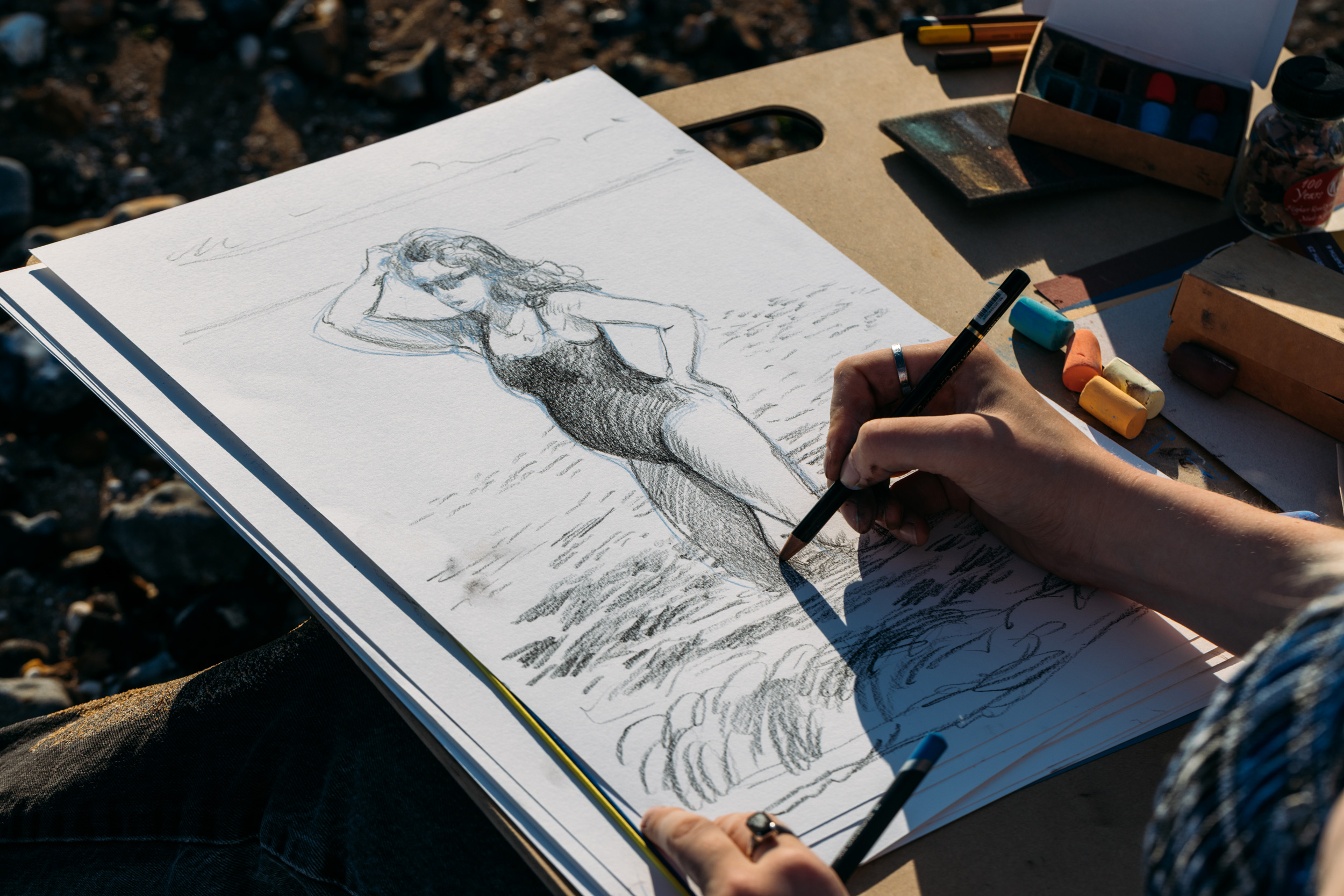
For my artwork example, I was inspired to draw bathers from life, without the formality of asking them to pose in the studio like the Neoclassical painters. Whilst you’re enjoying time at the beach or pool, ask your friends or family if you can draw them whilst they swim or sit by the water. Mine are all 1–3 minute rapid observational life drawings of my friends enjoying time at the beach.

For this art prompt you’ll need:
A Rosa Sketchboard with Magnetic Clip A2
A selection of loose sheets of paper
Your preferred coloured pencils – I mostly used a Caran d’Ache Pablo coloured pencil in Black
An eraser
Before I set off to the beach, I set up my Rosa Sketchboard to hold my materials. It has useful loops of elastic on the top corner for keeping pencils or brushes, and an elastic strap and magnetic clip to keep paper in place. I was able to carry everything I needed attached to the board, with my sharpener and eraser in my pocket.

Next, I set up on the beach. For my first quick drawings, I sat on a towel on the dry sand and drew my subject looking for shells in the water from a distance.

This immediately forced me to abbreviate my drawings, because I couldn’t see enough detail from far away to get caught on it. Making these first quick one-minute drawings didn’t allow for any correction, so I embraced any mistakes along the way and included them in my gestural lines.

After these first warm-up sheets, I got up and stood closer on the wet sand. As she moved and made new motions, I switched pages and redrew the same movement as many times as I could in the brief time frame.


This included drawing her floating in the water, rinsing her arms and hair, and walking out into deeper water.


Once she finished swimming, I crouched and drew her sitting on the edge of the water. I did a quick drawing of her pose first to establish it in my mind, before drawing it again, this time taking more care to include varied mark-making and tone.


After bringing them back to the studio with fresh eyes, I enjoyed the spontaneity of the drawings, and could use them as reference studies for later developed works.

Further Reading
Art Through Symbols: The Flower
How to Prepare for Your First Life Drawing Class
Preparatory Drawing Methods for Painting
Shop Art Materials on jacksonsart.com