Lions prowl, devour, and lounge throughout art history, with symbolism rooted in our innate primal fear of predatory creatures, paired with our wonder in the natural world. Across time and cultures, lions have symbolised power for their physical prowess and poise, naturally correlating them with rulers and royalty. Beyond this predominant interpretation, lions embody a well of deeper meaning in art, from divinity to dreams, heritage, and luck.
The Art Through Symbols series explores the interpretation of symbols throughout art history – whether cultural, religious, folkloric, or personal. Each article analyses a selection of artworks before offering an art-making tutorial inspired by the symbol for you to try.
Interpreting the Lion

Eugène Delacroix
Lithograph, 14.5 x 13.5 cm | 5.7 x 5.3 in
The Metropolitan Museum of Art
“Tigers, panthers, jaguars, lions, etc. Why is it that these things have stirred me so much? Can it be because I have gone outside the everyday thoughts that are my world; away from the street that is my entire universe?” – Eugène Delacroix
A lion looks back at us in the earliest known depiction of a spiritual being in history, in the form of a mammoth-tusk sculpture crafted by early humans. It fuses together the head of a now-extinct cave lion with a humanoid body. The miraculous 40,000-year-old Lion Man was discovered in southern Germany in 1939, and carefully reconstructed from fragments. An experiment concluded that it would have taken around 400 hours to sculpt using the tools available at the time, which is a considerable amount of effort for an era prioritising survival. Although the mythology of the Lion Man is lost to time, it’s clear that its creation was an important spiritual investment to our ancient ancestors.

In Christian art, the lion has been continuously reinvented as a symbol for both divinity and evil, from the fables told about their behaviour in illuminated manuscripts, to stomach-turning Baroque masterpieces depicting Daniel in the lion’s den. Themes of mortality are naturally tied to lions, a reflection of their fearsome strength as predators. Interestingly, the majority of paintings of lions in conflict are male, although we know that lionesses are the true hunters of their species. Perhaps the most potent symbolism of the fighting lion is when we see the inverse of their expected predator-prey dynamic – when the formidable lion is made into the weaker party, to assert the impossible strength of a secondary character.

Western artists grew fascinated with lions through the international trade of animals, conjuring fantasies of lands unknown, depictions which remain today as examples of exoticism in art. Yet lions have also been continuously depicted by artists from the regions they are native to, marking them as symbols of heritage and identity across Africa and Asia. In architecture, sculptures of lions populate global monuments and important entranceways, like the enormous lions of Trafalgar Square by Edwin Landseer, the lions flanking the entrance to the Art Institute of Chicago by Edward Kemeys, and the bronze lions guarding doorways in the Summer Palace in Beijing. Across the world, featuring the ‘king of the beasts’ innately communicates importance and grandeur.
Threat and Divine Protection

Peter Paul Rubens
Oil on canvas, 224.2 x 330.5 cm | 88.3 x 130.1 in
National Gallery of Art
When the Biblical character Daniel refused to stop praying to God under the rule of the Persian king Darius, he was thrown to the lions as punishment. But the lions didn’t devour him – instead they peacefully waited alongside him, whilst Daniel continued his prayers. This moment of spiritual intervention, where God protected Daniel from certain death in reward for his faith, has been much referenced throughout art history. It’s composed immersively in Daniel in the Lions Den by Rubens, who gave the lions characterful expressions, twisted in annoyance that they can’t have their feast. While Daniel looks to the heavens above him, hands clasped in prayer, several of the lions make eye contact with us, the viewer, as if questioning our position in the cave. Painted at a huge scale, these life-sized lions create a threatening sense that we may be their next victim if we choose to live without devotion to God. In this story, the lions symbolise the hostile and deadly forces in the world, conquered by faith.

Anonymous artist, Bruges or Brussels
Oil on wood, 84.5 cm x 61 cm | 33.3 x 24 in
Rijksmuseum
This isn’t the only instance of lions becoming docile through divine intervention. In the story of Saint Jerome, he was said to have been teaching students when a lion came limping toward him. Everyone else fled in fear, but Jerome stayed and examined the lion’s foot. There was a thorn stuck in it, which Jerome carefully removed, and in gratitude the lion stayed with him for the rest of his life. There are countless paintings depicting Jerome with the lion, which are symbolic of his empathy, compassion and faith.
Dreams and Mortality

Henri Rousseau
Oil on canvas, 113.7 × 160 cm | 44.8 x 63 in
The Metropolitan Museum of Art
Henri Rousseau painted his dreamlike jungle scenes by referring to plants in Paris’ botanical gardens. Lions appear in several of his paintings, including The Sleeping Gypsy, The Dream, and The Lion is Hungry. In his work The Repast of the Lion, we see a lion immersed in the foliage, devouring a leopard, whilst the light begins to either dip or rise. The cycles of the sun and moon appear in each of his leonine paintings, pairing the symbolism of mortality and rebirth with predator and prey.
The Sleeping Gypsy is amongst the most famed paintings in the world. In Rousseau’s description of the work, he wrote:
“Although the predatory animal is wild, it hesitates to leap upon its victim, who has fallen fast asleep from exhaustion.”
The tension between the vulnerability of the sleeping woman and the potential threat of violence from the lion is tangible, yet – at least in this moment – they coexist peacefully. Perhaps the lion is even protecting her from another foe – us, the viewer. The sleeper lies serenely on the sandbank, still clutching her walking stick, and garbed in flowing fabric that is gently illuminated in the moonlight, her eyes just beginning to open. The lion’s eye draws our attention – wide open as if struck by indecision over the woman’s fate, and echoed by the sphere of the moon. The painting remains open to wide interpretation since it’s unclear if the lion is real or part of the dream. In my opinion, the lion symbolises the unknowable timing of death.
The Lion Hunt – Power and Vulnerability
In ancient Assyria, killing a lion was reserved for kings as a spectacle of power, symbolising their strength and ability to protect their subjects. This history is immortalised in the masterwork of the age, the Lion Hunt of Ashurbanipal – a series of reliefs carved in 645-635 BC, displaying asiatic lions released into an arena for King Ashurbanipal to slaughter. The realism with which the lions are rendered is incredible for such an early period – they twist in pain, lunge in attack, and lie serene in death.

Attributed to Moderno
Bronze, 7.9 × 6.6 cm | 3.1 x 2.6 in
National Gallery of Art
Later, the Ancient Greeks reasserted the significance of killing a lion through the myth of Hercules, in the first of his twelve labours. One of his challenges was to kill the Nemean lion, a great beast whose coat was invulnerable to mortal weapons and whose claws were sharp enough to cut through any armour. Hercules initially attacked the lion by shooting it with an arrow but the arrow bounced off its impervious hide. He was eventually able to kill it by stunning and strangling it. He then skinned the lion and wore its pelt for the remainder of his trials, asserting himself as a formidable foe. The Nemean lion is a symbol for certain death, and by conquering it, Hercules demonstrated that his strength could defy nature.

Peter Paul Rubens and Jan Wildens
Oil on canvas, 248.7 x 377.3 cm | 98 x 148.5 in
Alte Pinakothek
The lion hunt was revived as a subject by the Baroque artists for its churning physicality. Notably, Rubens painted a series of hunting paintings, featuring hippopotami, crocodiles, boar, wolves, foxes, tigers, and lions. Some of these works were commissioned by the Elector of Bavaria, for the Schleißheim Palace in Germany. Designed to take the place of monumental tapestries in palatial buildings, the huge scale of Rubens’ hunt paintings set them apart in the genre. In his work Lion Hunt, the role of ‘prey’ is turned on its head. The human hunters find themselves violently under attack as the lions drag three of their party to the ground, creating a dramatic diagonal composition with the figure in white tossed from his white horse. The horses refer to those in Leonardo da Vinci’s lost work, The Battle of Anghiari. These lions symbolise the wrestle between the intellect of man, and the chaos of nature.

Eugène Delacroix
Oil on canvas, 76.5 × 98.5 cm | 30.1 x 38.8 in
Art Institute of Chicago
Later, in the Romantic period, artists reimagined the hunt anew as a subject representing emotional turbulence. In 1832, Eugène Delacroix was sent on a French diplomatic mission to Algeria and Morocco, as France was asserting colonial power in the region at the time. There he encountered North African culture first-hand, and became enamoured with it. In the wake of the trip he painted a series of lion hunt paintings, inspired by the culture he encountered, fused with inspiration from Rubens hunt paintings. Since he didn’t actually see a lion hunt on his trip, the works play into European fantasies about the Arab world by theatrically bringing imagined scenes to life, and incorporating pieces of traditional dress. In his hunt paintings, the lions become dually symbolic of exoticism and power.
Personification and Fascination
Delacroix didn’t just fantasise about lions; he also studied them in the Jardin des Plantes zoo and the zoological museum in Paris. He was close friends with the sculptor Antoine-Louis Barye, who gave him permission to work there, and sometimes worked with him. Delacroix, in particular, gave his lions humanoid qualities, both in personality and pose. In 1829 he wrote a letter to Barye when he heard that a captive lion called Coco had died, “The lion is dead. Ride at full speed!”. They were able to study Coco’s carcass, and witness its dissection, where Delacroix noted that the lion’s musculature reminded him of a human. These studies are the reason Delacroix was able to develop lions with distinct character in his paintings. In his works, lions become symbolic of his own fascination, and projected emotion.

Eugène Delacroix
Graphite on paper, 22.7 × 34.2 cm | 8.9 x 13.5 in
Art Institute of Chicago
Antoine-Louis Barye is best remembered as an animalier sculptor, who formed creatures with incredible musculature in dramatic poses. Aside from his sculptural work, he also made compelling watercolours, which place the animals he studied in the zoo in imagined ‘wild’ landscapes. His palette is proto-Tonalist, and his use of dusky colours to render generic, desolate terrain gives the works a fantastical quality. In his work Lion Sleeping, the outcrop the creature sleeps against diffuses ephemerally into the landscape beyond, as if disappearing into its dreams.

Antoine-Louis Barye
Watercolour on paper, 23.3 x 29.5 cm | 9.2 x 11.6 in
The Metropolitan Museum of Art
Delacroix and Barye are not the only notable artists to study lions from life – Rosa Bonheur also made a number of sharply observed paintings of lions. Remarkably, she kept a pair of Nubian lions and their cubs in the grounds of her chateau studio in Fontainbleu, France. In her 1881 painting, The Lion at Home, they are immortalised in a family portrait of sorts. In the work they are depicted with the poise and dignity of nobility, also noted in her portrait El Cid, whose title correlates the animal with the celebrated Spanish war hero.
Medicine and War
In Ancient Egypt, the goddess of war and medicine, Sekhmet, was depicted with the head of a lion. She represented the vengeful aspect of the sun God Ra’s power and was sometimes depicted with a sun disk atop her head. Associated with the blistering heat of the sun, she could deliver plagues and scorching desert conditions. In one myth, Sekhmet was overcome with such bloodlust after battle that she couldn’t contain her wrath, and almost destroyed all of humanity. To stop the bloodshed, Ra and the gods devised a plan to dye a lake full of beer red, so she would mistake it for blood. When she drank from it she became so drunk that she was forced to stop her lethal rampage. In her annual celebration each year, the Egyptians held a drunken party of their own to reenact the quelling of the Goddess’s violent fury.

New Kingdom, possibly Upper Egypt
Granodiorite sculpture, 213 × 49.5 × 97.5 cm | 83.9 x 19.5 x 38.4 in
The Metropolitan Museum of Art
In the Egyptian myth, the lion symbolised power and violence. These associations with warfare and martial power have been globally established and recur across cultures and throughout history. The lion as a symbol of military might persists – from St Mark’s lion of the Venetians to King Richard I of England, who was known as ‘Richard the Lionheart’. The association between nobility and physical power makes the lion a potent symbol of dominating force.
Fear of the Unknown, Resurrection, and the Devil
The manuscript illuminators and painters of the medieval age were unlikely to ever encounter lions in their lifetimes – but the lion featured repeatedly as a religious character that had to be illustrated. These artisans had to rely on depictions of lions from bestiaries and their own invention, and often based them on the animals they were able to observe, like dogs. This led to lions being depicted with outlandish, canine, and even alien features. Since these artists could only imagine what a lion might look like, and were informed by tales of them as being relentlessly bloodthirsty, their strange depictions symbolise the fear of the unknown.

Unknown artist, Burgos, Castile-León, Spain
Fresco mounted on canvas, 332.7 × 335.3 cm | 131 x 132 in
The Metropolitan Museum of Art
In many bestiaries, the lion represented Jesus, since people believed that lion cubs would lie lifeless in their caves until they heard the roar of their father – mirroring Christ’s resurrection after death. Other accounts suggest that lions slept with their eyes open, always ready to pounce, and that they were clever enough to cover their own tracks. On the other hand, the lion was also linked to the devil, their fearsome roar and incessant hunger symbolically tied to the devil preying on weak souls. In this era, the lion was also sometimes invoked by preachers as an allegorical symbol of the deadly sins of pride, wrath, and gluttony. Therefore they became figures of divinity, evil, and mystery, carrying rich yet contradictory symbolism.

Unknown artist, Franco-Flemish
Illuminated manuscript, tempera colors, gold leaf, and ink, 19.1 × 14.3 cm | 7.5 x 5.6 in
Getty Museum
Heritage and Royalty
Art historians have suggested that Henry Ossawa Tanner – noted as the first internationally acclaimed African American artist – saw lions as symbolic of his heritage. He would have seen lions in the zoo where he grew up in Philadelphia, and later when he moved to Paris, and they appear in several of his paintings. The subject matter of his work was primarily religious from 1895 onwards, having grown up in a devout Christian family, with a bishop for a father, and a missionary as a mother. Between 1897 and 1899, he travelled to Palestine and Egypt to study Biblical landscapes and culture first-hand. There he created studies of the desert for works including Lions in the Desert and Lion Drinking, before adding the lions themselves later in the studio. In Lions in the Desert, the lion in the centre lifts its head into golden light, flanked by two lionesses in the background. The illumination on its face gives the creature a noble effect, as if the light has chosen it alone to shine on.

Henry Ossawa Tanner
Oil on canvas, 39.5 x 74.5 cm | 15.6 x 29.3 in
Smithsonian American Art Museum
The Akan people, primarily from present-day Ghana, used the lion as a symbol for their royalty from the 1800s. The lion embodied all of the qualities required in a leader – strength, bravery, and wisdom – and was also an animal native to the region. Gold was a prized material reserved only for the elite in society, and these two ornaments were crafted using the lost-wax casting method. The artists who made sculptural objects such as these claimed to be descendants of Fusu Kwabi – the first goldsmith of the Akan/Asante people – who descended from heaven to teach them his methods.

Asante-Akan artist, Ghana
Gold ornament, 3.8 x 5.4 x 5.7cm | 1.5 x 2.1 x 2.2 in
The Metropolitan Museum of Art
The symbol of the lion was adopted in British heraldry. Three lions appear on the coat of arms for England, first introduced by Edward III, and as ‘the Rampant Lion’, which is the Royal banner of Scotland. Due to this, the lion has sometimes appeared in art as a symbol of Britain and its monarchy. Lions were even kept in the Tower of London for around 600 years as part of the Royal menagerie, which began in 1235 when Holy Roman Emperor Frederick II gave Henry III three lions.

George Stubbs
Oil on canvas, 243.8 × 332.7 cm | 96 x 131 in
Yale Center for British Art
George Stubbs is a renowned British animal painter, best known for his painting of the horse Whistlejacket. He repeatedly revisited the subject of lions attacking horses, in pursuit of the sublime – when moments of beauty and terror collide. It’s known that Stubbs had a distaste for the monarchy and intentionally avoided royal commissions. In works such as A Lion Attacking a Stag, a lion gleefully smiles on top of its helpless victim. It’s thought that Stubbs used the symbol of the lion to represent Great Britain, here dominating a stag – obliquely symbolising other nations. His depictions of lions frightening white horses have also been interpreted as allegories of the Jacobite cause, such as in his painting Horse Frightened by a Lion. Here, the lion is thought to represent England, subduing the white horse that symbolises the Hanoverian monarchy of George III. Stubbs second son was even named Charles Edward, after the Stuart who led the failed Jacobite uprising.
Good Luck and Protection
The lion has great cultural significance across Asia – notably in the Chinese tradition of the ‘lion dance’ where people perform together as one decorated beast, under a complex costume puppet. The tradition began during the Han dynasty, and spread across Asia to create iterations in Japan, South Korea, Taiwan, and Vietnam. Broadly, these performances symbolically ward off evil, and deliver good luck and fortune. In this woodblock print by Kitagawa Utamaro, we see several people performing as the lion under a sheet of fabric, watched by onlookers through a screen window and from the street. The chaos of their legs below moving in different directions, contrasts with the placidity of the onlookers, and the deliberate direction of the lion’s head, which follows a little boy running away.

Kitagawa Utamaro
Woodblock print, 21 x 36.2 cm | 8.3 x 14.3 in
The Metropolitan Museum of Art
According to an art historical anecdote, during the 1840s the Japanese master Katsushika Hokusai drew a Chinese lion almost every morning – totalling 219 surviving drawings. Hokusai’s biographer recorded that in a period of poverty, Hokusai would draw a Chinese lion or dancer and throw it out of the window every day, to ward off evil, and restore his family with fortune.

Katsushika Hokusai
Ink on paper, 44.1 × 29.7 cm | 17.4 x 11.7 in
Minneapolis Institute of Art
The Lion – Art Prompt

Eugène Delacroix
Graphite drawing, 11.7 x 18.3 cm | 4.6 x 7.2 in
The Metropolitan Museum of Art
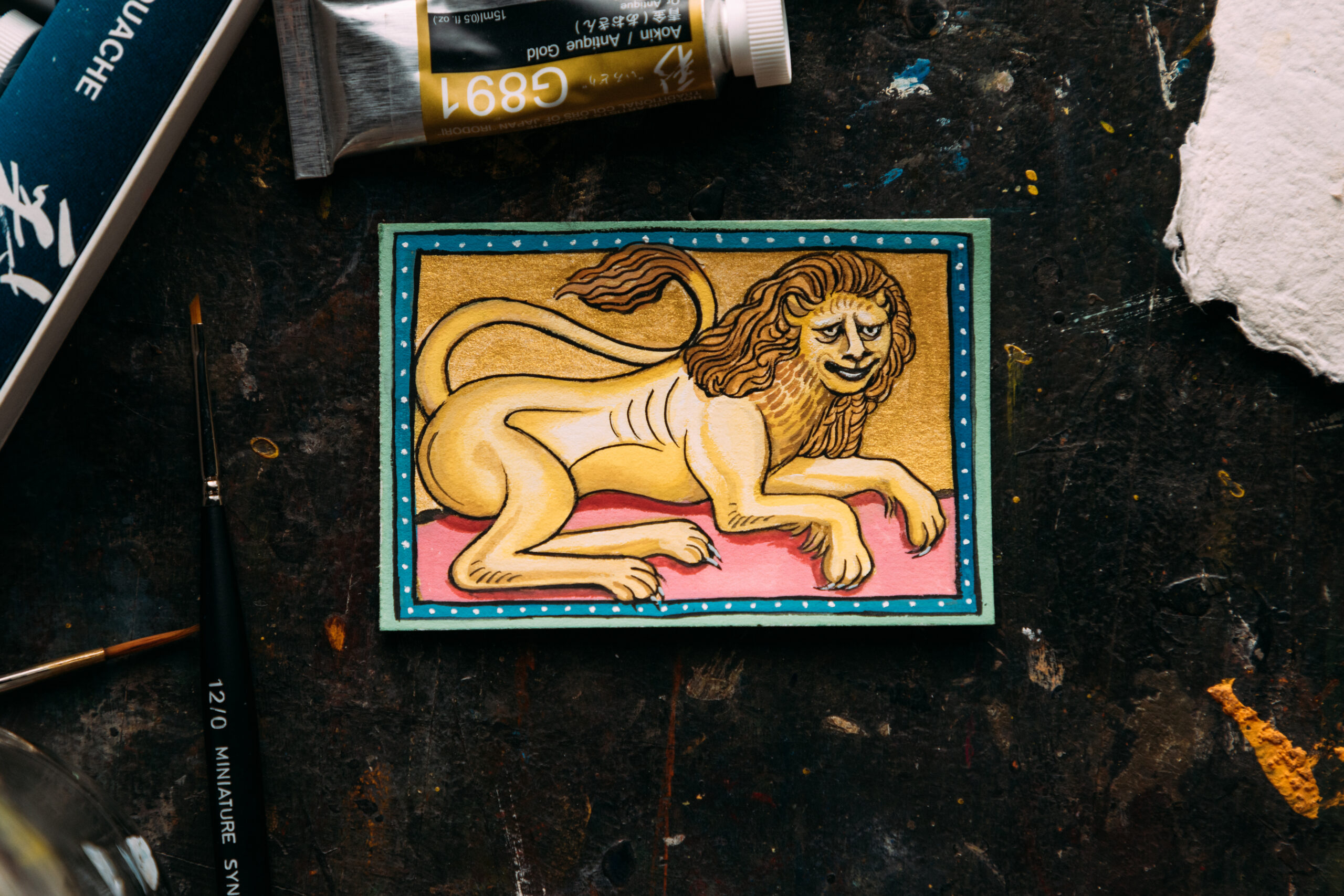
I was inspired by the studies Delacroix, Barye, and Bonheur drew from lions to prepare for their works, and the fantasy of the lion as a character in illuminated manuscripts. For this art prompt, we’ll create a page of studies of lions, carefully rendered in ink, before creating a miniature gouache painting of an imagined medieval lion.
For this art prompt you’ll need:
Jackson’s Acrylic Ink in Burnt Umber
Jackson’s Two Rivers Cold Pressed Watercolour Paper
A selection of watercolour brushes
A selection of gouache paints, I used: Holbein gouache’s in Black, Super Opaque White, Silver Grey, Dark Brown, Antique Gold, Oriental Blue, Kerria Japonica Yellow, and Crimson
Jackson’s Miniature Synthetic Brushes, I used: #12/0 Angular, #20/0 Liner, and #10/0 Bright
Two jars of clean water

Without any real lions to hand, to begin my sheet of studies I searched for photographs of lions online and from documentary footage. Once I found one I liked, I began working on a tonal study, by diluting the acrylic ink with water across a couple of small ceramic palettes, and lightly sketching the lion’s features in a light wash.

I worked progressively from light to dark in each study, blocking in areas of flat tone, and adding outlines where necessary. I added the lion’s fur with hatching by wrapping it around the form of their bodies to suggest volume.


To complete each study, I applied some ink straight from the bottle for the darkest details, like picking out the lion’s facial features and shadows in the lower body.


Once I’d completed my studies, I put this sheet away, and started working on my miniature medieval illuminated manuscript lion from memory, without worrying about any anatomical accuracy. To begin I tore a small piece of Jackson’s Two Rivers Cold Pressed Watercolour Paper, and lightly sketched my creature with a light pencil.
I gave my lion slightly humanoid features and elongated limbs. I painted the miniature with a restricted palette, adding only slight gradation of tone.

Next I added a reflective gold background to the painting, to emulate the gold leaf on illuminated manuscripts.

I used gouache to colour in the body of my lion, his main and tail, and the ground underneath him.

To complete my imagined medieval lion, I added a crisp black outline to the tiny painting using my Jackson’s Miniature Synthetic Brushes, and a decorated dotted border.


Further Reading
Art Through Symbols: The Horse
Art Through Symbols: Songbirds
Inside the Pages of a Medieval Sketchbook
Recreating the Palette of Henry Ossawa Tanner
Shop Art Materials on jacksonsart.com