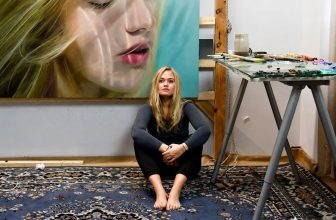
Dietlind Vander Schaaf is an American artist from Maine who uses encaustic to create abstract paintings inspired by the fluidity of water and the topography of the Earth – elements that feed into ideas about inner landscapes, and the interplay between concealing and revealing. She visited us in the Jackson’s Studio to discuss how her art and yoga practices are entwined through meditation and self-reflection, the influence of her background in writing, and her role as one of the core artists representing R&F Handmade Paints.

Contents
0:00 “There are times where I feel like I gave too much away and I needed to pull back.”
0:30 Introduction
0:51 “So much about being an artist is spending these long periods of time alone.”
1:40 “There weren’t any artists in my immediate family who made me think, ‘Oh, I want to be an artist.’”
2:30 “I just started playing around with my own ideas.”
3:11 “I would wander the city and just look – this act of looking is really critical to being an artist.”
4:02 “The painting had such a poetic quality to it, and I just couldn’t move away from it. I fell madly in love with it.”
5:33 “I was trying to understand why I didn’t feel prepared to deal with loss.”
7:51 “How can I make work that speaks to those experiences, but in a way that also celebrates the incredible beauty of that?”
8:29 “I found this 23-karat gold leaf from Italy; it’s expensive, it’s delicate, there are lots of reasons not to use it…there’s just nothing like working with real gold.”
9:33 “I wanted to have as little as possible in the work, while still having it hold together.”
11:18 “Both practising yoga and teaching yoga relate to my art making.”
12:42 “It was all about helping them to tell their own story.”
13:52 “This is everything I dislike about abstract art…I got obsessed with it.”
15:54 “Encaustic painting is a really fascinating medium with a super rich history.”
16:41 “I found colour super overstimulating in the beginning.”
18:19 “Colour mixing directly on the palette has an immediacy that I really like.”
20:27 “I often let an encaustic painting get really wild before I come back in and quiet it.”
24:25 “I describe it as a moving meditation because there’s this rhythm and cadence to applying a layer of medium.”
25:21 “I know sometimes for artists the blank canvas can be a little daunting, but that’s never really been an issue for me, I think partly because I am very process orientated.”
27:55 “There are several Japanese aesthetics that are really interesting to me.”
28:45 “Everything has to go through that kind of awkward teenage phase.”
30:01 “My studio is very peaceful and beautiful.”
31:15 “I’ve been working with R&F Handmade Paints for about 8 years now.”
32:57 “I can’t live without my potter’s needle.”
34:27 “That painting told me to have faith in myself as an artist.”
36:18 “Vision is always ahead of execution.
36:44 “Do you feel like it’s resolved or is there something in it that still needs to be addressed?”
37:44 “I do believe that things have evolved and unfolded as they should, so even though it often felt like there were these very desperate parts of my life, they all kind of fed into me arriving where I am today.”
38:42 Credits
Film Extract
I would put something out there, but it would feel like too much, and so I would pull it back. I put my whole self into my work – I pour it all in. There are times when I feel like I have given too much.

Dietlind Vander Schaaf
Encaustic, oil, and 23 karat gold leaf on panel, 101.6 x 152.4 cm | 40 x 60 in
I work with a medium called encaustic; it’s a wax-based paint. It’s different from working with a more fluid medium, like oil or acrylic. The whole process of applying and fusing it feeds into the way I work. When I first started using this medium, I would wander the city and just look. I think the act of looking is really critical to being an artist. The first body of work that I made with encaustic was my Windows series. And it was sort of a natural evolution from collage into working with a wax-based medium.

My name is Dietlind Vander Schaaf. I’m a painter from Maine, and I’m here in the Jackson’s Studio to talk about my practice.

As a child, my earliest memories are of looking at a Monet poster on the wall and just travelling into that scene. I was always creative, but I didn’t see myself becoming a professional. There weren’t any artists in my immediate family who made me think, ‘Oh, I want to be an artist.’

I grew up in a small town in Maine, and being on the water was a big part of my childhood. We were always on a boat or on the water in some way. Water is a huge factor in my work. Not so much the ocean, but more like lakes and rivers; these shallower bodies of water that you can look down through. And you can see the life that’s forming underneath there.

The first class that I ever went to was a collage class. I was in my mid-20s, and I went to a warehouse downtown and started making collages. It was super fun. But they were a disaster. I put everything in. I would fall in love with all this material and just make these crazy collages. It was that falling in love with the idea of making something and then hanging it on your wall. It was a very special time.

At college, after trying several different majors, I eventually settled on history. It was taught by philosophy and history professors who made the subject come alive. The program consisted of five courses covering history from antiquity to the modern period through all these great books. This idea of looking at history in a really interdisciplinary way, through the lens of what’s happening in the culture and writing of each era, is a beautiful way of looking at life and understanding the world.

I then got a scholarship to the American & New England Studies Program. For the final project, we had to do a thesis, but I did two. One was about exhibitionism and John Sloan and the turn-of-the-century art scene in New York, particularly the Ashcan School. But I also did a thesis on changes in the funeral industry. I was trying to understand why I didn’t feel prepared to deal with loss. I had experienced some pretty profound loss around that time, and I interviewed people about their experiences of loss and made a short film. A friend taught me how to do photography and develop the images. And I painted poems on my body, and we photographed and exhibited them.

I was looking for something that would represent the divine spark inside of each of us. So that’s when I hit on the gold leaf. I found this 23-karat gold leaf from Italy, which is expensive and delicate. There are lots of reasons not to use it, and I’ve experimented with other materials, but there’s just nothing like working with real gold.

It’s so beautiful, and it adheres to the encaustic wax pretty well. It’s very fragile and ephemeral too, but much of life is. But you also get this sort of interactive feeling when you’re looking at the painting because it’s actually reflecting light back at you.

I got my MFA in creative writing from the University of San Francisco, with a particular interest in non-fiction. I had always been in love with poetry and writing. And when I was pursuing my MFA, I became really interested in the ‘short short’, which is a very compressed form of narrative. That naturally led into the sort of collage work that I was making, because I also wanted as little as possible in the work while still having it hold together.

While I was in school studying how to write, I became so self-conscious that I just couldn’t write anymore. So, about five or six years ago, I started writing a blog, which was mainly related to yoga. The whole idea of some of the concepts that we study in Sanskrit – there’s one in particular. It’s a funny-sounding word, but it’s svādhyāya, and it means self-study. You almost gain a little distance from yourself, as though you’re watching what’s happening from the outside. I think that perspective serves us well in the studio as we grow and evolve as creatives.

Dietlind Vander Schaaf
Encaustic, oil, graphite, ink, and 23 karat gold leaf on panel, 91.4 x 91.4 cm | 36 x 36 in
About three years ago, as I returned to the water series with just paint, I felt that there was meaning missing for me. I started with a line from a poem that I loved, and I used my non-dominant hand because I didn’t want it to look like words. I just wanted to write it almost like a mantra. I wrote it with ink and used different tools, and I loved the way that it came out.

I’ve studied Kripalu yoga, and the essence of that yoga tradition is the development of self-awareness and non-judgmental self-compassion. Both practising yoga and teaching yoga relate to my art making. I think it just gives me the stamina to be able to spend large periods of time alone, quietly communing with myself in the studio. But also, a lot of the concepts from yoga feed into what my work is about.

Encaustic has this incredible quality. Over 2,000 years ago, it was used in Greece to seal the hulls of boats and paint them to make them look fierce. From there, it moved through the Mesopotamian border and into Egypt, where it became a refined painting technique. Portraits of young men and women were created during their lifetimes and displayed in the family home. When they passed away, a gold leaf crown was added, and the portrait was then attached to the sarcophagus and buried.

Dietlind Vander Schaaf
Encaustic, oil, graphite, and 23 karat gold leaf on panel, 91.4 x 91.4 cm | 36 x 36 in
My relationship to colour has really evolved over time. I found colour super overstimulating in the beginning. So when I began working with encaustic, I really just worked with the medium itself. It’s not exactly clear; it has a little bit of natural opacity to it, but it doesn’t have any colour. Blue is very dominant in my work, which is interesting, because if you went to my house, there’s nothing blue there. I gravitate towards more muted colours, and I am on the cooler side of things with my colour palette.

Dietlind Vander Schaaf
Encaustic, oil, and 23 karat gold leaf on panel, 101.6 x 101.6 cm | 40 x 40 in
I think about paintings as if I’m looking out of a window of an aeroplane, and I’m seeing this topography looking down over it. I’m seeing this sort of grid, almost like the way that we impose this man-made structure with our cities and our fields on the earth itself.

Dietlind Vander Schaaf
Encaustic on panel, 101.6 x 152.4 cm | 40 x 60 in
I would go down to this lake nearby and look at the life below and the things that were happening underneath. And I began to think of it as a metaphor for ourselves, that looking down through the human life, the human body, the human – the sort of inner landscape of a person, thinking about their stories, their experiences, all of that as being the elements of who they were. And I wanted to try and represent that with my own work.

When I began working with encaustic, I was embedding things in it, and I was working a lot with the grid. And I think looking back at that work now, I would say it felt very controlled and ultimately kind of static and tight, and I wanted more loose gestural aspects to it. But I think I have this play with myself where I need to have some organising principle as well. So even though I’ll get a little bit wild with my paint, ultimately I’ll come back in with a lot of line work.

To paint with encaustic, you need some kind of heated palette. And you want to work with natural bristle brushes because synthetic bristles can melt or scorch on the palette. It’s useful to have some palette cups so that you can melt larger amounts of colour. And it’s good to have a little bit of ventilation, some fresh air coming in, because even though it’s a totally safe medium, when you heat up things, they can release some fumes that people are sensitive to. And you want to make sure that you’re keeping it at safe working temperatures, but having some fresh air is a key component of that as well.

I always work on rigid supports, such as wood panels that aren’t going to flex or warp. If I’m really wanting to explore luminosity and transparency, I’ll start right on the panel – I describe it as building a painting from the ground up. There are certain things that you can use directly onto your substrate with encaustic; you want them to be mediums that are going to dry but maintain their porosity.

I often use R&F Encaustic Gesso to do underpainting. Sometimes I use just pure pigment dispersed in water. I wouldn’t recommend anything that’s gonna smear because once you go over it with heat and hot wax, paint is going to smear. So anything that’s like a loose or powdery kind of material, such as graphite, pastel, charcoal, those things are better done in between the layers of your painting so that you can fuse them into the wax and then brush another layer of medium over it.

If I’m doing a really transparent painting, I’ll start with something directly onto the panel to activate it. And then, once that’s dry, I begin building up the layers of encaustic. I tend to paint dark to light, and I’ll block in some darker shapes using a chromatic black. So something where I’ve mixed, maybe with Indigo, Blue Ochre, a little Courbet Green.

I often let a painting get really wild before I come back in and quiet it. Encaustic naturally lends itself to that because the medium, the base of the paint, is beeswax and damar. And it isn’t exactly clear. It has some opacity to it. But if you lay it on really thin, you can start to create layers that give you this optical depth. And if you add the medium to the paint and extend it, you can really play with translucency.

Dietlind Vander Schaaf
Encaustic, oil, and 23 karat gold leaf on panel, 61 x 121.9 cm | 24 x 48 in
There are also some other materials I work with alongside encaustic. So I’ve got the Encaustic Medium. I’ve also got the Encaustic Wax, which is the medium in which artist-grade pigment has been milled. And then you can extend that by adding more medium. I work with 23-karat gold leaf, and I use graphite; both graphite drawing sticks and graphite that’s already been applied to paper. I also use ink. Often, I’ll use that to activate a surface and get started, or I’ll use it in between layers of encaustic to draw with.

I use pigment sticks, which are oil sticks that you can use over the surface of the encaustic painting at the end. I use them almost like a printmaking technique. So it’s sort of like intaglio printmaking when you’re rubbing this pigment stick into the wax at the end, and it’s kind of leaving a patina behind and activating all the little spots where there might have been uneven texture. Or you’ve carved or etched into the surface of the wax where there are some brushstrokes, and it shows up all of those things.

I’ve always been interested in revealing and hiding. I think it parallels being an artist, but also being sort of a naturally shy person. I describe it as a moving meditation because there’s just this rhythm and cadence to applying layers of medium. And I usually work with a big, wide brush. So I’m like dragging the brush across, and then I’m fusing with my torch or my heat gun. So there’s this whole movement with your body that’s happening. And that also sort of prepares your brain to begin working. It’s like sweeping the floor and then everything’s empty, and I’m ready to begin working.

It’s always an active discovery as I’m building up a painting. Periodically, I want to quiet one section. Rather than covering it over with white, I’ll come in with at least a couple of layers of clear encaustic medium first, just to tone it down to see how quiet I need that area to get. Then I’ll come in with drawing materials on top of that, and then return again to painting with different-sized brushes. So there’s sort of like a back-and-forth movement that’s happening as I’m finding the shape of the painting.

It was a journey from doing more representational work to becoming so abstracted. It was like so many things in my life; it wasn’t like something that I saw. It was something that sort of evolved organically: I was doing more landscape work, and I was using different elements when I was still doing my acrylic work, collaging things in. And then when I began working with encaustic, it moved into this highly abstracted language, almost without me quite understanding what was happening.

Dietlind Vander Schaaf
Encaustic and oil on panel, 91.4 x 91.4 cm | 36 x 36 cm
There are several different Japanese aesthetics that I find really interesting. One is the idea of wabi-sabi, that sort of natural decay. I think that resonates with my own work. And the other is this: if you think about Japanese flower arranging, ikebana, things are not perfect and symmetrical, but the balance is very natural, and I want that feeling in my own work. I think Kenzo Okada’s work is probably the most influential to me because it’s like a poem, but it’s more like a haiku – so much about what’s not in the work itself.

Dietlind Vander Schaaf
Encaustic and oil on panel, 91.4 x 91.4 cm | 36 x 36 in
My studio is on the fourth floor of an old mill building. The space itself is really light. It has five huge windows overlooking the river. There’s one wall of exposed brick, and the floors are these big old planks. When I first started painting with encaustic, I just had a small setup – I didn’t even have a big, fancy studio or anything like that.

Each year in September in Maine, I run a retreat. It’s called the Maine Coast Encaustic Retreat. And this will be the 16th year. I’ve been running it myself for about 12 years. And when I first took it over, I reached out to R&F Handmade Paints because I was aware of the company from attending the International Encaustic Conference. And I just asked if they would donate something, a little bit of paint, some gesso, or some pigment sticks for my students. And they were so generous in supporting my retreat.

Shortly after that, I was invited to become one of their core artists. So for about four years, I was supported by R&F. Then the person running that program was leaving the company, so I reached out to the president, and I said, if you’re open to keeping this position remote, I’d love to talk to you.

I’ve been working with them for about eight years now. I run the donation support program that I was first invited to become part of. And then the job expanded into other things. I work with artists to train them to do demos for us at different retailers. It’s such a fantastic company.

Courbet Green is my favourite colour that R&F makes. It’s just this really, really dark green that’s got these gorgeous blue notes and tones to it. And I love the way it smells when it melts. I do use a lot of Ultramarine Blue Pale in my work. And there are certain colours that I like, not the way that they look straight up, but as mixers. So I’ll use our Dianthus Pink a lot. But I do find that I naturally gravitate more towards cool blue greens, a lot of whites, that sort of thing.

Dietlind Vander Schaaf
Encaustic, oil, and 23 karat gold leaf on panel, 101.6 x 101.6 | 40 x 40 in
I keep my tools pretty simple. The brushes I use are natural bristle brushes that are actually double-stitched, so they’re less likely to shed.

Beyond the brushes, I have a few tools that I can’t live without, and one is a potter’s needle. It’s just a simple, lowly, plain old potter’s needle, but I use it for almost everything. I also use a pear-shaped loop tool, and that is for doing more subtractive work, carving and cleaning the edges of the sides of my pieces, or carving something on the surface of the painting as well. So that’s pretty much everything in my toolkit.

For the writing elements in my pieces, I’m using my non-dominant hand. I’m using a brush that I’m holding at a distance. And I’m writing these lines, these words, but I’m doing it in a way where the form is dissolving, and it’s giving way to shape and organic line and gesture. So it’s not discernible; it’s not readable. You can’t look at it and say, “Oh, I know what she wrote here.” It just becomes like a shape that dissolves back into the world.

Dietlind Vander Schaaf
Encaustic, graphite, and oil on panel, 91.4 x 121.9 cm | 36 x 48 in
It’s such a hard thing to describe how you know when an artwork is finished. I would say that most often it’s like a little internal click that happens. I can step back from it and say, that’s it. It’s done. I will put a painting against the wall, and I’ll photograph it sometimes, and then I’ll look at it on my phone just to get a little bit of distance from it so that I can see it more clearly.

I do believe things have evolved and unfolded as they should. Even though there were often these very disparate parts of my life, they all fed into me arriving where I am now, and I wouldn’t be making the work I’m making if I hadn’t gone through everything I have. But if I could say something to my younger self, it would be: don’t worry so much. Take more risks and enjoy where you are. Yeah, that’s probably what I’d say.

Dietlind Vander Schaaf
Encaustic, oil and 23 karat gold leaf-on panel, 76.2 x 76.2 cm, 30 x 30 in
Further Reading
An Introduction to Painting with Encaustic Wax
In Conversation With Lyn Kirkland About R&F Encaustic Wax
Between Pastel and Paint: Testing R&F Drawing Oils
How to Paint on Wooden Surfaces
Shop Art Materials on jacksonsart.com