Cyrill Rafael Vasilyev won the Pastel Runner Up Award in Jackson’s Art Prize this year with his work Most Peculiar Circumstance. In this interview, Cyrill discusses how self-imposed limitations help bind his creative process together, the way he fictionalises his own experiences to create a sense of world-building in his work, and the portals created by his human-like canvases.
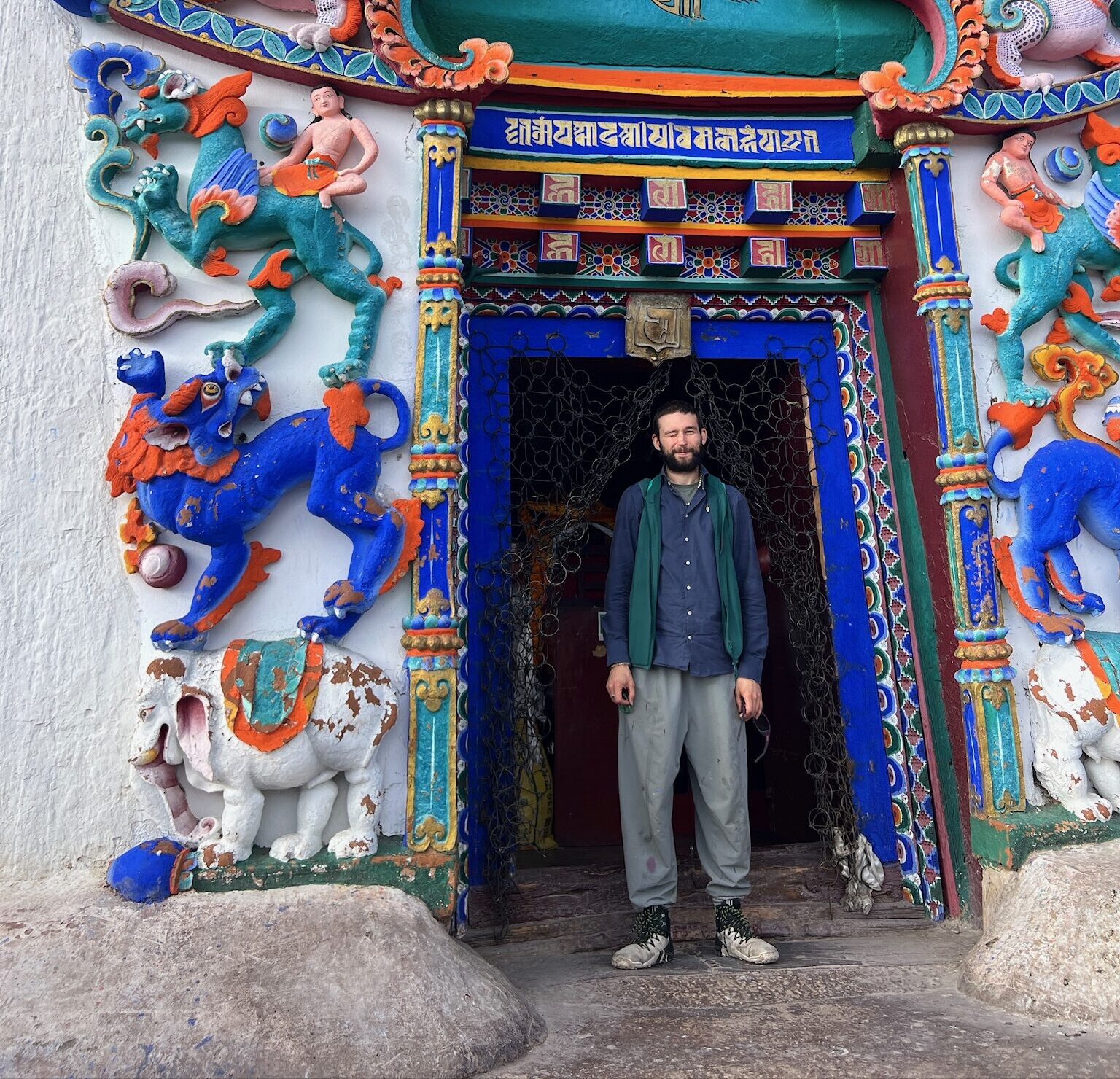
Above image: Cyrill out and about
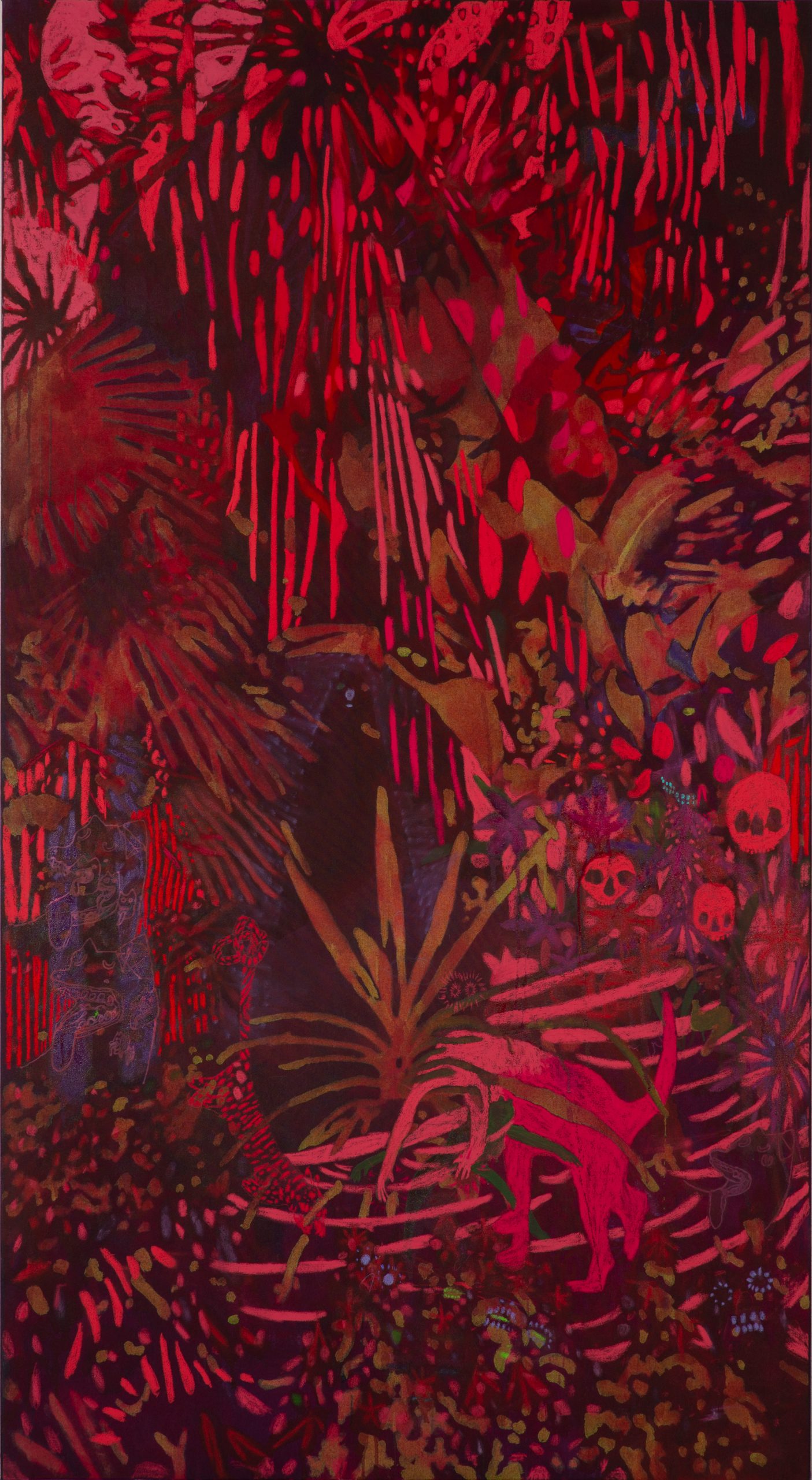
Oil pastel, soft pastel, pigment, aquatint on canvas, 220 x 120 cm | 86.6 x 47.2 in
Josephine: Could you share the story of how you became an artist and tell us more about your artistic background?
Cyrill: I grew up in Moscow. There are no artists in my family — my parents were loving and supportive, but there wasn’t really a role model for doing art as a living, or for being an artist. I thought about it constantly, of course, and it took me a long time to accept that this was what I really wanted to do — that I didn’t want to let it go, so I had to commit.
During my childhood, I was lucky enough to see modernist works at the Tretyakov Gallery, the Pushkin Museum, and elsewhere. The work of Monet and Matisse touched me deeply — Monet’s Rouen Cathedrals and landscapes, and Matisse’s Pink Studio and his Moroccan paintings communicated a sense of transcendental freedom to little me, and I kept coming back to look at them. I was also exposed to the artists of so-called Russian modernism, avant-garde, and symbolism. Perhaps this defined my path — I could never stop thinking about what I’d seen, returning to the paintings again and again, researching whatever I could. These works — not just visual art, but literature, music, philosophy too — came out of a vast cultural milieu that offered so much toward developing a certain subjective flexibility, an exposure to different ways of seeing and constructing the world. That quality resonated with me deeply; in time it grew into an interest in philosophy, and into the study and practice of Buddhism.
But back then — in my mid-teens or so — I was lucky to work with a teacher, Yuri Makhnev, who belonged to a lineage going back to the Russian modernist Pavel Kuznetsov. He taught me academic drawing, and then how to use oil paint — to build a composition, render light and space, and find that post-impressionist vibrancy in colour: to love it, respect it, pay attention to it. Even earlier than that, before I could read, my parents had some art books at home, and the work of Max Ernst struck me so deeply that I can still recall those images vividly today.
So, I was touched by something. It always felt natural to try to express that “something” through painting or graphic work. There was always a strong sense of a current passing through — that the concentration of drawing or painting opened me up as a conduit for it — and everything I saw, in museums, in books, in nature, and just around me, inspired me endlessly.
I remember starting to make linocuts, and suddenly seeing linocuts everywhere — in the shadows of leaves, in the contours of things around me. In a way, my work is about perceiving, about seeing things — and by working this way, I become more familiar with how we construct our ways of seeing, which is something I want to share through my work.

Cyrill Rafael Vasilyev
Mixed media (ink, pigment, pastel, spray paint) on canvas, 220 x 120 cm | 87 x 47 in
Josephine: What does a typical working day in the studio look like for you? Do you have any important routines or rituals?
Cyrill: I spend a lot of time cleaning my space — it helps clear my mind so I can work with full immersion. I also like to spend time in my garden. Otherwise, since painting involves — at least in my case — a certain amount of production, it has its own natural cycles and seasons. I make or order a number of stretcher bars and stretch cotton canvas onto them, which can take a few days, and then I have something to work with for the next few months — both physical surfaces to paint on, and an imaginal space that grows out of the themes and subjects that have been on my mind, or things I want to try, like a specific material.
I think having this built-in limitation — a pre-defined scope of work, whether in volume or in time (for example, when I’m travelling) — helps bind the creative process together. It also creates a sense of urgency: I have limited canvases, limited days, limited capacity and understanding, and I can only do so much. I relate to my practice as something closely linked to the biorhythms of my own body, but also to the seasons, the phases of the moon, and other events in the solar system. I keep this quite open — there’s no fixed system for me; the I Ching or Kabbalah could apply just as well to navigate this kind of semantic space. The point is that it stays alive — it can grow like a garden if I tend to it — and that there’s a right time for certain things.

Josephine: Which materials or tools could you not live without?
Cyrill: Clean water and air? — I’d wither away without the gifts of this planet. When I’m painting, a good support matters; at the sizes I work with, I use unprimed cotton canvas. I like its natural off-white colour, and the way wet media spreads and bleeds through it. I like to make my own paint too, mixing pigment into a polyvinyl emulsion sold as primer for concrete surfaces. My work wouldn’t be the same without pastels either — I use both dry and oil pastels. I sometimes try to avoid dry pastel, since it’s fragile and messy, but nothing looks quite like it. A stapler and pliers, for stretching canvas. As for brushes, I admit I prefer cheap synthetic ones — I don’t want to be precious about ruining an expensive tool while mixing rust powder into a concrete binder or applying bleach.

Josephine: Do you work from a reference? Tell us more about your process.
Cyrill: Sometimes I work from reference. I’ll sketch or take photos of things I see, usually outdoors, then interpret them through drawing, and later either project and trace those interpretations or work freehand — whatever feels appropriate. Sometimes I even use an image from the media. What I see can spark a composition or the start of a painting; other times the idea comes from exploring a material — cyanotype emulsion, for example, or a particular pigment, oxide pigments, different ferrous substances, dyes and DIY dyeing, or even just a certain colour or an idea about layering. In that sense, ideas for paintings most often come from working on them — in the process of making one piece, I’ll get ideas for several more.
I also like to let a painting develop on its own, and I try to stay attentive and receptive while I work. I know I tend to overdo things, so I’m conscious of giving space, of stopping myself or stepping back. I don’t always succeed, but I think the goal is to be comfortable with a whole gradient of how defined things are — which mirrors perception itself, which has its own inconsistencies and its own rhythms. What interests me isn’t just how things look, but how they appear and cease to exist — that quality perception has.
There’s a certain limit past which our senses fail to capture something — it’s too fast, too small, too subtle, too far outside the visible spectrum. Or it’s like the edges of our field of vision, where things gradually disappear into a black space we’re rarely conscious of. Every phenomenon within that space is, in its own way, also appearing and disappearing, always subject to change. It’s the same pattern everywhere — I see it as an ocean of interfering waves, and I think painting is a wonderful medium for exploring it. In a way, almost all painting has a figurative quality — we’re so quick to read figures into marks on a surface, which makes it endlessly rich and fertile. If I spend enough time even with a monochrome canvas, I’ll see things come and go, both within me and on the canvas — so I try to stay alert to the exciting possibilities a painting can offer. Sometimes I get lucky, and just need to step back before the canvas gets overcrowded.

Josephine: Do you regularly draw or keep a sketchbook? If so, how does this inform your work?
Cyrill: I keep a few sketchbooks in my studio. I like to draw to explore an idea, and sometimes I develop a piece of graphic work or translate it into another medium. I often draw from photos I’ve taken — sometimes it’s more like reportage drawing, or studies of spaces and objects that catch my interest. I like drawing in museums too, both art museums and natural history collections. My graphic work doesn’t translate easily into painting, but I enjoy exploring how the two can come together — it’s very rich territory. Sometimes I cut silhouettes out of paper, or even use a laser cutter to scale and cut out my drawings, so I can move them around the canvas freely before settling on a composition.
But what is very important for the piece are the materials, specific pigments I use and so on, and how they interact or look together. I do some colour and material test like that— mostly on loose paper and loose pieces of canvas— same I stretch on the frame

Josephine: Have you ever had a period of stagnation in creativity? If so, what helped you overcome it?
Cyrill: Sometimes it’s tied to personal circumstances. The best I can do is take care of myself — get plenty of sleep, exercise, stay hydrated, and work through it. My practice always comes back to me, or I keep coming back to it; it always feels resourceful and nourishing, and I never feel I need to rush myself. The sight of a certain hue, a plant, an animal, can be enough to inspire me and instill wonder — anything can be beautiful and strange and fantastic to look at. I try to make my practice as sustainable as possible, and think of it as a long-term, life-long project. Patience and perseverance can reveal wonderful things, and there’s a devotional aspect to my practice too, which can pull me through hard times when that’s where I happen to be. In the end, if someone’s struggling, I think getting enough rest can go a long way toward the creativity flowing freely again.

Josephine: Are there any specific artists or mentors who have inspired you?
Cyrill: Starting with mentors: Elly Strik and Femmy Otten. Among other contemporary artists, I find the work of Aemen Aededeen, Anna Bjerger, Winston Chmielinski, Henry Churchod, Andrew Cranston, Peter Doig, Semen Faîbisovich, Gommaar Gilliams, Doron Langberg, Adam Lee, John McAllister, Geoffroy Pithon, Tal R, Lou Ros, Dion Rosina, Maja Ruznic, Alexander Tovborg, and Salman Toor all so inspiring.

Josephine: What were you thinking about or exploring at the time you made Most Peculiar Circumstance? What inspired it, and how did it come to be?
Cyrill: I’d just come back to The Hague from a trip, visiting friends in Lisbon and then Turkey, and I made a number of paintings after that. Most Peculiar Circumstance is inspired by a botanical garden in Lisbon. My friendships there gave it context, as did the experience of encountering a new city as a stranger. Wandering into that botanical garden was wonderful — I was struck by all the thriving plant life and the play of light through the lush green. The choice of base hue came suddenly, midway through the process — a thin red glaze that bound all the colours together and made them buzz and vibrate visually. It also resonated with some visionary, energy-body experiences I’d had maybe a year before.
To some extent I like to draw on experiences like these in my work, and then fictionalise them — I enjoy a kind of covert world-building and narrative-building. It doesn’t have to be obvious, or even legible, but it informs the work, and I like to approach it speculatively; I think that helps me share what I find important and true. It’s also fair to say I sometimes explore these experiences through the practice itself. In this case, it was an experience of the world as a gradient of different planes of reality, arranged in a kind of hierarchy. Walking down a street in Berlin, in winter, I could find myself sliding into a plane that felt located far below the ordinary one — things looked more or less the same, but everything was pierced by a soft red light, or wrapped in a red haze. There was a sense of great energy running through it, and perhaps a sense of fear too. It was invigorating.
In the painting, the red veil renders the scene dreamlike and generative, fertile ground for imagination — the rest of the process was a kind of dialogue with that quality. When I stay receptive, images come through, and I feel invited to define them, though I also want the work to keep some of that open, receptive quality itself — something undefined and true. Other themes at play here are rebirth and the spirit world. There’s a figure that references the Sorcerer, the famous cave painting from Trois-Frères in France, often interpreted as a magician or shaman — so again there are ideas of manifesting will, skilful means, mastery, the shamanic journey, travelling between worlds or crossing the underworld stream, the flood of cyclic existence. I think art, from its beginnings, was never separate from humanity’s impulse toward the divine, the mystical, the transcendent, the supernatural — that idea still holds for me, and it informs what I do. There’s also the idea of a multiplicity of worlds and their permeability, a kind of vibrational matrix connecting them, and their recurrence — a rhythmic cyclicity, like tidal waves. And the idea of the world as made of light, as dreamlike, as a kind of magical illusion. Other references in the piece include a gel throwing-toy shaped like a tiger, which I’d made a drawing of; a very old Mayan clay vessel shaped like a dog’s head; and some pareidolic, ghostly imagery.

Josephine: What made you submit this piece to Jackson’s Art Prize?
Cyrill: I like this piece. In hindsight, transporting it was quite a challenge! Most of the paintings I make are this size, so I just chose one of my recent favourites — one that could stand on its own, and that felt representative of my practice as a whole.

Cyrill Rafael Vasilyev
Mixed media (ink, pigment, pastel) on canvas, 220 x 120 cm | 87 x 47 in
Josephine: How did you arrive at the title Most Peculiar Circumstance, and how do you usually go about titling your work?
Cyrill: I’m interested in poetry, especially very short forms. I’m also interested in stories and worldbuilding, in speculation. I like turning a few words over in my mind, letting a phrase saturate it — it helps me make sense of my paintings, and gives my practice a deliberately fragmented narrative dimension, sometimes a sense that I’m going somewhere with it. Some of these phrases end up as titles (occasionally I write them straight onto the canvas). They’re snippets I hear, read, or come up with myself — things like “haven’t seen another person in months, but silence is replete with bliss, full of promise”, “the crushing hell — celestial abodes”, “left to themselves, vanish by themselves”, “especially if you put your hand on the vibrating drum”. There’s a line from Jean Genet’s The Thief’s Journal that fascinates me — a book I admire and might still use for a painting — ‘Merely to turn a doorknob requires a host of movements, each as brilliant as the facet of the jewel’.
With Most Peculiar Circumstance, though, nothing quite stuck. The title is really me admitting I can’t fully grasp the work myself — I wanted to indicate that something had happened, something had occurred, most likely outside the frame, and that we see its effect in the painting. Maybe it’s like an eclipse. Or maybe the opposite of an eclipse— or some kind of phasal shift.

Josephine: This piece is very large, which makes the viewer feel as if they are standing at the precipice of the landscape itself. What made you decide to work at this scale, and is this immersive experience intentional?
Cyrill: I chose to work in this format many years ago — I wanted something as big as possible while still fitting through doors and staircases, and something I could move around single-handedly. I now have around 30 paintings this size. I like how this format relates, in scale, to the human body — for me it suggests an opening, a portal, and also, because of the proportions of the rectangle, the human figure.
Since my work is about perception, and embodiment is central to that, I like to think of the painting itself as a body, and also as an interface for exploring the body, perception, and awareness. I want to be generous with what I offer, and I want the work to affect and resonate with the viewer somatically — to make their own presence, the act of looking, and their own materiality feel more tangible, more grounded. My work is quite diverse technically; I like combining and exploring mediums, and surprising myself sometimes, so there’s real variability in the materials I use and the ways I arrive at an image — sometimes very minimal, sometimes very imagistic, however it comes, I like to explore. In an exhibition context, the visual rhythm of a repeated format helps hold and bind together, coherently, all the different things and ideas that went into the individual works.

Josephine: Are there any new techniques or ideas you’re excited to explore using the materials from your prize?
Cyrill: There are some materials I can’t normally afford — the best soft pastels, for instance. They’re so beautiful, each one like a perfect little painting in itself. I also want to try working with airbrush ink — mostly as ink, but also with an actual airbrush and compressor. It’s a completely different visual world from what I’m used to, even though plenty of artists already use this tool. Because I grew up with a modernist sensibility, the airbrush touch looks very unusual to me, very strange — and I like that. I really love Sennelier oil pastels; I already use them, but I’m excited to be able to apply them more generously. I’m afraid I have some tough choices to make!

Cyrill Rafael Vasilyev
Mixed media (ink, pigments, charcoal, pastels) on canvas, 220 x 120 cm | 87 x 47 in
Josephine: How did it feel to move through the stages of the competition and win the Pastel Runner Up Award?
Cyrill: A bit like winning the lottery? I’m grateful and happy to have made it this far. With almost 17,000 entries, there are inevitably a lot of worthy artworks that just don’t make it through — as an artist, I mostly end up in that pile, like everyone else I know. So I’m thrilled to have this chance to show and share my work. I don’t take the win too personally, for that reason, but I am genuinely delighted to receive it, and happy to take it as recognition for all the work and persistence behind it.

Josephine: What’s coming up next for you?
Cyrill: I’m showing a cyanotype painting at Big Art Rotterdam 2026, September 11–13, at Codrico Factory. One step at a time! Then in October I’m heading to Dalian, China, for a short course in Traditional Chinese Medicine.

Follow Cyrill on Instagram
Visit Cyrill’s website

Further Reading
Meet Angela Lizon, Winner of Jackson’s Art Prize 2026
Jackson’s Art Prize 2026 First Prize Winner Announced
How We Collaborate With Artists
Expert Advice on Making Your Way as an Artist
Shop Pastels on jacksonsart.com