Daniel Bell won a Jackson’s Choice Award in Jackson’s Art Prize 2026 with his work Spider. In this interview, he discusses how he captures the atmosphere of a creature, the freedom he discovered in painting reclusively, and his long walks to feed the crows.
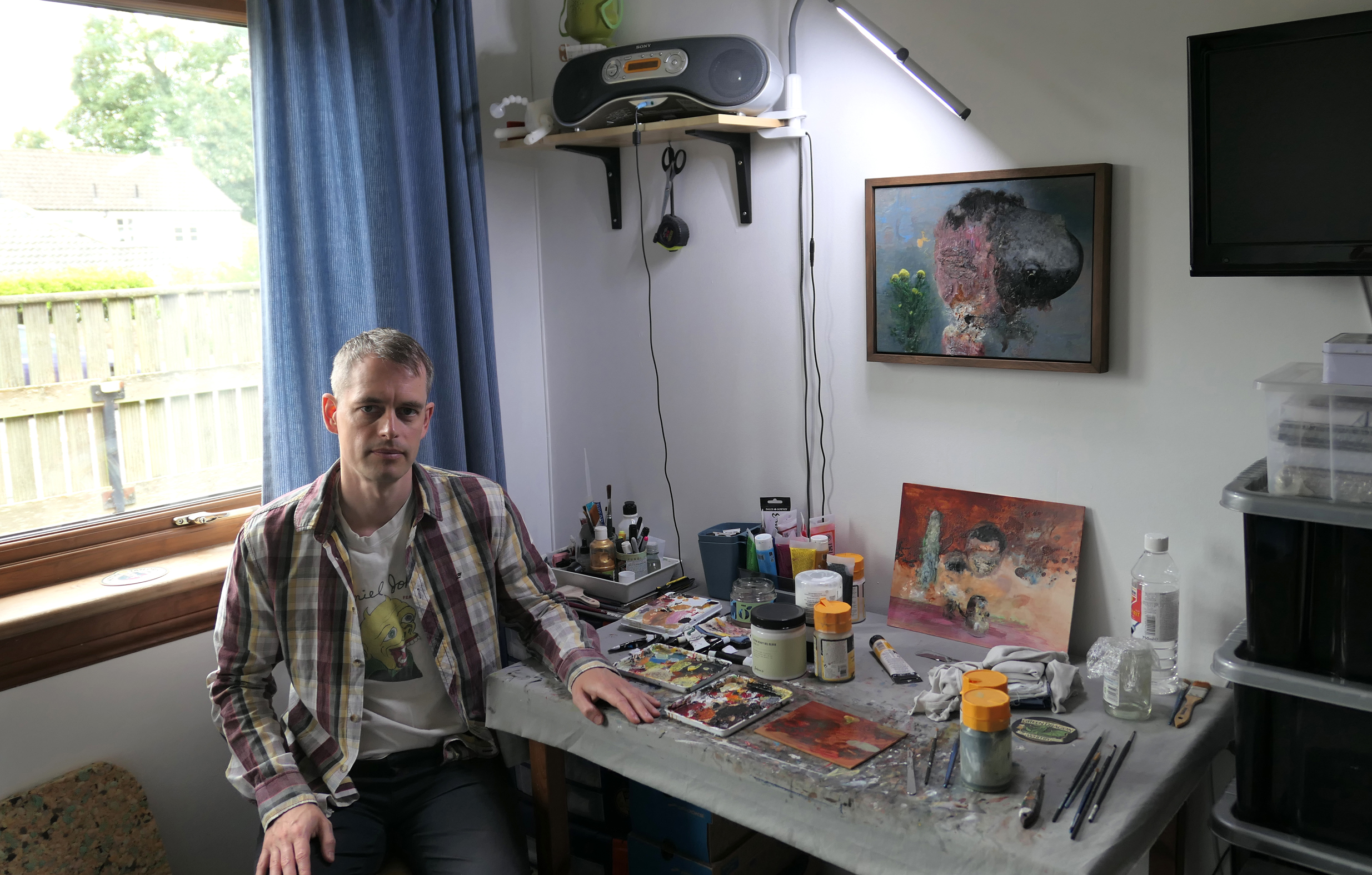
Above image: Daniel in his studio

Daniel Bell
Acrylic on panel, 18 x 22 cm | 7 x 8.6 in
Josephine: Could you share the story of how you became an artist and tell us more about your artistic background?
Daniel: I always loved making stuff as a child, and at secondary school I really got into observational drawing and painting. I remember a careers advisor coming into school when I was about 14 – I told her I wanted to be an artist, and she laughed in my face. I don’t think anyone really saw it as a serious vocation. I did art A-level at college though, and then a foundation course (and around that time started going to art galleries).
I went on to study Fine Art at Glasgow School of Art, but also took a year out to study at Rhode Island School of Design, and that was particularly inspiring. I struggled to find my way in the art world after graduating, though, and eventually did a Digital Practices MA in Norwich (focusing on animation). It was years after that before I found my way back to painting, and when I did, it felt like a completely fresh start. I think I really needed that time away to realise that painting was so important to me.

Daniel Bell
Acrylic, emulsion, gloss paint and wood stain on MDF, 40 x 30 cm | 16 x 12 in
Josephine: What does a typical working day in the studio look like for you? Do you have any important routines or rituals?
Daniel: I don’t have any particular rituals, and I’m not keen on routines. If I try to force my painting into some sort of regular schedule, it just completely kills it for me. I try to paint whenever I can, but I really have to be in the right mindset too – if I’m not, I can toil away for hours or days, and end up in a worse place than when I started.
A typical good day would involve working on some particular details on a painting or two, sections that I feel pretty sure I know the direction of. Then there would be a couple more paintings that I would be throwing everything at, experimenting and playing. And then a few pieces that fall somewhere in between. I would shift between these paintings (and ways of painting) as much as necessary to get something interesting happening.

Josephine: Which materials or tools could you not live without?
Daniel: Tubs. I have various tubs containing mixtures that I’ve put together – different colours, different thicknesses of gel, blends of oils, and varnishes, etc. I like to be surrounded by stuff that’s been stewing away for a while, so I’ve got plenty of options to dip into, things that might surprise me. Also, I make sure I’ve always got a lot of panels prepared and ready to go, so I can just start something new at any point. I use acrylics mostly, so I would have to say that is what I couldn’t live without, but my paintings are never 100% acrylic, so I always want lots of different materials within reach.

Josephine: Do you work from a reference? Tell us more about your process.
Daniel: I have a lot of photos that I’ve taken, so I’m regularly looking through them. I’ll either be searching for a specific object that I think would work well in a particular painting, or I’ll be seeing if some image jumps out at me as a starting point for something else. There are nearly always recognisable life-like elements in my work, but I have no set method of when or how I introduce them. Sometimes they begin to take shape at the start, but more often than not I’ll phase them in at a later point, as part of the battle with the paint. I don’t want to just piece together a painting though, like I’m following a formula – it’s got to be loose and follow a different route each time.

Josephine: Do you regularly draw or keep a sketchbook? If so, how does this inform your work?
Daniel: I don’t very often draw these days, and I don’t tend to use sketchbooks. None of that feels natural to me, in the way that painting does. I never feel that I want to plan a painting, and I don’t really want to think outside of it. I want it all to happen at once, thinking, feeling, getting lost in the process – I want the painting to come from a place that I don’t completely understand. For the sake of my painting, I’ve come to realise that taking time out to plan and to analyse isn’t necessarily a good thing.

Daniel Bell, Acrylic, oil, emulsion, varnish and anti-corrosion spray on MDF, 41 x 31 cm | 16 x 12 in
Josephine: Have you ever had a period of stagnation in creativity? If so, what helped you overcome it?
Daniel: I’ve had plenty of periods of stagnation. It’s tricky, because just walking away from it for a while can really help, but actually I feel my best paintings have emerged from long periods of banging-my-head-against-the-wall frustration. I think sometimes that battle can give birth to something new and exciting, but sometimes, of course, it can just sap all your energy. Once you’ve been through enough periods of stagnation and dissatisfaction, you learn not to be cowed by them. I’ll often just go out for a long walk, feed the crows, and keep my eye out for anything that might give me a bit of inspiration.

Josephine: Are there any specific artists or mentors who have inspired you?
Daniel: My tutor Peter Bishop, during my foundation course in Shrewsbury, really helped me when I was just starting out. His main advice to me was to stop thinking, to just embrace what I was doing (keep making, continuously, relentlessly). It seems obvious, but it changed the way I approached things, and it’s certainly relevant to the way I paint now.
Around that same time, I discovered the work of the Quay Brothers, and they became a very big inspiration. When I started making animation, I sent them some of my work (asking for help and advice), and got a great reply. They had taken the time to watch it all and told me which bits they thought worked, and which didn’t. They also gave me an insight into how they had struggled in the industry. It made me realise how tough it is to be creative at any level, but also how rewarding.

Daniel Bell
Acrylic, wood stain and emulsion on wooden panel, 21 x 15 cm | 8 x 6 in
Josephine: What were you thinking about or exploring at the time you made Spider? What inspired it, and how did it come to be?
Daniel: I was making a lot of work inspired by small creatures, with fewer and fewer human elements popping up. I was interested to see how little information I could give in a painting to show the animals that I wanted. With this piece, it was all about creating the atmosphere, rather than the figure. I felt that I was constructing something spider-like, but I wanted that feeling to just hang there and stay ambiguous. I was making an abstract painting essentially, and was really wrapped up in the tussle with the paint. The manoeuvring of oil, acrylic and varnish, the dragging of paint through multiple layers – it felt like a wonderfully convoluted way to make something that’s barely recognisable.

Josephine: What made you submit this piece to Jackson’s Art Prize?
Daniel: I felt that it was quite a striking piece. It had been so long in the making; it seemed to have a really used and grubby quality to it. As an object, I just really liked it, so I thought maybe other people would too. The eyes, of course, can draw people in, and I felt it had just the right amount of ambiguity.

Daniel Bell
Acrylic, oil and emulsion on MDF, 22 x 16 cm | 9 x 6 in
Josephine: There is a strong sense of surrealism and the subconscious at play in your work. Can you tell us more about your influences?
Daniel: When I first started looking at art and artists as a teenager, I was really drawn to surrealism (Dali, Ernst, etc). It’s obviously quite an appealing way into painting, as it seems fun, like you can just let your imagination run wild. I think the first painting I was really aware of though, was The Garden of Earthly Delights, as we had a copy on the dining room wall. It’s quite frightening for a child, but I loved Hieronymus Bosch, and I still do. I became increasingly dissatisfied with my paintings as I progressed through art school, and had stopped painting altogether by the time I graduated. When I eventually came back around to the ideas of surrealism and the subconscious, it was through film and stop-motion animation (Jan Švankmajer, Ladislaw Starewicz, etc).
When I started painting again, I didn’t have any hang-ups anymore, and I just wanted to see what I could create. Nobody cared (or even knew) that I was painting, so I felt completely free and really embraced my subconscious. I didn’t really look at other artists at that time – I just wanted to make work that was me, direct and unfiltered. I’m so glad I started painting again in such a reclusive way, as I feel that this let me be myself.
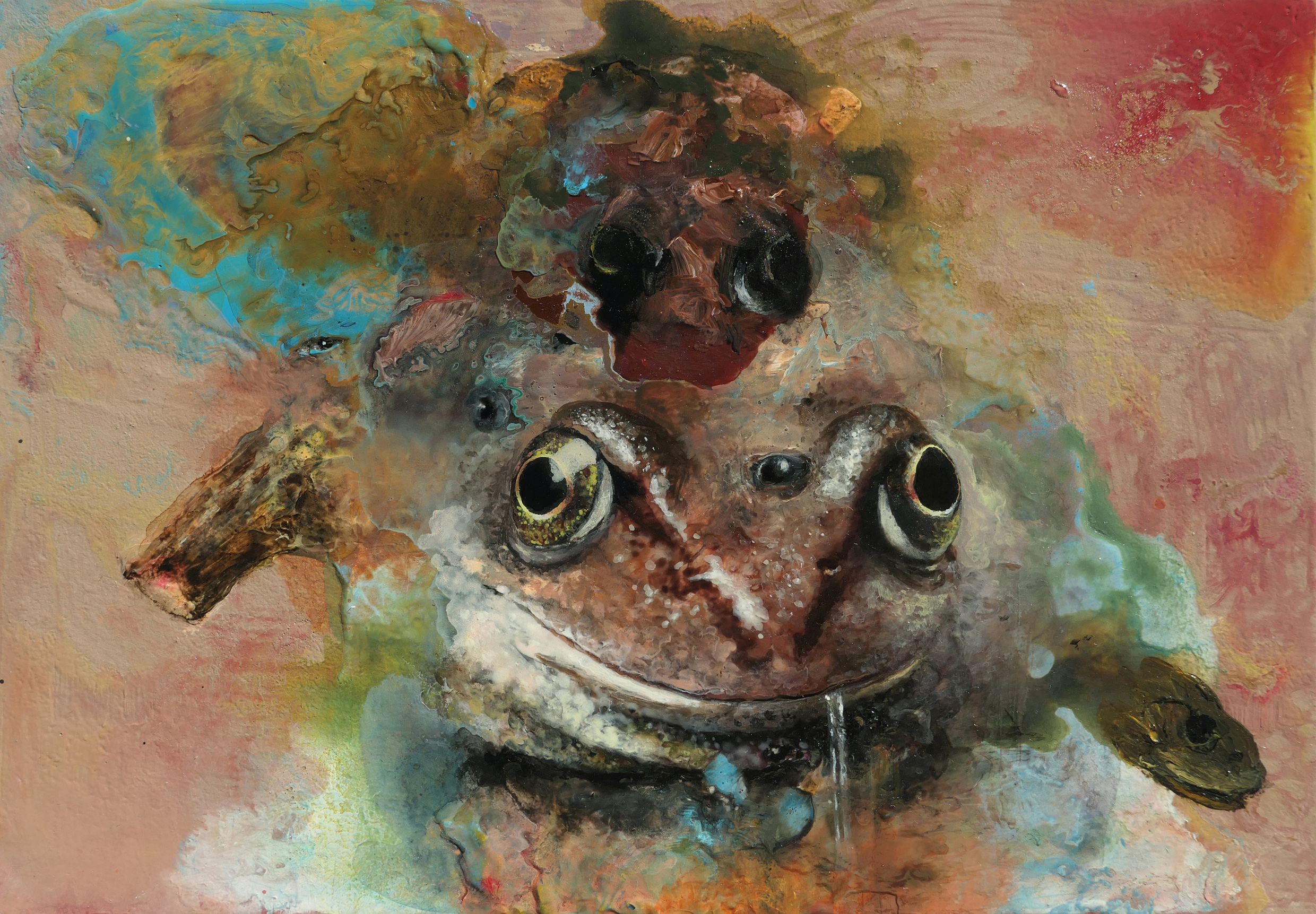
Daniel Bell
Acrylic, oil and emulsion on MDF, 22 x 16 cm | 9 x 6 in
Josephine: The subjects in your paintings have an amorphous, metamorphic quality about them that you augment in the way you handle paint. Tell us about the source material you use.
Daniel: I’m pretty open to what kind of subjects I paint, but I do tend to be drawn to things like fungi, invertebrates, amphibians, and other small creatures. I always feel I have humans in mind as well when I’m making a piece. Although I use photographs a lot when making a painting, I never get precious about how I recreate these elements in my work. The main thing is the paint itself, the shapes, the transitions – the subject matter drifts in and out. I don’t sketch anything out, or decide on a composition. The realistic, figurative parts can be worked in at any point, and if there’s an accident of colour or shape that I find more interesting, I will pursue that instead. The endless possibilities (and unpredictability) of paint fit perfectly with the mysteriousness of the life cycles and metamorphoses of the animals, plants, and fungi that I’m so interested in.

Josephine: Are there any new techniques or ideas you’re excited to explore using the materials from your prize?
Daniel: I’m really keen to throw more oil paint into the mix. The prize has given me some freedom to splash out a bit, so I’m going to make the most of it. I will definitely be experimenting a lot. There are some really great-looking acrylic paints and varnishes as well – I still feel a bit overwhelmed by it all. The first thing I did was get some nice new brushes (long overdue) and a big tub of acrylic gel, which I use a lot. I also got a daylight lamp, so my little studio room is already feeling more comfortable to work in.

Daniel Bell
Acrylic, oil, wood stain and emulsion on wooden panel, 40 x 30 cm | 16 x 12 in
Josephine: How did it feel to move through the stages of the competition and win a Jackson’s Choice Award?
Daniel: So many people had submitted their work, so I knew I’d done well to make it to the Longlist. Then to get onto the Shortlist just felt wonderful. I’ve managed that two years in a row now, so I feel very lucky. It was a really lovely surprise to win a Jackson’s Choice Award this time. My paintings are a bit weird and ugly, so I never know how they will go down with judges, or any audience – it’s very satisfying to know that people like what I make.

Josephine: What’s coming up next for you?
Daniel: I recently had the privilege of being one of the selectors for the Contemporary British Painting Prize, so I’m looking forward to seeing the work that we chose for that in September. I also just found out that one of my paintings has been shortlisted for the Cass Art Prize.
It feels great that my work is getting seen by people, and I’m getting to mix with other artists. I’m just trying to keep that going, and of course to keep painting as much as possible.
Follow Daniel on Instagram
Visit Daniel’s website

Further Reading
Meet Angela Lizon, Winner of Jackson’s Art Prize 2026
Jackson’s Art Prize 2026 First Prize Winner Announced
How We Collaborate With Artists
Expert Advice on Making Your Way as an Artist
Shop Acrylic Painting on jacksonsart.com