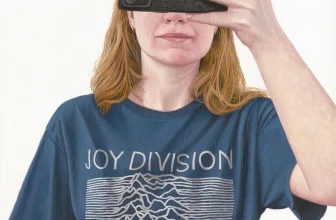
Doris Salcedo examines a section of House, 2026, in her Bogotá studio.
Photo Juan Fernando Castro/©Doris Salcedo
Doris Salcedo is best known for her moving “anti-monuments,” gigantic artworks—or sometimes negative spaces—that propose new ways to commemorate atrocities. Always, she focuses on the victims’ perspectives. Her best-known work, Shibboleth (2007), installed in Tate Modern’s Turbine Hall, comprised one giant, scar-like crack in the concrete, rerouting foot traffic in a manner that evoked the jarring disruption of borders more broadly.
The Colombian artist began working at such a monumental scale only after she began losing her central vision. At age 31, Salcedo was diagnosed with Stargardt disease, a rare genetic condition, and today she is legally blind, with only peripheral sight.
Related Articles

Doris Salcedo examines a section of House, 2026, in her Bogotá studio.
Photo Juan Fernando Castro/©Doris Salcedo
Before her vision started to change, Salcedo made all her sculptures alone. Reflecting on that time during a visit to one of her studios in Bogotá in July, she remembered treasuring “the privacy of improvising and of working directly with the materiality.” But as her condition progressed, she had to give up solitude “little by little” and started working with assistants.
Naturally, she mourned surrendering the spontaneity her independence enabled. At first, Salcedo, now 67, found that “it was a very difficult adjustment, especially losing the privacy.” She also found that she had to “think in a different manner,” since “before, I was improvising; I never had a prior drawing.” When she works with a team, she has to come up with a plan she can clearly communicate: “Things have to be absolutely defined,” she explained. Slowly, though, she found that working collaboratively “gave me the possibility of making better pieces than the ones I was making by myself. A collective statement is far more powerful than a lonely solo voice. It becomes like a chorus, and a really potent one.”
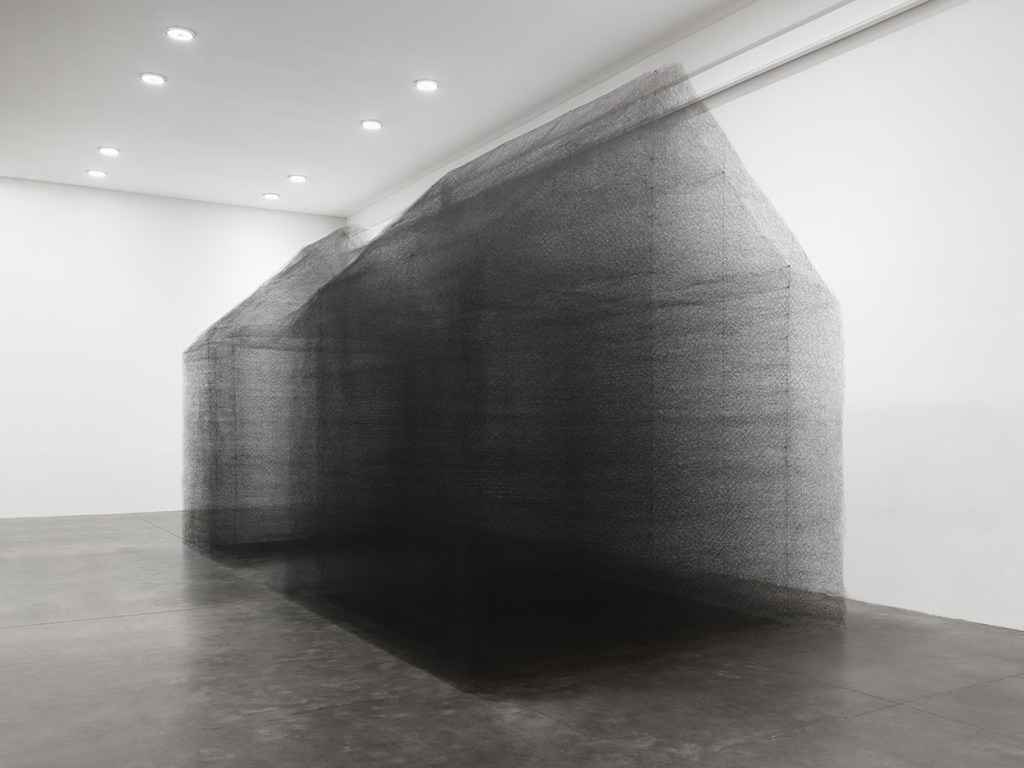
In November, at White Cube Gallery in New York, Salcedo will premiere a sculpture that is the culmination of decades of this collaborative way of working—and huge in a way that could never be accomplished by one person. A full-sized house—at nearly 30 feet—has been woven entirely from human hair. When I visited, dozens of assistants were working across her three studios, tying knots in individual strands, a painstaking process. The resulting pattern resembles chicken wire or a chain-link fence.
Even working with such a big team, the process took three years. “To be thankful is not enough,” Salcedo said of the collective effort, adding that it could have easily taken 20 years to make on her own—and that she couldn’t spare that kind of time at her age.
As Salcedo led me through her studio—her own iconic salt-and-pepper curls rhyming with the looping locks lining the space—she told me that all of her workspaces were designed by the architect Carlos Granada. The two have been working together for 25 years. He is also the architect behind Fragmentos, Salcedo’s 2018 “anti-monument” commissioned by her national government to commemorate the 2016 Colombian peace agreement. Visiting the building in the heart of Bogotá, what at first looks like a typical modernist, single-floor gallery takes on new weight in the feel of its flooring: The textured tiling is made from firearms that once belonged to the Colombian guerrilla group FARC and were later melted down. Visitors walk right on top of these instruments of violence and fear, on tiles Salcedo made in close collaboration with 20 Colombian women who survived sexual violence during the conflict.

Salcedo’s site-specific installation Fragmentos, 2018, is built into the ruins of a colonial-era house in Bogotá.
Juan Fernando Castro
The work has an undeniably chilling effect. School groups flock to it regularly. Some critics, though, have found its message misleading, since several splinter factions are still active and thousands of fighters rejected that 2016 agreement. But for Salcedo, Fragmentos is not a static space: She regularly invites other artists whose work resonates to exhibit within its walls. When I visited, a crew was de-installing a sound installation by Hajrah Waheed that filled the space with movingly hummed songs of resistance. The work, titled Hum II (2023), is surprisingly affecting, unifying: You’re made to feel something of the song’s sentiments even if they’re in languages you don’t understand. Fittingly, the title means “we” in Urdu, Waheed’s mother tongue.
Like Fragmentos, Salcedo’s studios boast high ceilings. Her workspaces also feature glass brick walls and floating staircases: These are sparse spaces that enable her and her team to see what they are working on. As she walked me through, magnifying glass in hand, she pointed out that one of her studios is the same shape as the home she is building—a triangle atop a square, as if a kid drew a house. Eventually, we came upon the net-like hair arranged in sections like a gradient, growing darker and denser at the bottom. She let me touch it, and I was surprised to find it so sturdy and lightweight at the same time.

Salcedo’s site-specific installation Fragmentos, 2018, is built into the ruins of a colonial-era house in Bogotá. Last spring, Hajra Waheed installed outdoor speakers there for Hum II (2023).
JUAN CASTRO PHOTOHOLIC
THE WORK-IN-PROGRESS MARRIED a complicated process to a simple shape. As we spoke, I found myself wondering about the latter—why a house? I found a hint in two books sitting on the surface of her desk, both of them scanned so she can see them on a screen in large print: Domicide: The Global Destruction of Home and Dreamhouse: Stories of Art and Shelter.
House is not her first work on the subject of the devastating effects of the global housing crisis. Uprooted (2020–22), her prize-winning work in the 15th Sharjah Biennial (where, as it happens, she met Waheed, a fellow prize winner), repurposed 804 dead trees into a mesmerizing, if uninhabitable, home. At almost 1,000 feet long, the work is meant to speak to the predicament of climate refugees. Her newer work, which takes the same shape, is about more deliberate displacement: specifically, “domicide,” which the authors of one of the books on her desk, J. Douglas Porteous and Sandra E. Smith, describe as the calculated destruction of homes. Explaining the impetus for her piece, Salcedo pointed to current conflicts in Ukraine, Gaza, Syria, and Sudan, where people are being violently displaced en masse.

Doris Salcedo: Uprooted, 2020–22, on view in the 15th Sharjah Biennial, 2023.
©Doris Salcedo. Photo Juan Fernando Castro.
Domicide, she pointed out, has a cascading effect: victims lose not just a structure but their communities. They lose access to privacy and respite, as well as bathrooms and places to cook and sleep. Mental health, studies show, tends to deteriorate rapidly as victims are forced into survival mode.
With House, Salcedo wanted to show that, while the dispossessed are of course vulnerable, they are also resilient. Her meshy nets are fragile and flexible, yet they are also much stronger than they seem. Hair may be ephemeral, but she makes it structural and sturdy. It’s all inspired, she told me, by the ways that spiders make webs of silk, material they take from their own bodies. Pairing hair and home, she evokes the ways that bodies and buildings—like dignity and domesticity—are tightly bound.

View of Salcedo’s series “Unland,” 1995–98, at the Museum of Contemporary Art Chicago, 2015.
©Doris Salcedo. Photo Patrizia Tucci/Courtesy White Cube, New York.
SALCEDO LEARNED TO WORK WITH human hair from earlier pieces: “Unland” (1995–98) comprises tables severed and then rearranged such that they depend on dissimilar tables for structural support. As if personifying the balancing act, the artist intricately threaded the surfaces with hair, drilling tiny holes in the tables to insert locks she gathered from a local salon. But for House, given its magnitude, she decided to source hair online, learning to look carefully for certain certificates, as there is a lot of violent crime in the human hair trade.
Hair is not the only tricky material that will feature in her fall show. On an upper floor of one of her studios, more assistants were at work on objects of a smaller scale, all destined for display alongside House at White Cube. They were wearing jeweler’s glasses and using X-Acto knives to meticulously remove the starch from individual grains of rice. A team of architects and engineers looked on, huddled around a computer on a lofted level as they worked out the structure of the sculpture’s shape. “I’ve never had such a large team,” she explained as I took in the scene. At one point, she tried working with a renowned engineer who eventually stepped down, saying the idea was too complicated.
When an artist uses sculpture’s most stalwart materials like wood or bronze—as Salcedo has in the past—“the tools are already designed for you,” she said. House required more trial and error than she’s ever needed before—so it also required her biggest team yet. “I had to fabricate new tools and new ways of working,” she explained as we watched assistants drill minuscule holes in starchless rice grains before passing them along to the next station, where still other assistants would thread individual hairs through those tiny openings. They were assembling a kind of mesh, then forming it around damaged cooking supplies—bowls and pots and pans—to form Grains of Sorrow (2023–26), a reminder of what is lost to domicide besides simple structure.

Doris Salcedo: Grains of Sorrow, 2023–26.
©Doris Salcedo. Photo Frankie Tyska.
If this sounds like an incredibly elaborate—and surprisingly elegant—way to speak to tragedy, for Salcedo, both beauty and labor are part of her point. She is cognizant of how her studio might provide jobs to those who need them, employing, for instance, 150 women from the Colombian countryside, where it is difficult for them to find work.
The decision to both scale-up and work elaborately is as conceptual as it is material: “My work has always been labor-intensive because in the Global South, labor is intensive,” she said. “It’s completely different from industrialized countries.” She meant this not only as a way to shine a light on contemporary conditions, but also as a retort to art-historical tropes: Modernity is too often narrated, she said, as if “no single person from the Global South participated. But we know all the labor and all the suffering created modernity.” She wants to combine the forms and traditions of European sculpture with painstaking labor to show the two were always intertwined.
I asked her about the role beauty plays for her; she replied that she’s received a lot of criticism on this matter. She maintained, however, that “in all the violence and terror I’ve been researching all my life, I think the abject part belongs to the perpetrator,” adding that “beauty has a lot to do with dignity”—something she wants to restore as she tells the stories of victims. Elegance is also a way to get people to really look: The stories she’s telling are almost always in the newspapers, but that doesn’t mean everyone stops to soak them in. Salcedo doesn’t want you to divert your eyes from the world’s horrors, so she goes to extreme lengths to make sure you can’t look away.