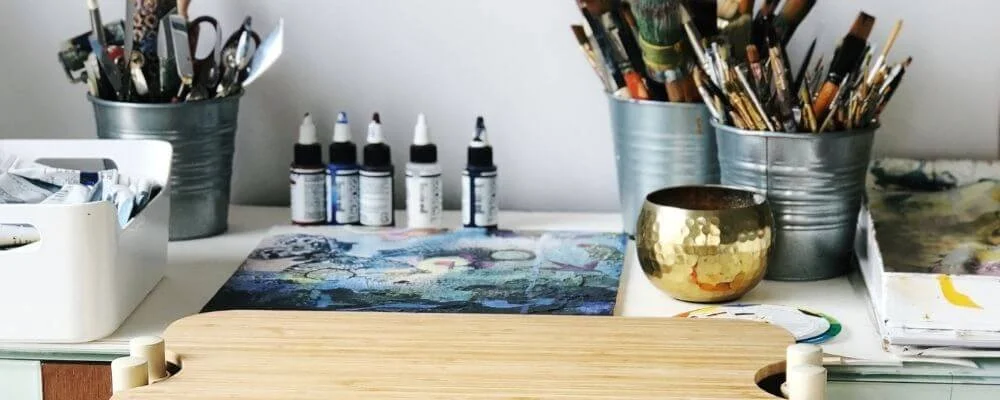
I’m thrilled to introduce you to Isabell Seidel, a visual artist born and raised in Lübeck, Germany. She is currently based in Ourense, Spain. Her passion for painting began in her childhood. She filled innumerable notebooks with watercolour sketches. Isabell also learned how to bind her own sketchbooks and thus adapted the medium to her needs and taste. Since then her sketchbooks and watercolour box have remained her faithful traveling companions. A few decades later, after graduating in Spanish and German Philology and Education, she moved to Galicia. Her sketchbooks became the basis for editorial projects and fashion collections. They served as a starting point for detailed illustrations, large format urban watercolours and acrylic landscapes.
Workshops and conferences focusing on urban sketching, bookbinding and watercolour masterclasses form a regular rhythm throughout the year for Isabell. In the summer months, she participates in outdoor painting competitions, exploring the terrain in her sketchbooks.
Tell us a bit about your journey as an artist?
It started early in my childhood. I´ve been making my own sketchbooks and filling them with drawings of my surroundings in Northern Germany for as long as I can remember.
I saved up my first pocket money to buy a box of watercolours and devoured books about painting available in the local library. Much later I spent several semester breaks with my mum drawing in Italy. We would explore our surroundings and draw everything which caught our eye and return with a sketchbook full of special moments and good food. Other travels have faded but the ones that I´ve drawn a lot are still fresh in my mind. A decade later, now living in Spain, I joined the Urban Sketching movement and was teaching on location drawing, bookbinding and watercolour painting when I was forced into my first solo show by my husband. That marked the beginning of painting on a larger scale. It also changed my conception of art as being something very intimate that I mainly kept to myself, to sharing it and starting to not only sketch but paint plein air. A couple years later, painting had become such an important part of my life, no longer limited only to my free time. I quit my teaching job at University to pursue painting full time.
What inspires your colour palette and creativity in general?
I love painting plein air, especially the urban landscape with its hustle and bustle and the ever changing play of light and shadow. Over the years I discovered that humans tend to feel contrast most strongly. That seems to be true as well for emotions as for physical changes like travelling. When I first came to Spain I was so inspired by the natural landscape, the mountains and the historic city centres so different from the Brick Gothic of my hometown Lübeck. I still admire and enjoy painting Galicia but the excitement is more subtle now and I endeavour to pay attention to the little changes in nature to keep the enjoyment and my palette fresh. Over the summer months I participate in speed-painting contests, which entails travelling, meeting friends, gaining new impressions and much more plein air painting.
How did you come to choose the artist path?
As I mentioned it was a slow process, spanning over 3 decades and a rather natural one. It wasn´t a big decision but an infinite number of small steps to follow what I was passionate about – record my surroundings and experiences in a sketchbook and then take this to the next level. I never had any plans to be a professional artist because I simply didn´t think that it could be an option. I only quit my teaching job, which I enjoyed very much, when painting demanded my whole attention and my income from art topped that from teaching. Once I decided to take this road, it was like a whole new world of possibilities suddenly opened up and I dived in full heartedly. I had taken classes with artists I admired before but it had felt a bit like an extravagance, spending that much for a hobby. This has changed completely from the moment I started working full time as an artist. I now consider spending money on art supplies and on my education as a very good investment and besides painting it is the most enjoyable part of being an artist.
I’m in awe of your organization skills. How does that help creatives in general?
Self-management plays a big role in teacher training. I´ve always been interested in making the most of time, space and opportunities. I took some classes while studying and again after half a year of working 90h/week teaching at a secondary school. The first years are the most stressful ones for young teachers because you don´t have sufficient routines and resources to rely on. However, I thought that it must be possible to be a good teacher and to have some time to be with family, friends and enjoy my hobbies. It really was a necessity to find time for painting so I figured out how to do that.
I´m sure organization skills come in handy for everyone – at our jobs and with our families. If you´re working professionally as a creative you have to handle your creative pursuits and the business side of things. You have to discover how to balance your studio practise with the time spent on promoting your work, getting your business organized, staying in contact with your clients and setting time aside for your ongoing education. If you work in a field you really love, chances are that the work will have a tendency to take over everything. You need to make sure you spend enough time with your family and friends and still have some space for other activities like exercising, sewing etc.
As a professional artist what time management skills will help bring one success in the studio?
The most important part is to assess your situation. First, get clear what is important to you, what does your professional business need and how do you want to spend your week? Then take stock of how you actually spend your time and be honest about how long things take. It´s not helpful if you plan for 30 minutes on social media each day but the reality is that it takes you 90 minutes. Compare your reality to your plan. There are probably some activities you didn´t account for in your plan but which take up time each day or week. Think about the importance of these activities. Do you want to stick to them or let them go? Also leave enough room for rest and unforeseeable events. You won´t be able match your reality to your plan directly, because this is a longer process with constant adjustments. This way you will make sure you spend your time on what really matters to you.
What words of encouragement can you offer to help those who think they are not creative?
Come on!! We´re all creatives! Starting with dressing ourselves in the morning to choosing what to cook for dinner, how to arrange things in our home or where to plant those beautiful Hellebores. Some things we all have in common out of necessity, others are individual. If you think you´re not creative it´s just that you haven´t discovered what it is yet. Look for the things that make your heart beat quicker, where you feel happy and truly yourself – that´s probably where you should investigate more.
Learn more about Isabell Seidel. Follow her on Instagram.