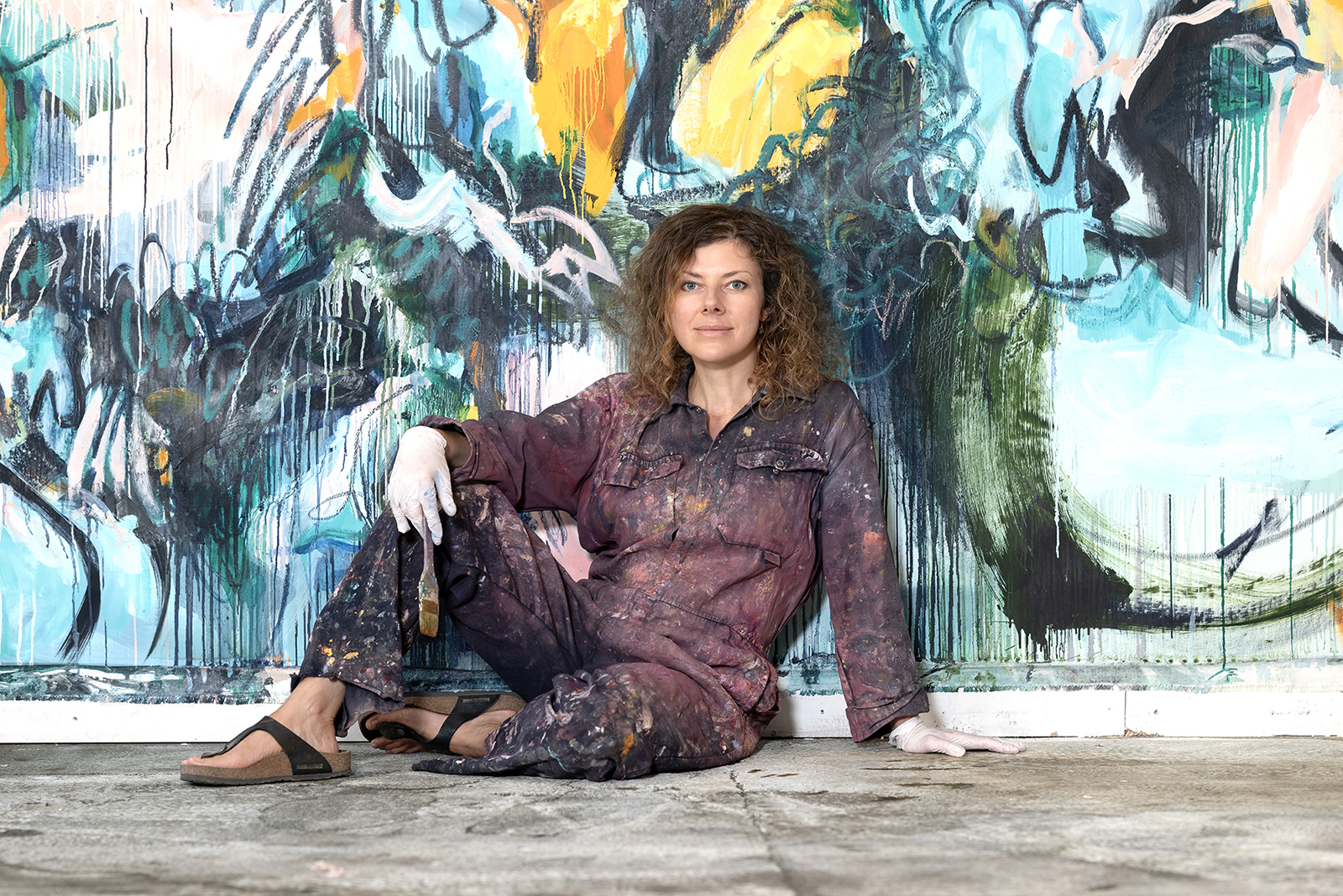
Katya Granova won Caroline Walker’s Choice Award in Jackson’s Art Prize this year with her work Picnic on the Meadow. In this interview, she discusses the influence of Jungian psychology on her work, how painting is the petrified state of the artist’s movement, and contemplating other careers but always returning to art.
Above image: Katya Granova in her studio. Photo credit: Ksenia Apresian

Katya Granova
Oil and oil sticks on canvas, 110 x 140 cm | 43.3 x 55.1 in
Josephine: Could you share the story of how you became an artist and tell us more about your artistic background?
Katya: However melodramatic it may sound, I decided to become an artist at the age of 18 because of a dream, or rather a nightmare. I went to see ‘The Mist’ with my boyfriend at the time, and I was deeply affected by the character of the religious fanatic, who turned out to be a greater evil than the otherworldly monsters. The same night, I had a dream where I was standing in front of the painted portrait of this character, and it was terrifying. But I also knew that I was standing in front of my own painting, looking into myself and facing a scary side of myself, the Jungian ‘Id’. The next day, I tried to paint this portrait, but I could not remember it, even though I vividly remembered the horror I felt in the dream. Instead, I started making colourful, expressive paintings of my other emotional states.
My paintings then were quite naive and over-intense, and I saw the point of making them as uncovering the subconscious, which is quite a predictable set of ideas from a third-year psychology student obsessed with Carl Jung. But exactly from this point, I started seeing myself as an artist.
No one in my family or circle of friends had ever done art professionally, so I never really considered it, but eventually, after some work experience in a hospice and elsewhere, I left psychology and concentrated on art. I studied in four different places, of which the most influential was the Royal College of Art, lived in five different countries, and obviously, it did not take long to move away from expressivity for the sake of expressivity. But my driving force to start my art practice was deeply related to psychology.

Josephine: What does a typical working day in the studio look like for you? Do you have any important routines or rituals?
Katya: I don’t really have any routine. I’m much more productive during art residencies, where I can step away from everyday life and fully concentrate; there I try to get up as early as possible and paint until dark. I take any opportunity to go to the residencies. When I’m not on a residency, I go to the studio maybe three days a week. But there I only paint and don’t do research, applications, or administrative work. My hours are random, but also depend on daylight, as I don’t work under artificial light.
I don’t really have any specific rituals, but first, I do something like cleaning my brushes while listening to an audiobook to get into the right mindset. I also always listen to music while painting, choosing music that energises me. Following Merleau-Ponty, I see painting as a performative medium – as the petrified trace of the dance of the painter’s hand and arm. To bring myself into that dance-like state, I need rhythm.

Josephine: Which materials or tools could you not live without?
Katya: I am an oil painter, so obviously good quality oil paint is the main thing. I like wide brushes of 10-15 cm, which are a nightmare to wash. And I love oil sticks and use them often, mostly Sennelier, to bring a gestural element into my work. I also use watercolour ink for works on paper, which is more radiant than normal watercolour.
Since I work while on residencies a lot, and they are in different countries, I have to adapt to whatever brands are available there and prepare for miscalculations – I have no clue why the colour Indigo is completely different from one brand to another, for example. But there are some paints I always bring with me, like Winsor Orange from Winsor & Newton, which gives me all those pinkish flesh tones that I use a lot.

Katya Granova
Oil on canvas, 155 x 185 cm | 61 x 72.8 in
Josephine: Do you work from a reference? Tell us more about your process.
Katya: My works are most often based on old found photographs. I started this practice about seven years ago while studying at the Royal College of Art. The experience of immigration, the feeling of alienation in a different culture, made me think a lot about where I am from, why I feel different, and what I brought with me to the new place.
I thought a lot about my family and its history. There was this photograph from my family archive that had somehow been haunting me. It featured my grandmother and her sister, elegant and very young, standing by a piano at a house party; they were familiar and unfamiliar at the same time. I decided to print it on canvas as an experiment and, while painting over it, discovered an energy, ease, and expressivity I had never had in my painting before. I thought then that my energy came from a desire to reconnect with my family, learn about their time and related history of the country, covered by layers of propaganda of all sorts, through my own eyes. But later, when I moved on from a family archive to flea-market photographs from various countries and the energy remained the same. I started thinking that it was not only about my family or immigration. It would not have kept me passionate for so long.
I believe that when I tried painting over a photograph, I rediscovered what I had always carried within me – the urge to be free, even from the basic conditions of being human. We are nailed to the present moment, moving like a train carriage on the rails of linear time without any stops; we never chose that we have to be born and then die; time will always overpower and eventually kill us. The moment in the photograph is unreachable, and that’s why it is so triggering — it is so realistic, but no human being is able to step in there. Ever since my early childhood, I have felt a protest against irreversibility of time. So my energy comes from a desire to do the impossible; to be able to intrude into the past, and this defines my gestures, my colours, and the energy of my painting.
My process starts with finding and selecting old photographs. I have several criteria when selecting them. First, I need a photograph to have more than two people, so it is not a portrait with all the attention focused on the face. Every single thing in the photograph is important because each thing shares the same existential condition of belonging to another time and therefore being inaccessible. Even if the people are still alive or the buildings still stand, they are now different, so I don’t want the viewer’s eyes to concentrate on one face. It must also provoke an emotional response in me. It must be from before my birth, so it could never have been possible for me to be there. The photographs must be black and white.
Then I print them, make colour studies, transfer the photograph onto canvas (via light-sensitive emulsion, a projector, or simply drawing from the reference). Then I mix paints in bulk and start painting. This part is the most fun for me, as decisions come easily, in a flow. In life, I can spend an hour deciding whether I want tea or coffee, so I really enjoy it when it’s like, ‘Want a red stripe here? Done!’
The next stage is when there is already something going on, and I more thoughtfully add new painterly voices that harmonise with what has already appeared, without removing or silencing anything; whatever has happened must stay. Deciding when to stop is the hardest part. In most cases, I think, ‘Okay, just a little more.’ Then I feel I’ve overdone it, regret it, and suffer for a bit. Eventually, I think, ‘Whatever, I don’t care anymore,’ do something unexpected, and then have a strong feeling of, ‘Yes, it’s done, I like it!’ Sometimes I manage to avoid this stage of doubt, but my favourite works are not those executed very quickly, but those completed after much hesitation and reflection.

Josephine: Do you regularly draw or keep a sketchbook? If so, how does this inform your work?
Katya: I don’t keep a sketchbook or make preparatory drawings in the traditional sense. Instead, I make small studies, which are the closest thing I have to sketches. After choosing a photograph, I take a picture of it and print five or six copies on office paper. Then I paint over them, trying to see what my first colour response to its contents is. Most of the time, I know immediately. For example, “this will be purple, yellow, pink, dark blue, and sepia, done.” But it’s useful to check if the actual shades feel right and develop a relationship with the image. Often, it also affects the composition.
The final painting normally keeps a little bit of a resemblance to the study, but more colours are added, more unexpected things happen, brushstrokes develop their own complex relationships, so it goes much further.

Josephine: Have you ever had a period of stagnation in creativity? If so, what helped you overcome it?
Katya: My crises mostly come from doubts about whether I’m doing something genuine, or lying to myself, trying to please the viewer, or related to the purpose of art making how I can be an artist and paint paintings when the world is on fire and I could volunteer in so many places, or whether I’d be better off as a scientist, surgeon, firefighter, or whatever. And when they happen, then, well, what can you do? I think, write sad texts, walk in the park, complain to my artist friends, call my mum, and start trying to paint again – and then I often find that the sense of making work somehow lies beyond any rational purpose. In the process, I feel I am doing something important, but I can’t fully explain it. This is how I eventually, I come out of crises. Often, this refinding of the sense in painting marks the start of a new productive period.
But the development of each painting also contains moments of crisis, when I get too attached to what is already there and can’t add things, or can’t decide what is missing or how to proceed. What helps is to leave it alone for some time and do something else, so I normally have three or four canvases in progress simultaneously to switch attention. After some time, my attachment fades a bit, and I can see more clearly what is lacking. This ‘some time’ can take years, but eventually I finish all my work.

Josephine: Are there any specific artists or mentors who have inspired you?
Katya: I’ve been inspired by many artists at different stages of my life. As a teen, often in museums, especially the Hermitage with its Impressionist collection, I dreamed of learning to paint like Cézanne or Matisse. Then, when I started painting expressively, my biggest inspiration was James Ensor. Then I became obsessed with Rubens and the fleshiness of Baroque painting. But with time, I became more and more interested in colour, which I see as the voice through which reality speaks, the leading force within the cacophony of human experience, and I got very much into Bonnard. Among contemporary painters, the artists who have influenced me most are Cecily Brown, Marlene Dumas, Mohammed Sami, Jennifer Packer, Peter Doig, Emma Fineman, Danel Richter, Rose Wylie, and Sanya Kantarovsky.
The first really important tutor I had was Stephen McClymont at the Paris College of Art. He recognised and encouraged my potential as a painter at a time when painting was far from the most welcome medium, and I was struggling to find my position within it. Then, tutors at the Royal College of Art left a lasting impression on me, especially the painters Ivan Seal, Philip Allen, and Emma Talbot. Their tutorials felt almost like psychotherapy sessions, except that the subject wasn’t me, but my artistic practice. They never told students what to do or what was right – objectively, no one really knows – but helped us to find a way to our own approaches, and that’s probably the most valuable form of mentorship I could have.

Katya Granova
Oil on canvas, 60 x 85 cm | 23.6 x 33.4 in
Josephine: What were you thinking about or exploring at the time you made Picnic on the Meadow? What inspired it, and how did it come to be?
Katya: Picnic on the Meadow belongs to a body of work called Intruded Picnics, in which I’ve taken my practice of transferring old photographs onto canvas further by inserting not just my painterly presence, but also a representational one, directly into the scenes. It is based on anonymous archival photographs of picnics, which I sourced from the book The Very British Picnic. The particular photograph I used for this work featured an elegant picnic in a meadow in the 1930s, with four smartly dressed people enjoying a sunny afternoon.
Picnics are an archetype of British leisure and social tradition, where you normally have to be invited. As an immigrant, you often hear that no one invited you here, so learn to behave, stop complaining, go back, or something along those lines, and with the rise of Reform UK, I started hearing this more often. It always sounded a bit funny to me, as I have always been deeply connected to British culture and art, and know them quite well, starting with the fact that as a child I really loved Dickens and had read all his books in translation by the age of about eleven. Since I once worked as a tour guide, I probably know British history better than that of my country of origin. At university, we studied a great deal of British philosophy. So if I’m an intruder disrespecting the culture, then who isn’t?

Katya Granova
Oil on canvas, 180 x 220 cm | 70.8 x 86.6 in
Josephine: What made you submit this piece to Jackson’s Art Prize?
Katya: Like many artists, I submit to quite a lot of opportunities. Let’s be honest: you just see an opportunity, measure the time needed to submit and decide whether it’s worth it, and make your decision accordingly. Nowadays, every artist opportunity attracts hundreds or even thousands of applicants, so there is never much hope for anyone to stand out against 1,000 other artists. I think it’s important to say this because otherwise every ‘Thank you for your application’ letter feels devastating. Every artist who has ever won anything had hundreds of refusals before, and some applications require hours and days of unpaid work.
The Jackson’s Art Prize has a relatively easy application form, which is a big plus. I also liked that there are guest judges who are practising painters. I think no one can see painting as painters do, so recognition from a fellow artist means a lot to me.

Credit: Damien Griffiths
Josephine: What inspires your colour palettes?
Katya: My relationship with colour is entirely intuitive. I look at a reference photograph and ask myself how it resonates with me through colour, what palette would be my most honest response to it and try it directly on a printed photograph. Colour is another way of asserting my own presence and agency within the image, because a black-and-white photograph has no inherent colour of its own. I can’t always explain why one photograph calls for yellow and another for blue. It’s an emotional response rather than an intellectual one. Looking back, though, I sometimes recognise where those choices may have come from. They might be connected to the photographs of surgical operations that surrounded my growing up in a family of surgeons, or to experiences that appeared happy from the outside but didn’t feel that way. Yellow, for instance, can be both the colour of sunshine and the colour of illness.
When certain colours seem to argue with one another, my instinct is never to remove anything but to add more. I like to think that any conflict can be resolved by introducing new voices rather than silencing the existing ones. Some colours are natural troublemakers, while others are peacemakers. There’s room for all of them, as long as each is allowed to speak with its own strength.

Katya Granova
Oil on canvas, 115 x 150 cm | 45.2 x 59 in
Josephine: Have you experienced any particular challenges in your practice that you have overcome?
Katya: Well, organisation of time. As an artist, you really need a great deal of willpower to navigate making money, applying for opportunities, teaching in my case, networking, research, and then, out of the blue, free creativity. You’re not going to get very far lying around watching reels, although obviously we all do it sometimes. Plus, it’s hard to find time to rest, because it’s hard to see your work as work, especially when you spend hours in an indecisive stage and don’t do anything that feels productive. But that is actually at the core of an art career, and I think I’m much better with it now then before.

Josephine: Are there any new techniques or ideas you’re excited to explore using the materials from your prize?
Katya: I plan to buy a set of R&F oil sticks, which I usually can’t afford. Sennelier stopped producing the ones I liked, and for a while I have been looking for an alternative. But to really get a sense of them, you need to try several colours together and see how they feel as a set. I also work on a large scale, so I always need a lot of canvas.

Katya Granova
Oil on canvas, 200 x 310 cm | 78.7 x 122 in
Josephine: How did it feel to move through the stages of the competition and win Caroline Walker’s Choice Award?
Katya: Last year, I only got as far as the longlist, so I did not have much hope to win. But getting to the shortlist was already a big deal – 70 out of 16000 is indeed impressive. I won the specific Caroline Walker Choice Award, and this is extremely encouraging for me because Caroline is a great painter whose work carries many strong ideas that I deeply share, and being selected by her is a great honour. I had a chance to invite Caroline to my studio and show her my work, which was super nice, encouraging, and informative. I am very grateful to Jackson’s Art Prize for having this opportunity.

Katya Granova
Oil on canvas, 180 x 200 cm | 70.8 x 78.7 in
Josephine: What’s coming up next for you?
Katya: I have two upcoming residencies in Mexico City! I am very excited to explore the Mexican art scene.
Follow Katya on Instagram
Visit Katya’s website

Further Reading
Meet Angela Lizon, Winner of Jackson’s Art Prize 2026
Jackson’s Art Prize 2026 First Prize Winner Announced
How We Collaborate With Artists
Expert Advice on Making Your Way as an Artist
Shop Oil Painting on jacksonsart.com