One of my achievements over the past 30 years has been discarding New York condescension to art from what NYC calls “the boondocks” and realizing that there have been good artists everywhere. New York continues to be where most art world reputations are made, obviously, but artists across the land struggle with the same problems: what do you have to say, how can you best say it, and how can you share your vision with others? In front of a blank canvas, every artist is the same.
Two shows Roberta and I recently saw on a West Coast trip illustrate the situation from opposite ends of the spectrum. Beyond Mysticism: The Modern Northwest, curated by Theresa Papanikolas and on view at the Seattle Art Museum through August 2, is an exhibition of works by artists who worked in the Pacific Northwest during the second and third quarters of the 20th century. Mark Tobey and Morris Graves have the biggest reputations today, and it was interesting to see paintings done before they arrived at the styles that brought them national fame. Working Man, a 1942 painting by Tobey, for example, is a striking example of Social Realism, but the white lines denoting the folds in the worker’s clothing hint at the fully abstract style he will soon adopt.
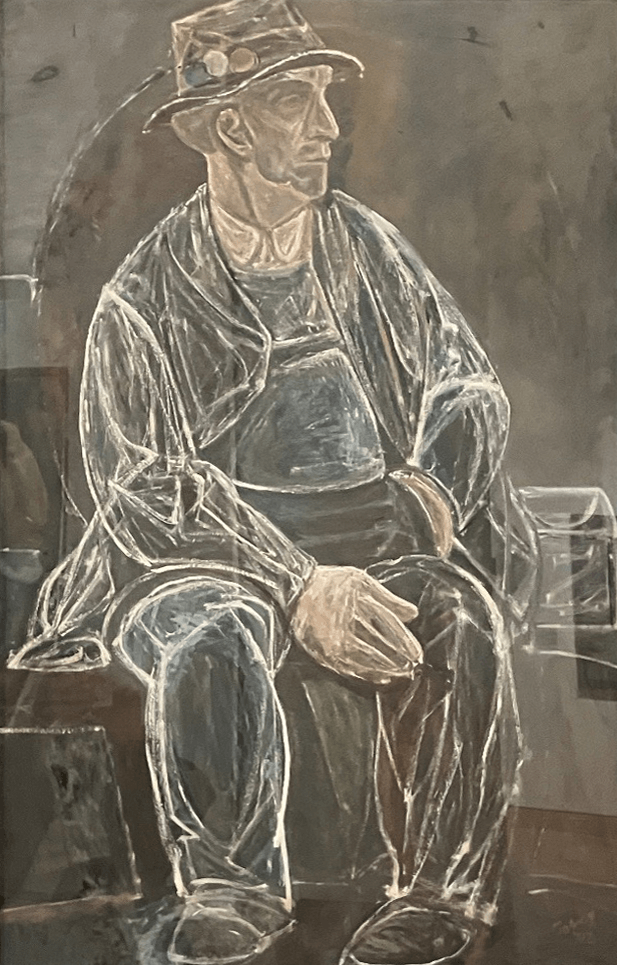
Seattle Art Museum, Eugene Fuller Memorial Collection.
Photo: Roberta Upshaw
I knew Tobey’s and Graves’s work, of course, but it was a treat to discover several artists who are unknown outside the Pacific Northwest. Many of them worked under the auspices of the Works Progress Administration. I especially liked the work of Vanessa Helder (1904-1968), who documented the construction of Grand Coulee Dam and caught the geography of the austere landscape.
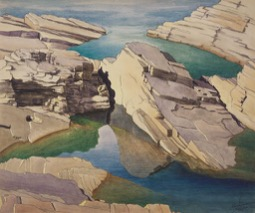
Northwest Museum of Arts and Culture.
Photo courtesy NMAC.
Malcolm M. Roberts (1913-1990), “the Seattle Surrealist,” had studied at the Art Institute of Chicago and in Europe before settling in Washington. He discovered surrealism while still an art student and produced his share of works reminiscent of Salvador Dali and Yves Tanguy, but even as a young man he could produce images that evoke something of surrealism’s spooky mood while being strikingly original. The work below, done when he was only 23, was acquired by the Seattle Art Museum soon after its execution, as the museum attempted to support the local scene.
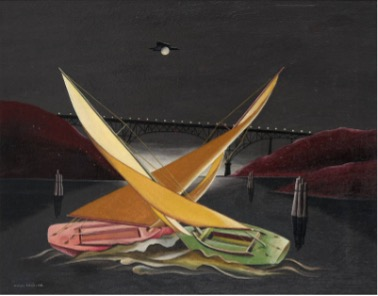
Seattle Art Museum, Eugene Fuller Memorial Collection. Photo Scott Leen.
It’s wonderful when museums support local artists, but the life blood of a city’s artistic scene is conversation between artists in bars, studios, and living rooms. A gallery in the Beyond Mysticism exhibition is devoted to a fanciful reconstruction of an artist’s living space of the time, with works by local artists, reproductions of European and American modernist works, art magazines, books, and music, the environment in which Seattle artists attempted to perfect their craft. It was lovely to sit on the armchairs and sofa that were part of the space, listen to music from the era, and flip through period magazines while taking everything in.
Eight hundred miles south of the Seattle show, the San Francisco Museum of Modern Art has mounted an intriguing exhibition through September 13 built around one of the crown jewels of its collection, Femme au Chapeau by Henri Matisse. The painting caused a scandal when it was exhibited at the 1905 Salon d’Autumne along with paintings by Andre Derain, Maurice de Vlaminck, and others whom a Parisian critic termed the “Wild Beasts.” SFMOMA has assembled other works from that exhibition and has installed them in a gallery decorated as closely as possible to the décor at the 1905 exhibition, as shown in vintage photographs.
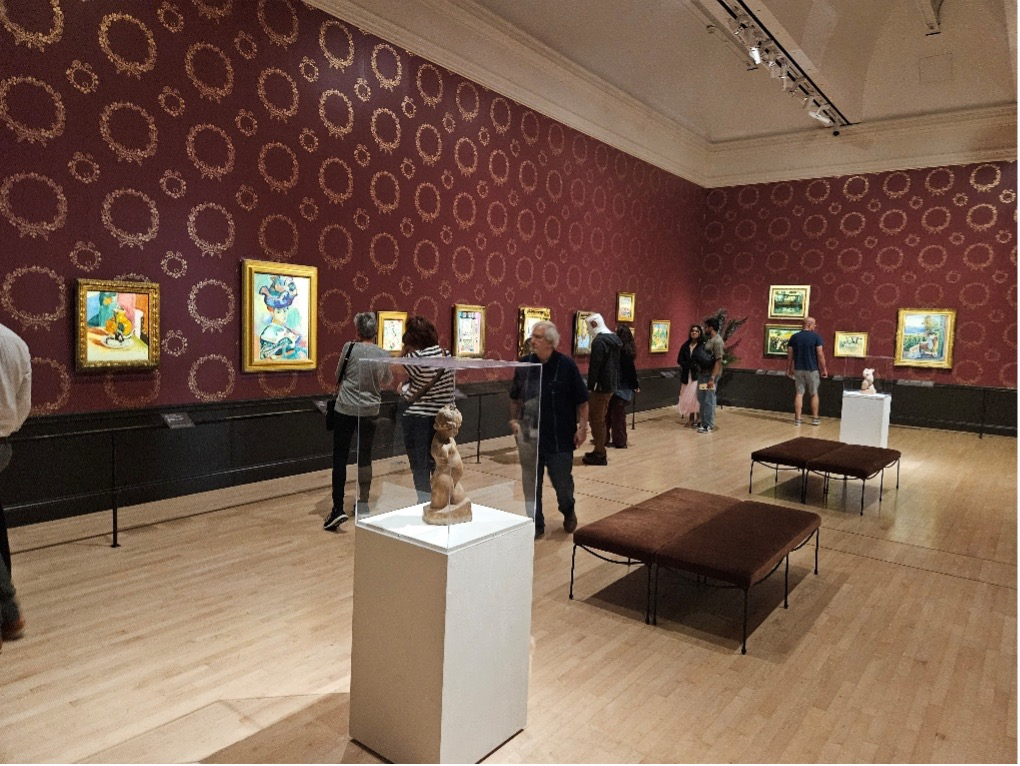
Title painting is second from left. Photo: Reagan Upshaw.
Everyone with a basic knowledge of modern art has seen reproductions of Femme au Chapeau, but seeing the painting hung amid the over-the-top décor we associate with Belle Epoque is a forceful reminder of how shocking it was when viewers first encountered it.
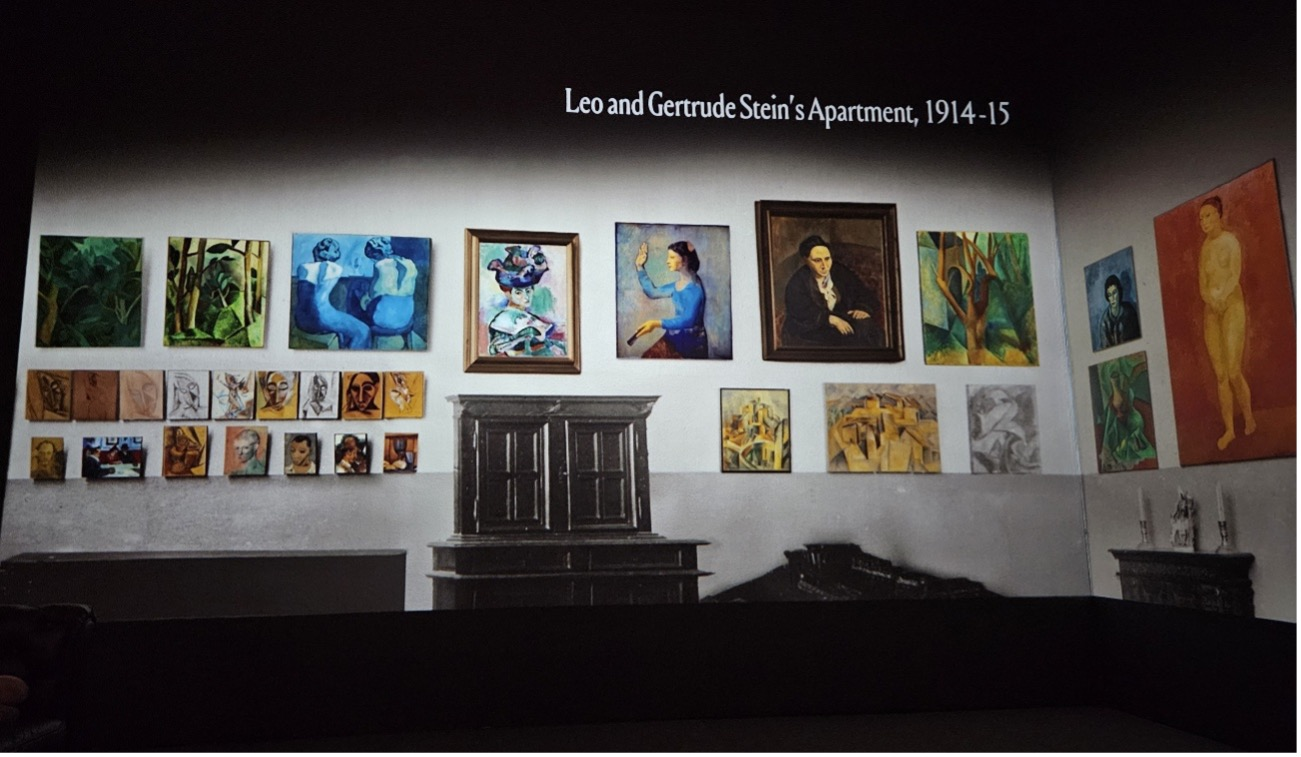
Femme au Chapeau was purchased by writer Gertrude Stein and her brother Leo. It occupied a prominent spot in their Left Bank Paris apartment. SFMOMA curators Maria Castro and Janet Bishop had the happy idea of designing a gallery in which vintage photographs of the Steins’ apartment are projected on the gallery walls, with the apartment walls and furniture remaining sepia in tone while the paintings in the photos are gradually replaced by colored images. The display changes to reflect changes made by the Steins to their collection over the years. As in the Seattle show, this gallery has comfortable seating which makes spending time in the space a pleasure.
Photo: Reagan Upshaw.
I spoke earlier about the need of artists to congregate and exchange ideas, not just with each other. but with artists and writers in other fields. The Steins’ weekly open houses were among the most important meeting places for artists in the 20th century. As Max Weber, a young American artist in Paris at the time, wrote, “Leo and Gertrude Stein graciously received art students, students of philosophy, writers, young poets, musicians, and scientists. This salon was a sort of international clearing house for the young and aspiring artists from all over the world.”
Artists’ apartments in Seattle and two collectors’ apartment in Paris were both crucibles from which modern culture was profoundly changed. See these tributes if you can.