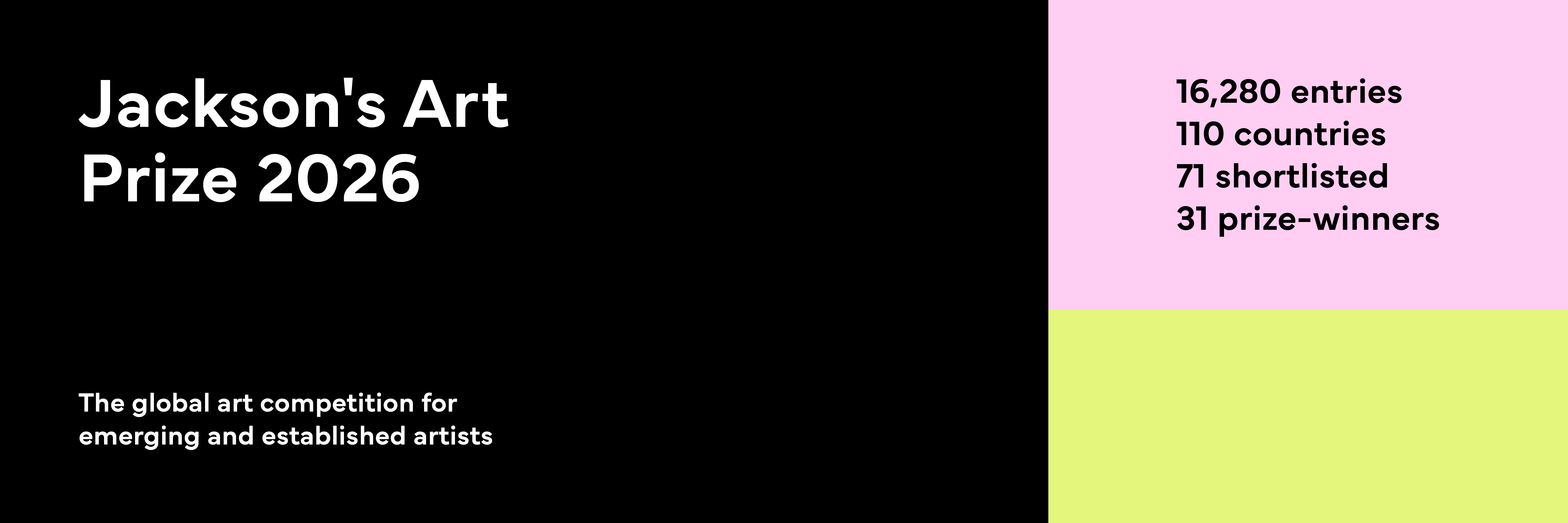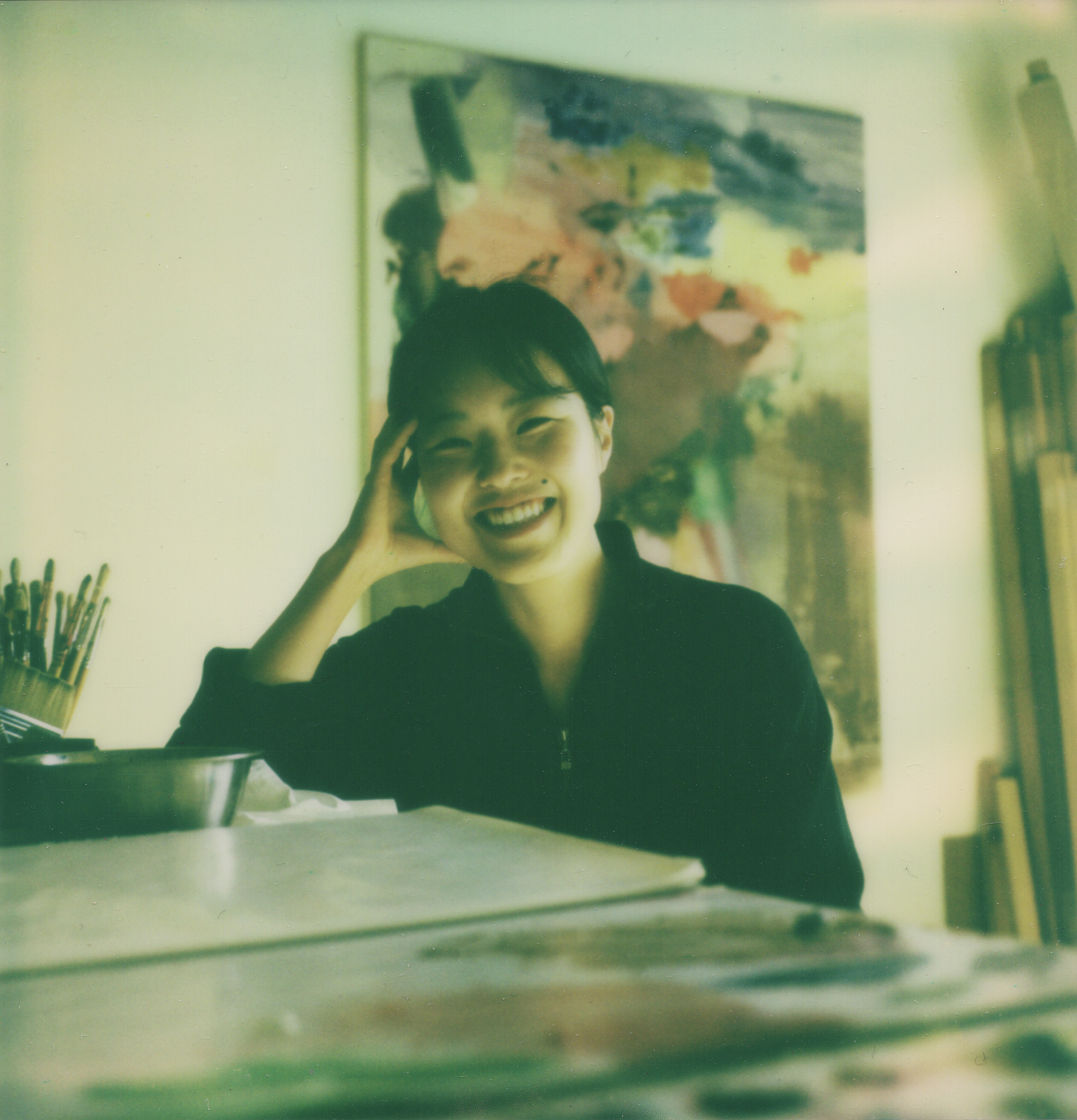
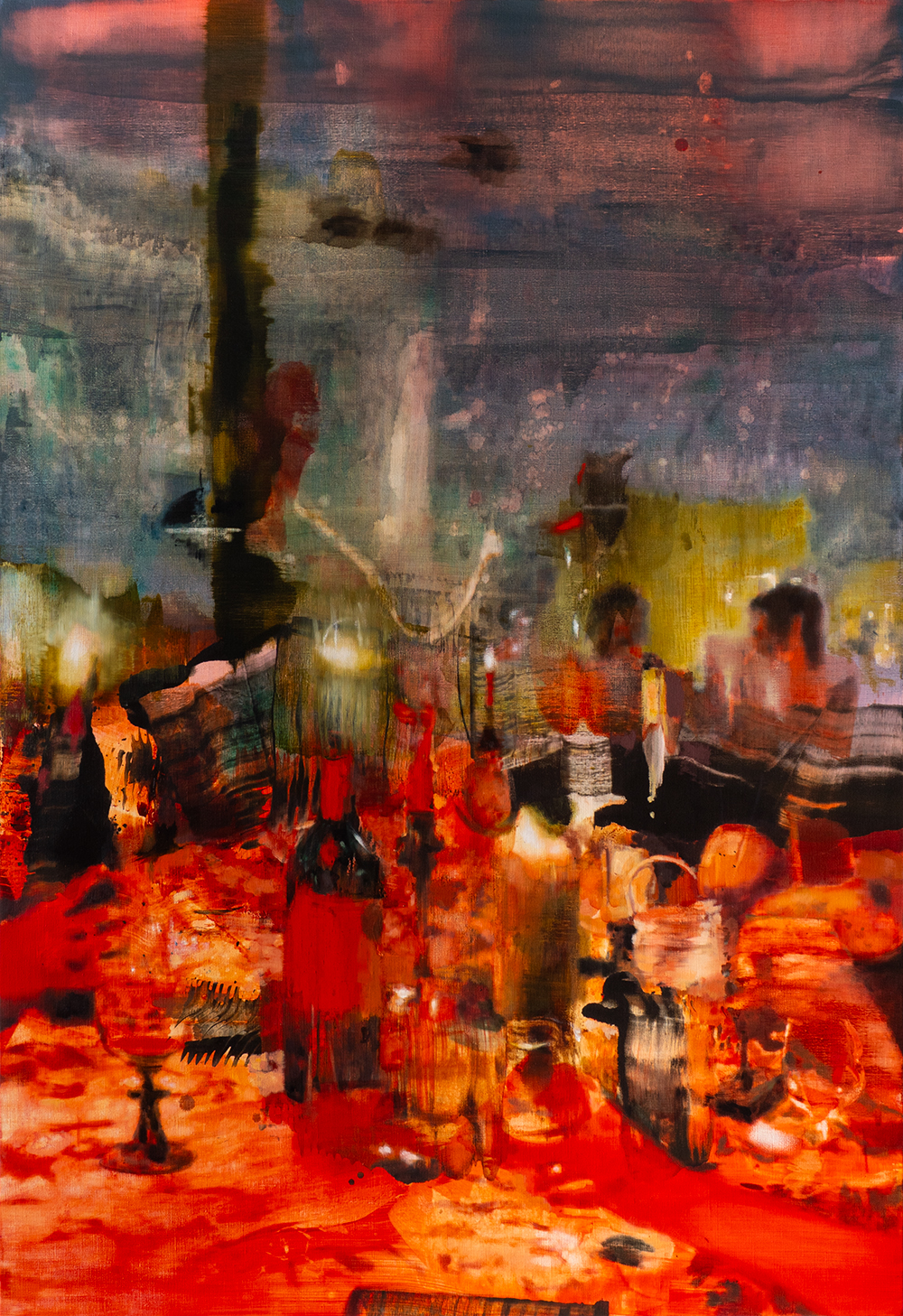
Yeji Lee won the Oil Award in Jackson’s Art Prize this year with her work The Temperature of the Night. In this interview, she discusses how her sensory memories have shaped her world, the importance of a notebook over a sketchbook for her practice, and the rhythm of evenings spent over shared meals.
Above image: Yeji in her studio
Yeji Lee
Oil on canvas, 130.3 x 89.4 cm | 51.2 x 35.4 in
Josephine: Could you share the story of how you became an artist and tell us more about your artistic background?
Yeji: I honestly don’t think there was ever a single moment when I decided to become an artist. Looking back, it feels more like I just followed the flow of things than made a conscious decision. Different interests and experiences have gradually accumulated over time, and somehow that path became the life I live today. There are times when painting feels effortless, and others when it feels almost impossible, but I genuinely enjoy working through both.
One of my earliest memories is wanting a toy violin when I was very young. My parents wouldn’t buy it for me, so a few days later I made one for myself out of cardboard. It wasn’t really about the violin itself. Whenever there was something I longed for but couldn’t have – a pet dog or even an imaginary world – I would make it myself. Looking back, I realise that creating things was never just a hobby. It just felt like the most natural way for me to understand the world and make invisible things feel real.
When I think about where my work comes from, I often return to another childhood memory. While my mother was pregnant with my younger brother, we spent several months in Busan, South Korea, where my grandmother worked in a traditional market. I used to wander through the narrow alleys on my own while she was working. The adults there always seemed happy to see me, but what has stayed with me most vividly isn’t a particular person or event. It’s the atmosphere – the fluorescent lights reflecting through coloured plastic canopies, the changing light moving through the market, the warmth that seemed to exist whenever people gathered together, and the feeling that a space could almost have its own temperature and rhythm.
It wasn’t until much later that I realised how deeply those memories had shaped the way I see the world. Studying painting at Tokyo University of the Arts, and later at the Academy of Fine Arts Munich, helped me understand those early experiences more consciously. These days, I don’t think I’m really painting people anymore. I’m much more interested in what happens between people, for example, the traces of light and time that remain in a space after everyone has gone. Looking back, I realise those memories have been quietly guiding my work all along. And I think I’m still trying to understand them through painting.

Josephine: What does a typical working day in the studio look like for you? Do you have any important routines or rituals?
Yeji: I usually leave home between 8:30 and 9:00 in the morning and spend about an hour travelling to my studio, almost like commuting to an office. Painting is such an uncertain thing; it can go anywhere, and some days it feels like anything is possible while other days nothing seems to work. I think that’s why I’ve always liked having the rhythm of an ordinary working day. It gives me something stable before I step into the uncertainty of the studio.
The first thing I do is make a cup of coffee. If there are any urgent emails, I’ll reply to those first, but I never like rushing straight into painting. I usually spend a little time just settling into the studio before I begin. I think I need that small transition before I can really focus.
I don’t really have any rituals when it comes to painting. I rarely make preparatory drawings, and what I work on usually depends on how the paintings feel that day. Sometimes I move between a couple of canvases, but I generally stay with one or two rather than jumping between lots of different things. There’s almost always music playing, although what I’m listening to changes all the time.
I usually leave the studio around 9:00 or 10:00 at night. For me, it’s never really been about having the perfect routine. It’s more about showing up every day and giving the paintings enough time. I’ve realised that paintings just need time. The longer I stay with a painting, the more I notice.

Yeji Lee
Oil on Linen, 130.3 x 97 cm | 51.3 x 38.2 in (Photo: Ken Kato)
Josephine: Which materials or tools could you not live without?
Yeji: If I had to choose just one tool, it would be a wide Italian-made hog bristle brush, about 12 cm across. I’ve been using the same one for so many years that the wooden handle snapped a long time ago, but I still use it almost every day. I don’t think I could replace it.
Because it’s so wide, I naturally paint with my whole arm rather than just my wrist. That changes the way I move across the canvas. Sometimes it softens the surface, and sometimes it leaves bold, physical marks behind. I like that I can’t completely predict which one it’s going to do.
Oil paint itself is just as important because it gives me time. I can leave a painting, come back to it the next day, scrape something away, or let a surface slowly build over weeks. Lately, I’ve become much more interested in allowing the paint to keep some of its own character instead of trying to control every mark. That old brush reminds me to leave certain things alone, and quite often that’s when the painting starts telling me something I wasn’t expecting.

Josephine: Do you work from a reference? Tell us more about your process.
Yeji: I do use references, but probably not in the way people might expect. Most of them are photographs that I’ve taken myself while walking through cities or spending time in places that stay with me. The biggest change in my process has happened over the past few months. I used to make digital collages from those photographs before I started painting, but I don’t really work like that anymore.
These days, photographs feel more like reminders than instructions. I still rely on them, but I don’t feel any need to stay faithful to them. Before starting a large painting, I usually make lots of small sketches with coloured pencils and watercolours. That’s where I look for the composition and the colours.
After that, I make a small oil study before moving to the final canvas. Paint has a way of changing the image, so I need to understand what happens once it becomes paint. Quite often, something appears at that stage that I couldn’t have planned.
By the time I start the final painting, I gradually stop looking at the references altogether. From that point on, I’m mostly responding to what’s happening on the canvas. I rarely end up exactly where I thought I would, and that’s usually when the painting starts taking me somewhere I wasn’t expecting.

Josephine: Do you regularly draw or keep a sketchbook? If so, how does this inform your work?
Yeji: I wouldn’t really say I keep a sketchbook in the traditional sense. I do draw quite regularly, but usually on loose sheets that I tear out and work on separately, especially when I’m trying to figure out a composition or colour relationship. What I do keep is the same notebook I’ve been using for years. All sorts of things end up in there – drawings, colour combinations, fragments of writing, titles, and words or ideas that catch my attention. Sometimes it’s just a single sentence that I don’t want to forget. I go back to it all the time. It’s funny how an idea that didn’t seem very important at the time can suddenly find its way into a painting months, or even years, later.
For me, drawing has never just been about recording what I see. It’s part of how I think. Over time, I’ve realised that notebook probably tells me more about how I think than how I draw. Looking through it, I often find that I was already thinking about a painting long before I actually started making it.

Josephine: Have you ever had a period of stagnation in creativity? If so, what helped you overcome it?
Yeji: Yes, many times. Looking back, I’ve realised that creative stagnation usually happens when I’ve reached the end of a particular way of working, even if I haven’t yet discovered what comes next. Sometimes my work has already changed internally, but I’m still trying to paint in the same way. That gap creates a sense of resistance.
I don’t think there’s a single thing that helps me overcome those periods. More than anything, I need time. If possible, I physically remove the painting from my studio and leave it somewhere I can’t see it for a month or so. Creating that distance helps me stop trying to solve the painting by force.
When I return to it, something has often shifted. Not necessarily in the painting itself, but in the way I see it. The problem that once felt impossible to resolve often no longer feels important, or I can finally recognise something that I couldn’t see before.
Looking back, I’ve realised that this has happened almost every time my work has begun to change. Those periods are still frustrating while I’m in them. But afterwards, I can usually see that they were taking me somewhere I couldn’t recognise at the time. They’re not a break from the process. They are part of it.

Yeji Lee
Oil on Linen, 162 × 162 cm | 63.8 × 63.8 in
(Photo: Ken Kato)
Josephine: Are there any specific artists or mentors who have inspired you?
Yeji: The artists who have inspired me emotionally aren’t always the same ones I turn to while I’m painting. Since I was a teenager, I’ve been deeply drawn to the work of Käthe Kollwitz and Horst Janssen. Even before I understood why, I was moved by the emotional honesty and psychological depth in their work. That feeling has stayed with me ever since.
When I’m painting, I often look at artists such as Pierre Bonnard and Peter Doig. I admire the way they build space through colour and light, and how atmosphere can exist without relying on a clear narrative. I don’t necessarily want to paint like them, but they still remind me of what painting can do.
Another important experience came when I was 20, visiting the Rothko Room at the Kawamura Memorial DIC Museum in Japan. Until then, I had mostly thought about painting as something you looked at. Standing in that room, I realised a painting could be experienced physically, and that the boundary between the painting, the body, and the surrounding space wasn’t as fixed as I’d once thought. That changed the way I think about painting, and it’s still something I carry with me.
The person who has influenced me the most, though, is my mentor, O JUN. More than teaching me how to paint, he changed the way I look at my own work. He often talks about the difference between the painting you try to make and the painting that reveals itself as you’re making it. He taught me to pay attention to the things that appear before I can explain them. I still think about that every time I paint.

Josephine: What were you thinking about or exploring at the time you made The Temperature of the Night? What inspired it, and how did it come to be?
Yeji: The Temperature of the Night came out of a time when I felt my work was beginning to change. For several years, much of my painting had centred on the lives of working women in traditional markets in South Korea. Those paintings were deeply connected to my childhood memories and remain an important part of my practice. But around 2024, I began to feel that my own experiences were changing, even if my paintings hadn’t quite caught up yet.
After studying in Germany in 2022, I started returning every summer to spend time with my partner and his family. Gradually, those visits became an important part of my life as well as my practice. Every time I went back, I felt like I was noticing something new. I wasn’t simply discovering a different place; I was becoming aware of a different rhythm of life, different colours, and different ways of spending time together. At some point, I realised I wanted my paintings to reflect those experiences instead of holding on to a direction that no longer felt completely true to where I was.
One of the strongest impressions came from sharing evening meals with my partner, his family, and friends in Munich. What stayed with me wasn’t the food itself, but the rhythm of the evening. Growing up in an East Asian household, I was used to meals where everything was shared at once, and conversations naturally followed that pace. In Germany, I experienced something quite different: meals unfolding course by course, conversations lingering over wine, and candlelight quietly reflecting across glasses and plates as time seemed to slow down. I became fascinated by the atmosphere that appeared through that slower passage of time.
I’ve always been interested in how food reveals culture. I wasn’t really trying to paint a dinner table. I wanted to paint the invisible atmosphere created by people sharing a space – the warmth, presence, and traces of time that remain long after the evening has ended. Looking back, I think The Temperature of the Night quietly marked the beginning of the work I’m making now.

Yeji Lee
Oil on Linen, 60.6 x 91 cm | 23.9 x 35.8 in (Photo: Ken Kato)
Josephine: What made you submit this piece to Jackson’s Art Prize?
Yeji: I’ve always looked for opportunities to show my work outside Japan. I’ve always hoped my paintings could travel beyond Japan, so when I came across Jackson’s Art Prize and saw its support for emerging artists from around the world, it felt like the right place to apply.
I submitted several paintings, but The Temperature of the Night was one I really wanted to include. By then, I already knew my work was beginning to change, and this painting felt like an important turning point for me. It was moving away from individual figures and becoming much more about the atmosphere and the traces people leave behind.
It was also one of the first paintings where I consciously pushed the materiality of oil paint further. I became much more interested in letting the paint remain active on the surface instead of using it simply to describe an image. At the time, it just felt like the right painting to send. Looking back now, I think it naturally pointed towards the direction my work has continued to take.

Josephine: The title The Temperature of the Night adds another layer to the viewer’s experience of the painting. Could you talk about the role that sensory experiences play in your work?
Yeji: I think sensory experience has always been at the centre of what I do. I’m not really interested in painting a particular place or moment. What stays with me is what remains after an experience has passed.
By the time I begin painting, the experience itself has already become a memory. I’m no longer working from direct observation, but from the bodily sensation of remembering. That’s why I often use words like temperature, humidity, or presence. They’re not metaphors for me. They describe something I genuinely experience.
For me, temperature isn’t simply about warmth or cold. It’s the physical sensation of memory. It includes the emotional distance between people, the density of the air they create together, the humidity of a summer evening, the quality of light, and the rhythm of time shared within a space. All of those things become part of how I remember a place.
I’m not trying to recreate a memory or illustrate those sensations. I’m trying to give them a physical presence through painting. If someone can recognise something of their own through the painting, even if it’s completely different from my own memory, then I feel it’s doing what I hoped it would do.

Yeji Lee
Oil on Linen, 91 × 60.6 cm | 35.8 × 23.9 in
(Photo: Ken Kato)
Josephine: The judges described your painting as ‘a feat in rich, lively paint handling’. How much of that energy comes from a planned approach, and how much emerges through the process of painting?
Yeji: At the time I made The Temperature of the Night, I was still working quite closely with digital photo collages as references, so I usually had a fairly clear idea of the overall composition and where I wanted the painting to arrive. In that sense, the destination was often planned.
The journey, however, was much less predictable. I’ve always valued chance in painting. The way the paint moves, the layers build up, or unexpected textures appear is something I don’t try to control completely. Oil painting often reminds me of stirring a large pot from the bottom. Layers that seem hidden continue to influence the final surface, much like ingredients quietly shaping the depth and richness of a dish. I think that’s where the energy comes from.
So I usually begin with a fairly clear image in mind, but I deliberately leave room for the painting to surprise me. Some of the most important decisions happen because the paint does something I wasn’t expecting. That’s probably what keeps painting interesting for me.

Josephine: Are there any new techniques or ideas you’re excited to explore using the materials from your prize?
Yeji: One of the most exciting discoveries for me has been working with Michael Harding oil colours. Until now, I’ve mainly painted with Japanese oil paints, which I really admire for their consistency, refinement, and control. Working with Michael Harding paints felt quite different. The colours remain incredibly rich, but the material itself feels much more immediate and physical. It made me much more aware of the paint as a living material, not just something I use to make an image.
At the same time, my own work has also started to change. Recently, I’ve become much more interested in leaving room for chance – for allowing brushstrokes, texture, and the natural behaviour of the paint to remain visible instead of trying to control every surface completely.
I don’t think I’m really looking for a new technique. What I’m interested in is responding more to what the paint wants to do. I’m trying to trust the paint a little more and see what happens when I stop asking it to do exactly what I want. That’s probably what I’m most excited to keep exploring.

Josephine: How did it feel to move through the stages of the competition and win the Oil Award?
Yeji: I was genuinely happy to receive the Oil Award, and I’m very grateful for the recognition. Whenever you enter a competition, there’s naturally a part of you that hopes to go as far as possible. I had a strong belief in The Temperature of the Night because I knew it represented an important shift in my work, and I was curious to see how it would be received.
What meant the most to me, though, was that the painting was recognised outside Japan. For a long time, I’ve wanted to share my work internationally, so having it selected by an international panel of judges felt like an important milestone. It gave me confidence that the direction my work had been moving in could connect with people beyond the place where it was made. More than anything, the award didn’t change the way I work. It simply gave me the confidence to keep going in the direction I was already heading.

Josephine: What’s coming up next for you?
Yeji: Over the past few months, I’ve felt a real shift in both my paintings and the way I think about painting itself. Right now, I’m most excited about continuing to follow this new direction in my work. It feels like I’m at the beginning of something, which is both exciting and a little uncertain.
This November, I’ll also be taking part in a collaborative project between artists from Germany, Switzerland, and Japan, initiated by my mentor, O JUN. It’s a project that’s been developing over the past three years, so I’m really looking forward to finally seeing it come to life. I’m putting a lot of energy into preparing for it at the moment.
Beyond that, more opportunities to exhibit outside Japan are gradually beginning to appear, which I’m very grateful for. More than anything, I’m excited to see where my paintings take me next.
Further Reading
Meet Angela Lizon, Winner of Jackson’s Art Prize 2026
Jackson’s Art Prize 2026 First Prize Winner Announced
How We Collaborate With Artists
Expert Advice on Making Your Way as an Artist
Shop Oil Painting on jacksonsart.com