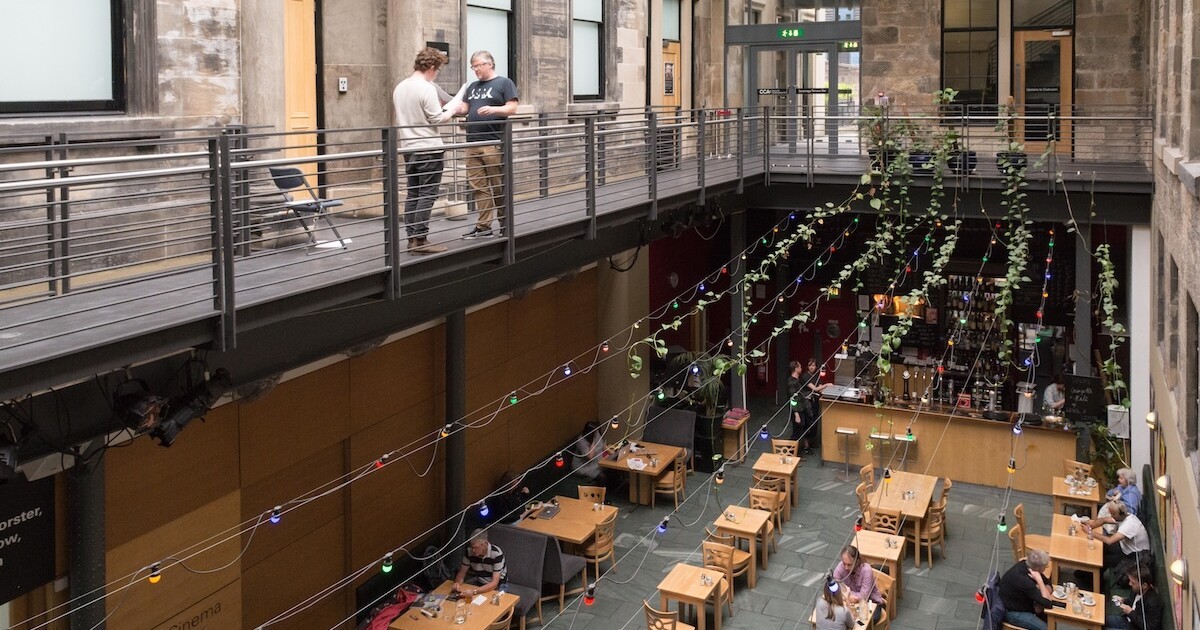
Saramago Cafe Bar at the Centre for Contemporary Arts, Glasgow (Kay Roxby / Alamy)
The entire contents of the Centre for Contemporary Arts in Glasgow were auctioned off by a commercial asset sales company on 30 July. In the days leading up to the sale, it was promoted in theHerald as an exciting opportunity to ‘purchase a major piece’ of Glasgow’s ‘creative heritage’.
But the heritage of a civic arts centre belongs to the community it serves. Before it went into voluntary liquidation on 30 January, the CCA was a publicly funded, multidisciplinary arts institution with an ‘open source’ programming policy: artists could use the space for free and the public didn’t have to pay for exhibitions or events. The building, which was designed by Alexander ‘Greek’ Thomson and is close to the Glasgow School of Art on Sauchiehall Street, is owned by Creative Scotland (previously the Scottish Arts Council).
Before the CCA opened in 1992, the building was the home of the Third Eye Centre, an innovative arts venue founded by the poet, playwright and musician Tom McGrath in 1974. Between 1999 and 2001, it was redeveloped with funds from the SAC, the National Lottery, the European Regional Development Fund and Glasgow City Council.
The CCA sale, however, has been marked by a lack of public accountability: very little is known about the reasons for the liquidation, which resulted in forty redundancies. The locks were changed on the day the closure was announced, leaving the artists and organisations based there unable to access any of the materials left inside. The speed at which the contents were auctioned off has been matched by the turnaround time for expressions of interest in buying the building (the estate agent’s deadline was 12 August). A grassroots campaign to Save Our CCA is trying to keep the building in public use as an arts centre.
Protests against the closure and sale have been attended by many of those whose labour contributed to the life and legacy of the CCA. Its ‘creative heritage’ belongs to us, too. It is painful to see it unceremoniously divided up and sold to the highest bidder. I used to work for MAP magazine, which had an office on the top floor of the building, and would often spend my lunch breaks in the galleries.
It is also painful to view the sale of the CCA in its wider context. Despite the lip service still paid to the ‘miracle’ of the mid-1990s, when Glasgow produced, among other things, sixteen Turner Prize nominees, the city’s public cultural infrastructure has been severely depleted in recent years. In February, the tenants of Trongate 103 were served a 400 per cent rent increase, threatening seven arts organisations with de facto eviction. Last month the art school announced that it could not afford to restore the fire-ravaged Mackintosh building as promised.
The contents of the CCA have been divided into two categories of asset: equipment and fittings, which were sold in July; and the CCA archive, which is listed for sale ‘through private treaty’, with the deadline for expressions of interest set for today (14 August). But the archive does not belong to Creative Scotland: it was created by a major research project that ran from 2012 to 2014, based at the art school and led by the then director of the CCA, Francis McKee. ‘The Glasgow Miracle: Materials for Alternative Histories’ was awarded £122,501 of public funding by the Arts and Humanities Research Council.
An exhibition, What We Have Done, What We Are About To Do, aimed to ‘open up’ the archive even as it was being constructed, establishing it as a living part of Glasgow’s cultural history. Its title was taken from a 1975 issue of NuSpeak magazine in which McGrath describes the ‘very positive step’ represented by the Third Eye Centre despite the ‘hard times’ it was born into.
Material relating to the Third Eye Centre, much of which was recorded on VHS, is a central part of the archive. Experimental, countercultural and international, it includes rare recordings of performances by the minimalist composer Julius Eastman, the South African jazz drummer and anti-Apartheid activist Louis Moholo-Moholo, the Scottish poet Ivor Cutler and the Serbian performance artist Marina Abramović.
In the 1980s, the Third Eye Centre began to publish books, including Noise and Smoky Breath in 1983, an anthology of poems edited by Hamish Whyte. In the introduction, Whyte makes the case for art as a form of resistance to the ‘gradual destruction’ of the city and cautions against what Edwin Morgan called the ‘desperate throes of renewal’. The archive includes footage of the urban transformation of the city, and last week McKee emphasised the collection’s significance to Glasgow’s political history: it holds ‘documentation of the Barlinnie Special Unit, records of the fight against fascism and racism in the 1970s, and of the independence referendum in 2014’.
The Scottish culture secretary, Màiri McAllan, says she has received ‘concrete assurances’ from Creative Scotland that the CCA archive has a ‘secure future’. What this future might be, however, remains unclear. There are rumours of a partnership between the Ballast Trust, which supports at-risk archives, the city council, Glasgow Life and Creative Scotland, and hope that the archive will be moved to an accessible home in the city. Whatever happens, fifty years of cultural history are currently in a profoundly precarious position. In the words of the artist Elizabeth Price, speaking in support of the Save Our CCA campaign, ‘the closure of the CCA cancels its future, while the sale of its archive erases its past.’ The lack of communication from the bodies tasked with the protection of both looks like an abdication of responsibility: a public funding body has a duty to public history as well as to the public. A civic arts centre should not be sold off for parts.