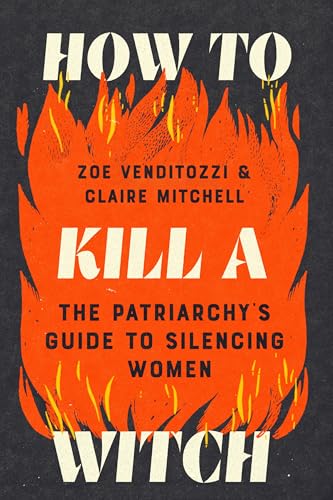
How to Kill a Witch: The Patriarchy’s Guide to Silencing Women by Zoe Venditozzi and Claire Mitchell @RandomTTours @Octopus_Books #witches #trials #nonfiction #history #bookreview


I am delighted to share my review today for How to Kill a Witch: The Patriarchy’s Guide to Silencing Women by Zoe Venditozzi and Claire Mitchell. The authors are the creators of the podcast “The Witches of Scotland”.
My huge thanks to Anne Cater at Random Things Tours for my spot on the Blog Tour and for arranging my e-copy of the book from Octopus Books.
Nothing brings people together like a common enemy, and witches were the greatest enemy of all.
Scotland, 1563: Crops failed. People starved. And the Devil’s influence was stronger than ever—at least, that’s what everyone believed. If you were a woman living in Scotland during this turbulent time, there was a very good chance that you, or someone you knew, would be tried as a witch.
During the chaos of the Reformation, violence against women was codified for the first time in the Witchcraft Act—a tool of theocratic control with one chilling to root out witches and rid the land of evil. What followed was a dark and misogynistic chapter in history that fanned the flames of witch hunts across the globe, including in the United States and beyond.
In How to Kill a Witch, Zoe Venditozzi and Claire Mitchell, hosts of the popular Witches of Scotland podcast, unravel the grim yet absurdly bureaucratic process of identifying, accusing, trying, and executing women as witches. With sharp wit and keen feminist insight, they reveal the inner workings of a patriarchal system designed to weaponize fear and oppress women.
This captivating (and often infuriating) account, which weaves a rich tapestry of trial transcripts, witness accounts, and the documents that set the legal grounds for the witch hunts, exposes how this violent period of history mirrors today’s struggles for justice and equality. How to Kill a Witch is a powerful, darkly humorous reminder of the dangers of superstition, bias, and ignorance, and a warning to never forget the past… while raising the question of whether it could ever happen again.
MY REVIEW
This is a fabulous non-fiction book. From the title, it is obviously about witches and how women have been treated throughout history. The book focuses on the accused from history and then explains why they were treated as they were.
This is an addictive read, and it is one that lovers of historical fact and the role of women or how women have been treated centuries ago. Most of us are aware of witches from either fairy tales, folklore or myth. The author has used sections from transcripts, documents and the account of the time. I am no expert, but to me it feels very well researched, and there is a large list for further reading if you decide to delve further.
The author does use some of the more well-known characters or areas in history where there have been witch trials. But, this book focuses more on the Witches that were tried in Scotland. The author has a podcast called Witches of Scotland, and this is another great visit.
The way women have been portrayed in history changes depending on the viewpoint of others. A woman could be sought out to help with delivering a baby, but if something went wrong or there was some sort of affliction, then it would be common for either that woman or another from the area to be blamed. A snide remark, a wrong look or just not being liked or being seen as an outsider could be enough for you to be reported.
We are aware that the way the law worked was very different to today. Being moneyed, gentry, mayoral, important figure was enough for you to be part of the bench that would pass judgment. Not allowing women or other people to explain themselves and give their account of things was not part of the trial. Instead, confessions were used; these were obtained by force and then admitted as the overriding evidence.
While the book does explore the ways witches were sought out, what made them dangerous, how to capture and extract confessions, it is also about how women were treated by the largely patriarchal society of the time. Yes, it can be an infuriating read as the sense of injustice is very obvious.
This book looks at life in the 1500 and 1600s, and explores the role of women, their status in the family and society and how easy to was to pin the badge of witch to them if they stepped out of line. I thoroughly enjoyed reading this book and it is one I would definitely recommend.
Many thanks for reading my post, a like or share would be amazing 🙂 xx