Turin (or Torino in Italian) is the capital of the region of Piedmont in northwestern Italy. I’ve been to many parts of Italy, including an epic road trip in Piedmont, but somehow, I never thought of Turin. As a birthday gift to myself – I do this every year – I decided to visit Turin for three days. The idea was to combine the city centre with a few excursions to the surrounding area. As I did my pre-trip research, I discovered that three days was insufficient to cover the places I wanted to visit. There are so many things to see and do in Turin in the city centre alone!


A spectacular city!
During my very first day in Turin, I knew I’d have to plan a return trip. I was absolutely captivated! Beyond its stunning UNESCO World Heritage-listed palaces and castles, Turin is a city that oozes style. From its magnificent architecture and vintage storefronts to its classy boutiques, historic cafés and delicatessens, there’s an effortless elegance to the city that I found irresistible. Much of the historic city centre is pedestrianised, making it a joy to explore on foot. I kicked myself for only planning three days in this spectacular city!

Why you should visit Turin
The more I saw, the more I wanted to see. 42,000 steps and hundreds of photos later, I found myself completely smitten. So, if you’re wondering whether Turin is worth visiting, my answer is an emphatic YES! Whether you’re interested in history and art, design and fashion, culture and heritage, automotive history, architecture or cuisine, the city has something for you. For chocolate lovers, you’re in for an indulgent treat as Turin is Italy’s ‘Capital of Chocolate’. In fact, after this trip, it’s become one of my favourite cities in Italy! Read on for my guide to the places I visited during my three days in Turin.
A (very) brief history of Turin
One of Italy’s economic hubs, Turin has a history that goes back to the 2nd century B.C.. Throughout the centuries, it played a significant role in the history of the region as the royal capital of the Duchy of Savoy and later the Kingdom of Sardinia. The 19th century movement to unite Italy began here and Turin was the first capital of the Kingdom of Italy between 1861 and 1865.
These days, in addition to being a major economic and cultural centre, Turin is known for its palaces, museums, varied architecture, galleries, chocolate boutiques and restaurants. It’s also the home of famous Italian brands such as Fiat, Alfa Romeo, Lavazza (coffee), Campari (vermouth) and Juventus (football).

I decided to write a list post about the top things to see and do in Turin as I’m sure I’ll return, hence making it easy to expand this post after a future trip. For now, it only covers places I visited in the city centre and the Cit Turin district. You’ll need at least three days in Turin to visit these places, which I’ve pinned on the map below:
1. The Royal Palace of Turin
Originally built in the 16th century, and renovated in the 17th century in the Baroque style, the Royal Palace of Turin was for centuries the main palace of the House of Savoy.

The vast palace complex also includes the Palazzo Chiablese and the Chapel of the Holy Shroud, which was added in the 17th century to house the Holy Shroud, a famous religious relic alleged to be the burial shroud of Jesus of Nazareth.

One of the top things to do in Turin is to tour the Royal Palace. The tour starts with the magnificent Staircase of Honour and Ballroom, and continues through richly-decorated rooms and halls. The highlights include the Throne Room, Dining Room, Chinese Private Room and the breathtaking Armoury, the last two forming a jaw-dropping combination.


Visitors also have access to the Chapel of the Holy Shroud via the Royal Palace. The Shroud of Turin was housed in the chapel for centuries, but it was moved to the Cathedral in 1993.

2. San Lorenzo Church
The San Lorenzo Church, adjacent to the Royal Palace, is a stunning Baroque masterpiece, yet you wouldn’t notice it from the outside. Step inside and you’ll be greeted by a breathtaking interior crowned by an extraordinary dome. Its interlocking arches form an eight-pointed star, while strategically places windows flood the space with light.


The architect, Guarino Guarini, who also designed other historic buildings in Turin, integrated many geometric shapes and hidden artistic details in the structure. Look up and you’ll get the eerie feeling that the devil is staring at you.

During the spring and autumn equinoxes, sunlight shines through specially engineered openings in the dome to reveal hidden frescoes that remain in the dark for the rest of the year.

3. The Shroud of Turin
The Shroud of Turin is Turin’s most treasured religious artefact. Allegedly used as the burial shroud of Jesus of Nazareth, it has been venerated by Christians for centuries. First housed in a church in France, the linen shroud was acquired by the House of Savoy in the 15th century and moved to their new capital, Turin, in the 16th century. In 1983, the House of Savoy gifted the shroud to the Holy See.
In the 19th century, a black-and-white photographic negative of the shroud clearly revealed an image of a man with wounds consistent with traditional depictions of Jesus of Nazareth after his death by crucifixion.

San Lorenzo Church
Visit the 17th century San Lorenzo Church to see copies of the shroud and the photographic negative. These are housed in a separate room inside the church.

Cathedral
Built in the late-15th century, the Turin Cathedral is now the home of the Shroud of Turin. Encased in a state-of-the-art box, the shroud is rarely displayed to the public.

If you’re in good physical condition, consider climbing the Cathedral bell-tower (roughly 210 steps) for panoramic views of the city and the gorgeous Baroque dome of the Chapel of the Holy Shroud.

4. Via Roma
Via Roma is the elegant boulevard (0.6 kilometers or 0.38 miles long) that runs from Piazza Carlo Felice (opposite Porta Nuova station) via Piazza San Carlo to Piazza Castello. Following the path of an ancient Roman road, Via Roma was first built in the 16th century during an expansion of the city by the House of Savoy. Its elaborate Baroque façades and arcades were added in the following centuries.

In the 1930’s, the section between Piazza San Carlo and Piazza Carlo Felice was demolished and rebuilt in the Italian Rationalist style. The elegant Baroque arches and windows made way for orderly, geometric designs that projected authority.

These days, Via Roma is a pedestrian street filled with a mix of high-street fashion brands and high-end boutiques. If you enjoy shopping, Via Roma is the place to start. For the fashion-minded Torinesi, it’s the city’s longest catwalk!
5. Piazza San Carlo
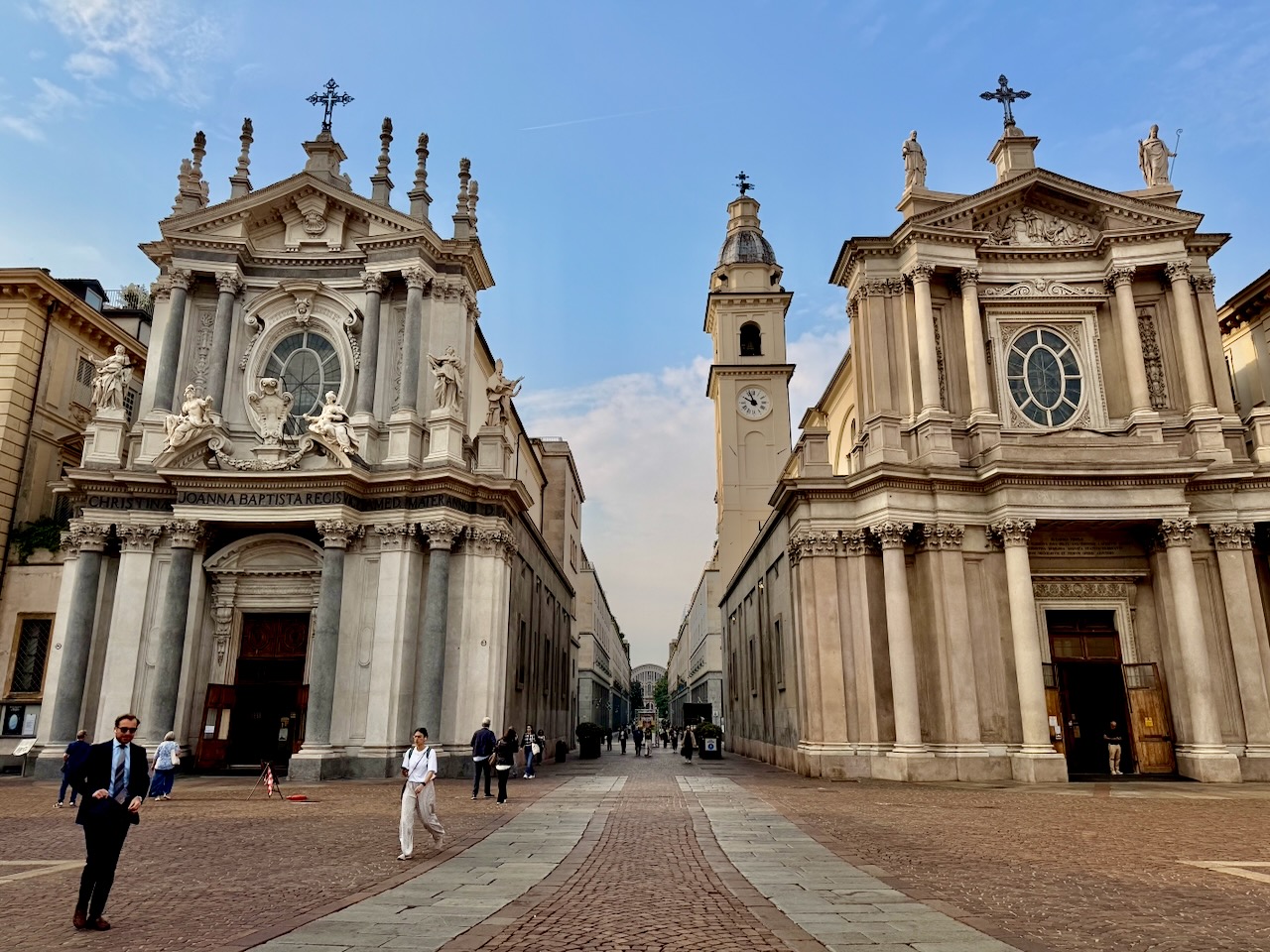
Turin’s most impressive square, Piazza San Carlo was constructed in the Baroque style during the expansion of Turin by the House of Savoy in the 17th century.

At its southern end are two identical churches, Santa Cristina and San Carlo Borromeo, while the bronze equestrian statue of Emanuele Filiberto, Duke of Savoy, stands proudly in the centre of the square.

Things to look out for at Piazza San Carlo
I recommend visiting the twin churches – despite their identical exterior, they have different interiors.

Behind the churches, facing Piazza C.L.N., are two beautiful fountains in the Italian Rationalist style: Fontana del Po (that pays tribute to the Po River) and Fontana de la Dora (a tribute to the Dora River).

The square is lined by arcades which house shops, chocolate boutiques and cafés. Various historic establishments can be found here, including Caffè San Carlo, Caffè Torino and the iconic Stratta confectioner.


Just outside Caffè Torino, you’ll find in the pavement a bronze bas-relief of a bull, the symbol of the city of Turin. According to local folklore, stepping on the bull brings good luck, and for visitors, a return to the city.

A few doors away is Biraghi, a famous ice-cream maker (gelato di latte) and food store. I recommend visiting the beautiful store where you’ll find many Piedmontese food products.

You’ll also find ultra chic fashion stores in the courtyards behind the arcades. Look out for the head of David, turned upside down, in the passage between the square and Via Lagrange.

In the Sinatra Galerie de Beauté, you’ll find a perfume store and café on the ground level and a gorgeous champagne bar on the first floor.

6. Palazzo Carignano
This extraordinary palace was built in the 17th century as the residence of the Prince of Carignano, Emmanuel Philibert. The architect, Guarino Guarini, designed the palace in the Piedmontese Baroque style with an imposing brick façade. Famous as the birthplace of the first King of Italy, Vittorio Emanuele II, the palace is a stunning complex with two very distinct façades.

In the 19th century, a new section was added to the rear of the palace to house the Italian Parliament following the unification of Italy. Sadly, the capital was moved from Turin – first to Florence in 1865, then to Rome in 1871 – before construction was completed.

These days, it houses the National Museum of the Risorgimento (the 19th century movement to unite Italy). Visit the museum to see the former apartments of the Princes of Carignano, the staterooms and the grand Parliament Hall.
7. Historic galleries
Another highlight of Turin for me was its three historic galleries. Each has a unique character that exudes elegance and style, and it’s a treat to walk through them.
Galleria Subalpina
Opened in 1874, Galleria Subalpina connects Piazza Castello and Piazza Carlo Alberto. This gorgeous gallery features a mix of Renaissance and Baroque styles, and a wrought iron and glass roof that fills this grand space with light. One of Turin’s most famous historic cafés, Caffè Baratti & Milano, can be found here.

Galleria San Federico
This Art Deco/neo-Baroque gallery was built in the 1930’s and is occupied by shops and Cinema Lux. This cavernous passageway, that connects Via Roma with Via Bertola, is absolutely breathtaking.

Galleria Umberto I
This 19th century gallery links Via della Basilica to the Porta Palazzo market.

8. Historic cafés
Turin’s historic cafés are elegant time capsules, where ornate interiors, marble tables and grand mirrors evoke a bygone era. Over the centuries, these cafés played an important role in the political, cultural and social landscape of Turin. In my book, a visit to one or a few of them is a must; for excellent coffee, gianduotti chocolates and a taste of Turin’s glamorous café culture. Here are six cafés I recommend:
Caffè Bicerin
Established in 1763, Caffè Bicerin is the city’s oldest. It’s particularly well-known as the birthplace of bicerin, the famous Turin beverage that consists of espresso, chocolate and a layer of milk foam or cream. It’s a busy place and there may be long queues.

Caffè Baratti & Milano
Located in the Galleria Subalpino (though the entrance faces Piazza Castello), Caffè Baratti & Milano (1858) is a grand café that began as a confectionary. Today, it’s famous for its gianduotti chocolates (ingot-shaped Turin chocolates with 30% hazelnuts) and excellent coffee, but you can also enjoy a meal there.


Caffé Mulassano
Just around the corner from Baratti & Milano, Caffè Mulassano is credited with inventing the tramezzino, the classic Italian triangular sandwich. The café is tiny, so you may have to wait for a table, but the beautifully ornate interior, with its intricate woodwork, mirrors and decorative details, is well worth admiring.

Caffé Torino
Established in 1903 on Piazza San Carlo, Caffè Torino is a beautiful historic café where you can stop for a quick espresso at the bar or settle into one of its elegant Belle Époque-style salons for a meal.

Caffé San Carlo
Located at the corner of Piazza San Carlo, this grand café was established in 1842. With its elegant interior, it’s another wonderfully atmospheric café for a coffee, drink or meal.
Note: as in other parts of Italy, the price paid for a coffee depends on where you order/drink it. It’s cheapest if you’re standing at the bar and pricier if you’re seated at a table.
9. Chocolatiers
Widely known as the ‘Chocolate Capital of Italy‘, Turin’s love affair with chocolate dates back to the 16th century. By the 18th century, the city had become a chocolate-making hub, later inventing gianduja, a delicious blend of chocolate and hazelnuts that remains a local specialty. You can’t visit Turin without tasting its amazing chocolates, and bringing some home with you.

Famous chocolatiers I recommend visiting include Guido Gobino (often listed as one of the best chocolatiers in the world), Stratta, Domori, Peyrano and Baratti & Milano.


The city even hosts its own Chocolate Festival each year. The CioccolaTò festival, that coincides with Valentine’s Day, brings together regional and international chocolate producers, pastry chefs, bakers and ice-cream and liqueur makers. If you love chocolate, this is one festival you won’t want to miss!
10. Egyptian Museum
Turin’s Egyptian Museum houses one of the world’s most important collections of ancient Egyptian artefacts, second only to Cairo’s in size. Founded in 1824, it boasts thousands of fascinating objects, including statues, sarcophagi and mummies.

Like many, I wondered what the connection was between Egypt and Turin. While there, I learned about the House of Savoy’s fascination with Egypt. They sponsored expeditions to Egypt in the 18th and 19th centuries and purchased thousands of artefacts. Opened in 1824, the Egyptian Museum is the oldest museum in the world that’s entirely dedicated to ancient Egyptian culture.
11. Mole Antonelliana
Turin’s most visible landmark has a backstory that I found absolutely fascinating. The Mole Antonelliana was designed by architect Alessandro Antonelli and construction began in 1863, originally as a synagogue for Turin’s Jewish community. However, the architect had a grander structure in mind than what the Jewish community had wished for. By the time it was completed in 1889, the Jewish community had built a more modest synagogue elsewhere and the Mole Antonelliana was left unoccupied for years.

An elevator was installed in 1961 for visitors to easily reach the observation deck. its soaring dome became the city’s iconic landmark. In 2000, the National Museum of Cinema moved to its location inside Mole Antonelliana.

The observation deck is one of Turin’s top spots for panoramic views of the city and the Alps (on a clear day) but I also recommend touring the museum, which has fantastic exhibitions about the history of Italian and international cinema.

12. Palazzo Madama
Palazzo Madama is a magnificent palace in Piazza Castello, showcasing Turin’s fascinating history through its blend of medieval architecture and Baroque grandeur. The palace has a fascinating history, dating back to the Roman era, when a city gate stood on this site. Over the centuries, it evolved into a medieval castle and later a residence for the women of the House of Savoy.

Its contrasting façades tell this story beautifully: the medieval brickwork at the rear contrasts with the magnificent Baroque façade, designed by Filippo Juvarra in the 18th century. Once a royal residence, it now houses the Museum of Ancient Art, with beautiful interiors and artworks. You can also see its ancient Roman foundations.
13. Quadrilatero Romano
A short stroll away from the grandeur of Turin’s city centre, the Quadrilatero Romano is a fascinating district to explore on foot, with atmospheric lanes that follow the grid layout of the city’s ancient Roman streets.

Today, the district packed with lively cafés, restaurants and bars, making it a wonderful place to wander and soak up the atmosphere.
From Piazza Castello, walk along Via Pietro Micca – take a moment to admire the glorious architecture in this street – and enter Quadrilatero at Via San Tommaso.

Drop by Latteria Bera, a shop that’s packed with Piedmontese products, near the entrance of Via San Tomasso. From here, I recommend wandering through the grid of streets between Via San Francesco D’Assisi/Via Milano and Via XX Settembre.

Along the way, you’ll find charming squares such as Piazza Corpus Domini, with its 17th century Baroque church, Turin City Hall, the bustling Via Garibaldi shopping street, and gorgeous buildings such as Casa Florio.


14. Cit Turin Art Nouveau district
I love Art Nouveau architecture and design, and Turin had a grand treat for me: the Cit Turin district! Located northwest of the city centre (a ±25-minute walk along Via Garibaldi from Piazza Castello, or you can take the underground and disembark at Principi d’Acaja), the Cit Turin district is packed with stunning early-20th century Art Nouveau buildings.

These are mostly residential complexes so I didn’t get to see the interiors but the façades were sufficient to keep me fixated. Stroll along Via Principi d’Acaja, Via Duchessa Jolanda and Via Pietro Pifetti to admire elegant facades, floral motifs, wrought-iron balconies and decorative windows.

Highlights include Casa Fenoglio-Lafleur (one of the city’s finest examples of this distinctive architectural style), Casa Tasca, Casa Talucchi and Palazzo della Vittoria.

15. Storefronts and façades
As you wander around Turin, you’ll soon notice its beautiful historic storefronts and café façades, many dating from the 19th and early 20th centuries. I love how the city has preserved these architectural gems, which are not only a feast for the eyes but also an integral part of Turin’s identity and heritage.


Admire the façades but don’t hesitate to step inside – I found numerous amazing deli’s and cafés full of old-world charm.
16. Piedmontese cuisine
Turin is a wonderful place to savour Piedmontese cuisine, known for its rich flavours and seasonal ingredients. Expect dishes such as tajarin pasta, agnolotti stuffed pasta and vitello tonnato (veal with a tuna sauce). The region is also famous for its white truffles, hazelnuts and excellent wines, making every meal a delicious experience.
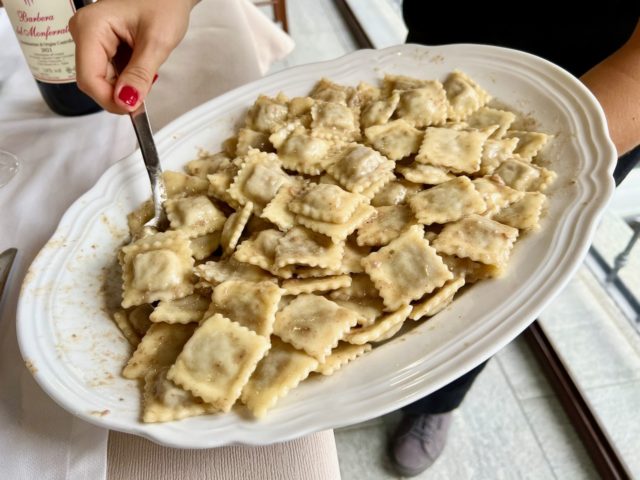
To help visitors discover the best places for traditional Piedmontese cuisine, the city created the Mangébin circuit. This network of restaurants in and around Turin offers a delightful array of Piedmontese dishes, desserts and wines.

During my stay, I dined at two Mangébin restaurants: Barbagusto (map) and San Giors (map). Barbagusto had a lively ambiance and terrific food – the tartare and red wine agnolotti were superb! San Giors, which is also an inn, treated me to a warm welcome, and a fabulous dinner.

Another Piedmontese specialty I enjoyed was gofre, a crispy, wafer-thin waffle with sweet or savoury fillings. A wonderful place to try a gofre is Gofreria Piemontèisa (map) in the Quadrilatero district.

17. Porta Palazzo market
If you enjoy browsing around markets, like I do, I recommend visiting the expansive Porta Palazzo market. Comprised of several halls and a large square packed with stalls (Europe’s largest open-air market), the Porta Palazzo market is a feast for the senses. Get there by noon to see the freshest produce.

18. Roman ruins
Originally a Roman military garrison established by Julius Caesar in the 1st century B.C., Turin grew into a Roman colony named Julia Augusta Taurinorum. Remnants of Roman Turin are visible till this day.
The Romans laid out the town in a grid pattern, which can still be seen in the streets of the Quadrilatero district. The settlement was enclosed by defensive walls for protection. The main east-west Roman road is now the Via Garibaldi. One of the gates, Porta Palatina (1st century B.C.), is these days considered to be one of the best preserved Roman gatehouses in Italy.

The Roman Theatre (adjacent to the Royal Palace) is regarded as one of the most important sites of Roman Turin.

If you’re interested in Turin’s Roman history, I recommend visiting the Museum of Antiquities adjacent to the Royal Palace.
19. Shopping
Turin is a delight for shoppers, from the elegant boutiques along Via Roma and Via Lagrange and high street brands in Via Garibaldi to the independent shops and vintage stores tucked into its historic lanes and galleries.

Look out for Italian fashion and design, artisanal chocolates, local delicacies and beautifully crafted leather goods.
20. Aperitivo
You can’t leave Turin without experiencing an aperitivo, a beloved Turin tradition, where an early-evening drink comes with snacks or a generous buffet of local specialties. Head to the elegant historic cafés around Piazza San Carlo such as Caffè San Carlo or Caffè Torino, or explore the lively bars in the Quadrilatero Romano district. Order a vermouth (such as Campari), which originated in Turin, for the full experience.

Other Turin attractions
Three days was definitely not enough to see all the major attractions in and around Turin. Prior to my trip, I made a list of places I wanted to visit. These are the places on my list which I’ve saved for a future trip:
- Piazza Vittorio Veneto (another of Turin’s elegant squares)
- Po River promenade (for scenic views across the Po River)
- Basilica Santa Maria Ausiliatrice (a stunning church with frescoes and the tomb of St. John Bosco (Don Bosco)
- Villa della Regina (part of the UNESCO World Heritage listed 13 residences of the House of Savoy)
- National Automobile Museum (an impressive collection of vehicles that showcase the history of automobiles)
- Basilica of Superga (perhaps Turin’s most beloved church, with panoramic views)
- La Venaria Reale (expansive royal palace in the Baroque style with beautiful gardens)
Where to stay in Turin
There are many accommodation options in Turin, from palatial-like hotels to budget-friendly accommodations. I stayed at the Hotel Roma e Rocca Cavour. Located at Piazza Carlo Felice, just across the road from Porta Nuova station, it’s a roughly 10-minute walk to Piazza San Carlo. The hotel has a lovely old-world charm and the rooms are spacious and comfortable.

How to get to Turin
Turin has an airport (±20 minutes by taxi from the city centre) with flights to other cities in Italy and major European hubs such as London, Paris, Frankfurt, Amsterdam and Istanbul.

High-speed rail services connect Turin with Milan (1 hour), Florence (±3 hours), Bologna (>2 hours), Rome (>4 hours), other Italian cities, as well as Lyon and Paris.
Note: a big thank you to Turismo Torino for your gracious hospitality and for showing me your city.