

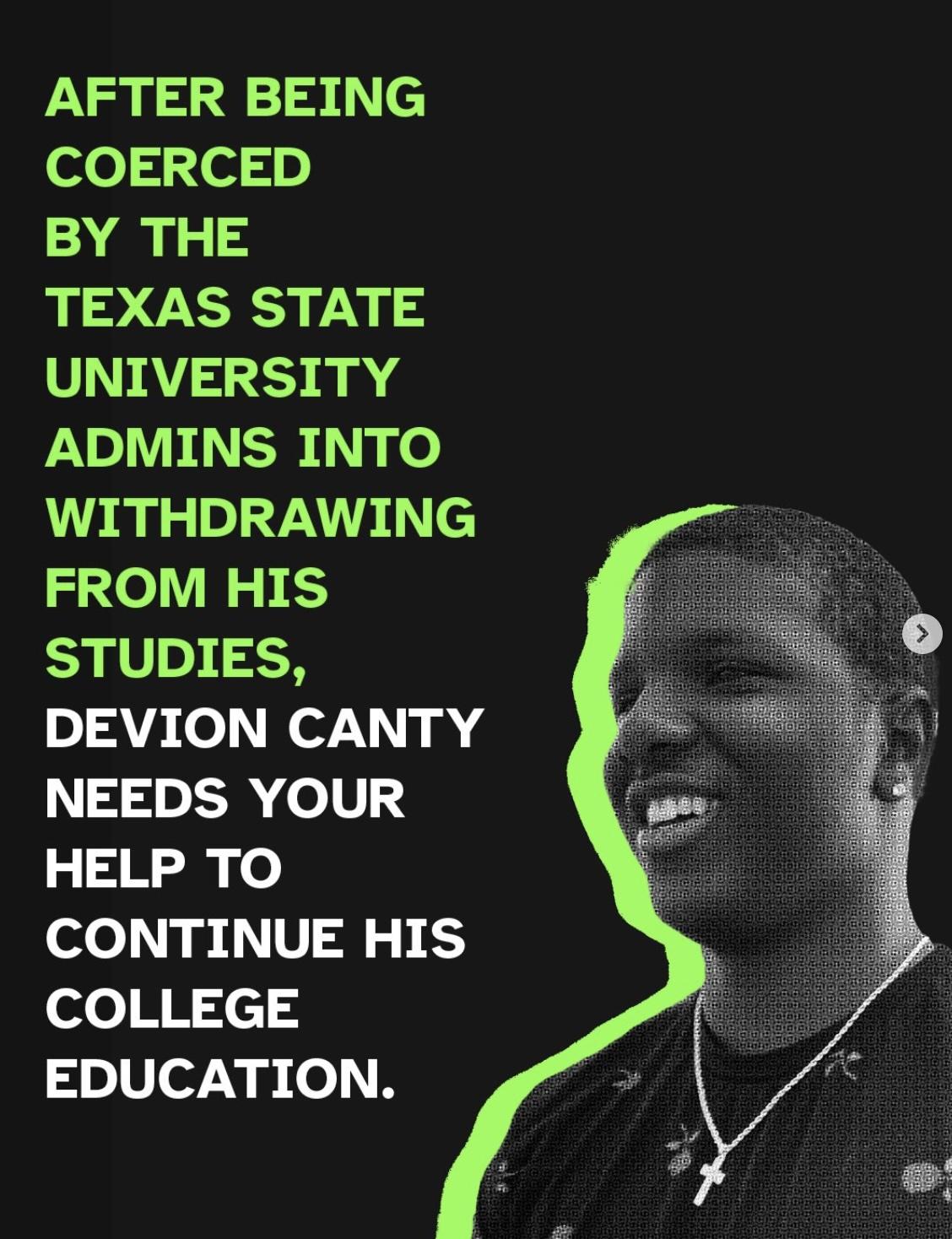
Last fall, on September 16, 2025, Devion Canty was forced to withdraw from Texas State University, just two weeks into his first semester in college. Canty had attended a protest at a campus “memorial” for Charlie Kirk, head of the white supremacist group Turning Point USA, who had been assassinated days earlier (Kirk was shot in the neck by a sniper while giving a public talk). Someone caught Canty on video falling to the ground as if shot in the neck, in a theatrical imitation of Kirk’s assassination. Texas Governor Greg Abbott shared the video on social media in the late morning of that day, urging Texas State University to “expel the individual immediately.”
Within hours, Texas State University coerced Canty into withdrawing. As a result, he lost his federal grants. He also had to abruptly leave his life at Texas State behind – all while facing death threats and relentless racist harassment. Determined to continue his education, Canty will be restarting college this fall at Johnson C. Smith University, a historically Black college in North Carolina, and is currently fundraising to pay the costs of housing.
Canty’s case shows yet again how universities cave under political pressure from right-wing forces. But it also demonstrates how universities increasingly deny access to anyone but the wealthy. That happens through increased tuition, gentrification and unaffordable housing, and rules that make it harder to get loans and later get out of student debt. This denial is a tool of political control – a way to prevent radical struggles from forming on campus. In a time of engineered scarcity, mutual aid is crucial to supporting those abused by this system.
Forced Out for Protesting White Supremacy
Universities have a reputation for being slow, but under pressure from fascist politicians they can be quite efficient. As the University Star reported, Texas Governor Abbott posted the video on social media at 11:17 am, on September 16, 2025, calling to expel the Texas State University (TXST) student. By 12:30 pm, TXST President Kelly Damphousse – a former prison guard whose academic research area is counterinsurgency – issued a statement saying the University is working on identifying the student in the video. At 5:12 pm, he announced that “the individual [Canty] is no longer a student at TXST.” In a university-wide email sent out that day, Damphousse condemned Canty’s behavior, and even claimed that the notion that many students might share Canty’s views of Kirk “cause[s] some of our students to feel unsafe.”
It was Canty, meanwhile, who was getting barraged with racist insults and death threats. At the campus protest that day, Canty and other Black students were getting called n-word by those attending the Kirk “memorial,” while white student protesters were called n-word lovers. Canty was spat at, and several of the protesters were also pushed to the ground. Later, his cell phone number got leaked and he began receiving death threats and racist messages from strangers, forcing him to change his number. While his belongings were left unceremoniously behind in his dorm room, his family pooled together their money for a plane ticket back home and out of the danger closing in on him in Texas.
TXST weaponized the fact that Canty was in real danger to get him to withdraw. Once he was identified from the video on September 16, Canty received a phone call from TXST’s Dean of Students. He was told he must pack his things immediately and meet with her. A Black SUV, of the kind typically driven by undercover police, picked him up from his dorm and took him to the University police station. At the station, in a room with police officers present, Canty was told by the Dean of Students that he should withdraw if he doesn’t want to get expelled. Expulsion, the Dean of Students explained, would prevent him from being admitted to other universities in the Texas public system (such as Texas A&M).
Under these coercive conditions – and determined to continue his education elsewhere – Canty had little choice but to withdraw.
As a result of TXST’s coercive maneuver, Canty lost all his federal grants and financial aid. According to federal rules, a student must be enrolled long enough for the grants to get activated; the early withdrawal had put him in violation of these rules. As the fundraiser for Canty puts it, “Given this country’s long history of denying Black youth their right to learn, it is difficult not to view the university administration’s actions within that same racist context.”
Texas State’s draconian handling of Canty fits with the University’s wider pattern of repression. TXST has recently terminated three of its faculty members over their political speech: Idris Robinson, Tom Alter, and Saeed Moshfegh. Robinson, a tenure-track philosophy professor, was terminated for expressing solidarity with the Palestinian liberation struggle in an off-campus talk, after Zionist agitators began smearing him on social media. Robinson sued TXST, and in May 2026 a federal judge in Texas ordered the University to reinstate him, with pay, for a year or until the trial resolves (the case is ongoing). Alter, who was a tenured history professor, was similarly fired for an off-campus speech after a fascist influencer made a video smearing him. Alter also sued TXST and was reinstated by a court order only to be fired a second time; his case is also ongoing. Moshfegh, an Iranian physics lecturer, put up a sign declaring his office “a safe space for immigrants.” He was reprimanded, and later TXST decided not to renew his contract.
In the cases of Robinson and Alter, just as in Canty’s case, TXST quickly met the demands of external right-wing forces.

Texas State Employees Union (TSEU) standing in solidarity with Devion Canty, who will be restarting college at Johnson C. Smith University in Charlotte, North Carolina this fall, after being forced to withdraw from Texas State University in September 2025. Photo by TSEU.
Universities… but Only for the Rich
The instances of faculty repression at TXST are important and deserve the attention they have received, but Canty’s case has mostly disappeared from view. As an undergraduate student, Canty is in a highly precarious position. His total yearly housing costs at Johnson C. Smith, where he will start this fall, are around $16,000 (and he currently needs to raise at least $8,000 by August 26, 2026). And like many students who don’t come from families with wealth, Canty doesn’t have someone who can co-sign a loan for him.
Canty’s fight to continue his education is taking place as college is becoming increasingly unaffordable. Tuition rates have skyrocketed, along with student debt. Today, about 42.6 million people are indebted through federal student loans, totaling $1.7 trillion. In July 2026, the Trump administration made these loans more restrictive: under the new rules, even those in the lowest income brackets will have to start paying their loans sooner, with larger monthly payments. The new rules also place restrictions on loans to parents paying for their children’s college. Unfortunately, over the last decades major universities have been investing in anything but making themselves more accessible. They have taken over whole cities, drawing corporate partnerships and luxury real estate developers, fueling gentrification, and causing rent and food prices to go up.

Cost of US colleges from 1963-2022, in constant 2022-23 dollars. This includes all institutions (four-year and two-year colleges, public and private). Source: National Center for Education Statistics (NCES).
With the higher costs of everything, who can afford college, even at a “public” institution? At the University of Michigan, Ann Arbor, where I work, 12% of undergraduates have parents who are in the top 1% (based only on income, excluding other assets). In theory, it’s a “public” university. In practice, it’s a private wealth generating machine that caters to wealthy students, donors, corporations, and real estate developers. The same applies to most major US universities, whether public or private.
TXST is somewhat different in that less than 2% of its undergraduates come from the top 1%. It’s a university that serves the broad public, at least on paper. Yet Canty’s story shows how the mechanisms used to discipline students still disproportionately punish working-class and poor students. One “misstep,” and you could lose everything. How sickening it is that the Governor of Texas, a university president who makes close to $1 million, and their teams of obedient middle-class professionals used their resources to try to ruin the life of an 18-year-old college student, simply because he moved his body in public space in a way they disapprove of.
It is as necessary as ever to support those harmed by this system.
Help Devion Canty reach $16,000 to cover housing costs for his first full year in college: Devion Canty’s fundraiser.


