The Best PC Games Ever Released Only on Disc

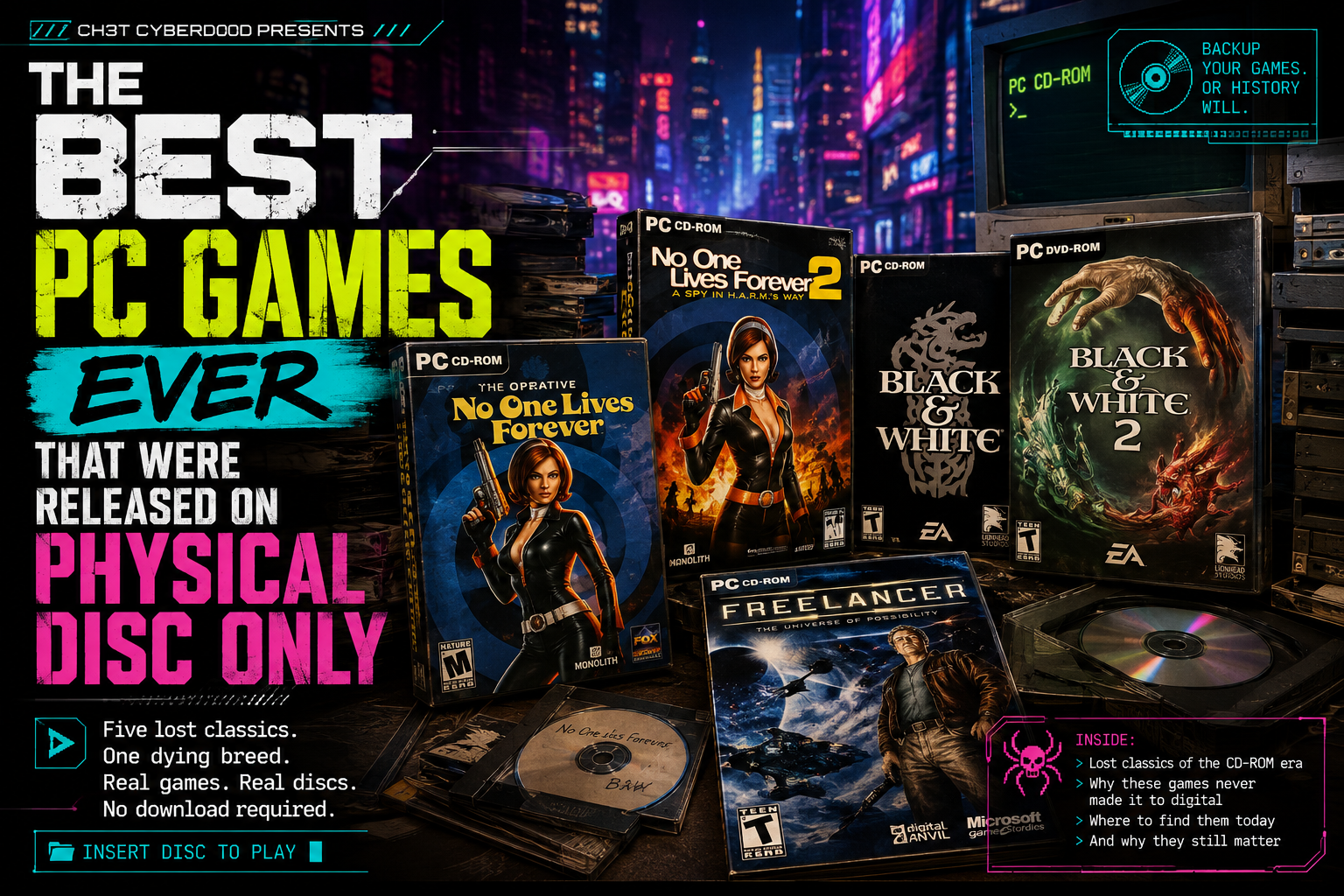
Five lost classics from the era when your save file lived next to your CD-ROM drive
By Ch3t Cyberd00d
There was a time, choomba, when buying a PC game meant making an actual physical commitment.
You walked into a store. You examined a cardboard box the size of a small deflector array. You read the back. You handed over fifty bucks. Then you went home, inserted Disc 1 of 4, and discovered that your computer had approximately 40 MB of free hard-drive space.
This was gaming before the cloud.
Before Steam.
Before GOG could resurrect a forgotten classic with one click.
And before your entire game collection could disappear because somebody forgot to renew an ancient licensing agreement.
Some of those old games have survived the transition to digital. Others have not. They’re stranded in a strange technological limbo: perfectly playable artifacts sitting inside plastic jewel cases while modern storefronts stare blankly into the abyss.
So today, we’re firing up the retro CD-ROM drive and asking:
What are the greatest PC games that remain trapped in the physical era?
A quick clarification: I’m using “physical-disc only” in the practical modern sense—games that received legitimate physical PC releases and do not currently have an official digital storefront release. That’s more interesting than merely asking whether a game originally came on a disc, because practically every major PC game from the era did.
And, gentlemen and ladies, Data has located the floppy-era ghosts.

2000 — Monolith Productions / Fox Interactive
The pitch: What if James Bond were a woman, Austin Powers had better game design, and somebody gave Q a rocket-launching briefcase?
Before BioShock. Before Dishonored. Before Agent 47 became the patron saint of elaborate murder puzzles, there was Cate Archer.
And Cate Archer absolutely rules.
The Operative: No One Lives Forever is one of those games that makes you wonder how the hell the industry managed to forget it.
Cate is a British spy working for UNITY, fighting the evil H.A.R.M. organization in a gloriously ridiculous 1960s espionage universe. The game mixes first-person shooting with stealth, gadgets, disguises, absurd weapons and comedy that understands the difference between parody and simply being silly.
Rocket-launching attaché cases.
Exploding lipstick.
Robot poodles.
A spy cigarette lighter.
This is the kind of inventory that makes Q look like a guy who shops at Costco.
The original Windows release arrived in November 2000 on CD-ROM, with a Game of the Year edition following in 2001.
And then the licensing universe collapsed.
The game is now one of PC gaming’s great digital-orphans. It isn’t sitting comfortably on Steam or GOG waiting for you to click INSTALL. GOG users are still asking for the series to be resurrected.
That’s a tragedy.
Because Cate Archer deserves her own franchise revival.
Ch3t verdict: ★★★★★
Digital resurrection priority: MAXIMUM
Required hardware: One functioning CD-ROM drive and a willingness to negotiate with Windows compatibility settings.

2002 — Monolith Productions / Fox Interactive
Yes, I’m cheating.
No, I don’t care.
If the first No One Lives Forever belongs on this list, its sequel gets its own slot because NOLF 2 is arguably the better game.
Cate Archer returns, and Monolith takes practically everything that worked in the original and turns the dial toward ridiculous.
The Cold War is heating up. The Soviet Union is involved. H.A.R.M. is involved. There’s a mysterious island. There’s a potential global catastrophe.
And somehow there’s still room for some of the funniest stealth-game situations ever programmed.
The sequel arrived for Windows in 2002 on CD-ROM.
The remarkable thing about NOLF 2 isn’t simply that it’s unavailable digitally.
It’s that the game feels like something modern developers should be stealing from.
Its levels encourage experimentation. Its stealth systems are flexible. Its characters are memorable. Its tone is confident enough to be genuinely funny without constantly screaming LOOK! WE ARE MAKING A JOKE!
And then there’s Cate herself: one of the great forgotten protagonists of the PC era.
If you’re compiling a list of the greatest games trapped behind physical media, leaving NOLF 2 off would be like compiling a list of Starfleet’s greatest captains and forgetting Picard.
The Klingons would demand a recount.
Ch3t verdict: ★★★★★
Most painful absence from Steam/GOG: 10/10
Klingon assessment: A game worthy of bat’leth and honor.

2001 — Lionhead Studios
Now we get weird.
Beautifully, gloriously weird.
Peter Molyneux’s Black & White asked one of the most intoxicating questions in PC gaming:
What if you were God?
Not a god.
God.
You control an island populated by worshippers. You perform miracles. You shape civilizations. And eventually you acquire a gigantic creature that becomes a physical manifestation of your divine personality.
Want to be benevolent?
Teach your creature to help people.
Want to become an enormous supernatural bastard?
Teach it otherwise.
The famous interface was literally a giant hand floating over the world. You could pick up villagers. Move objects. Interact with buildings. Perform miracles.
The game shipped on PC CD-ROM in 2001.
And here’s the really strange part:
There still isn’t an official digital release.
Even GOG’s own community dreamlist continues to feature people asking for Black & White to be brought back.
Which is astonishing.
Because Black & White wasn’t some obscure shareware experiment. It was a major EA release from one of the most celebrated designers in PC gaming.
Yet somewhere between corporate ownership, aging technology, licensing and the infinite bureaucratic maze known only to lawyers, this enormous creature of a game got trapped in a box.
The irony is almost too perfect.
A game about becoming an omnipotent god has absolutely no control over its own distribution.
Ch3t verdict: ★★★★★
Creature I’d choose: Tiger
Moral alignment: Increasingly questionable
Status: Awaiting digital reincarnation

2005 — Lionhead Studios / Electronic Arts
And if you’re going to bring the god-game apocalypse, you might as well bring the sequel.
Black & White 2 expanded the original concept into something much closer to a god-game/RTS hybrid.
You don’t merely influence individual villagers anymore. You build civilizations. Command armies. Shape settlements. Develop technologies.
And, of course, you still have your enormous supernatural pet.
The 2005 PC release came on CD-ROM/DVD-ROM depending on edition and territory; contemporary specifications specifically called for a DVD-ROM drive for the release.
And, like its predecessor, Black & White 2 remains absent from the modern digital storefront ecosystem. GOG’s Dreamlist is still full of players asking for its return.
This is one of the great lost opportunities in PC preservation.
Imagine Black & White 2 properly remastered for modern PCs.
Ultrawide monitor support.
Modern creature AI.
Cloud saves.
High-resolution textures.
Ray-traced divine lightning.
A 2026 PC could make that giant cow look terrifyingly majestic.
Instead, we’re left rummaging through physical collections like archaeologists recovering a lost civilization.
Which, appropriately, is exactly what the game was about.
Ch3t verdict: ★★★★½
Best feature: The creature
Worst feature: Modern operating systems remembering that SafeDisc exists
Divine intervention required: Considerable

2003 — Digital Anvil / Microsoft
Now we’re leaving Earth.
The year is 2003. The Xbox has arrived. Broadband is beginning to change everything. Star Wars is still ruling the multiplex.
And Microsoft releases a space-trading-and-combat game called Freelancer.
It becomes one of the most beloved space games of its generation.
You play Edison Trent, a pilot trying to survive in a vast interstellar economy populated by competing factions, corporations, pirates and governments.
You buy ships.
You upgrade weapons.
You trade.
You take missions.
You explore.
And eventually you realize you’ve spent three hours flying around space doing absolutely nothing related to the main story.
Which is how you know you’ve found a good space game.
Freelancer arrived for Windows in March 2003, with the physical PC release distributed on CD-ROM.
And here’s the kicker: there has never been a proper modern official digital re-release.
The community has kept the game alive with patches, servers and modifications, but the original game remains one of those great pieces of PC software that never made the migration to the modern storefront era.
That makes Freelancer especially fascinating.
Because its underlying idea feels more relevant now than it did in 2003.
Persistent online worlds.
Player-driven economies.
Factions.
Space exploration.
A gigantic interconnected universe.
Back then, this was science fiction.
Today, we’re still trying to build it.
Somewhere, a Ferengi is nodding approvingly.
Ch3t verdict: ★★★★★
Space nerd rating: 11/10
Best way to play: With a physical copy, community patches and approximately three decades of accumulated PC gaming knowledge.
There’s something strangely beautiful about these games.
The industry spent decades telling us that digital distribution would make games immortal.
No more scratched discs.
No more lost manuals.
No more hunting through flea markets for a copy of Freelancer.
Just download the game.
Forever.
Except…
Not forever.
Because digital distribution is still dependent on ownership rights, licensing agreements, storefronts, operating systems, DRM servers and corporations continuing to care about a product.
A physical disc, meanwhile, is gloriously dumb.
It just sits there.
Waiting.
Like a little optical time capsule.
The disc doesn’t know that Lionhead closed.
It doesn’t know that a publisher’s licensing agreement expired.
It doesn’t know that Steam removed the game.
It doesn’t know that the operating system has changed seven times.
It simply says:
INSERT DISC TO PLAY.
There is something profoundly cyberpunk about that.
The old physical economy was supposedly primitive. The new digital economy was supposed to liberate us from physical media.
Instead, we’ve created a world in which a game can be simultaneously everywhere and nowhere.
You can find screenshots of No One Lives Forever instantly.
You can read reviews.
Watch videos.
Discuss Cate Archer with strangers on the internet.
But legally acquiring the original game?
Now you’ve entered the black market of nostalgia known as eBay.
A few games almost made this list.
The Movies, for example, is absolutely one of the great physical-PC artifacts—but it doesn’t strictly qualify because Activision actually brought it to Steam in 2007 before the game was later removed from sale.
And that’s precisely why I’m making the distinction.
There are hundreds of beloved PC games that started life on a CD or DVD and eventually became digital.
The fascinating ones are the games where the disc became the last surviving commercial gateway to the original experience.
We used to think physical media was temporary.
Turns out it was an archive.
That old jewel case in your closet might contain something that no modern storefront can sell you.
A spacefaring universe.
A lost spy franchise.
A god simulator.
A digital civilization.
A forgotten piece of gaming history.
So don’t throw away those old discs just yet, choomba.
That scratched-up Freelancer CD might be more than nostalgia.
It might be the last working copy of a world.
And as the Borg would probably put it if they were interested in PC preservation:
Resistance is futile. But please don’t recycle the CD-ROM.
— Ch3t Cyberd00d
Reporting from the archaeological layer beneath the Steam library