‘Tell us’: Gaza family trapped between hope and pain over missing brothers | Israel-Palestine conflict

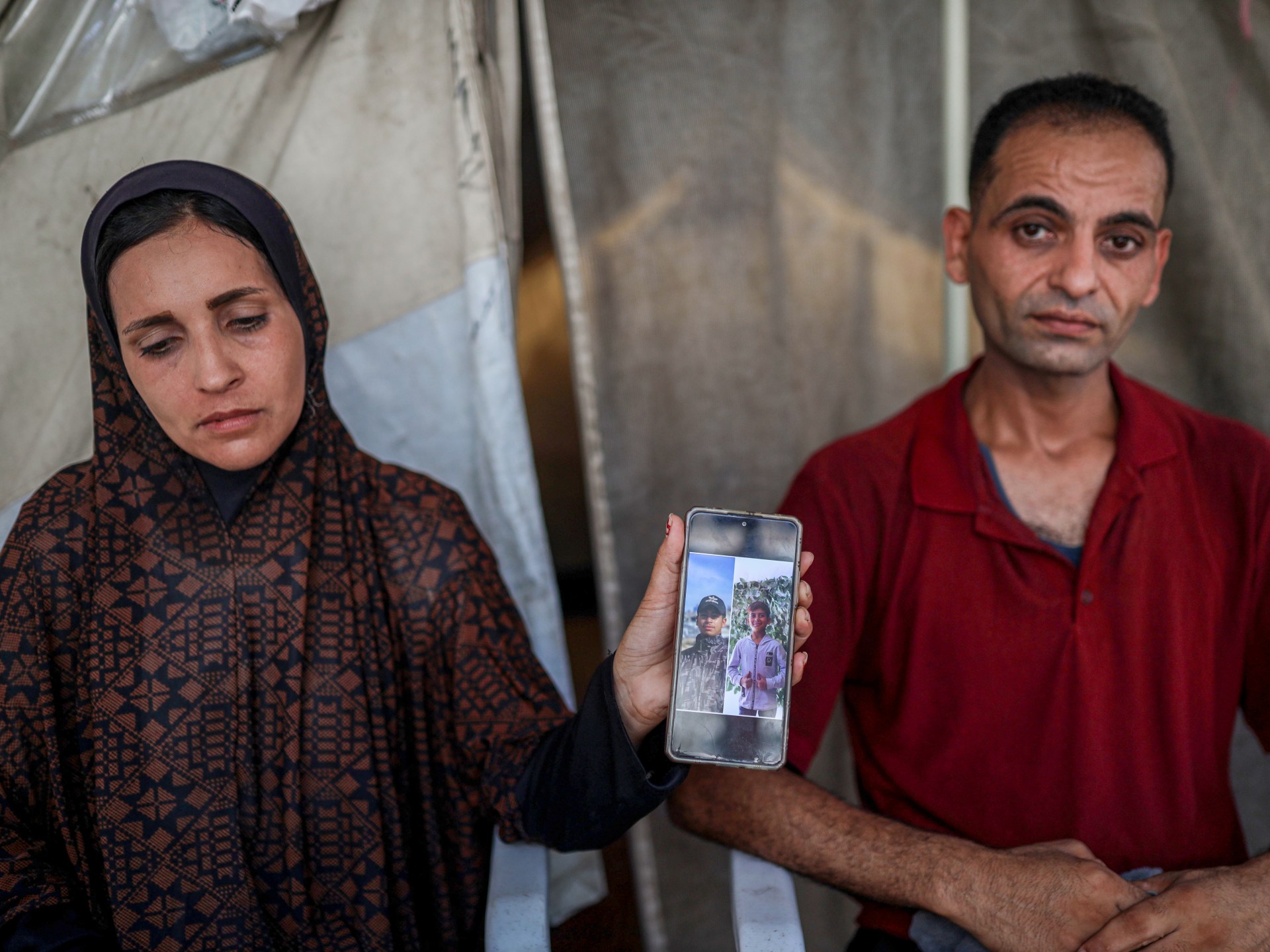
Gaza City, the Gaza Strip – For more than a year, Ashjan Abdel Aal’s life has been suspended between grief and hope.
Two of her sons, Othman and Sami, have been missing since the morning of June 29, 2025, when they left their displaced family’s home in Gaza City – only never to return.
“I want them to come back,” the 36-year-old says through tears. “I want a day when I can see them, hug them and hear their voices.”
Ashjan remembers the last time she saw them.
The two brothers – Othman, who would now be 17, and Sami, 13 – said they would head to an aid distribution point near the so-called Netzarim Corridor in central Gaza, promising their six-year-old sister Emarat they would bring her sweets. Ashjan also recalls hearing that they might pass by the family’s old home in the Shujayea neighbourhood of eastern Gaza City – something they had also done previously – to bring back a pair of shoes for her.
The Abdel Aal family is one of the thousands to have been forced from their homes during Israel’s genocidal war against Palestinians in the Gaza Strip that has killed more than 73,340 people, according to health officials, and left much of the besieged and bombarded territory in ruins. Ashjan, her husband, Rafaat, and their children found shelter at a relative’s house in Gaza City in April last year, at a time when hunger, soaring prices and shortages of basic items pushed many people to take risks searching for food.
“People were either returning to dangerous areas or going to aid distribution points because they had no other choice,” says Rafaat, 41.
On August 1 last year, the United Nations said at least 1,373 Palestinians had been killed while seeking food since late May 2025 – 859 near aid distribution sites and 514 along the routes of food convoys.
On the day Othman and Sami left, Rafaat was away. He had also headed towards United States-backed aid distribution sites near the Zikim area in northern Gaza.
“I was there for a day and a half,” he recalls. “When I returned, my wife told me that the boys had not come back. I became very worried and started asking about them.”
The family waited through the evening, hoping, in vain, that they would return. On the following day, Rafaat began searching hospitals, displacement shelters and among relatives, but found no trace of his sons – since then, the boys’ disappearance has turned the family’s life into an endless search for answers.

Conflicting reports
The first potential lead came more than a month later. A resident of Shujayea told the family he had seen four bodies near their old home. Two had been identified, but the other two had not.
Rafaat says the descriptions he received resembled his sons, but the family could not confirm whether the bodies were Sami and Othman.
Then, two days later came another painful message. A relative shared a photo of an unidentified body at al-Ahli Arab Hospital, saying it looked like Othman.
“At first glance, I was deeply shocked,” recalls Rafaat. “I said this was my son Othman with 90 percent certainty. I went to the hospital, but when I saw the body, it was not my son.”
In October 2025, after Israel and the Palestinian group Hamas reached a “ceasefire” deal, Rafaat was able to reach the area near their old home in Shujayea. He found only destruction. “There was a piece of a missile, fragments and a small bone remnant,” he says.
But later, the family could no longer access the area since it fell behind the so-called Yellow Line demarcating Israeli control within Gaza.
The search continued through the International Committee of the Red Cross (ICRC) and human rights organisations, but no confirmed information was available.
At times, Rafaat says, the uncertainty became unbearable.
“During many moments, because of the immense psychological pressure, I thought about going to the civil registry and requesting official death certificates for them,” he says. “But even that was not possible because there were no witnesses or enough evidence confirming their deaths.”
Hopes and unanswered questions
Months later, in May, a new piece of information rekindled the family’s hopes. Rafaat received a phone call from his wife’s brother who had been helping him communicate with human rights groups, international institutions and lawyers.
“He called me and told me that a lawyer from inside the 1948 areas, who presented herself as someone following missing persons’ cases with human rights organisations and the Red Cross, had said that the boys were alive and in detention” in the Israeli prisons of Ofer and Naqab, says Rafaat.
Ashjan remembers that moment. “My husband told me, and we hugged each other and cried so hard,” she says. “We cried because we thought maybe they were coming back.”

The information, however, was never officially confirmed. The family tried contacting the lawyer again, but received no response. Al Jazeera also attempted to reach the lawyer, but the phone numbers provided by the family were not working.
“I am like a drowning person holding on to any straw,” says Ashjan. “My heart tells me they are alive. I see them in my dreams coming to me and telling me not to cry.”
She says before the boys’ disappearance, Othman, a teenager on the autism spectrum, would always notice when she was sad before anyone else. “He would try to comfort me in any way he could,” she says. “Because of his kindness, Sami became very attached to him. He followed him everywhere.”
Rafaat struggles to hold back tears as he listens to his wife describe their sons. He says the boys had tried to help the family despite his objections, going out in search of aid in the hope of bringing food home.
“Since they left, I feel like I am living in a cycle that never ends,” he says. “I cannot move forward, and I cannot stop thinking about what happened to them.”
Families trapped in uncertainty
The story of the Abdel Aal family reflects a wider struggle faced by many families in Gaza who are searching for missing relatives amid the absence of confirmed information and the spread of conflicting reports.
Gaza’s Government Media Office estimates that some 11,200 people remain missing across the territory, including those believed to be trapped under the rubble as well as others whose whereabouts remain unknown.
Nada Abu Aita, director of the Palestinian Centre for Missing and Forcibly Disappeared Persons, says one of the biggest challenges in documenting cases of missing people is what she describes as the “multiplicity of sources”.
She says the centre’s work depends on communicating with families, collecting details about disappearances and documenting the circumstances surrounding each case.
But for families already living through war, displacement and loss, not knowing the fate of a loved one creates another layer of suffering.
“They live in a state of uncertainty that prevents them from continuing their lives or even overcoming their grief for the missing person,” says Abu Aita. “In the morning, they search for hope that they will find them, and in the evening, they become certain that they have died.”
She says this painful uncertainty makes families more vulnerable to information from unofficial sources, especially when those sources offer the possibility of finding their missing relatives.

The lack of complete information from the Israeli side, even for international groups, leaves some families believing that unofficial mediators or lawyers may have access to information that established organisations do not.
Abu Aita says the centre has received many reports from families contacted by people claiming to be lawyers or representatives of organisations who told them that their relatives were being held in Israeli prisons.
But after examining some of these cases and checking the organisations these individuals claimed to represent, the centre found that some of those institutions did not exist and that some names appeared to be fabricated.
“We cannot force families to believe or reject this information,” says Abu Aita.
“In many cases, families choose to believe these reports, which we classify at the centre as misleading, because they want to hold on to any hope that could bring their son back to them,” she adds, noting that the absence of comprehensive official lists of detainees makes the situation even more difficult.
Open requests
Pat Griffiths, spokesperson for the ICRC in Jerusalem, says the organisation’s work begins with what is known as a “tracing request”.
When a family approaches the ICRC, the organisation collects its contact details as well as information about the missing person and any available details about the circumstances of the disappearance. This allows the organisation to share confirmed information whenever it becomes available.
But Griffiths says the process is often extremely difficult. “This work is often slow, complex and frustrating. Answers are not always available to us to share with families,” he says.
One of the biggest obstacles faced by the ICRC is that it has not had access to Israeli places of detention since the start of the war in October 2023, despite continued dialogue with Israeli authorities to restore that access.
“This means that we are not able to confirm to families those who are detained, like we used to,” says Griffiths.

In cases involving people who are believed to have been killed, Griffiths says there are major challenges related to searching for remains and identifying them through forensic methods. These difficulties, he adds, can delay confirmation for families for months or even years.
“Living in that limbo, of not knowing the fate or whereabouts of a lost loved one, is a terrible and unique kind of pain,” he says. “We talk to so many families who are going through that.”
Griffiths says the ICRC currently has “thousands of open tracing requests”, but does not publish a specific number of missing persons because the figure changes daily as new cases are opened and others are closed.
When confirmed information becomes available, he says, the organisation contacts the family that opened the request, whether the person is being held somewhere, unable to communicate, or, in the most painful scenario, has died.
“At the end of the day, families have the right to know the fate or whereabouts of their loved ones. Whether helping give them the opportunity to finally mourn a loss, or hopefully reconnect or reunite with a loved one, we do this work for them.”
For Rafaat, every new piece of information no longer brings comfort. Instead, it prolongs the pain because the family cannot verify it.
“I don’t want to keep looking forever. I want to know,” he says. “When a person has someone missing, they cannot grieve for them, and they cannot celebrate their return.”
As for Ashjan, she says all she wants “is one certain piece of information about their fate”.
With her voice breaking, she adds: “If they are dead, tell us. If they are alive, tell us.”