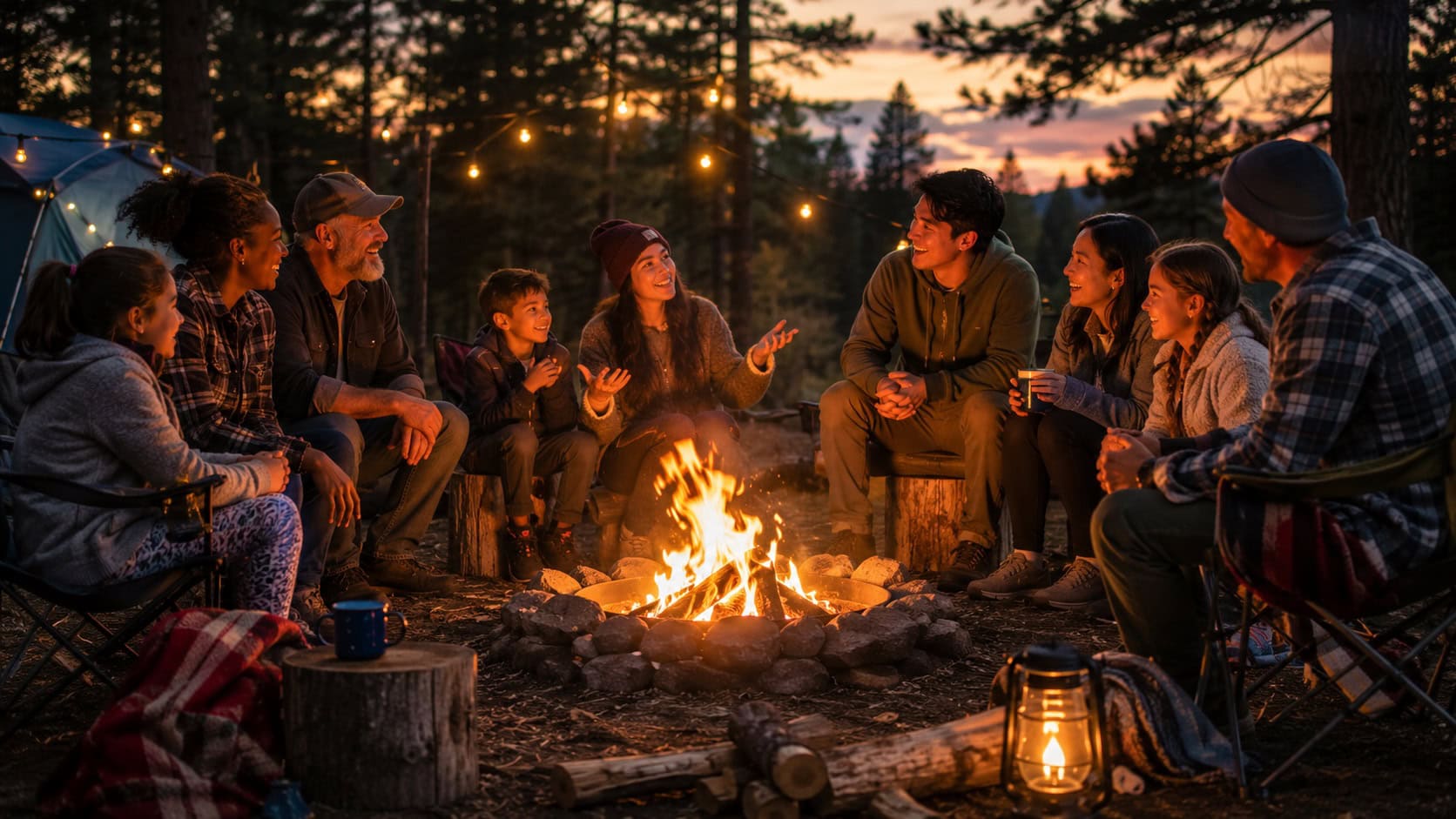
There’s something about sitting around a campfire that just makes people want to talk, laugh, and be silly together. I have some very fond memories from church camp.
Maybe it’s the warmth, maybe it’s being away from screens, or maybe it’s just the simple fact that everyone’s stuck in a circle with nowhere else to be.
Whatever it is, campfire time is prime time for games. The best part?
You don’t need equipment, a referee, or a rulebook the size of a dictionary.
Most of these games need nothing more than a few people, a little creativity, and a willingness to look slightly ridiculous in front of your nearest and dearest.
This list has 30 campfire games that work for kids, teens, adults, and mixed-age groups.
Whether you’re on a family camping trip, at a backyard bonfire, running a youth group, or just hanging out with friends under the stars, there’s something here for everyone.
Need more games? Check out >>10 Easy Outdoor Games for Kids You Can Set Up in 5 Minutes
🔥 A Quick Safety Note Before You Play
Campfire games should be fun, not dangerous. Keep these simple rules in mind:
- Keep games seated or at a safe distance from the fire. This isn’t the place for sprinting relays.
- Supervise younger kids at all times, especially if they’re near the fire.
- No running or rough play near the fire. Save that energy for the morning hike.
- Choose games based on your group. A game that works for adults might not land well with a group of six-year-olds—and vice versa.
With that out of the way, let’s get into it.
The 30 Best Campfire Games
1. Would You Rather
What it is: A simple, hilarious question game that sparks debate and reveals a lot about the people you’re sitting with.
Would you rather fight one horse-sized duck or a hundred duck-sized horses? Would you rather give up coffee forever or never eat dessert again? The questions can be silly, thought-provoking, gross, or deeply philosophical—it’s entirely up to you.
How to play: One person asks a “Would you rather” question. Everyone has to choose one of the two options—no “neither” allowed. Players can explain their reasoning (which is usually where the fun kicks in), and the group can debate their choices.
Best for: All ages, mixed groups
Supplies needed: None
2. Two Truths and a Lie
What it is: A classic getting-to-know-you game that’s been played at icebreakers since the dawn of time—and for good reason. It works.
The magic of this game is that the more outrageous someone’s life has been, the better they are at it. You’ll be amazed at what you learn about people you thought you knew well.
How to play: One person shares three statements about themselves—two of which are true and one of which is a lie. The rest of the group tries to guess which one is the lie. Once everyone has guessed, the person reveals the answer. Then the next person takes a turn.
Best for: Teens, adults, families with older kids (11+)
Supplies needed: None
3. Telephone
What it is: The campfire version of Chinese Whispers. A phrase starts at one end of the circle and travels around via whispers—and what comes out the other side is almost never what went in.
This is one of those games that sounds too simple to be fun, until you actually play it and end up crying laughing at how badly the message got mangled.
How to play: One person thinks of a phrase—the sillier, the better—and whispers it to the person next to them. That person whispers what they heard to the next person, and so on around the circle. No repeats allowed. The last person says the phrase out loud, and everyone compares it to the original.
Best for: All ages, great for kids
Supplies needed: None
4. Campfire Story Round Robin
What it is: A collaborative storytelling game where one person starts a story and each person around the circle adds to it. Stories can go anywhere—and they usually go somewhere completely unexpected.
This game is especially great for creative kids and teens who love a bit of drama. Pro tip: encourage people to end their turn with a cliffhanger.
How to play: One person starts a story with a sentence or two, then stops. The next person picks up where they left off and adds a few sentences. Continue around the circle. You can let the story go as long as you want, or set a rule that it must wrap up after one full rotation.
Best for: All ages, especially families with kids
Supplies needed: None
5. 20 Questions
What it is: A classic guessing game that tests your strategic thinking. One person thinks of something—an object, an animal, a famous person—and the rest of the group has 20 yes-or-no questions to figure out what it is.
It sounds straightforward, but watching someone try to figure out “a marshmallow” or “Abraham Lincoln” one yes-or-no question at a time is surprisingly gripping.
How to play: One person picks a secret word or person and keeps it to themselves. The rest of the group takes turns asking yes-or-no questions to narrow it down. If someone thinks they know the answer, they can guess. If no one gets it within 20 questions, the person who picked the word wins that round.
Best for: All ages
Supplies needed: None
6. Charades
What it is: No sound effects, no words, no miming props—just your body and your best acting chops. Charades is one of the most reliable campfire games out there because it never stops being funny, no matter how many times you’ve played it.
How to play: One person acts out a word, phrase, movie title, book, or TV show without making any sounds. The rest of the group tries to guess what it is. If playing in teams, the team whose member is acting tries to guess within a time limit. The first person—or team—to guess correctly wins that round.
Best for: All ages, families, groups with kids who love performance
Supplies needed: Optional: a hat with word suggestions written on slips of paper (very helpful for younger kids)
7. Name That Tune
What it is: One person hums, whistles, or sings a few bars of a song, and everyone else races to name it. If there’s a guitarist in the group, consider yourself very lucky.
Fair warning: this game has a way of turning into an impromptu singalong, which is never a bad thing.
How to play: One person hums, whistles, or plays a short riff of a song. The first person to correctly name the song earns a point. Play in teams or individually. You can use themes (90s pop, Disney songs, campfire classics) to make it easier—or harder.
Best for: All ages
Supplies needed: None (a guitar is a bonus but definitely not required)
8. I Spy
What it is: A campfire-friendly take on the classic road trip game. Simple, low-key, and perfect for keeping younger kids entertained while everyone else settles in for the evening.
It’s especially fun around a campfire because the flickering light creates all kinds of interesting shadows and shapes to spy.
How to play: One person picks something they can see and says, “I spy with my little eye, something beginning with [letter].” The rest of the group takes turns guessing what it is. Whoever guesses correctly goes next.
Best for: Younger kids, families
Supplies needed: None
9. Fortunately/Unfortunately
What it is: A storytelling game where the group builds a story together, alternating between fortunate and unfortunate events. The results are equal parts absurd and hilarious.
This game is one of my personal favorites for groups with a mix of ages, because absolutely everyone can participate and it rarely takes more than two minutes to get everyone giggling.
How to play: One person starts a story with a “fortunately” sentence—for example, “Fortunately, we found a treasure map in the woods.” The next person adds to it with an “unfortunately” sentence—”Unfortunately, the map was written in a language no one could read.” Then the next person adds a “fortunately,” and so on. Continue until the story reaches a natural (or completely unnatural) conclusion.
Best for: All ages, especially families with kids
Supplies needed: None
10. The Alphabet Game
What it is: A storytelling game where each person must add a sentence to a growing story—but their sentence must start with the next letter of the alphabet. It forces creativity and quick thinking in equal measure.
How to play: The first person starts a story with a sentence beginning with the letter A. The next person adds a sentence starting with B. Continue through the alphabet. Anyone who hesitates too long or messes up the letter is out. The game ends when someone reaches Z—or when everyone’s too tired to remember what letter they’re on.
Best for: All ages (with some adaptation for younger kids)
Supplies needed: None
11. Never Have I Ever (Family-Friendly Version)
What it is: The classic party game, cleaned up for mixed-age groups. This version skips the drinking component and focuses on the fun of finding out who in your group has done the most surprising things.
How to play: Everyone holds up ten fingers. One person says something they’ve never done—”Never have I ever eaten a bug”—and anyone who HAS done that thing puts a finger down. The first person to put all their fingers down loses. You can also flip the premise: say something you HAVE done and see who else has done it too.
Best for: Families, teens, adults (family-friendly version)
Supplies needed: None
12. Vegetable, Vegetable
What it is: One of the silliest games on this list—and that is saying something. Everyone gets assigned a vegetable name and has to say it without showing their teeth. Try staying serious. You won’t be able to.
How to play: Each person picks a different vegetable name. One person starts by saying their own vegetable name twice, then another player’s vegetable name twice—for example, “Pumpkin, pumpkin, carrot, carrot.” That player does the same and passes it on. The catch: you’re not allowed to show your teeth while speaking. Anyone who flashes a smile is out. Play continues until one person remains.
Best for: All ages, especially great for mixed groups and kids
Supplies needed: None
13. One Word Story
What it is: A storytelling game where each person contributes exactly one word at a time to build a story together. It sounds easy. It is absolutely not easy. It’s also one of the funniest games you’ll play all night.
How to play: Going around the circle, each person adds one word to an ongoing story. No pausing, no “um”s—just one word, right away. The story will go in directions no one expects, and that’s entirely the point. You can let it run freely or set a rule that the story must end after two full rotations.
Best for: All ages, especially creative groups
Supplies needed: None
14. Who Am I?
What it is: A classic guessing game where everyone secretly assigns someone else a famous person’s name, then has to figure out who they are by asking yes-or-no questions. It’s like 20 Questions, but slightly more chaotic because everyone’s playing at once.
How to play: Everyone writes the name of a famous person on a slip of paper. The papers get shuffled and handed out—you can’t look at your own card. Hold it to your forehead so everyone else can see it. Go around the circle asking yes-or-no questions to figure out who you are. First person to guess correctly wins.
Best for: All ages
Supplies needed: Paper and a pen (or just use your phone’s notes app)
15. Ghost
What it is: A surprisingly competitive word game where players take turns adding letters to spell a word—but whoever completes a word gets a letter toward the word G-H-O-S-T. Spell out GHOST and you’re out.
How to play: One person says a letter. Going around the circle, each player adds a letter, trying to extend the word without completing it. You must always be building toward a real word. If someone can’t think of a valid letter, they can challenge the previous player—but if the previous player had a real word in mind, the challenger gets the letter. If they didn’t, they get the letter. First person to spell out G-H-O-S-T is eliminated.
Best for: Older kids, teens, adults
Supplies needed: None
16. I’m Going on a Picnic
What it is: A memory chain game where each player adds an item to a growing list. The longer the chain gets, the harder it is—and watching someone try to remember fifteen items in order is very satisfying.
How to play: The first person says, “I’m going on a picnic and I’m bringing [item starting with A].” The next person repeats the list and adds an item starting with B. Continue through the alphabet. Anyone who forgets an item or says one out of order is out.
Best for: All ages, great for kids
Supplies needed: None
17. Desert Island
What it is: An imagination game that sparks genuine conversation and reveals a lot about what people actually value. Ask everyone to imagine they’re stranded on a desert island—what would they bring? Who would they want with them?
How to play: The facilitator (whoever feels like it) poses a Desert Island scenario with a set number of choices—”If you were stranded on a desert island and could only bring three things, what would they be?” Everyone shares their answers and explains their reasoning. You can make the prompts more specific: three books, three foods, three famous people. Debate is highly encouraged.
Best for: All ages, great for deeper conversations
Supplies needed: None
18. Wink Murder
What it is: Part drama, part detective work, part poker face competition. One person is secretly the murderer, and they “kill” victims by winking at them. The detective has to figure out who it is before the whole group is eliminated.
How to play: One person (the detective) steps away from the fire or covers their ears. The group quietly selects a murderer. The detective returns. The murderer winks at other players one at a time—if you’re winked at, you dramatically “die.” The detective gets three guesses to identify the murderer. If they guess correctly, they win. If the murderer eliminates the whole group first, they win.
Best for: All ages
Supplies needed: None
19. In the Pond, Out of the Pond
What it is: A fast-paced listening game where everyone puts their hands in the “pond” (the center of the circle), out of the pond (above their heads), or on the bank (on their thighs) based on what the caller says. It sounds simple. People mess it up constantly.
How to play: Everyone sits in a circle with their hands on their thighs. One person is the caller. They call out “in the pond,” “out of the pond,” or “on the bank” in rapid succession—sometimes repeating the same command twice to trick players. Anyone who moves to the wrong position is out. Last person remaining wins.
Best for: All ages, excellent for large groups
Supplies needed: None
20. Most Likely To
What it is: A voting game that’s funny, revealing, and perfect for groups who know each other reasonably well. Think superlatives, but interactive.
How to play: One person asks a “most likely to” question—”Who is most likely to forget where they parked?” or “Who is most likely to eat the last s’more without telling anyone?” Everyone simultaneously points at the person they think fits the description. The person who gets the most votes has to explain themselves. Keep it good-natured and light.
Best for: Teens, adults, families with older kids
Supplies needed: None
21. The Moon Game
What it is: A clever observation game that’s absolutely perfect for younger kids learning their manners—though adults get a kick out of it too. One person holds a stick and draws something in the air. The secret rule? You have to say “thank you” when you receive the stick.
How to play: One person (who knows the secret) holds a stick or pen and draws a shape in the air. They hand the stick to someone and say, “Is that a moon?” If the person said “thank you” when they took the stick, whatever they drew is a moon. If they didn’t, it isn’t. The goal is for everyone to figure out the secret rule.
Best for: Younger kids, families, groups who love a good puzzle
Supplies needed: A stick or pen
22. Six Degrees of Kevin Bacon
What it is: A pop culture trivia game based on the famous theory that every actor in Hollywood can be linked to Kevin Bacon through six or fewer connections. It’s a challenge that sounds easy until you actually try it.
How to play: One person names a random actor or actress. The group has to find the shortest chain of connections back to Kevin Bacon, where each connection is a shared film. For example: Meryl Streep was in The Devil Wears Prada with Emily Blunt, who was in Sicario with Josh Brolin, who was in… and so on. Debate is very much encouraged.
Best for: Teens, adults, film lovers
Supplies needed: None (though a phone is handy for fact-checking)
23. Word Association
What it is: A rapid-fire word game where each person says a word associated with the one before it. Simple on the surface—but add in the rule that you can’t repeat any word (or any part of a word) and it gets surprisingly tricky.
How to play: One person says a word. The next person immediately says a word they associate with it. Continue around the circle. Anyone who hesitates too long, repeats a word, or says something the group deems completely unrelated is out. For a more strategic version, have each player secretly pick a word at the start—the goal is to steer the chain toward your word without being obvious.
Best for: All ages
Supplies needed: None
24. I Won’t Laugh
What it is: One of the best games for groups with naturally funny people—or people who can’t keep a straight face. One person sits alone while the rest of the group tries to make them laugh in 30 seconds. Simple, ruthless, effective.
How to play: Split the group into two teams. Team One selects someone from Team Two to sit alone. Team One has 30 seconds to make that person laugh using any (appropriate) means available—funny faces, jokes, stories, impressions. If they succeed, they earn a point. If the person holds it together, Team Two earns a point. Alternate until everyone has had a turn in the hot seat.
Best for: All ages
Supplies needed: None
25. The Counting Game
What it is: A minimalist game that somehow becomes completely addictive. The group tries to count out loud together from 1 to 21—but no one can signal who speaks next. If two people say a number at the same time, you start over.
How to play: Anyone can say a number at any time, as long as numbers are called in order starting from 1. No pointing, no nodding, no eye contact signals. The moment two people say the same number simultaneously, the group resets to 1. Can you make it to 21?
Best for: All ages, great for large groups
Supplies needed: None
26. Categories
What it is: A quick-fire elimination game where everyone tries to name things in a category in alphabetical order. Sounds easy until you’re stuck on the letter Q.
How to play: One person names a category—”Types of dogs,” “Things you find in a kitchen,” “Countries in Europe.” Going around the circle, each player names something from that category starting with the next letter of the alphabet. Anyone who hesitates too long or can’t think of something is out. The last person standing picks the next category.
Best for: All ages
Supplies needed: None
27. Campfire Trivia
What it is: Classic trivia, campfire edition. One person (or rotating people) fires off questions, and whoever answers correctly first earns a point. You can theme it by topic or keep it general.
How to play: One person acts as the quizmaster and asks trivia questions out loud. The first person to call out the correct answer wins a point. Play to a set number of points, or just keep going until interest fades. If you want teams, assign groups at the start. Good topic ideas include animals, geography, movies, sports, history, and camping facts.
Best for: All ages (tailor difficulty to the group)
Supplies needed: A phone to pull up trivia questions is helpful, but not required if someone has a good mental bank of trivia
28. Story Spine
What it is: A structured collaborative storytelling game where each person’s contribution must follow a specific prompt. It’s used by improvisers and screenwriters—and it works just as well around a fire.
How to play: Each person in the circle adds one line to a growing story, following these prompts in order:
- “Once upon a time…”
- “Every day…”
- “Until one day…”
- “Because of that…”
- “Because of that…” (repeat as needed)
- “Until finally…”
- “Ever since then…”
- “And the moral of the story is…”
It creates surprisingly coherent stories—even when the group is trying to derail it.
Best for: All ages, especially creative groups
Supplies needed: None
29. The Ha Game
What it is: A game with exactly one rule: don’t laugh. The goal is to keep a straight face while saying “Ha”—but hearing other people say “Ha” in a row makes it nearly impossible.
How to play: Sitting in a circle, the first person says “Ha.” The next person says “Ha, ha.” The next person says “Ha, ha, ha”—and so on, each person adding one more “Ha.” Anyone who breaks character, smiles, or laughs is out. The last person remaining who can say their full chain of Ha’s without cracking wins.
Best for: All ages, especially younger kids and anyone with a low giggle threshold
Supplies needed: None
30. This or That
What it is: A fast, easy, surprisingly revealing game that works for literally any group. Ask “this or that” questions—beach or mountains, cats or dogs, early bird or night owl—and watch the debates unfold.
How to play: One person asks a “this or that” question. Everyone simultaneously calls out their answer or holds up one or two fingers to indicate their choice. Discuss and debate. Keep going around the circle with new questions. You can keep it light and fun, or edge into more interesting territory—”adventure or comfort?” “fame or fortune?”—to spark real conversation.
Best for: All ages
Supplies needed: None
Tips for Choosing the Right Campfire Game
With 30 options in front of you, it helps to have a quick framework for deciding what to play. Here are a few things to consider:
Think about your group’s age range. Games like I Spy, The Moon Game, and In the Pond, Out of the Pond work brilliantly with younger kids. Teens tend to gravitate toward games with social stakes—Most Likely To, Two Truths and a Lie, and Ghost are solid picks. Adults usually appreciate wordplay and strategy games like Ghost, Six Degrees of Kevin Bacon, and Campfire Trivia.
Consider your group’s energy level. Toward the start of the night when everyone’s buzzing? Go for active, competitive games like Name That Tune or Categories. As the fire dies down and people get sleepy, shift to low-key games like Would You Rather, Desert Island, or Story Spine.
Factor in group size. Small groups (under six people) tend to shine with conversation-based games like Two Truths and a Lie or Fortunately/Unfortunately. Larger groups do well with physical response games like In the Pond, Out of the Pond or the Counting Game, where the chaos of many players is part of the fun.
Keep it simple. If explaining the rules takes longer than actually playing the game, it’s probably not the right pick for a casual campfire setting. The best campfire games for families are the ones that are up and running within 60 seconds of explaining.
Don’t be afraid to rotate. Not every game will land with every group. If something isn’t clicking, move on. The goal is laughter and connection—not forcing the perfect round of Wink Murder if nobody’s feeling it.
Keep It Simple, Keep It Fun
Here’s the thing about campfire games: they’re not really about the games. They’re about the laughter that follows a terrible charades performance, the heated debate over a Desert Island question, and the moment a whispered phrase comes out the other end of a telephone game as something completely unrecognizable.
The fire does half the work for you. All you have to do is show up with a few ideas in your back pocket and let the evening take care of itself. Start with a game or two from this list—something low-key to ease people in—and follow the energy from there.
Some of the best memories from camping trips, bonfires, and backyard evenings happen right here: in the circle, in the warmth, in the middle of a game nobody expected to love.


Melissa is a passionate minister, speaker and an ongoing learner of the Bible. She has been involved in church and vocational ministry for over 18 years. And is the founder of Think About Such Things. She has the heart to equip the saints by helping them get into the Word of God and fall more in love with Jesus. She also enjoys family, cooking, and reading.
She has spoken in churches in California, Oregon, Texas, and Mexico and has been featured in Guidepost Magazine and All Recipes Magazine. Read More…