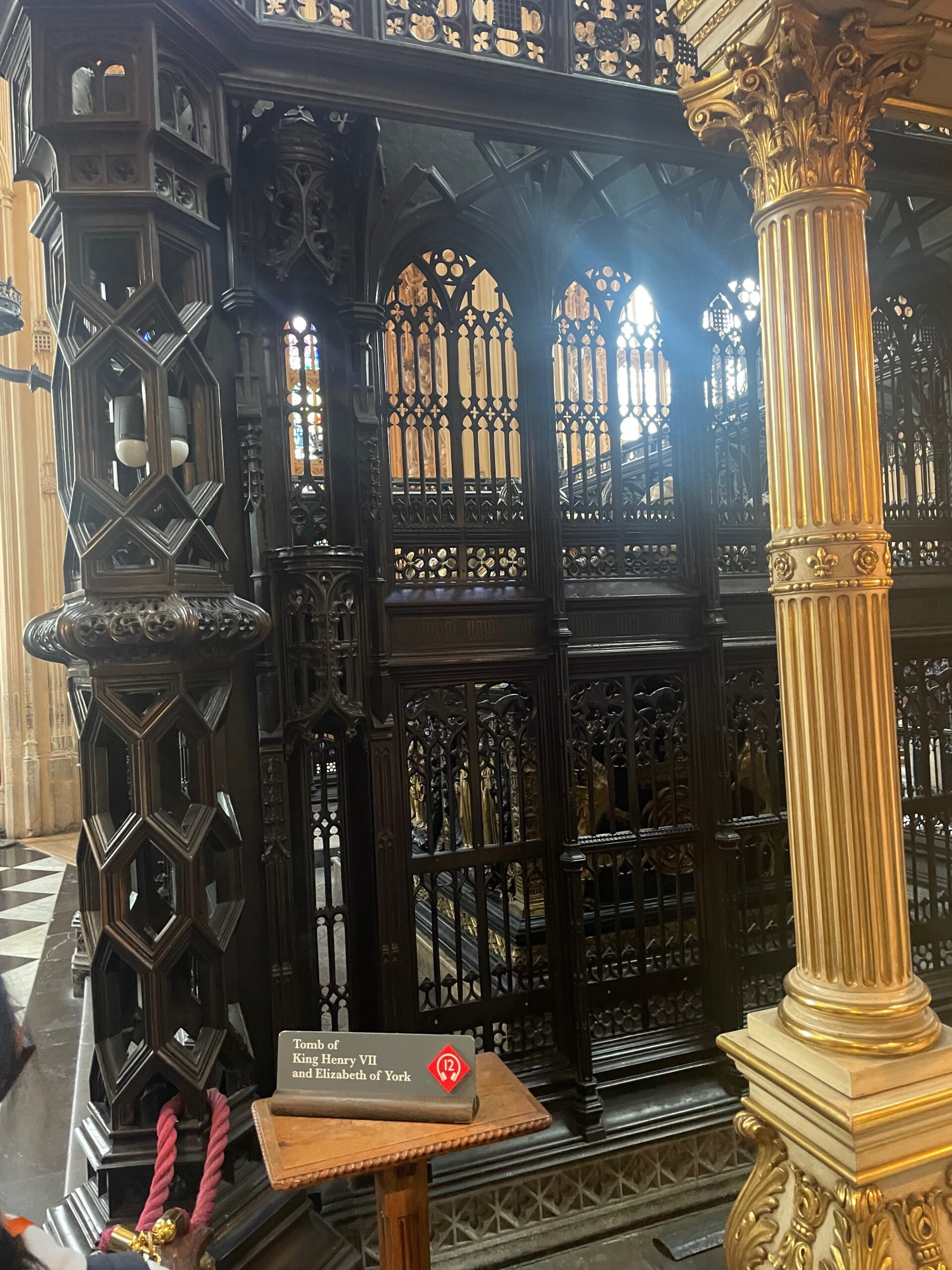
This is the grave of King Henry VII.


Born in 1457 in Pembroke Castle, Wales, Henry grew up in the mess of the War of the Roses. His mother was all of 13 years old at his birth. This was the era of the War of the Roses. Henry Tudor’s family was all over that, leading the Lancasters after the male heirs to that side of the war died off in 1471. Henry’s mother was the great granddaughter of Edward III, leading to a legit claim, plus they were leading the effort anyway against the House of York. When Edward IV retook his throne in 1471 after being briefly evicted from power, Henry was sent away to Brittany, where he would remain in exile until 1485. But when Edward IV died and Richard III possibly had Edward V killed so he could take over himself, the opportunity was perfect for Henry and his allies, including the French and the Scots. When they defeated Richard III at Bosworth Field, Henry became king.
Henry VII was the stabilizing force England needed. He was not a beloved king in terms of historical memory, but he was a stable person and a strong leader who tampened down the power of the nobility while ending the decades of civil wars. He also did the thing you needed to do in early modern Europe, which is marry Edward IV’s daughter Elizabeth of York, who is also buried here. Moreover, Henry had promised York nobles he would marry Elizabeth even before he invaded England, which may well have contributed to the decline in support for Richard. It’s also of course very difficult to get a sense of the real Richard because Richard III is perhaps the best history play Shakespeare wrote and turns Richard into a monster, so when I read about this, I wonder if they were turning because was a murderous bastard and then I’m like, well maybe but is that just Shakespeare speaking to me?
Why was Henry successful? First of all, he was determined to unite the nation. He claimed that any of Richard’s followers who rebelled would have their lands confiscated and be executed, but then he worked to pardon leading figures of Richard’s circle to show that he didn’t want to do that. He allowed anyone who swore fealty to him to be let off. He married Elizabeth, as he said he would. He had Parliament repeal Richard’s Titulus Regius that declared Edward IV’s marriage illegitimate and the kids ineligible to the throne. Now, none of this meant the Yorkists had gone away. There were several rebellions until the late 1490s, mostly of the pathetic variety, pretenders to the throne and the like. But Henry managed to cut these off by first defeating the rebellions when they did get to the point of having serious nobility behind them and then pardoning as many people as he could. He was simply a master of creating loyalty to himself. And if he had to, Henry would have people close to him executed, such as the Earl of Warwick, killed in 1499 for his role in plots.
The other part of Henry’s success is why people found him kind of boring when they wanted to romanticize the kings of the past–he was more interested in financial matters than war. The War of the Roses had bankrupted the country. Henry was very careful about money. He increased the power of the monarchy and decreased that of the nobility and some of that was through taxation. He had a good way of doing this too–the more a noble spent, the more he was taxed. This put the burden of taxation on those nobles who liked to live large, have large military forces, and otherwise be the type that could threaten the crown. If you were quiet and stayed at the castle, you weren’t going to be bothered much. All of this made Henry’s tax collectors hated by the nobility. Later, one of the first acts of Henry VIII’s, Henry’s very different son, was to execute the most aggressive of the tax collectors. He expanded English trade, particularly in alum, which was used to fix dyes for the clothing industry. This was really useful because there was only spot on the continent with alum mines and it was controlled by the papal states. So this created competition and lowered prices, making everyone happy except the Pope.
Mostly, Henry tried to avoid wars, preferring to increase British financial stability rather than blow a bunch of money in France. He didn’t always succeed here–he invaded Brittany in 1492 in an action that didn’t really go anywhere. He was close to the French anyway, since they had protected him during his exile, The French were increasingly concerned with Italy at this time anyway and so kept Henry pretty happy. Where Henry did spend was building up the English navy. He had the first dry dock in the world built in Portsmouth in 1495. John Cabot appealed to Henry to explore the ocean west of Ireland for the crown, which Henry approved.
Henry was also smart in his foreign policy. He had his oldest son Arthur marry Catherine of Aragon, hoping to build good relations with the newly united Spanish throne. But Arthur died in 1502, only 15 years old. So his second son Henry ended up marrying her after that, which ended….not great. Plus England would have had a King Arthur for real, what a bummer. Henry worked out a treaty with the French where they wouldn’t support pretenders to the English throne, which had long destabilized their northern neighbor. His boycott of the wool trade with Dutch supporters of one the pretenders to the crown ended up moving the center of that trade from Antwerp to Calais, while he also evicted Flemish merchants from England. This all led to the 1496 Intercursus Magnus, a trade agreement between England and Burgundy that also brought in Venice, the Dutch states, and other merchant interests, which was a sort of proto-free trade agreement that significantly opened economic opportunities for English traders and which made the nation much wealthier in the sixteenth century than it was in the fifteenth.
Henry used the Court of the Star Chamber to tremendous effectiveness, forcing the rich and the nobles to acquiesce to laws with a court that was really going to prosecute them. While Henry may not have been too concerned about peasants, for middling people who did matter a bit, it was important to show them that he was a fair ruler and they couldn’t just be ripped off or have their rights trampled upon by the rich. It was considered a rare beacon of fairness in a time when fairness was a rare commodity.
So you can see why people would find Henry boring–he was a good governance guy in an era of warriors and really flawed humans who did much more colorful things than these things.
Henry genuinely loved Elizabeth and evidently had no mistresses, speaking of rare things for kings. He was devastated upon her death in 1503. He never really recovered. He died himself, of tuberculosis, in 1509. He was 52 years old.
Henry VII is buried in Westminster Abbey, London, England.
If you would like this series to visit some Henrys of America, you can donate to cover the required expenses here. Henry Kissinger is in Arlington and Patrick Henry is in Aspen, Virginia. Previous posts in this series are archived here and here.