
IEW Fix It! Grammar Level 6: Little Mermaid Review

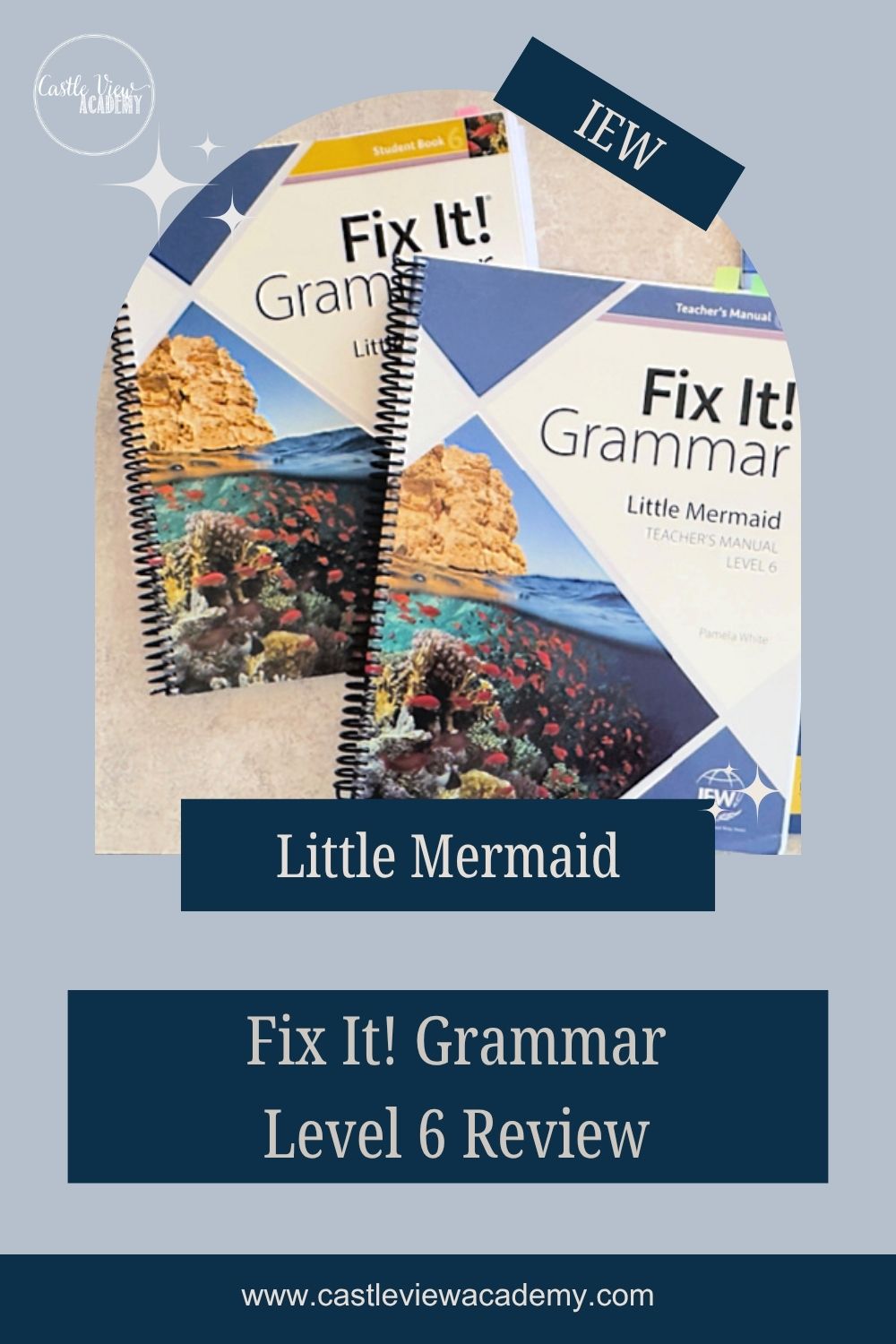
Is IEW’s Fix It! Grammar Level 6: Little Mermaid worth adding to your homeschool? In this review I’m sharing our family’s experience using the final book in the series as my daughter prepares for college after sixteen years of home education.
Let’s go through how the curriculum works, what’s included, the teaching philosophy behind it, and what we really thought after completing the course. As both a home educator and an English teacher with experience in Japan and Northern Ireland, I found there was far more to this programme than simply learning grammar rules.

This post may contain affiliate links through which I may receive a small commission.
When we received Fix It! Grammar Level 6: Little Mermaid from the Institute for Excellence in Writing (IEW,) in exchange for our honest opinions, at the beginning of May, the timing couldn’t have been better.
My youngest teen, Kallista, will be starting a one-week fast-track Essential Skills Literacy course at college in August as she transitions from home education to further education here in Northern Ireland. She wanted a grammar refresher to build her confidence before entering a classroom environment for the first time.
This also marks the final level in the Fix It! Grammar series. Kallista had completed the previous five levels several years ago, so we were interested to see just how much she remembered.
How it Works
Unlike traditional grammar workbooks that teach isolated rules followed by endless exercises, Fix It! Grammar teaches students through an ongoing story, in this case, The Little Mermaid.
Each lesson contains a short passage from The Little Mermaid. The passage has been injected with errors in grammar, punctuation, spelling, word usage, and other errors. Students work through the text, identify the mistakes, correct them, and then rewrite the passage correctly at the bottom of the page.
Because the story continues chronologically, grammar becomes part of reading and writing rather than only completing worksheets. It’s always easier to pick out the errors in another’s work than your own, but spotting it in this way can also help one prevent such errors in their own work.
There are 30 weeks of lessons, with four lessons scheduled each week. Since Kallista is preparing for college this summer, rather than following a traditional school year, we’ve been completing between ten and fifteen lessons per week.

What We Received

Our package included:
The books are spiral bound, allowing them to lie flat on the table while working, which is a feature I always appreciate as it means no cracked spines and the books can lay flat.
Students can also download and print a vocabulary glossary, and families who already own the optional Fix It! Grammar cards can continue using them alongside this level.
Little Mermaid Student Book
The student book begins with a list of the grammar cards relevant to this book, and a a list of the vocabulary items that will be learned and the scope as well as the sequence for each concept in the book in a table to easily see which concepts apply to which lessons.
Each lesson follows the same format:
- Learn It!
- Read It!
- Mark It!
- Fix It!
- Rewrite It!
This structure becomes routine quickly so that students always know what to expect from each lesson.

We read the complete Little Mermaid story in full during one of our daily read aloud sessions as a refresher to the story before beginning the lessons. The full text appears in Appendix I.
Learn It!
Each week there are one or more grammar concepts for students to familiarise themself with before applying them in the daily lessons. Topics include parts of speech, punctuation, sentence structure, vocabulary, usage, clauses, and much more.
Rather than overwhelming students with pages of explanation, the information is presented in manageable pieces while continually reviewing concepts from previous lessons.
Although Kallista initially commented, “I don’t remember this,” after only four or five lessons everything began coming back to her. Before long she was confidently identifying errors and even challenging some of the answers.
Thankfully, whenever we reached one of those, “But couldn’t this also be correct?” moments, the Teacher’s Manual provided clear explanations for the reasoning behind the answers. Yes, I can teach conversational English, but when it comes to all the rules of English grammar (and the infinite exceptions), I may know how to use them, but not how to explain why, so I was thankful of this part of the Teacher’s Manual.
Read It!
Students then read the next portion of The Little Mermaid and because each lesson builds on the previous one, there is a real sense of progressing through a complete story rather than working through disconnected grammar exercises that don’t connect with each other. This is one thing that sets this series apart from other grammar books.
Mark It!

This is where students become editors by using the proofreading marks they’ve learned and identifying the errors within the day’s passage.
Students might be looking for:
- Capitalisation
- Punctuation
- Parts of speech
- Sentence structure
- Vocabulary
- Word usage
- Grammar errors
- Spelling
Rather than simply circling answers on a worksheet, students are actively analysing real writing. Changing a comma to a period, fixing run-on sentences and misplaced modifiers, or spotting the differences in rise/raise, they mark up the text in their workbook.
Fix It!
Now that students have marked up all of the errors they’ve spotted, it’s time to correct them.
Students aren’t expected to rely on guesswork. Each lesson builds upon previous knowledge while introducing new concepts gradually through spiral learning. There is a list above each lesson guiding students in what they should be looking for.
Rewrite It!

Finally, students rewrite the corrected passage neatly at the bottom of the page on the lines provided. While this may seem easy, it reinforces several skills at once.
Students practise:
- Applying correct grammar
- Attention to detail
- Handwriting
- Editing their own work
As I’ve mentioned before, one of the best ways to improve your own writing is by learning to recognise mistakes in someone else’s. Over time, students naturally begin spotting errors in emails, signs, social media posts, and eventually their own writing.
Teacher’s Manual

The Teacher’s Manual contains far more than an answer key, and I couldn’t do without it. In addition to the corrected passages are explanations, teaching notes, definitions (did I mention that each lesson includes a vocabulary word), and helpful guidance whenever a grammar point could cause confusion.
As English speakers know all too well, there are plenty of situations where we instinctively know something sounds wrong but struggle to explain why. The manual provides those explanations, making it useful for both students and parents. It also includes a glossary of the grammar terms used throughout the course.
The Included Audio Downloads

One feature that surprised me was how much I enjoyed the two audio presentations included with the course, even though I have listened to them previously.
The first, But, But, But… What About Grammar? explores the philosophy of teaching grammar. Andrew Pudewa discusses the history of grammar, the four paradoxes of grammar, and why grammar is often misunderstood or poorly taught.
As someone who has taught English in Japan and more recently, English as a Second Language in Northern Ireland, I particularly appreciated his explanation of why many native English speakers instinctively know when something is incorrect but cannot explain the rules, while second-language learners often understand the technical side of grammar remarkably well.
The second presentation, Mastery Learning, Ability Development, and Individualized Education, discusses how children learn most effectively.
Listening to Mr. Pudewa explain cumulative learning reminded me of educational approaches I encountered while living in Japan. I also recognised many of the same principles in the way Kallista has learned piano over the years with the Suzuki method – new skills are continually revisited and strengthened rather than being taught once and forgotten.
Although these audio downloads aren’t required to teach the course, I found them interesting. If you’d like to listen to them, too, they’re available to dowload for free using the links I’ve provided.
How We Used Fix It! Grammar Level 6
Each morning after finishing our read-aloud, Kallista and I would work through a couple of lessons together. Although she had completed the earlier levels several years ago, it didn’t take long before the familiar routine returned. After the first lesson was marked up and officially corrected, she’d then get through the next three lessons of the unit and we’d correct those in one go.
One unexpected benefit was the conversations grammar sparked. At the start of June there were some riots here in Northern Ireland and I showed Kallista photographs of hate graffiti in one of those areas. Instead of reacting to the message itself, she identified seven grammatical errors.

That led to a larger discussion about why grammar matters. It’s not because everyone needs perfect English, but because clear communication helps people explain their ideas, understand opposing viewpoints, and avoid being misunderstood.
We also talked about why some people struggle with grammar, why English can be such a difficult language to learn, and why students learning English as an additional language often understand grammar terminology better than native speakers.
Things then led onto talking about generational trauma and socioeconomical disadvantages and how although it can be very difficult, it’s important to recognise this and try to make the world a better place for everyone. Those conversations became every bit as valuable as the course itself.
A Note for UK Families
As IEW is an American publisher, the course uses American spelling rather than British or Canadian English. This wasn’t a drawback for us (obviously, as we’ve used IEW for years). Instead, it became another learning opportunity as we discussed spelling differences and occasionally converted words into British English. For us it added another layer of understanding and observations, but for families outside of the USA, it’s something that they should be aware of before purchasing this course.
What We Think of Fix It! Grammar Level 6
One of the greatest strengths of Fix It! Grammar is that grammar is never taught in isolation. Students learn by reading, analysing, editing, correcting, and rewriting.

I also like the philosophy behind the program. Grammar isn’t presented as a list of rules to memorise but as a practical tool for communicating clearly.
For our family, this course came at exactly the right time, and as of today, Kallista has completed the course. It has refreshed Kallista’s grammar knowledge before college while also giving us one last opportunity to enjoy learning together. I’m going to miss home education and the time it’s allowed me to spend with my children over the past eighteen years. This may well be the final curriculum we complete side by side before she begins the next chapter of her education.
That makes Fix It! Grammar Level 6: Little Mermaid one we’ll remember for reasons far beyond grammar alone.
Connect with IEW

Website | Facebook | Twitter | Pinterest | YouTube | Instagram
More IEW Course Reviews:


