STEM Research Grants And Fellowships For International Students In Germany, Netherlands, And Sweden – Expressiveinfo

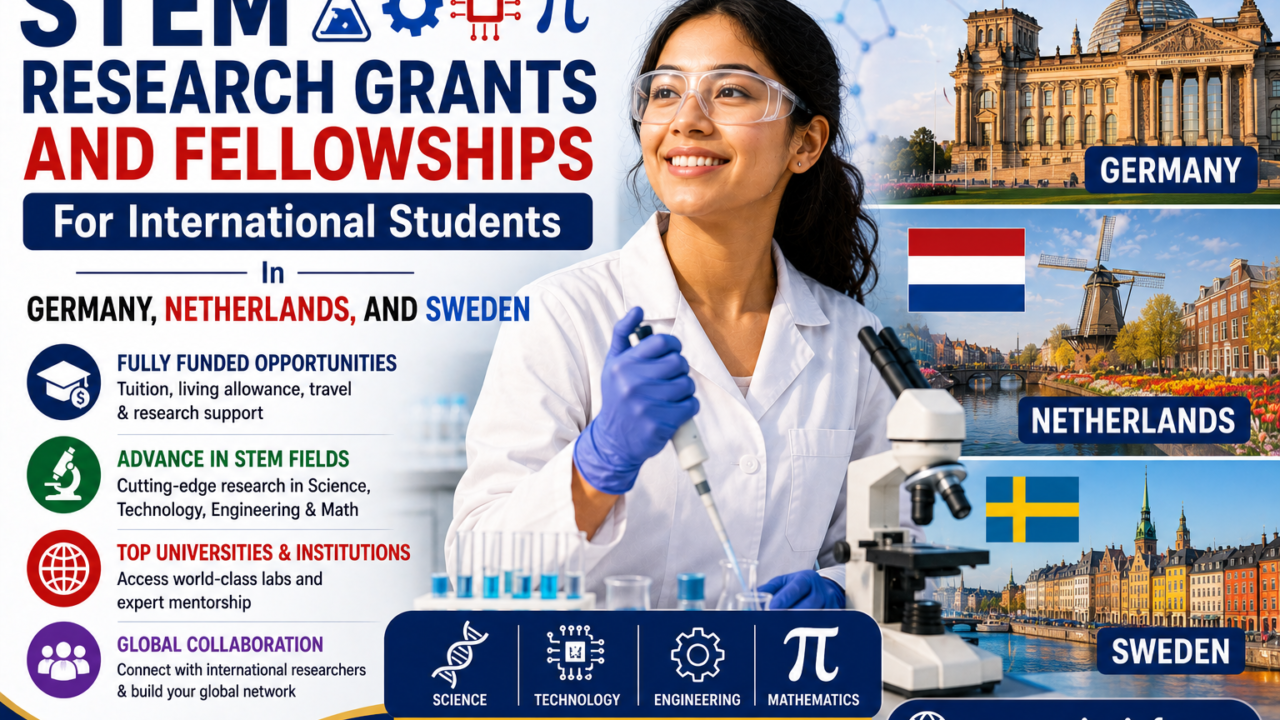
STEM research grants and fellowships in Germany, Netherlands, and Sweden offer exceptional funding opportunities for international students pursuing science, technology, engineering, and mathematics research at world-class European institutions. These three countries collectively represent Europe’s most innovation-focused research ecosystems, with substantial government and private funding available for international STEM researchers at doctoral and postdoctoral levels.
For the 2026/2027 research year, dozens of prestigious STEM-focused grants remain available including DAAD programs (Germany), NWO grants (Netherlands), and Swedish Research Council funding. This guide breaks down the major STEM research grants and fellowships worth pursuing.
Whether you’re targeting artificial intelligence research at ETH-caliber institutions, biotechnology programs at leading Dutch research centers, or renewable energy fellowships at Swedish innovation hubs, this guide covers the funding pathways.
Top STEM Grants In Germany
Germany’s engineering and scientific research culture creates exceptional STEM funding:
- DAAD Research Grants For STEM Fields — funds doctoral and postdoctoral STEM research at German universities. Provides monthly stipends (€1,200 doctoral, €1,600+ postdoctoral) plus travel and health insurance.
- Alexander Von Humboldt Foundation Feodor Lynen Research Fellowship — enables German researchers to conduct research abroad; reciprocal programs support international STEM researchers in Germany.
- Max Planck Society Doctoral And Postdoctoral Positions — funded positions at world-renowned Max Planck Institutes across STEM fields.
- Helmholtz Association Research Positions — Germany’s largest research organization funds doctoral and postdoctoral positions across STEM fields.
- Fraunhofer Society Research Positions — applied research positions in engineering, IT, and materials science.
- German Research Foundation (DFG) Project-Funded Positions — doctoral and postdoctoral positions funded through DFG-supported research projects.
- Konrad-Adenauer-Stiftung STEM Fellowships — supports STEM doctoral candidates at German universities.
Top STEM Grants In The Netherlands
The Netherlands offers world-leading STEM research funding:
- NWO (Dutch Research Council) Vidi And Vici Grants — funds exceptional early-career and mid-career researchers with €800,000 to €1.5 million grants for 5-year research programs.
- NWO Talent Scheme — includes Rubicon fellowships for postdoctoral researchers moving abroad and Veni grants for talented postdoctoral researchers in the Netherlands.
- Delft University Of Technology (TU Delft) PhD Positions — fully funded 4-year PhD positions in engineering and applied sciences.
- Eindhoven University Of Technology (TU/e) PhD Positions — funded positions in engineering, computer science, and applied physics.
- University Of Amsterdam Doctoral Fellowships — funded doctoral positions across STEM fields.
- Netherlands Fellowship Programmes (NFP-Nuffic) STEM Track — supports professionals from developing countries in STEM master’s programs.
Top STEM Grants In Sweden
Sweden’s innovation-driven economy creates exceptional STEM research opportunities:
- Swedish Research Council (VR) Grants — funds doctoral and postdoctoral STEM research at Swedish universities.
- Wallenberg Foundation Grants — Sweden’s largest private research foundation funds cutting-edge STEM research including postdoctoral fellowships and doctoral positions.
- KTH Royal Institute Of Technology Doctoral Positions — fully funded doctoral positions in engineering, technology, and computer science.
- Chalmers University Of Technology Doctoral Positions — funded positions in engineering and applied sciences.
- Karolinska Institutet Doctoral Programs — Sweden’s leading medical research institution offering doctoral positions.
- Swedish Institute Fellowships — supports international students in Swedish universities.
STEM Grant Value Comparison
| Grant | Country | Value |
|---|---|---|
| DAAD STEM Doctoral | Germany | €1,200 monthly + benefits |
| Max Planck Doctoral | Germany | €1,400-€1,800 monthly + benefits |
| Humboldt Postdoc | Germany | €2,700+ monthly + benefits |
| NWO Veni | Netherlands | €250,000 over 3 years |
| NWO Vidi | Netherlands | €800,000 over 5 years |
| NWO Vici | Netherlands | €1,500,000 over 5 years |
| TU Delft PhD Position | Netherlands | €3,000+ monthly |
| Wallenberg Foundation | Sweden | Varies by program |
| KTH PhD Position | Sweden | SEK 32,000+ monthly |
| Swedish Research Council | Sweden | Varies by grant type |
Eligibility Requirements For STEM Grants
Common eligibility criteria across these programs include:
- Bachelor’s degree in STEM field for doctoral applications
- Master’s degree in STEM field for postdoctoral positions
- Strong academic record — typically top 15% of graduating class
- Research proposal aligned with grant priorities
- English proficiency (IELTS 6.5+ or TOEFL 88+); German for many German programs
- Faculty supervisor identified and confirmed
- Publications preferred (particularly for postdoctoral positions)
- Strong references from research mentors
- Detailed research proposal with methodology and expected outcomes
How To Apply For STEM Grants
- Identify Target Universities And Programs — start 12-18 months before intended enrollment
- Contact Potential Supervisors Directly — European STEM programs strongly emphasize supervisor-fellow collaboration
- Take Required Language Tests — IELTS, TOEFL, or country-specific tests
- Apply To PhD/Postdoctoral Programs — many European STEM programs require program admission before grant application
- Draft Detailed Research Proposals — the most critical component with clear methodology and impact
- Secure Strong Recommendation Letters from research mentors and previous supervisors
- Submit Applications Through Program-Specific Portals
- Complete Interviews — many programs conduct research-focused interviews
For related research funding, see our guides on Fully Funded PhD Grants Worldwide and Research Grants in USA, UK, Canada.
Frequently Asked Questions
Are STEM grants more competitive than humanities?
STEM grants generally have similar competitiveness to humanities fellowships but higher absolute funding levels. Success rates for major programs like NWO Vidi typically range 10-15%; DAAD STEM programs 15-25% depending on country and field.
Do European STEM programs require language proficiency in local languages?
Increasingly, no — most Netherlands STEM programs and many German engineering programs are taught entirely in English. However, learning the local language significantly improves post-fellowship employment prospects and social integration.
Can STEM grants be combined?
Yes — many researchers combine multiple funding sources (institutional PhD funding + external DAAD grants, or NWO project funding + Humboldt postdoc). Coordinate with your host institution to avoid conflicts.
Final Word
STEM research grants in Germany, Netherlands, and Sweden offer world-class funding for international researchers pursuing cutting-edge research at leading European institutions. Success requires strategic preparation, strong supervisor relationships, and exceptional research proposals. For related funding pathways, explore our guides on PhD Grants Worldwide, Humanities Fellowships, and Top Postdoctoral Fellowships Worldwide.
For official NWO (Dutch Research Council) information, visit the Netherlands Organisation for Scientific Research (NWO) website.