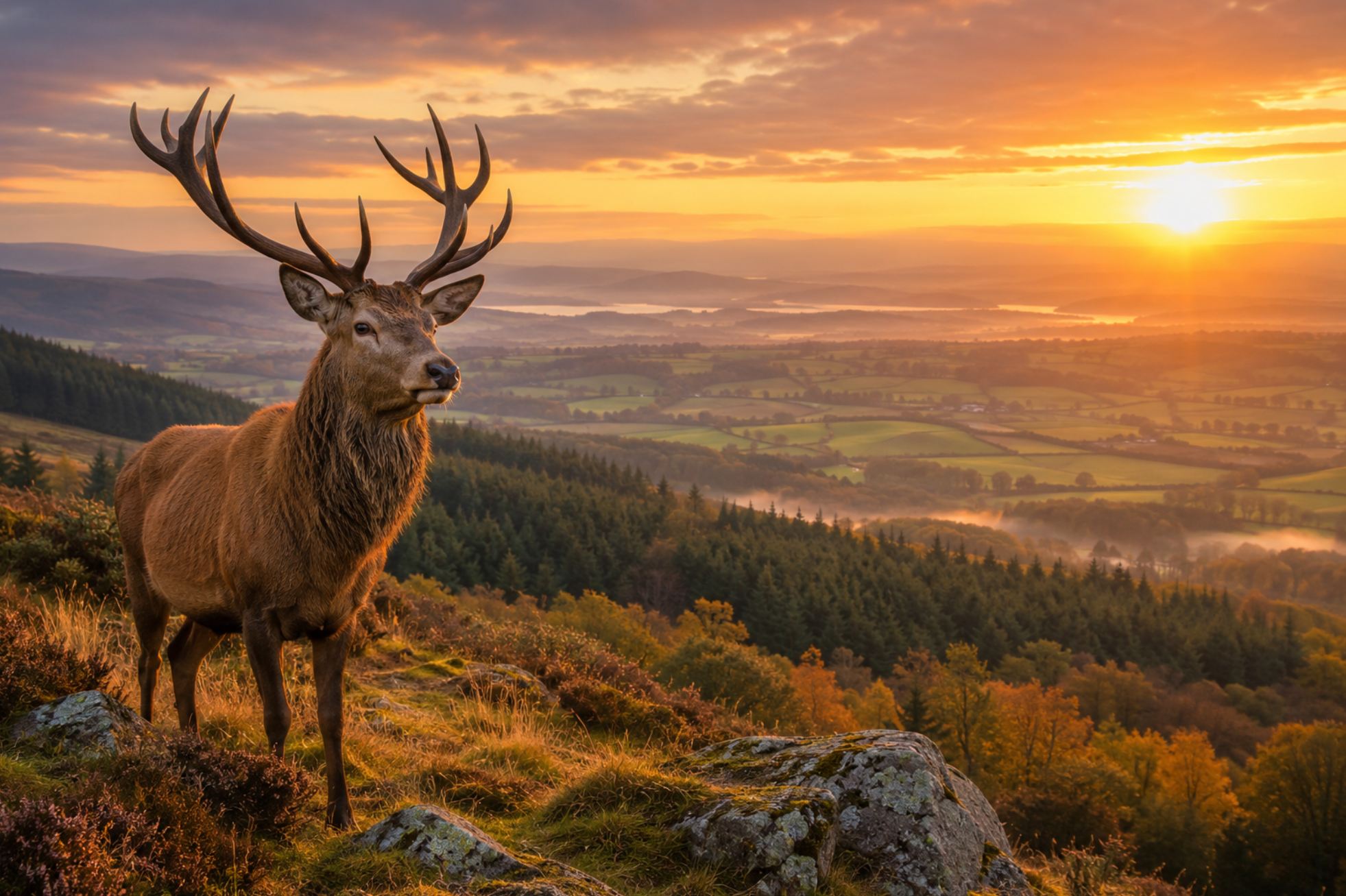
Much of the public discussion understandably focuses on hunting. Yet farmers often experience the greatest day-to-day impacts. Depending on the location, deer can cause:
Damage to Grazing
Large groups of deer consume significant quantities of grass, reducing the amount available for livestock. While individual animals may seem insignificant, sustained grazing pressure across an entire season can become costly.
Crop Damage
Young crops may suffer repeated browsing, trampling or contamination. In some areas this becomes an annual issue rather than an isolated event.
Forestry Damage
Perhaps the greatest concern nationally relates to forestry. Young trees are particularly vulnerable to browsing. Repeated damage can:
- prevent regeneration
- deform growing trees
- delay establishment
- reduce timber value
This is one of the principal reasons why forestry organisations have become closely involved in the new strategy.
Disease Concerns
Another sensitive issue is disease.
Scientific research has demonstrated that wild deer can become infected with bovine tuberculosis (TB) and may contribute to disease transmission under certain circumstances.
It is important to remember that TB is a complex disease involving multiple wildlife and livestock species. The presence of infected deer does not automatically mean they are the original source of infection on a particular farm.
Nevertheless, reducing unnecessary interaction between infected wildlife and livestock forms an important part of wider disease control strategies.
Road Safety
Anyone who regularly drives through parts of Wicklow, Dublin Mountains, Kildare or other deer hotspots will appreciate how unpredictable deer can be.
Collisions frequently occur:
- at dawn
- at dusk
- during the autumn rut
- where woodland borders busy roads
Unlike livestock, deer can suddenly emerge from dense vegetation with very little warning. Motorists should remember that where one deer crosses the road, others may be following.
Understanding Section 42 Licences
One of the terms that frequently appears in discussions about deer management is the Section 42 licence. For many landowners, it can initially sound like a complicated legal process, but its purpose is actually quite straightforward.
Under the Wildlife Acts, deer are protected wild animals. However, where deer are causing serious damage to agriculture, forestry, flora or fauna, the National Parks and Wildlife Service (NPWS) may issue a Section 42 permit, allowing control measures outside the normal open season or under conditions that would not otherwise apply.
It is important to understand that a Section 42 licence is not a general hunting licence. Instead, it is a targeted wildlife management tool designed to deal with genuine damage.
Applications normally require information such as:
- the location of the damage;
- the species involved;
- the type of damage being caused;
- maps showing the affected land;
- details of the nominated stalkers;
- the proposed method of control.
The NPWS assesses each application individually.
For many landowners, particularly those applying for the first time, completing the paperwork can appear daunting. This is one area where good communication between landowners, experienced hunters and the relevant authorities can make the process much smoother.
Why Deer Cannot Be Managed Property by Property
One of the most significant changes in thinking over recent years is the recognition that wildlife rarely respects property boundaries. A deer feeding in a forestry plantation at night may spend the following morning on farmland several kilometres away before sheltering in woodland during the day.
This constant movement creates a challenge. A farmer may successfully reduce deer activity on one field, only to find neighbouring populations moving in a few weeks later. Similarly, a hunter carrying out careful management on one property cannot control what happens on adjoining land.
This is precisely why the Irish Deer Management Strategy promotes landscape-scale management. Rather than measuring success on a single farm, the objective is to reduce impacts across an entire area.
That philosophy has already proved successful in several European countries where neighbouring estates, hunters and forestry managers cooperate rather than work independently.
Lessons Ireland Can Learn from Other European Countries
Ireland is certainly not the first country to face increasing deer populations. Across Europe, many countries have spent decades refining their approach to balancing wildlife conservation with farming, forestry and public safety.
Although each country has different legislation and hunting traditions, several common themes emerge.
Germany
Germany has long promoted close cooperation between forestry managers and hunters. Management plans are often developed for large woodland areas rather than individual estates, helping to reduce browsing damage while maintaining healthy deer populations.
Hunters are expected not only to harvest deer but also to contribute to habitat management and population monitoring.
Norway
Norway places a particularly strong emphasis on data collection. Harvest records, observations and biological information are routinely gathered, helping wildlife managers understand long-term population trends rather than relying on estimates.
Scotland
Scotland has increasingly adopted collaborative deer management groups, particularly within the Highlands, where multiple estates work together to address shared challenges such as habitat restoration and woodland regeneration.
The lesson common to all three countries is remarkably similar. Long-term success comes from:
- cooperation;
- reliable information;
- clear objectives;
- responsible hunters;
- engaged landowners.
These same principles sit at the heart of Ireland’s new strategy.
Common Misconceptions About the New Strategy
Because the Deer Management Strategy is still relatively new, several misunderstandings continue to circulate. Let’s address some of the most common ones.
“Hunters will lose their permissions.”
There is currently no evidence that this is the intention of the programme. Landowners continue to decide who may hunt on their land. The strategy encourages collaboration, not compulsory redistribution of permissions.
“Professional shooting teams will replace local hunters.”
Again, this is not how the programme has been designed. The emphasis is on working with existing hunters wherever possible while encouraging better communication and coordinated management.
“The objective is to eliminate deer.”
Absolutely not. Healthy deer populations remain an important part of Ireland’s natural heritage. The objective is to achieve sustainable numbers that the landscape can support without causing unacceptable environmental, agricultural or economic impacts.
“This is only about hunting.”
In reality, hunting is just one component. The strategy also addresses:
- biodiversity;
- woodland regeneration;
- farming;
- road safety;
- public health;
- disease surveillance;
- sustainable food production;
- community engagement.
Why This Matters Beyond the Farming Community
Many people living in towns and cities rarely think about deer management until they encounter a deer beside a road. However, the consequences affect far more than rural communities.
Healthy forests store carbon, improve biodiversity and provide recreational spaces. Successful farming supports food production and rural employment. Reducing collisions benefits motorists, emergency services and insurance providers. Healthy ecosystems benefit everyone.
The Deer Management Strategy is therefore not simply a hunting initiative. It is an environmental management programme involving multiple sectors working towards shared objectives.
Where Owl Pest Control Sees Similar Principles
Although deer management is a specialist discipline in its own right, many of the principles behind the new strategy are surprisingly familiar to those working in professional pest management.
At Owl Pest Control, we frequently work with commercial premises, farms, local authorities and private landowners where wildlife issues extend beyond a single property. Rodents, gulls, pigeons and other pest species rarely recognise boundaries either.
Experience has shown us that long-term success almost always depends on cooperation between neighbouring properties, accurate reporting, careful monitoring and clear communication.
Simply treating one building while ignoring the surrounding environment rarely provides a lasting solution.
The same principle now underpins Ireland’s approach to deer management. Rather than reacting to isolated problems, the emphasis is shifting towards understanding what is happening across the wider landscape. It is an approach that makes good environmental sense.
Practical Advice for Landowners
If deer are becoming an increasing concern on your property, consider the following steps.
Record what you are seeing
Keep a simple record of:
- dates;
- approximate numbers;
- locations;
- species where known;
- type of damage observed.
Over time, this information becomes far more valuable than relying on memory.
Speak to your neighbours
There is a good chance they are experiencing similar issues. Sharing information often reveals movement patterns that would otherwise go unnoticed.
Work with experienced, qualified hunters
Responsible deer management requires more than marksmanship. Look for hunters who:
- communicate well;
- understand safety;
- respect property boundaries;
- are properly licensed;
- carry appropriate insurance;
- are willing to work with neighbouring landowners where appropriate.
Report concerns early
Problems are generally easier to manage before they become severe. Waiting until forestry damage or crop losses become extensive may reduce the range of available options.
Practical Advice for Hunters
Hunters also have an important role in building trust. Simple actions can make a significant difference.
- Keep landowners informed – A quick message before entering land and another when leaving helps reassure landowners that they know who is on their property.
- Report what you see – Even if no deer are harvested, observations remain valuable. Recording sightings contributes to a much better understanding of local populations.
- Think beyond today’s outing – Successful deer management is measured over years rather than weekends. Monitoring populations, understanding seasonal movements and maintaining good relationships with landowners all contribute to better long-term outcomes.
- Continue learning – Modern deer management continues to evolve. New research, technology and training opportunities are helping hunters develop an increasingly professional approach to wildlife management. Those willing to learn will play an important role in the future success of the strategy.
One observation worth considering
An interesting point frequently discussed within the hunting community is that recreational objectives and management objectives do not always perfectly align. Many hunters primarily harvest venison for their own household.
Once the freezer is full, it is perfectly understandable that hunting activity may naturally reduce. From a landowner’s perspective, however, deer continue to browse crops, forestry and grazing throughout the year.
This is not a criticism of recreational hunting—after all, most hunters have careers, families and limited free time—but it does highlight why ongoing communication is so valuable. Where a property requires more regular monitoring, agreeing clear expectations from the outset helps both landowner and hunter work towards the same objective.
What Does the Future Hold for Deer Management in Ireland?
The Irish Deer Management Strategy is still in its early stages. Like any new national initiative, it will take time to develop, refine and demonstrate measurable results. Not every Deer Management Unit (DMU) will face the same challenges, and what works well in one county may need to be adapted elsewhere.
However, one thing is already becoming clear: the future of deer management in Ireland is unlikely to be shaped by legislation alone. Instead, it will depend on people:
- It will depend on farmers willing to engage with neighbouring landowners.
- It will depend on hunters who understand that communication is just as important as marksmanship.
- It will depend on forestry managers, conservation bodies and Government agencies sharing information rather than working independently.
Above all, it will depend on trust. Building that trust will take time, particularly where there have been misunderstandings about the objectives of the programme. Open discussion, transparency and cooperation will ultimately determine whether the strategy succeeds.
Why Young Hunters Will Play an Increasingly Important Role
One issue receiving growing attention is the age profile of Ireland’s hunting community. Many highly experienced deer stalkers have spent decades building relationships with landowners and developing an exceptional understanding of local deer behaviour. Their knowledge is invaluable.
However, like many countryside skills, there is a need to encourage the next generation. Young hunters who invest in recognised training, maintain high safety standards and understand the importance of ethical deer management will become increasingly important over the coming years.
Modern deer management is no longer simply about harvesting deer. Increasingly, it requires people who are comfortable with:
- recording observations;
- using digital technology;
- communicating with landowners;
- understanding wildlife legislation;
- maintaining professional standards when handling venison;
- contributing to long-term environmental management.
This represents an exciting opportunity for younger hunters who wish to become actively involved in conservation as well as responsible deer management.
Deer Management Is About Balance, Not Numbers
It is tempting to judge the success of deer management simply by asking: “How many deer were culled this year?”. In reality, that question only tells part of the story. Success should instead be measured by outcomes. For example:
- Has browsing damage reduced?
- Are young native woodlands regenerating naturally?
- Have crop losses decreased?
- Are landowners reporting fewer problems?
- Has communication improved between neighbouring stakeholders?
- Are road collisions reducing?
- Are healthier deer populations being maintained?
Ultimately, deer management is about finding the point where wildlife, farming, forestry and biodiversity can all thrive together. That balance may look different from one part of Ireland to another, but the underlying principle remains the same.
A Shared Responsibility
One of the most refreshing aspects of the Irish Deer Management Strategy is that it recognises no single organisation can solve the problem alone.
- Farmers cannot achieve lasting success without neighbouring cooperation.
- Hunters cannot effectively manage deer if they only understand one property.
- Government agencies need reliable information from people working on the ground.
- Landowners benefit from trusted relationships with responsible hunters.
- Forestry managers, conservation organisations and environmental groups all bring valuable knowledge and experience.
The strategy therefore asks everyone to contribute something, not necessarily more work but simply better communication. Sometimes, the smallest improvements make the greatest difference.